Breaking Beckmann’s Fall
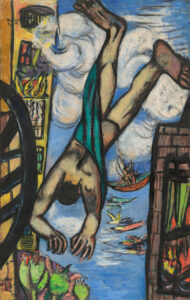
In both Max Beckmann’s Falling Man, painted in 1950 shortly before the artist’s death that same year, and throughout Carl Einstein’s early-twentieth century writings on art, the opposition between “ground” and “groundless” is complicated through a dialectical suspension of the two terms. Caught between falling and landing, Falling Man presents us with an image that neither plummets to earth nor hits the ground but floats between states. Much like Einstein’s reading of a sailor scaling the rigging in the sky of Hercules Seghers’ 1625 print Mountain Gorge by a Road, Beckmann’s not-quite falling man hovers midway between what Einstein calls the fixed ground of the “tectonic” and the unformed flux of the “liquid living movement” below. Beckmann and Einstein, it turns out, share common ground in the ungrounded abeyance that lies between falling and crashing down.