
“First we feel. Then we Fall.”
— James Joyce, Finnegans Wake1
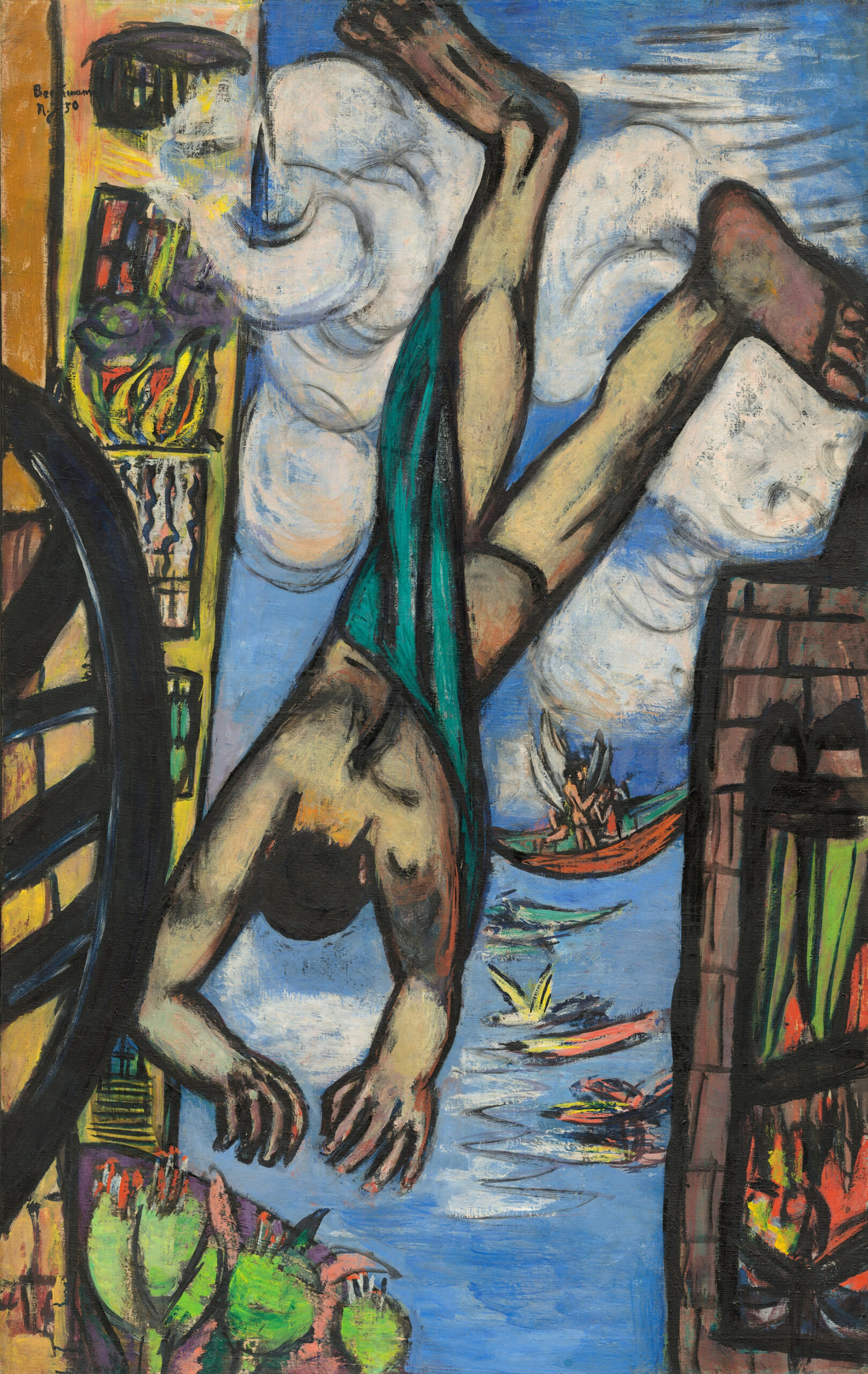
I begin with three representations of falling, one visual—a painting by Max Beckmann titled Falling Man produced shortly before his death in 1950 (fig. 1)—and two written: my epigraph from Joyce, with which I’ll also conclude, and an excerpt from the poem Design for a Landscape by Carl Einstein published in 1930:
In falling you are suspended
Entangled
In the contradiction
Between image and ground.
…………………..
You won’t be carried along by the boastful images
That sail across the bottomlessness.2
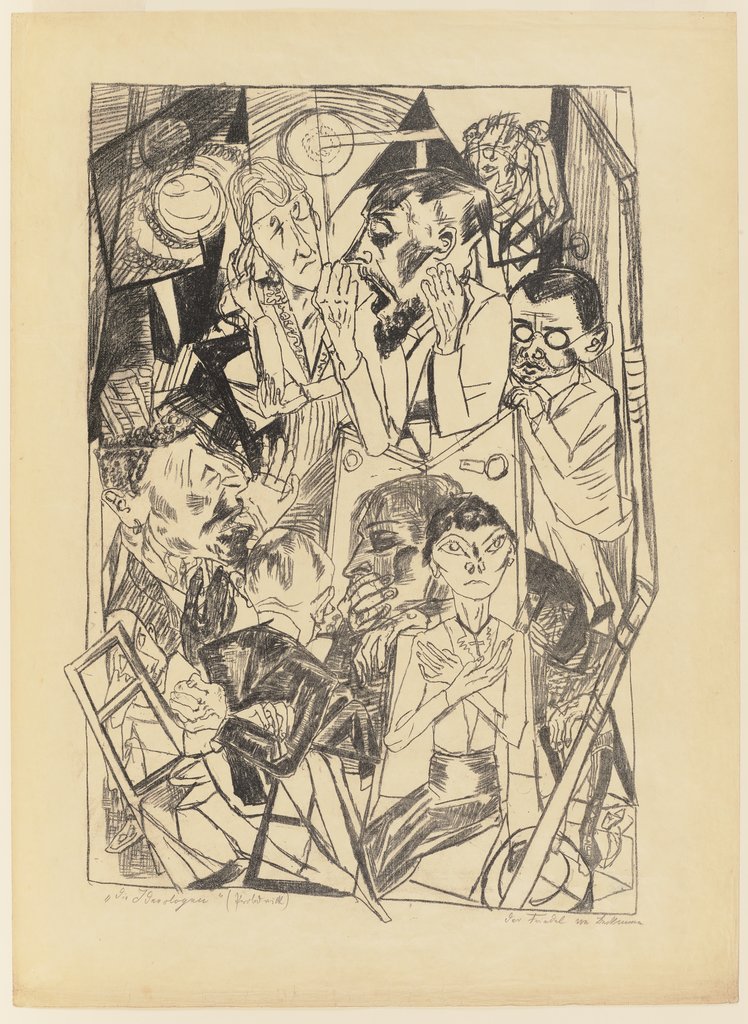
Beckmann and Einstein had been aware of each other and each other’s work from as early 1916 when Einstein began a long-term romance with the Countess Augusta vom Hagen, Beckmann’s friend and patron since their initial meeting in Paris in 1904. Beckman makes the connection explicit in his 1919 lithograph, “The Ideologues” (fig. 2), in which he pictures himself next to vom Hagen and Einstein.3 Beckmann had likewise written sporadic but favorable snippets on Beckmann’s work, most significantly in his substantially revised third edition of The Art of the Twentieth Century published in 1931.4 But in comparing Falling Man with Design for a Landscape, I want to connect Beckmann with Einstein less directly, through their shared concern with being simultaneously grounded and groundless.
Shifting from the second person “you” of the poem to the third person “him” in Beckmann’s painting, the nearly naked figure cuts a diagonal swath across the clouded blue sky, plummeting headlong through space like a toppled statue, stiff and impassive, as if knocked from its perch. In Einstein’s poem, the fall is “suspended” not because it appears frozen in pictorial time, as in Falling Man, but because it is “Entangled / In the contradiction / Between image and ground.” We get a sense of what Einstein might mean by this, and what such an entanglement might look like, in the image of the downward fall of Beckmann’s figure and his simultaneous ensnarement and compression into the painting’s surface. Indeed, Falling Man presents us with two very different types of ground, each in “contradiction,” as Einstein puts it, with the other. On the one hand, and most obviously, we see the depicted ground: the endpoint of the man’s downward fall in the quarter-circle of earth and plants at the base of the building in the lower left corner. On the other, we see the flat, material ground of the pictorial support asserted throughout the painting.
The physical flatness of the canvas is made conspicuous, for example, in the outward splay of the man’s legs and feet, wedging him into the upper and right framing edges of the image. Indeed, when I first saw this painting years ago at the National Gallery in Washington with a painter friend, she remarked how the man’s feet felt compressed into the surface, as if flattened between two sheets of glass like butterfly wings. This feels essentially right to me. The legs and feet do indeed seem related to the aerodynamics of flying, although more like tailfins perhaps than wings. Groundless and grounded, the man’s body presses into the surface of the painting. But to my eyes, the force of that lateral push into the painting has less to do with being pressed between two surfaces and more to do with hitting the ground, as the material plane of the canvas transforms into the hard surface that stops the man’s fall, flattening his body on impact. Beckmann’s hallmark black cloisonné further emphasizes this lateral collapse into the canvas. Like a tonally reversed chalk outline of a corpse on asphalt, the black border surrounding the man’s body twists our viewpoint back and forth, from a downward fall as the man plummets towards his death to a view from above, in which his body has already crashed and flattened into the ground plane. Seen from above, looking down on the man below, our vision aligns with the circular railing of the balcony that hugs the left side of the painting. This double viewpoint is crucial. For if the man is falling, we see an image as ground in the quarter circle of earth and plants, but if the man has fallen and already landed, we see the ground as image, as the literal support of the canvas hardens into the illusion of a surface that breaks his fall.
The double image of simultaneous free fall and impact is further underscored in the contrast between the collapse of the man’s body into the picture plane, most evident in his feet, and the shaded depth of his upper left arm (our right), which, depending on one’s point of view, either peels off from the ground, raising the corresponding shoulder in the process, or recedes into space, pushing the adjoining elbow into pictorial space away from the viewer.5 At the same time, we see how the man’s right foot twists flat to accommodate another set of multiple viewpoints, seen from the side and from above or below simultaneously. Note too how its especially thick, coarsely scumbled outline almost—but not quite—connects with the dark spire of the right-flanking building. In so doing, it frames the ossified white cloud that hooks into the crook of his foot, forming an off-kilter, roughly hewn block that thickens on the surface of the painting, feeling more like marble than sky.
Below this, we see what appears at first blush to be some kind of hammock suspended between the twin supports of the dark-brown building and the man’s body. Looking closer, we see that the hammock doubles as a boat, manned by mysterious winged figures. Along with the green fish-like animals that swim above the bird-in-flight and the lily pad flower below, the boat transforms falling into floating, as the groundless sky becomes a watery surface. The black-and-white zigzag ripples in the now-liquid space below the boat appear to move across the water rather than twist and turn in thin air as we see above. And in so doing, Beckmann’s painting again folds back onto Einstein’s poem, which likewise evokes this same shift from falling to suspension to floating: “You won’t be carried along by the boastful images / That sail across the bottomlessness.”6
Although Einstein could not have been thinking about Beckmann’s Falling Man when he wrote these words, he was—as Sebastian Zeidler has made clear—thinking very much of another artist: the seventeenth-century Dutch printmaker Hercules Seghers. Having published an essay on the artist’s etchings in the journal Documents the year before, Einstein was particularly taken with Seghers’ 1625 Mountain Gorge by a Road (fig. 3). Produced by reusing a previously worked etching plate, the final landscape overlaps and merges with the ghostly bow of a massive sailing ship. As Einstein describes the resulting palimpsest, “This is the uninhabited desert. Seghers banishes air, the sign of flux and vital movement. At times the clouds assume the forms of boulders. … a ship’s rigging scratched into the sky… a sailor scales the ropes. Here we see a new symptom of anesthesia: the sea is identified with rock, flowing water is equated with dead matter, death is, as it were, transferred to animate matter.”7
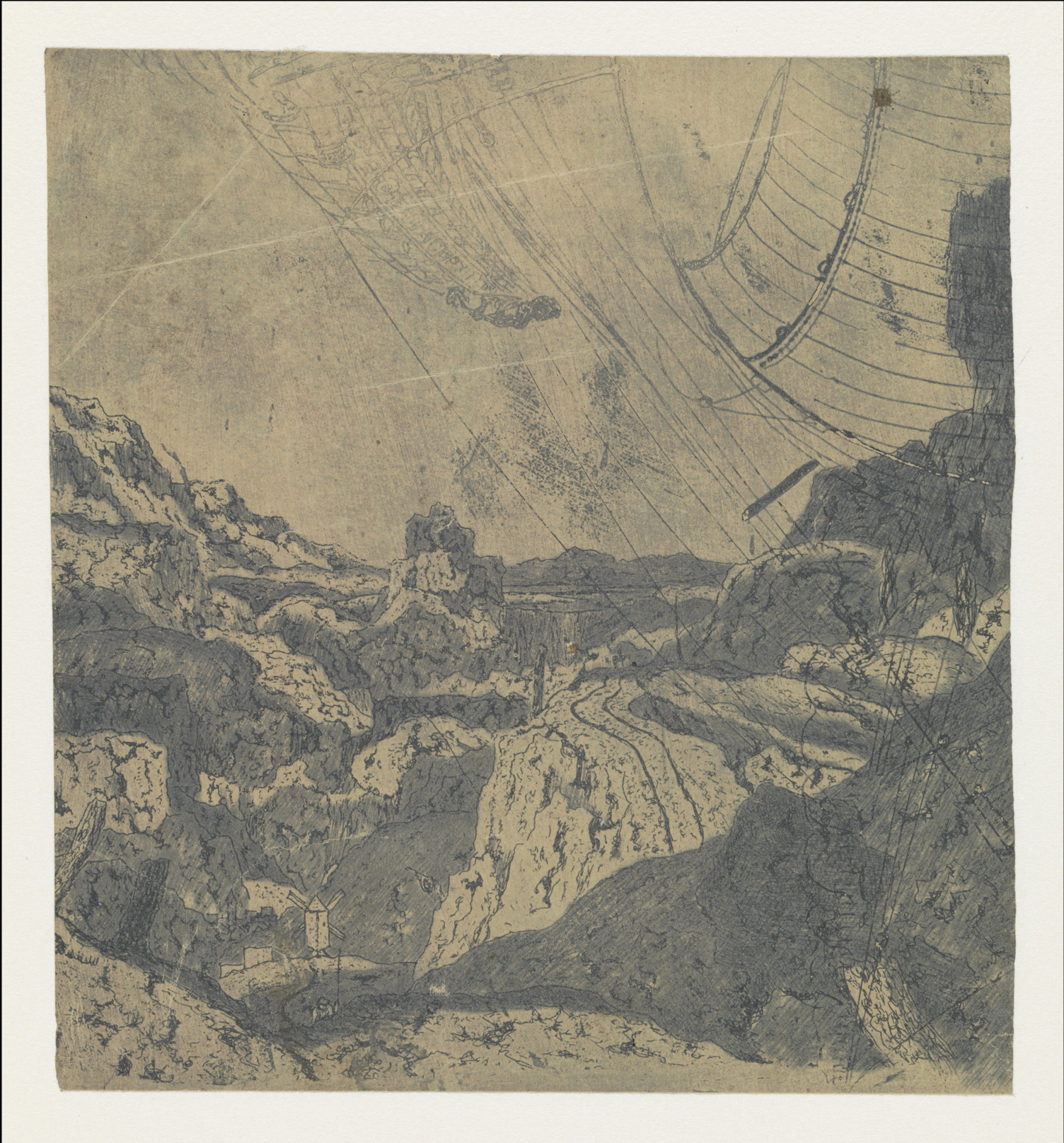
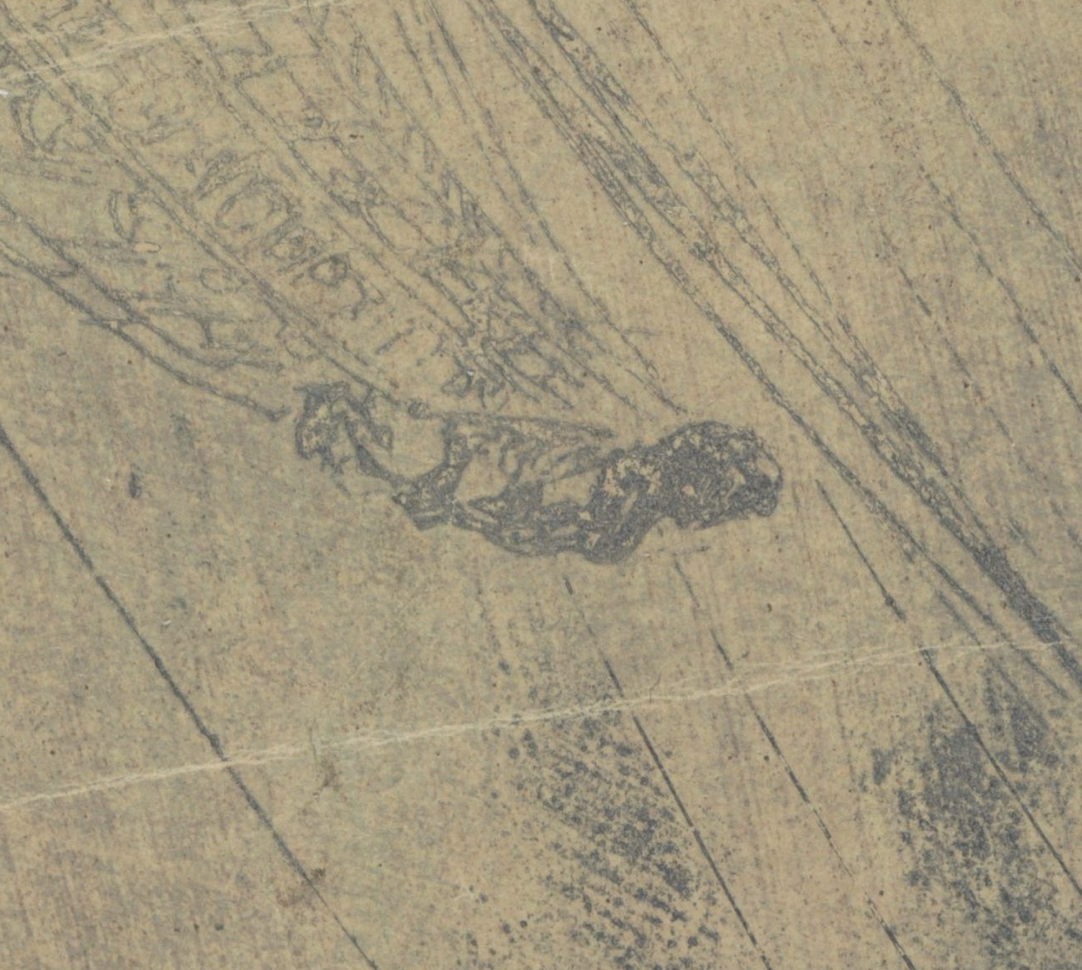
Einstein imagines the ship’s crudely formed figurehead (fig. 4) as a sailor who, in climbing the rigging to escape the airless moonscape below, has fallen, becoming entangled in the ropes, suspended in mid-air. As Einstein continues, “Vertigo signifies the fatality of the fall and at the same time the fact of remaining rooted to the spot.” The “fatality” of the fall described by Einstein begins to feel a lot like the impending death of Beckmann’s falling man, who, much like Seghers’ sailor, remains nonetheless “rooted to the spot.” For Zeidler, the “you” of Einstein’s poem—“in falling you are suspended”—refers to the sailor, the artist (Seghers), and the writer of the poem (Einstein), all of whom are “Entangled / In the contradiction / Between image and ground.”8 But the “you” of the poem is also “us,” the viewers of Seghers’s image. For just as the overlapping ship and landscape disorients our perspective as each image bleeds into the other, so too does the suspended sailor and easily missed figure in the lower left, along with the town and windmill behind him, disrupt our sense of scale. As a result, Einstein claims, we flip back and forth between the safe ground of the familiar and the estrangement of uprootedness, producing a form of vertigo whereby, suspended between falling and stasis, we find ourselves, as Einstein puts it, “cramped between two extremes, experiencing a psychic annulment.”9
Consistent with the majority of his writing in Documents, the overwrought rhetoric of Einstein’s essay reflects his larger engagement with a philosophy of being that he termed “the real.” As Zeidler and Charles W. Haxthausen have helpfully glossed, Einstein’s ontology of “the real” is comprised of two interconnected layers or strata, one overlaid on top of the other, much like the phantom ship and landscape in Seger’s etching. The “lower” primordial layer is composed of brute instinctual chaos and flux, an oceanic realm devoid of structure or boundaries where formless bodies exist in a state of constant psychic ebb and flow. Above this lies the “upper” tectonic layer of static form and structure that has emerged out of the underlying fluid chaos, much as the sailor has climbed the rigging to escape what Einstein calls the “liquid living movement” below. And in this sense, the sailor stands in for artist, critic, and viewer alike—stands in, that is, for all of us, as we hang suspended on the ropes, constantly at risk of falling back into the primordial morass. The upper “tectonic” layer, which goes by various names and assumes various forms in Einstein’s writing—“culture,” “civilization,” “art,” “architecture,” “philosophy,” “literature”—attempts to hold the primordial flux at bay.10
As Zeidler notes, Einstein’s conception of the real suggests certain parallels with Freud’s speculation in “Beyond The Pleasure Principle” that organisms develop a “hardened” psychic “crust” as a defensive barrier in response to excessive stimuli—a barrier not unlike, for example, the black outline that surrounds Beckmann’s falling man.11 For Einstein, the reified realm of the tectonic likewise functions as a defensive shield against the excessive stimulation of primordial flux. And in the same way that Freud famously sees our efforts to escape the threat of psychic disturbance as leading to an unconscious desire for the ultimate absence of nervous agitation—namely, death—the tectonic reification of culture, for Einstein, produces a similar desire within art and literature: static, lifeless, arid, and structured to wall off the disturbance of instinctual chaos. As a result, Zeidler writes:
The salient question for Einstein was whether the presence of the real “below” is acknowledged or denied by the forms of culture “on top.” Whether in art, philosophy, or personal biography: is form used as a means of denying the real even exists? Or is it used as a means of acknowledging the fragility of human life; a fragility that’s caused by its ongoing exposure to the real? In the first instance, a culture will pretend to be grounded in itself; in the second, it will admit to the threat of its own groundlessness. (FAR, 159)
But things aren’t quite so simple as this might suggest. For, as Zeidler notes, there are not two options available to artists and writers but rather three.
The first possibility, we’ll call this option A, embraces what Einstein, following Heinrich Wölfflin, calls “the tectonic.” For Einstein, this option has assumed countless forms and variations over history, from the Sumerian sculpture of the ruler Gudea to the “closed form” of Raphael’s Ansidei Madonna to the geometric abstraction of Kandinsky’s work of the late 1920s and 1930s. The second possibility, option B, strives for the opposite effect, bypassing the architecture of reason through the uninhibited release of pure “Dionysian psychic intensity” into and onto the artwork.12 Above all, Einstein is thinking here of Surrealism in general and André Masson in particular. But despite Einstein’s repeated endorsements of Masson’s automatic drawings in the pages of Documents, there was more than a hint of ambivalence in his support of the artist’s efforts to liberate the psyche from the ossified structures of the mind—an ambivalence that ultimately gave way to disillusion as Einstein increasingly came to view Masson’s Surrealism as less an escape or a release from the death grip of the tectonic than the flip-side to the same coin. For if, as Einstein claims, the strict imposition of rigid, static structure leads not just to death but the cruel sadism of the punishing super-ego demanding more and more control over the drives and instincts, the passivity of Masson’s Surrealism embraced the opposite extreme: a form of masochism that leads to the same deathly conclusion.13
Against option A and option B, then, Einstein offers a third possibility; we’ll call this option C. Far more difficult to find in the history of art—Seger’s etching, prehistoric cave paintings, and African masks are rare examples14—option C acquires its greatest contemporary force of expression with Einstein’s artistic hero, Pablo Picasso. Mobilizing what Einstein called the “dialectical simultaneity of solution and counter-solution,” the artist’s work, especially during the late twenties and early thirties, held option A and B in tension, “oscillating” between the two “psychological poles” of the Apollonian and tectonic, on the one hand, and the Dionysian and the ecstatic, on the other.15 Einstein had various names for these rare artistic instances in which the twin poles of structured stasis and transgressive flux are held together without resolve—“tectonic hallucination,” “fixed ecstasy” (a concept explored at length in Charles Palermo’s writing on Einstein), and above all, “the double style.”16
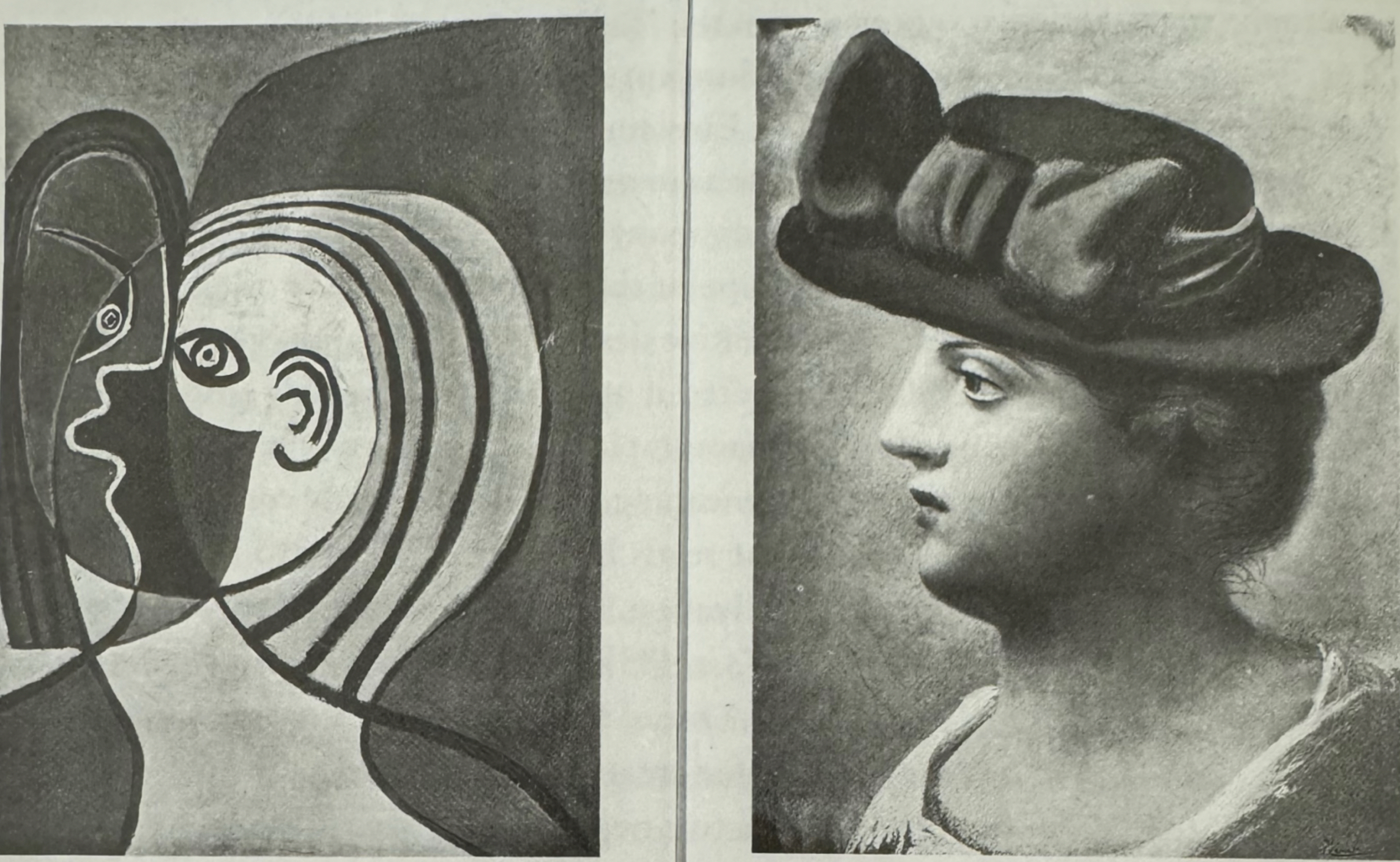
At times, as Zeidler demonstrates, Einstein foregrounded Picasso’s double style quite literally, as evidenced in the repeated side-by-side comparisons of the artist’s work in the pages of Documents. In the double-page spread that precedes his contribution to the 1930 special issue on Picasso (fig. 5), for example, Einstein juxtaposed a neoclassical pastel—Woman with a Red Hat from 1921—with the Surrealist Head of a Woman, painted eight years later. Not only does the neoclassical “tectonic” image fold directly onto the Surrealist “hallucination” when the pages are shut, only to separate and rejoin with each new opening and closing, but both images are also internally doubled. We see this most clearly in the two warring halves of the unambiguously divided head of the 1929 painting. But as Zeidler points out, a similar internal division is also present, if less obviously so, in the earlier pastel, as the fleshy hat appears at once integrated and at odds with the neoclassical head on which it sits, the almost grotesque bow appearing as a kind of unconscious thought bubble to the sitters’ repressed instincts.17
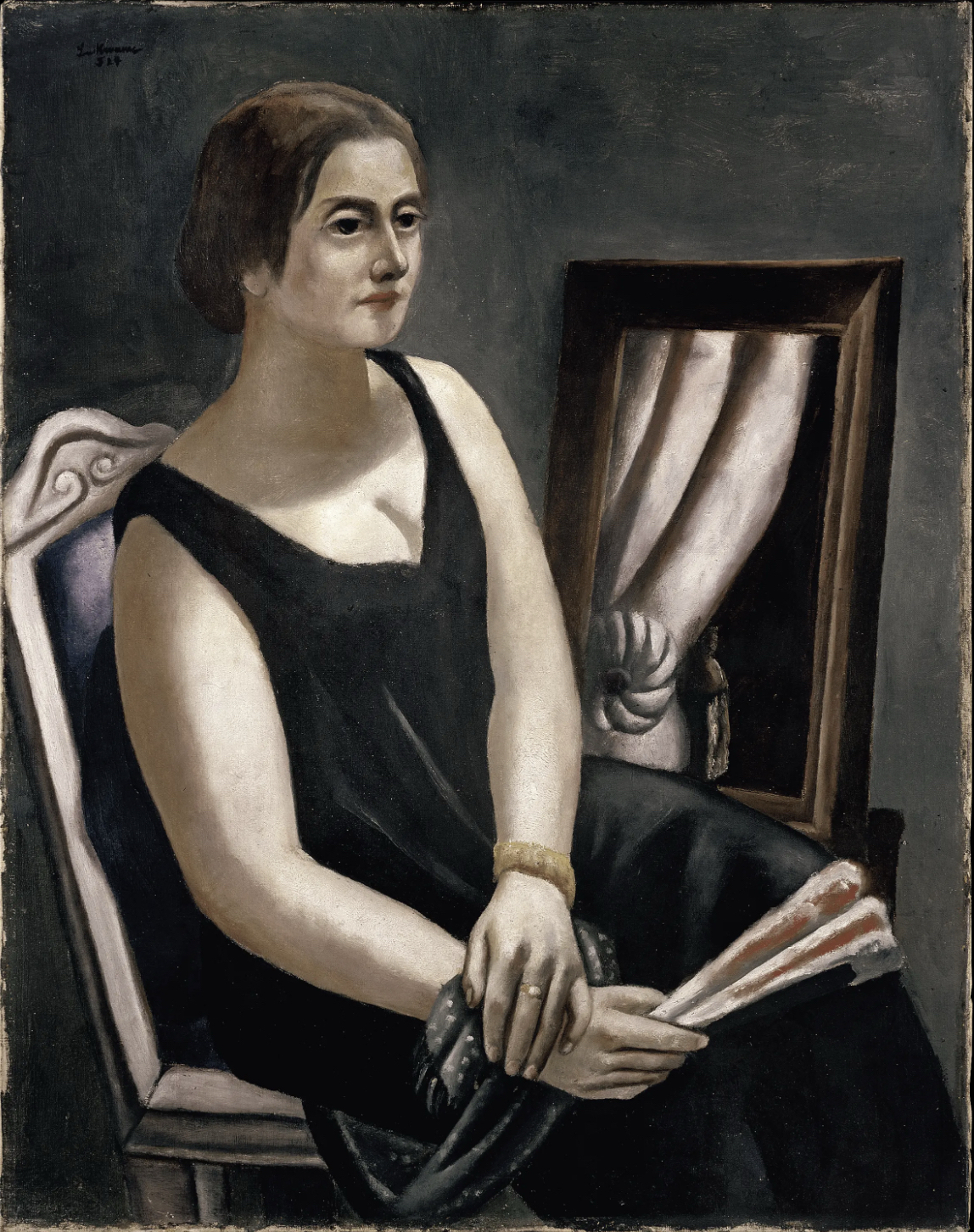
It is this unexpected irruption of the repressed into the space of neoclassicism that Picasso’s influence on Beckmann’s so-called verism of the early 1920s is felt most keenly. Apparent not just in terms of its purported rappel à l’ordre neoclassicism and subject matter—“one would be hard pressed to deny the obvious influence,” as Hans Belting puts it—it is their shared engagement with the “double style” that separates them from the crowd of the genuinely conservative Return to Order.18 Indeed, if we were to take, for example, Beckmann’s 1924 portrait of his first wife, Minna Beckmann-Tube (fig. 6), one could easily argue that Beckmann’s particular version of the double style places the opposition of tectonic classicism and Dionysian flux under greater tension than Picasso. Much like Woman with a Red Hat, Beckmann’s portrait appears at first glance entirely straightforward in its juste milieu neoclassicism. But to leave it at that would be to miss not only the oddly meat-like quality of the fan in her right hand but also the even more unsettling and transgressive image of the curtain reflected in the mirror to her left. Unsettling not so much because it seems as if, because of its placement and angle, the mirror should be reflecting the sitter rather than the curtain but because there is a perverse suggestion that Beckmann’s wife is precisely what we see in the painting-like mirror image against the wall. For not only does the rectangular form of the chairback appear to double the rectangular form of the mirror, implying a certain visual reciprocity between the contents of the two oblique frames—torso and curtain—but the corporeal qualities of the curtain seem to reflect the bodily qualities of the sitter. This is evident, perhaps most obviously, in the hoary-pink European-flesh colored fabric and the way in which the curtain’s outer fold “mirrors” Beckmann-Tube’s left arm, both of which seem to touch elbows at the curtain tie. Above all, however, it is the curtain tie’s unmistakably anus-like appearance that is the most corporeal, most transgressive aspect of the mirror’s reflection. Much like the slightly grotesque bow in Woman with a Red Hat, the anus curtain tie erupts into the field of representation, reflecting not the outer appearance of the rather prim sitter but the repressed internal instincts that, like the tie that pulls back the curtain on the dark void beyond, holds everything in place. Perhaps this is what Einstein had in mind when he wrote cryptically that “Beckmann no doubt attempted to bring together something like an aggregate of modernism,” trying “not to elude the conflict between artistic preconception and empirical motif, but rather to escalate that conflict into an almost tragic confrontation.”19
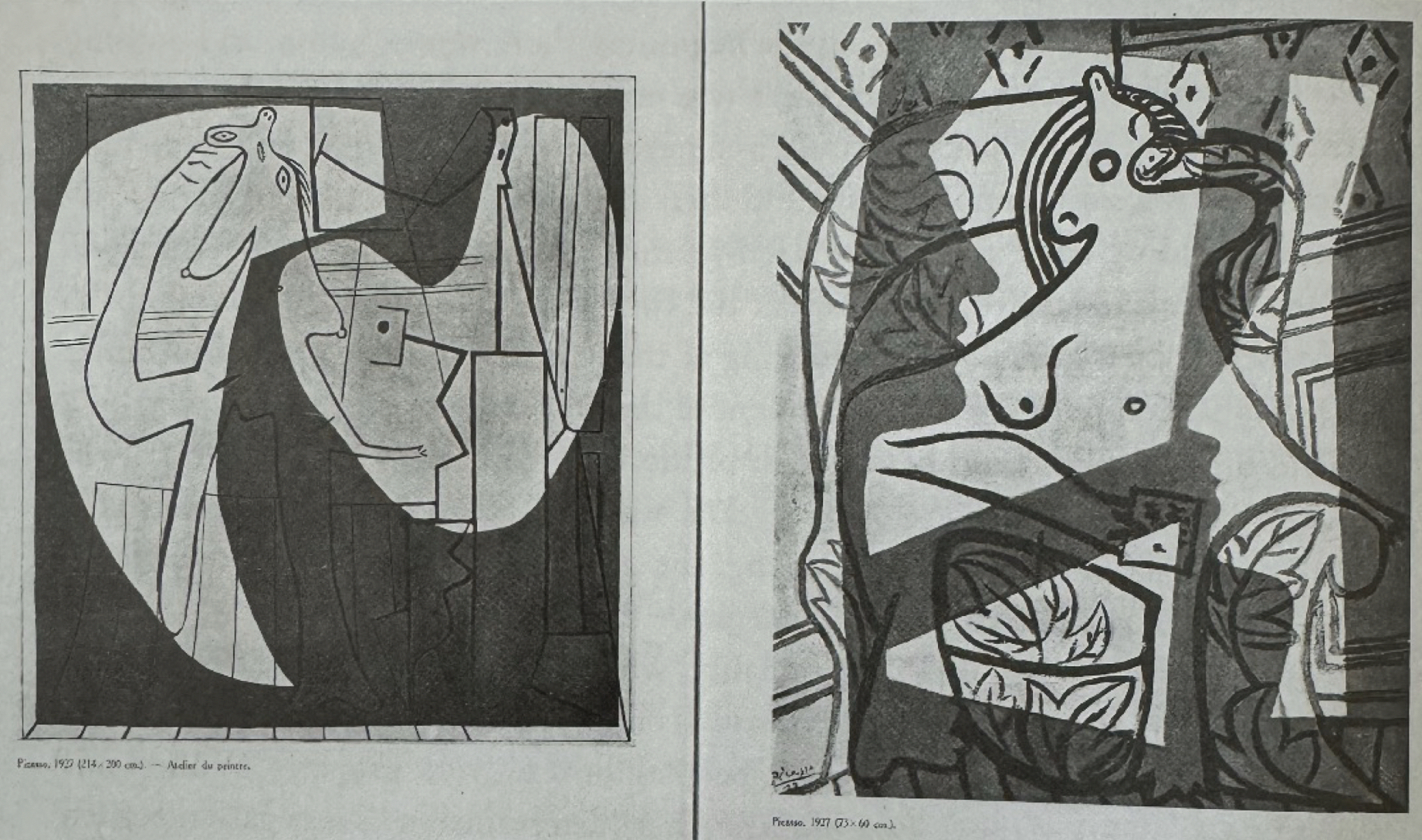
Zeidler’s second example of the double style is another pairing of Picassos in Documents (fig. 7): The Painter and His Model from 1927 and Woman in an Armchair from the same year. In the latter painting, two neoclassical silhouettes, one in shadow, the other in light, overlap the Surrealist female nude, over and at whom they exchange glances. The protrusions extending from the heads of both profiles create a suggestion of symmetry, as if above and below could serve equally as necks. This invites the viewer to imagine the painting flipped on its head, making visible the conjoined twins of each silhouette formed at the intersection of contour and tone. The Painter and His Model likewise doubles the play of light and line as the linear images of the artist at his easel on the right faces off against his monstrous sitter on the left, each appearing caught in the twin spotlights that Zeidler describes as a crescent and a kidney. For my part, I would argue that “the kidney” is, in fact, a palette, emphasizing the more overt three-sided rectilinear palette and thumbhole that appears at the end of the painter’s zig-zag arm, while “the crescent” gives form to the hairs of a brush, seen from the side, being dragged across the surface of a canvas. This, in turn, enlarges the artist’s other hand. I’ll return to the painter’s self-projection into the canvas as I move towards a conclusion.
Finally, in the same issue of Documents (fig. 8) we find a pair of acrobat paintings completed shortly before the journal’s publication in 1930: one of a female trapeze artist falling, the other of a male contortionist touching the ground and sides that contain him. As before, figure flips into ground, and vice versa, as both profiles give form to a distorted but clearly visible opposing silhouette along their shared outline.20 Each light-colored face kisses the dark ground of its partner while negative space cups the trapeze artist’s breast and erotically supports the contortionist’s head. Grounded and groundless, Picasso’s acrobats pair off two seemingly opposed experiences of being-in-the-world: one of falling and flux, the other of stasis and structure. But as Zeidler emphasizes, falling and rootedness each give rise to the other for Einstein, much as the dark negative ground that slowly appears in the space surrounding the acrobats gives form to the positive figure that we see with ease.
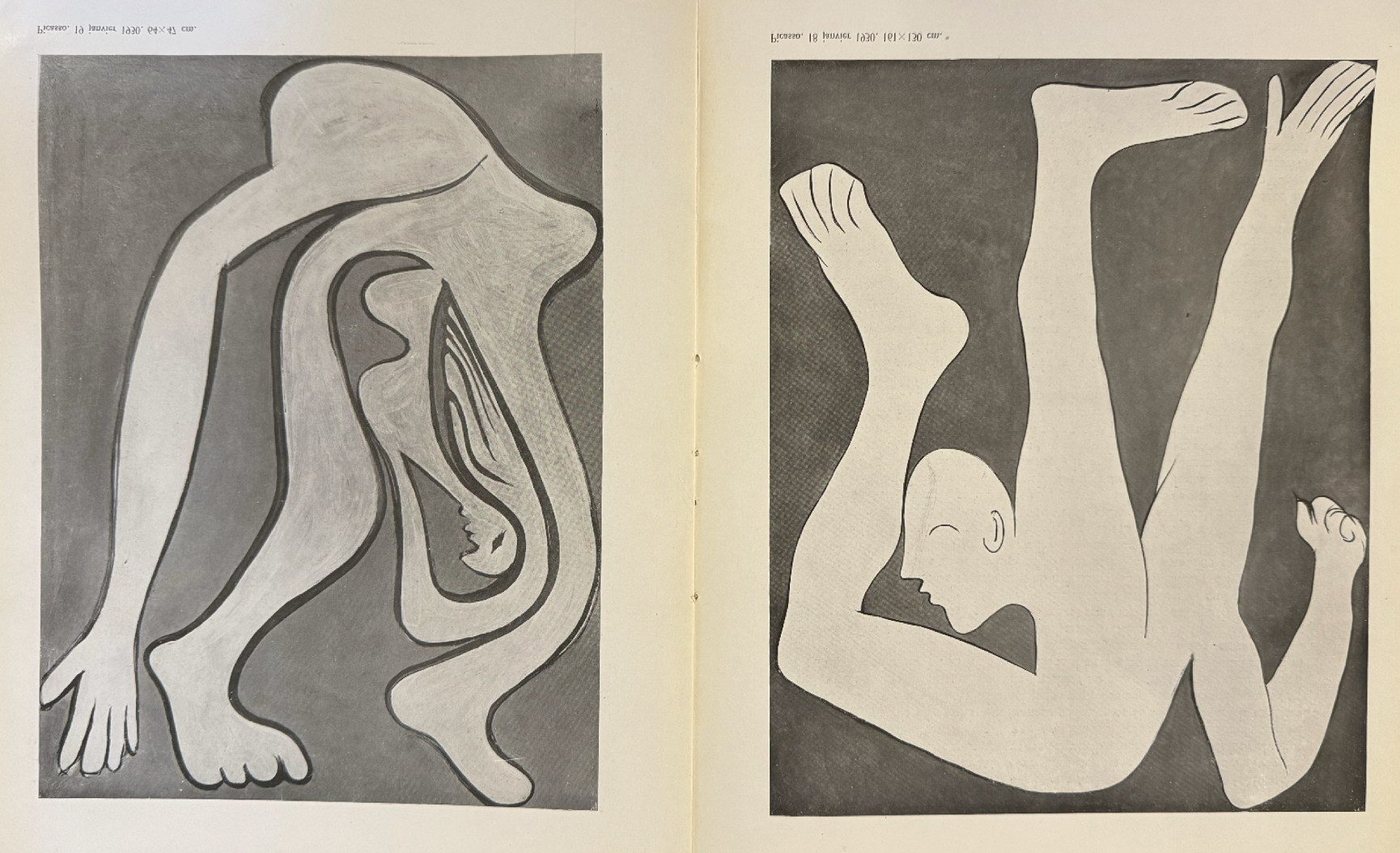
But I would add a couple of things that Zeidler omits. First, as with the image of the palette and the brush in The Painter and His Model, it seems important to me that these two images of falling and being rooted to the spot reference the act of painting. This is most apparent, I think, in the hand of the tumbling trapeze artist that not only doubles as her hair but triples as the hair of the artist’s brush. The relation between hand, hair, and the hairs of a brush, each merging into the other while touching the vertical surface that is both the back of the acrobat and the surface of a canvas, pictures the act of painting as an act of falling. This is then countered in the contortionist, whose fingers and toes similarly double as bristles. Legs and arms morph accordingly into handles, with the feet conveying the same sense of pressure and drag as the crescent-shaped brush form in The Painter and His Model. The acrobat’s touching and standing become, to my eye, the painter’s touch of the brush on canvas while standing before an easel.
And second, the acrobats are in evident dialogue with a third image, Picasso’s La nageuse from 1929 (fig. 9). Unlike the leaden tones of the acrobats, La nageuse comes to life in a literal ocean of color, inhabiting a different kind of space, neither solid ground nor thin air—neither option A nor option B—but a liquid medium that contains properties of both: floating and sinking, lying on the surface and submersion below. The swimmer’s ground thickens into the fluid flesh of the world made literal, as skin once again touches skin in the form of another phantom face that emerges along the shared outline of the swimmer’s profile. But we also see something new, a threat previously unseen, as the water surrounding the swimmer’s leg, buttock, and upper arm transforms into the open-mouthed attack of a shark.
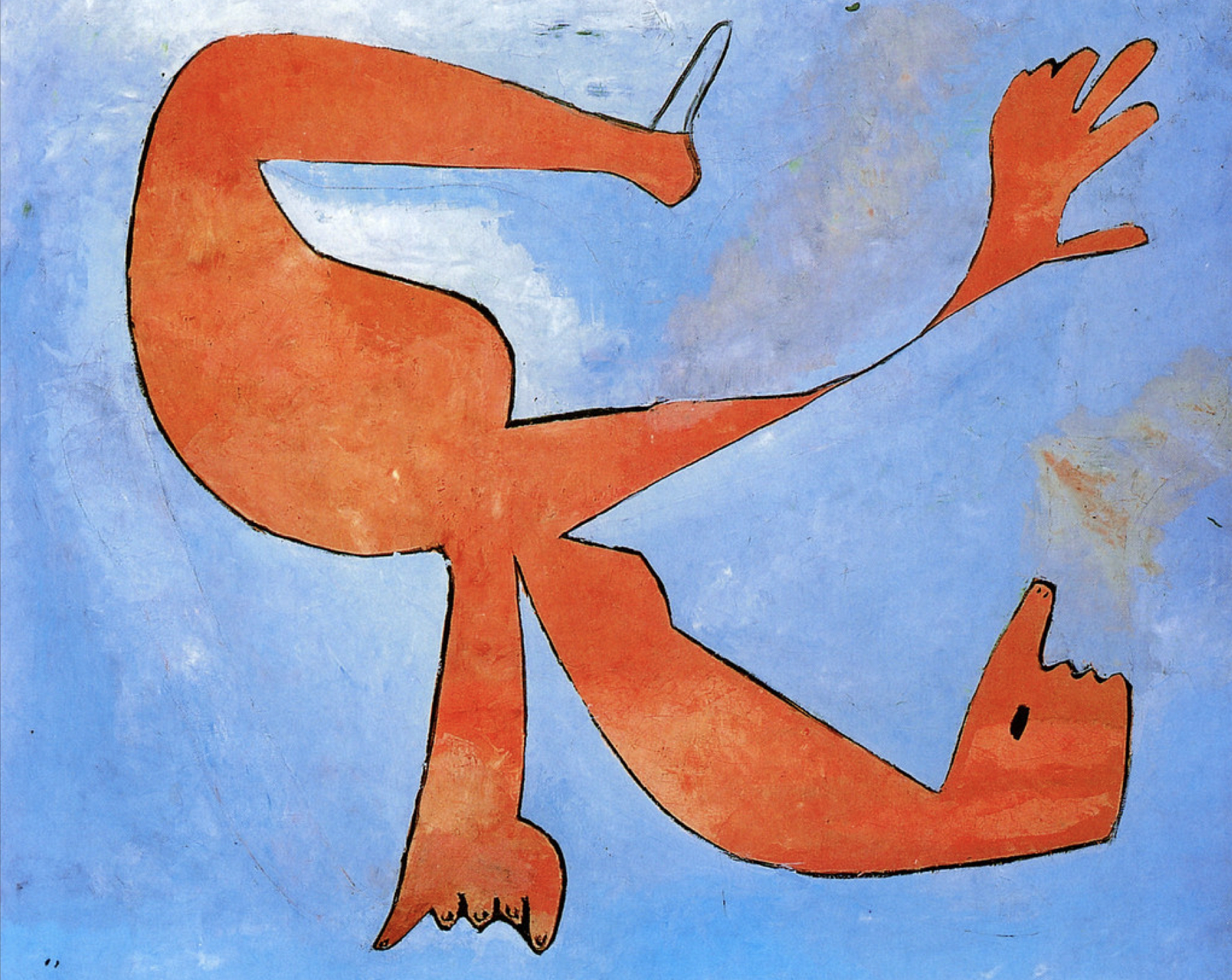
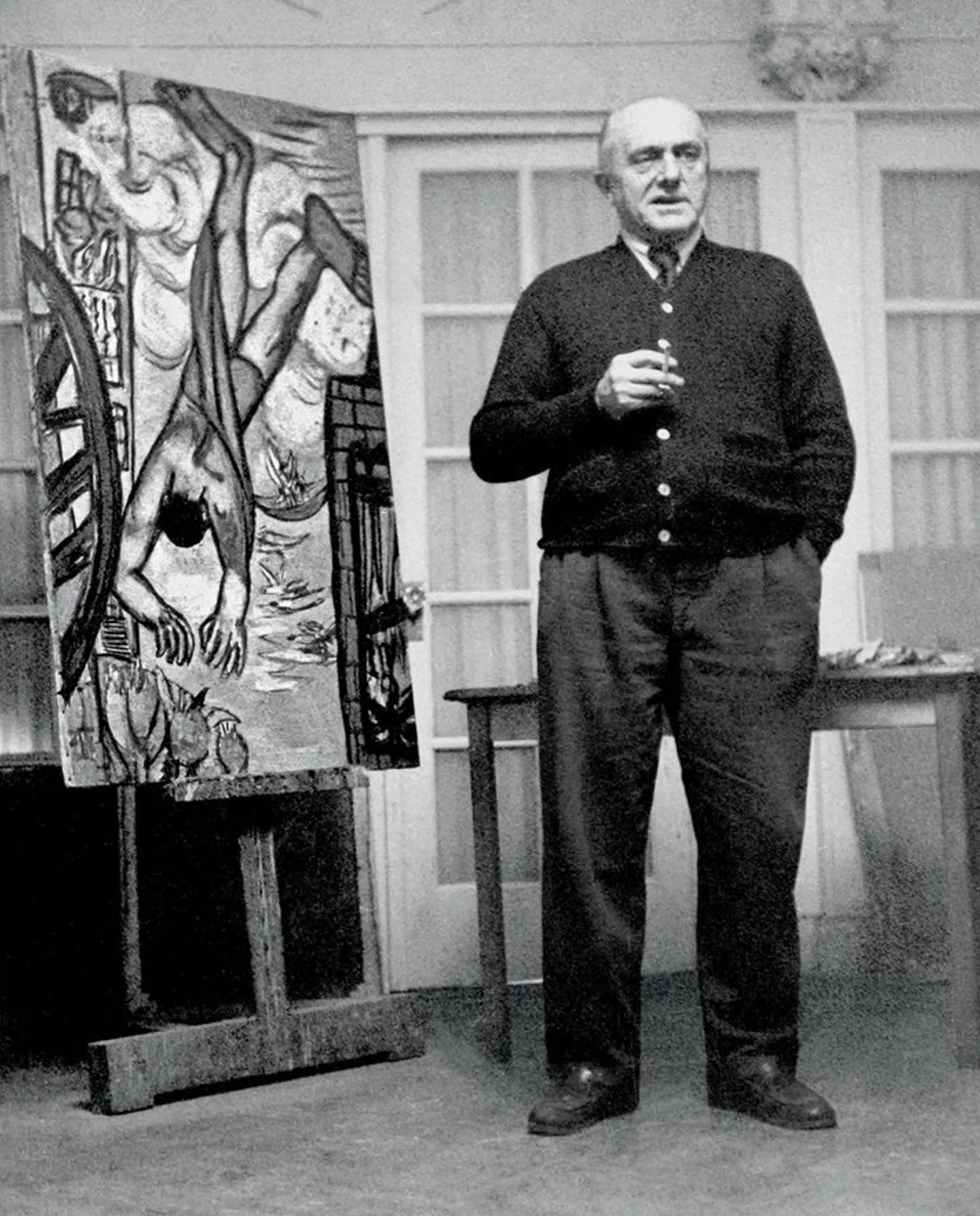
Grounded, groundless, and swimming: we return full circle to the image of Beckmann’s Falling Man. Here too, I would argue, we see the image of the figure—simultaneously falling, fallen, and floating—as a projection of the artist into the painting, flipped on his head. Clamped between two buildings, the white-blue expanse of air-turned-ground-turned-water reflects the expanse of white-painted canvas clamped within the architecture of the painter’s easel, as seen in a photograph of Beckmann in his East 19th Street studio in New York (fig. 10). Again, the fingers of the man’s hands take on the form of the artist’s brushes, as do the plants below. At the same time, both the quarter-circle of earth and the balcony above can be seen as intrusions of Beckmann’s palette into the painting. More significantly still, what I had been seeing as the terra firma endpoint of the man’s fall into the quarter-circle of dirt and plants can just as easily be seen—thank you Chuqi Min for pointing this out to me—as the floating leaf or lily pad of its accompanying lotus flowers, flipping solid ground into another image of floating.
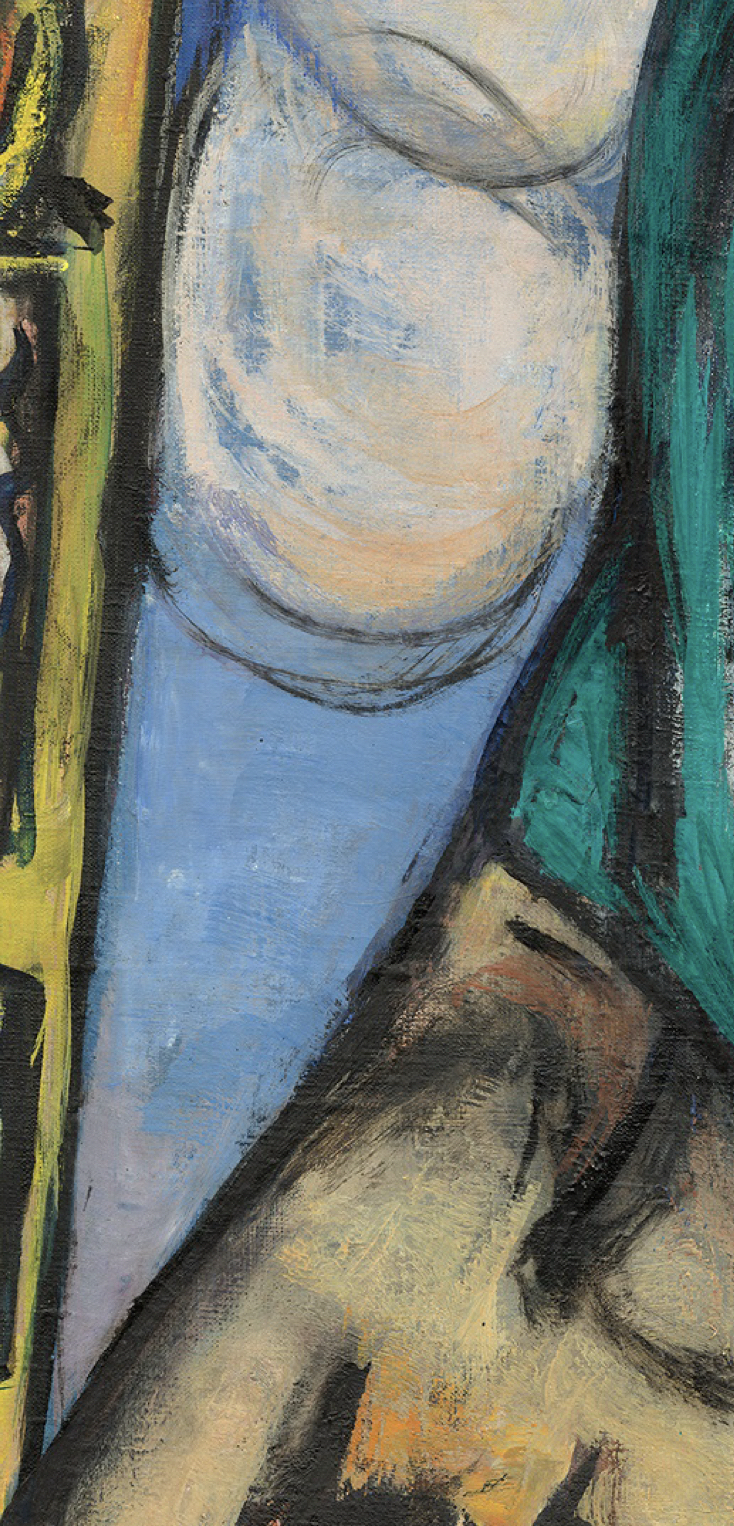
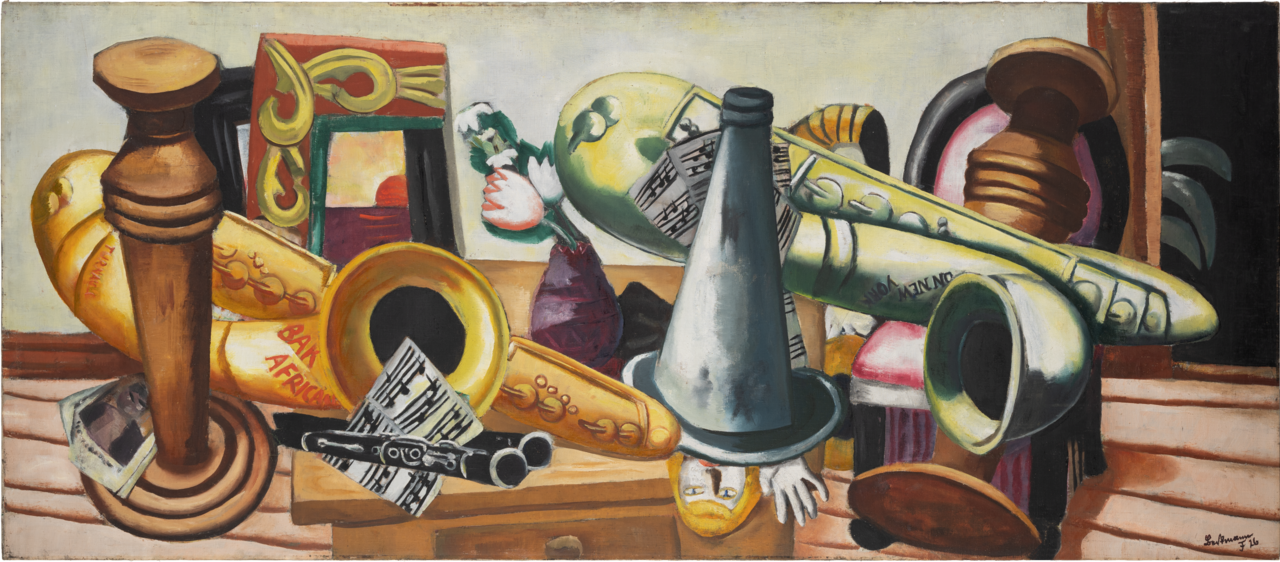
Looking to the falling man’s left side (his right), we again see how the sky shifts between flatness and depth, ground and groundlessness, in the blue-and-white cone that forms in the gap between his torso and the yellow building (fig. 11). Its pink-hued tip models the solidity of its rounded form even as it dissolves into thin air. A recurring motif, cones appear in various guises throughout Beckmann’s work: from the 1948–49 watercolor and gouache Early Humans to the 1925 painting Galleria Umberto to his 1921 Self-Portrait as a Clown, among many examples. In each case, the cone serves as a form that funnels space down or through while pushing up and out. This can take the form of forced air moving through a horned instrument, as in Still Life with Saxophones from 1926, or our vision as it propels through space, as in the 1927 Still Life with Telescopes (fig. 12). In the case of Falling Man, the cone serves as both a funnel-shaped chute that accelerates and directs the man’s movement downward and, at the same time, a parachute flattened out and seen from above, arresting movement and suspending the man in space.
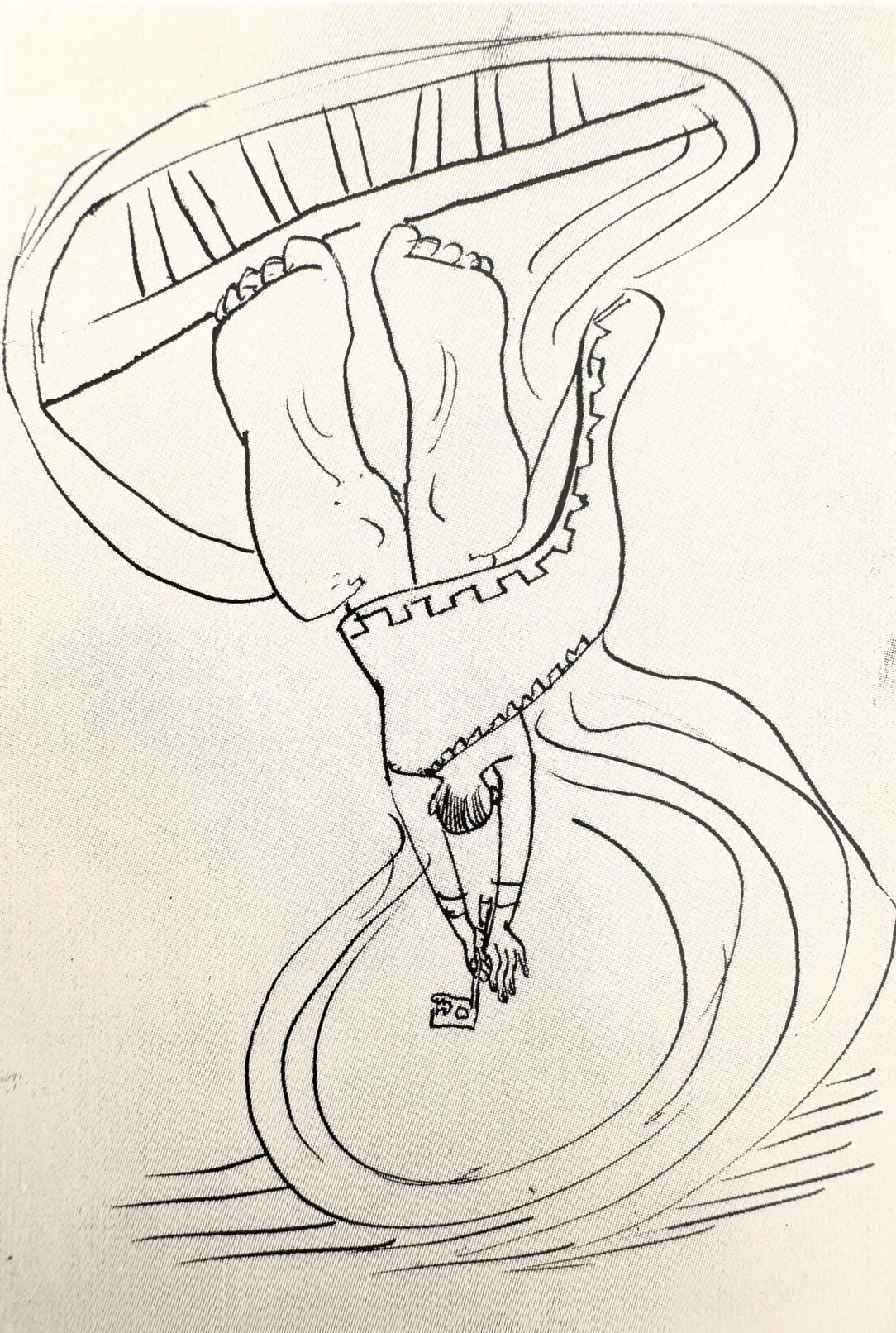
Not coincidentally, the cone—or more accurately, double cone—appears as the central compositional element within one of the most direct precedents to Falling Man: Beckmann’s 1944 ink-on-paper illustration to Mephistopheles’ speech as he sends Faust to the groundless realm of The Eternal Mothers (fig. 13). “Descend, then! I might also tell you: Soar! / It’s all the same. Escape from the Existent / To phantoms’ unbound realms far distant!”21 The dual directionality—up and down, in and out—of Beckmann’s recurring cone motif is made explicit in the hourglass shape that flips the sands of time in both directions. Formed through two interlocking cones that taper towards the figure’s hands at one end and feet on the other, the figure-eight pushes and pulls Faust in both directions as he descends and soars. As in Falling Man, we see the rounded railing of the balcony from which he plummets at the top of the drawing. But as we soon notice, the balcony doubles as a set of teeth, combining with the pattern on Faust’s jaw-shaped toga to form a mouth that chews and swallows him whole. Into the rounded stomach, Faust falls headlong down the chute only to be vomited back with each new turn of the hourglass. Descending and soaring, as Goethe writes, “It’s all the same.”
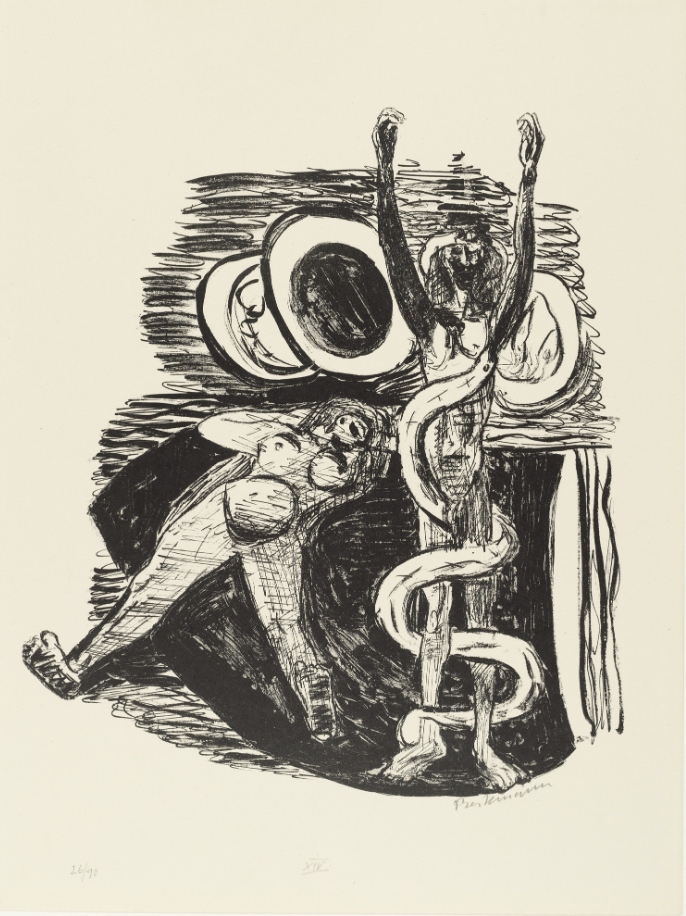
The other evident forerunner to Falling Man is The Fall of Man in Beckmann’s 1946 portfolio of fifteen lithographs titled Day and Night (fig. 14). Seen from face on rather than behind, the figure of Adam assumes the same basic stance as Beckmann’s 1950 painting: stiff and impassive with his arms above his head, legs straight, feet splayed outward. In addition, the serpent that winds its way around the man’s body in the lithograph becomes, in Falling Man, the green toga that wraps across from the falling figure’s torso from his left elbow down to his right knee. Most notably, however, the man’s head seems to be entering some kind of circular opening or portal, much like the image of Faust set upright.
Beckmann’s drawing of Faust pictures a figure swallowed and coughed up by another figure. And in this sense, Faust’s descent into the void and reascent back onto firm footing becomes analogous to Beckmann’s own fall into, and out of, Falling Man. And indeed, as Todd Cronan recently pointed out to me, just as Beckmann’s Faust is chewed up and swallowed by two roughly circular forms—a mouth and a stomach—so too does the figure in Falling Man appear to fall directly into the cogs of a machine, into the grinding gears of the balcony above and the quarter-circle of earth below. Like a giant Catherine wheel that is about to break the body of its victim, the balcony bears down on the man. The stairs immediately beside and below the two interlocking circular “gears,” just to the left of the man’s right forearm, look unmistakably like the cogs of a machine that, no less than the teeth that chew and swallow Faust, appear as if they too are about to pull the falling man in, grind him up, and spit him back out.
Touch and vision are fundamental to this double condition of being pulled in, ground up, swallowed, and pushed back out in ways both obvious and less obvious. No one needs to be told, for example, that a skilled painter such as Beckmann is hyper-attuned to the precise pressure and feel of his brush as it makes and breaks contact with the canvas, or the tactile sensation of its bristles as he drags it over the warp and woof of the painting’s rough surface, leaving an oily trail in its wake. Nor does anyone doubt the precision, care, and nuance of seeing as the painter steps back and looks at his marks, scrutinizing each brushstroke at a remove. For all his mastery and facility—for all the sensuous pleasure he doubtless derived from the act of painting—this was, nonetheless, clearly a torturous process for Beckmann; pulled in, pushed out, again and again. Touch and vision, very obviously, constitute the mainstay of Beckmann’s activity as a painter. Less obvious, perhaps, is the way by which these two senses map onto Einstein’s double strata of the real. In his writing on Einstein, Charles Palermo describes the distinct phenomenological relation of vision and touch in the critic’s writing in Documents:
Vision permits “objectification” more easily than touch. That is to say, the objects of vision can readily seem wholly distinct from the perceiving subject, while touch tends to emphasize the continuity between subject and object. When I look at a table, I see it as located there; when I touch it, though, it seems to me to be here, meaning that it is where I am, even to the point of making it difficult to feel its distinctness from me [this is the crucial point], because I encounter it only in the space of my own body.22
Much as Palermo describes the “inner world” of touch, certain acts and tactile experiences, for Einstein, break down the safe, fixed distance of the neatly bounded “outer world” of vision. Touch becomes a site of potential confusion and destabilization, ungrounding the tectonic fixed image of vision. When we touch the world in the way that a painter, for example, touches a canvas, then, according to Einstein, “The limits of objects have disappeared. Man no longer observes. He lives in the orbit of objects turned psychological functions.”23
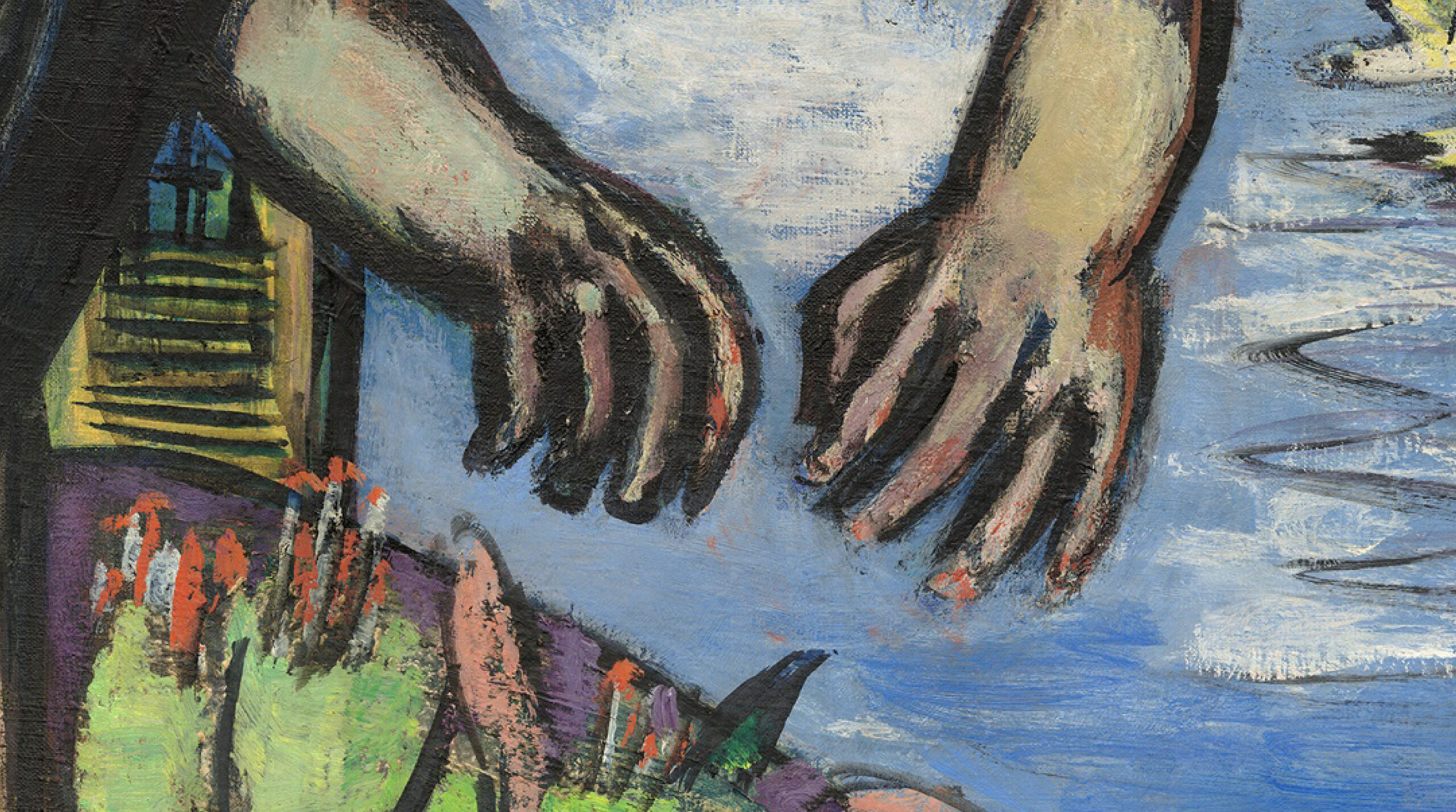
Look once more at the hands of Beckmann’s Falling Man (fig. 15). To our left, his right hand appears sealed off from the world, encased by the thick dark lines that surround it, as though touching nothing, or nothing but air. The protective border surrounding his left hand, by contrast, breaks down where his fingers make contact with the world, dissolving the black and reddish-pink of his body into the similarly colored flecks outside his body in the watery-blue space through which he falls, or floats, or both. The black space between his index and middle finger in particular seems neither fully part of nor fully detached from his body, occupying some kind of middle ground between. If these hands can be seen, as I believe they should, as proxies for the artist’s brush, then like the man in the painting, Beckmann also fell with each touch, and with each step back to look and see, he grounded himself afresh. “First we feel. Then we Fall.”24
Notes

“First we feel. Then we Fall.”
— James Joyce, Finnegans Wake1
I begin with three representations of falling, one visual—a painting by Max Beckmann titled Falling Man produced shortly before his death in 1950 (fig. 1)—and two written: my epigraph from Joyce, with which I’ll also conclude, and an excerpt from the poem Design for a Landscape by Carl Einstein published in 1930:
In falling you are suspended
Entangled
In the contradiction
Between image and ground.
…………………..
You won’t be carried along by the boastful images
That sail across the bottomlessness.2
Beckmann and Einstein had been aware of each other and each other’s work from as early 1916 when Einstein began a long-term romance with the Countess Augusta vom Hagen, Beckmann’s friend and patron since their initial meeting in Paris in 1904. Beckman makes the connection explicit in his 1919 lithograph, “The Ideologues” (fig. 2), in which he pictures himself next to vom Hagen and Einstein.3 Beckmann had likewise written sporadic but favorable snippets on Beckmann’s work, most significantly in his substantially revised third edition of The Art of the Twentieth Century published in 1931.4 But in comparing Falling Man with Design for a Landscape, I want to connect Beckmann with Einstein less directly, through their shared concern with being simultaneously grounded and groundless.
Shifting from the second person “you” of the poem to the third person “him” in Beckmann’s painting, the nearly naked figure cuts a diagonal swath across the clouded blue sky, plummeting headlong through space like a toppled statue, stiff and impassive, as if knocked from its perch. In Einstein’s poem, the fall is “suspended” not because it appears frozen in pictorial time, as in Falling Man, but because it is “Entangled / In the contradiction / Between image and ground.” We get a sense of what Einstein might mean by this, and what such an entanglement might look like, in the image of the downward fall of Beckmann’s figure and his simultaneous ensnarement and compression into the painting’s surface. Indeed, Falling Man presents us with two very different types of ground, each in “contradiction,” as Einstein puts it, with the other. On the one hand, and most obviously, we see the depicted ground: the endpoint of the man’s downward fall in the quarter-circle of earth and plants at the base of the building in the lower left corner. On the other, we see the flat, material ground of the pictorial support asserted throughout the painting.
The physical flatness of the canvas is made conspicuous, for example, in the outward splay of the man’s legs and feet, wedging him into the upper and right framing edges of the image. Indeed, when I first saw this painting years ago at the National Gallery in Washington with a painter friend, she remarked how the man’s feet felt compressed into the surface, as if flattened between two sheets of glass like butterfly wings. This feels essentially right to me. The legs and feet do indeed seem related to the aerodynamics of flying, although more like tailfins perhaps than wings. Groundless and grounded, the man’s body presses into the surface of the painting. But to my eyes, the force of that lateral push into the painting has less to do with being pressed between two surfaces and more to do with hitting the ground, as the material plane of the canvas transforms into the hard surface that stops the man’s fall, flattening his body on impact. Beckmann’s hallmark black cloisonné further emphasizes this lateral collapse into the canvas. Like a tonally reversed chalk outline of a corpse on asphalt, the black border surrounding the man’s body twists our viewpoint back and forth, from a downward fall as the man plummets towards his death to a view from above, in which his body has already crashed and flattened into the ground plane. Seen from above, looking down on the man below, our vision aligns with the circular railing of the balcony that hugs the left side of the painting. This double viewpoint is crucial. For if the man is falling, we see an image as ground in the quarter circle of earth and plants, but if the man has fallen and already landed, we see the ground as image, as the literal support of the canvas hardens into the illusion of a surface that breaks his fall.
The double image of simultaneous free fall and impact is further underscored in the contrast between the collapse of the man’s body into the picture plane, most evident in his feet, and the shaded depth of his upper left arm (our right), which, depending on one’s point of view, either peels off from the ground, raising the corresponding shoulder in the process, or recedes into space, pushing the adjoining elbow into pictorial space away from the viewer.5 At the same time, we see how the man’s right foot twists flat to accommodate another set of multiple viewpoints, seen from the side and from above or below simultaneously. Note too how its especially thick, coarsely scumbled outline almost—but not quite—connects with the dark spire of the right-flanking building. In so doing, it frames the ossified white cloud that hooks into the crook of his foot, forming an off-kilter, roughly hewn block that thickens on the surface of the painting, feeling more like marble than sky.
Below this, we see what appears at first blush to be some kind of hammock suspended between the twin supports of the dark-brown building and the man’s body. Looking closer, we see that the hammock doubles as a boat, manned by mysterious winged figures. Along with the green fish-like animals that swim above the bird-in-flight and the lily pad flower below, the boat transforms falling into floating, as the groundless sky becomes a watery surface. The black-and-white zigzag ripples in the now-liquid space below the boat appear to move across the water rather than twist and turn in thin air as we see above. And in so doing, Beckmann’s painting again folds back onto Einstein’s poem, which likewise evokes this same shift from falling to suspension to floating: “You won’t be carried along by the boastful images / That sail across the bottomlessness.”6
Although Einstein could not have been thinking about Beckmann’s Falling Man when he wrote these words, he was—as Sebastian Zeidler has made clear—thinking very much of another artist: the seventeenth-century Dutch printmaker Hercules Seghers. Having published an essay on the artist’s etchings in the journal Documents the year before, Einstein was particularly taken with Seghers’ 1625 Mountain Gorge by a Road (fig. 3). Produced by reusing a previously worked etching plate, the final landscape overlaps and merges with the ghostly bow of a massive sailing ship. As Einstein describes the resulting palimpsest, “This is the uninhabited desert. Seghers banishes air, the sign of flux and vital movement. At times the clouds assume the forms of boulders. … a ship’s rigging scratched into the sky… a sailor scales the ropes. Here we see a new symptom of anesthesia: the sea is identified with rock, flowing water is equated with dead matter, death is, as it were, transferred to animate matter.”7
Einstein imagines the ship’s crudely formed figurehead (fig. 4) as a sailor who, in climbing the rigging to escape the airless moonscape below, has fallen, becoming entangled in the ropes, suspended in mid-air. As Einstein continues, “Vertigo signifies the fatality of the fall and at the same time the fact of remaining rooted to the spot.” The “fatality” of the fall described by Einstein begins to feel a lot like the impending death of Beckmann’s falling man, who, much like Seghers’ sailor, remains nonetheless “rooted to the spot.” For Zeidler, the “you” of Einstein’s poem—“in falling you are suspended”—refers to the sailor, the artist (Seghers), and the writer of the poem (Einstein), all of whom are “Entangled / In the contradiction / Between image and ground.”8 But the “you” of the poem is also “us,” the viewers of Seghers’s image. For just as the overlapping ship and landscape disorients our perspective as each image bleeds into the other, so too does the suspended sailor and easily missed figure in the lower left, along with the town and windmill behind him, disrupt our sense of scale. As a result, Einstein claims, we flip back and forth between the safe ground of the familiar and the estrangement of uprootedness, producing a form of vertigo whereby, suspended between falling and stasis, we find ourselves, as Einstein puts it, “cramped between two extremes, experiencing a psychic annulment.”9
Consistent with the majority of his writing in Documents, the overwrought rhetoric of Einstein’s essay reflects his larger engagement with a philosophy of being that he termed “the real.” As Zeidler and Charles W. Haxthausen have helpfully glossed, Einstein’s ontology of “the real” is comprised of two interconnected layers or strata, one overlaid on top of the other, much like the phantom ship and landscape in Seger’s etching. The “lower” primordial layer is composed of brute instinctual chaos and flux, an oceanic realm devoid of structure or boundaries where formless bodies exist in a state of constant psychic ebb and flow. Above this lies the “upper” tectonic layer of static form and structure that has emerged out of the underlying fluid chaos, much as the sailor has climbed the rigging to escape what Einstein calls the “liquid living movement” below. And in this sense, the sailor stands in for artist, critic, and viewer alike—stands in, that is, for all of us, as we hang suspended on the ropes, constantly at risk of falling back into the primordial morass. The upper “tectonic” layer, which goes by various names and assumes various forms in Einstein’s writing—“culture,” “civilization,” “art,” “architecture,” “philosophy,” “literature”—attempts to hold the primordial flux at bay.10
As Zeidler notes, Einstein’s conception of the real suggests certain parallels with Freud’s speculation in “Beyond The Pleasure Principle” that organisms develop a “hardened” psychic “crust” as a defensive barrier in response to excessive stimuli—a barrier not unlike, for example, the black outline that surrounds Beckmann’s falling man.11 For Einstein, the reified realm of the tectonic likewise functions as a defensive shield against the excessive stimulation of primordial flux. And in the same way that Freud famously sees our efforts to escape the threat of psychic disturbance as leading to an unconscious desire for the ultimate absence of nervous agitation—namely, death—the tectonic reification of culture, for Einstein, produces a similar desire within art and literature: static, lifeless, arid, and structured to wall off the disturbance of instinctual chaos. As a result, Zeidler writes:
The salient question for Einstein was whether the presence of the real “below” is acknowledged or denied by the forms of culture “on top.” Whether in art, philosophy, or personal biography: is form used as a means of denying the real even exists? Or is it used as a means of acknowledging the fragility of human life; a fragility that’s caused by its ongoing exposure to the real? In the first instance, a culture will pretend to be grounded in itself; in the second, it will admit to the threat of its own groundlessness. (FAR, 159)
But things aren’t quite so simple as this might suggest. For, as Zeidler notes, there are not two options available to artists and writers but rather three.
The first possibility, we’ll call this option A, embraces what Einstein, following Heinrich Wölfflin, calls “the tectonic.” For Einstein, this option has assumed countless forms and variations over history, from the Sumerian sculpture of the ruler Gudea to the “closed form” of Raphael’s Ansidei Madonna to the geometric abstraction of Kandinsky’s work of the late 1920s and 1930s. The second possibility, option B, strives for the opposite effect, bypassing the architecture of reason through the uninhibited release of pure “Dionysian psychic intensity” into and onto the artwork.12 Above all, Einstein is thinking here of Surrealism in general and André Masson in particular. But despite Einstein’s repeated endorsements of Masson’s automatic drawings in the pages of Documents, there was more than a hint of ambivalence in his support of the artist’s efforts to liberate the psyche from the ossified structures of the mind—an ambivalence that ultimately gave way to disillusion as Einstein increasingly came to view Masson’s Surrealism as less an escape or a release from the death grip of the tectonic than the flip-side to the same coin. For if, as Einstein claims, the strict imposition of rigid, static structure leads not just to death but the cruel sadism of the punishing super-ego demanding more and more control over the drives and instincts, the passivity of Masson’s Surrealism embraced the opposite extreme: a form of masochism that leads to the same deathly conclusion.13
Against option A and option B, then, Einstein offers a third possibility; we’ll call this option C. Far more difficult to find in the history of art—Seger’s etching, prehistoric cave paintings, and African masks are rare examples14—option C acquires its greatest contemporary force of expression with Einstein’s artistic hero, Pablo Picasso. Mobilizing what Einstein called the “dialectical simultaneity of solution and counter-solution,” the artist’s work, especially during the late twenties and early thirties, held option A and B in tension, “oscillating” between the two “psychological poles” of the Apollonian and tectonic, on the one hand, and the Dionysian and the ecstatic, on the other.15 Einstein had various names for these rare artistic instances in which the twin poles of structured stasis and transgressive flux are held together without resolve—“tectonic hallucination,” “fixed ecstasy” (a concept explored at length in Charles Palermo’s writing on Einstein), and above all, “the double style.”16
At times, as Zeidler demonstrates, Einstein foregrounded Picasso’s double style quite literally, as evidenced in the repeated side-by-side comparisons of the artist’s work in the pages of Documents. In the double-page spread that precedes his contribution to the 1930 special issue on Picasso (fig. 5), for example, Einstein juxtaposed a neoclassical pastel—Woman with a Red Hat from 1921—with the Surrealist Head of a Woman, painted eight years later. Not only does the neoclassical “tectonic” image fold directly onto the Surrealist “hallucination” when the pages are shut, only to separate and rejoin with each new opening and closing, but both images are also internally doubled. We see this most clearly in the two warring halves of the unambiguously divided head of the 1929 painting. But as Zeidler points out, a similar internal division is also present, if less obviously so, in the earlier pastel, as the fleshy hat appears at once integrated and at odds with the neoclassical head on which it sits, the almost grotesque bow appearing as a kind of unconscious thought bubble to the sitters’ repressed instincts.17
It is this unexpected irruption of the repressed into the space of neoclassicism that Picasso’s influence on Beckmann’s so-called verism of the early 1920s is felt most keenly. Apparent not just in terms of its purported rappel à l’ordre neoclassicism and subject matter—“one would be hard pressed to deny the obvious influence,” as Hans Belting puts it—it is their shared engagement with the “double style” that separates them from the crowd of the genuinely conservative Return to Order.18 Indeed, if we were to take, for example, Beckmann’s 1924 portrait of his first wife, Minna Beckmann-Tube (fig. 6), one could easily argue that Beckmann’s particular version of the double style places the opposition of tectonic classicism and Dionysian flux under greater tension than Picasso. Much like Woman with a Red Hat, Beckmann’s portrait appears at first glance entirely straightforward in its juste milieu neoclassicism. But to leave it at that would be to miss not only the oddly meat-like quality of the fan in her right hand but also the even more unsettling and transgressive image of the curtain reflected in the mirror to her left. Unsettling not so much because it seems as if, because of its placement and angle, the mirror should be reflecting the sitter rather than the curtain but because there is a perverse suggestion that Beckmann’s wife is precisely what we see in the painting-like mirror image against the wall. For not only does the rectangular form of the chairback appear to double the rectangular form of the mirror, implying a certain visual reciprocity between the contents of the two oblique frames—torso and curtain—but the corporeal qualities of the curtain seem to reflect the bodily qualities of the sitter. This is evident, perhaps most obviously, in the hoary-pink European-flesh colored fabric and the way in which the curtain’s outer fold “mirrors” Beckmann-Tube’s left arm, both of which seem to touch elbows at the curtain tie. Above all, however, it is the curtain tie’s unmistakably anus-like appearance that is the most corporeal, most transgressive aspect of the mirror’s reflection. Much like the slightly grotesque bow in Woman with a Red Hat, the anus curtain tie erupts into the field of representation, reflecting not the outer appearance of the rather prim sitter but the repressed internal instincts that, like the tie that pulls back the curtain on the dark void beyond, holds everything in place. Perhaps this is what Einstein had in mind when he wrote cryptically that “Beckmann no doubt attempted to bring together something like an aggregate of modernism,” trying “not to elude the conflict between artistic preconception and empirical motif, but rather to escalate that conflict into an almost tragic confrontation.”19
Zeidler’s second example of the double style is another pairing of Picassos in Documents (fig. 7): The Painter and His Model from 1927 and Woman in an Armchair from the same year. In the latter painting, two neoclassical silhouettes, one in shadow, the other in light, overlap the Surrealist female nude, over and at whom they exchange glances. The protrusions extending from the heads of both profiles create a suggestion of symmetry, as if above and below could serve equally as necks. This invites the viewer to imagine the painting flipped on its head, making visible the conjoined twins of each silhouette formed at the intersection of contour and tone. The Painter and His Model likewise doubles the play of light and line as the linear images of the artist at his easel on the right faces off against his monstrous sitter on the left, each appearing caught in the twin spotlights that Zeidler describes as a crescent and a kidney. For my part, I would argue that “the kidney” is, in fact, a palette, emphasizing the more overt three-sided rectilinear palette and thumbhole that appears at the end of the painter’s zig-zag arm, while “the crescent” gives form to the hairs of a brush, seen from the side, being dragged across the surface of a canvas. This, in turn, enlarges the artist’s other hand. I’ll return to the painter’s self-projection into the canvas as I move towards a conclusion.
Finally, in the same issue of Documents (fig. 8) we find a pair of acrobat paintings completed shortly before the journal’s publication in 1930: one of a female trapeze artist falling, the other of a male contortionist touching the ground and sides that contain him. As before, figure flips into ground, and vice versa, as both profiles give form to a distorted but clearly visible opposing silhouette along their shared outline.20 Each light-colored face kisses the dark ground of its partner while negative space cups the trapeze artist’s breast and erotically supports the contortionist’s head. Grounded and groundless, Picasso’s acrobats pair off two seemingly opposed experiences of being-in-the-world: one of falling and flux, the other of stasis and structure. But as Zeidler emphasizes, falling and rootedness each give rise to the other for Einstein, much as the dark negative ground that slowly appears in the space surrounding the acrobats gives form to the positive figure that we see with ease.
But I would add a couple of things that Zeidler omits. First, as with the image of the palette and the brush in The Painter and His Model, it seems important to me that these two images of falling and being rooted to the spot reference the act of painting. This is most apparent, I think, in the hand of the tumbling trapeze artist that not only doubles as her hair but triples as the hair of the artist’s brush. The relation between hand, hair, and the hairs of a brush, each merging into the other while touching the vertical surface that is both the back of the acrobat and the surface of a canvas, pictures the act of painting as an act of falling. This is then countered in the contortionist, whose fingers and toes similarly double as bristles. Legs and arms morph accordingly into handles, with the feet conveying the same sense of pressure and drag as the crescent-shaped brush form in The Painter and His Model. The acrobat’s touching and standing become, to my eye, the painter’s touch of the brush on canvas while standing before an easel.
And second, the acrobats are in evident dialogue with a third image, Picasso’s La nageuse from 1929 (fig. 9). Unlike the leaden tones of the acrobats, La nageuse comes to life in a literal ocean of color, inhabiting a different kind of space, neither solid ground nor thin air—neither option A nor option B—but a liquid medium that contains properties of both: floating and sinking, lying on the surface and submersion below. The swimmer’s ground thickens into the fluid flesh of the world made literal, as skin once again touches skin in the form of another phantom face that emerges along the shared outline of the swimmer’s profile. But we also see something new, a threat previously unseen, as the water surrounding the swimmer’s leg, buttock, and upper arm transforms into the open-mouthed attack of a shark.
Grounded, groundless, and swimming: we return full circle to the image of Beckmann’s Falling Man. Here too, I would argue, we see the image of the figure—simultaneously falling, fallen, and floating—as a projection of the artist into the painting, flipped on his head. Clamped between two buildings, the white-blue expanse of air-turned-ground-turned-water reflects the expanse of white-painted canvas clamped within the architecture of the painter’s easel, as seen in a photograph of Beckmann in his East 19th Street studio in New York (fig. 10). Again, the fingers of the man’s hands take on the form of the artist’s brushes, as do the plants below. At the same time, both the quarter-circle of earth and the balcony above can be seen as intrusions of Beckmann’s palette into the painting. More significantly still, what I had been seeing as the terra firma endpoint of the man’s fall into the quarter-circle of dirt and plants can just as easily be seen—thank you Chuqi Min for pointing this out to me—as the floating leaf or lily pad of its accompanying lotus flowers, flipping solid ground into another image of floating.
Looking to the falling man’s left side (his right), we again see how the sky shifts between flatness and depth, ground and groundlessness, in the blue-and-white cone that forms in the gap between his torso and the yellow building (fig. 11). Its pink-hued tip models the solidity of its rounded form even as it dissolves into thin air. A recurring motif, cones appear in various guises throughout Beckmann’s work: from the 1948–49 watercolor and gouache Early Humans to the 1925 painting Galleria Umberto to his 1921 Self-Portrait as a Clown, among many examples. In each case, the cone serves as a form that funnels space down or through while pushing up and out. This can take the form of forced air moving through a horned instrument, as in Still Life with Saxophones from 1926, or our vision as it propels through space, as in the 1927 Still Life with Telescopes (fig. 12). In the case of Falling Man, the cone serves as both a funnel-shaped chute that accelerates and directs the man’s movement downward and, at the same time, a parachute flattened out and seen from above, arresting movement and suspending the man in space.
Not coincidentally, the cone—or more accurately, double cone—appears as the central compositional element within one of the most direct precedents to Falling Man: Beckmann’s 1944 ink-on-paper illustration to Mephistopheles’ speech as he sends Faust to the groundless realm of The Eternal Mothers (fig. 13). “Descend, then! I might also tell you: Soar! / It’s all the same. Escape from the Existent / To phantoms’ unbound realms far distant!”21 The dual directionality—up and down, in and out—of Beckmann’s recurring cone motif is made explicit in the hourglass shape that flips the sands of time in both directions. Formed through two interlocking cones that taper towards the figure’s hands at one end and feet on the other, the figure-eight pushes and pulls Faust in both directions as he descends and soars. As in Falling Man, we see the rounded railing of the balcony from which he plummets at the top of the drawing. But as we soon notice, the balcony doubles as a set of teeth, combining with the pattern on Faust’s jaw-shaped toga to form a mouth that chews and swallows him whole. Into the rounded stomach, Faust falls headlong down the chute only to be vomited back with each new turn of the hourglass. Descending and soaring, as Goethe writes, “It’s all the same.”
The other evident forerunner to Falling Man is The Fall of Man in Beckmann’s 1946 portfolio of fifteen lithographs titled Day and Night (fig. 14). Seen from face on rather than behind, the figure of Adam assumes the same basic stance as Beckmann’s 1950 painting: stiff and impassive with his arms above his head, legs straight, feet splayed outward. In addition, the serpent that winds its way around the man’s body in the lithograph becomes, in Falling Man, the green toga that wraps across from the falling figure’s torso from his left elbow down to his right knee. Most notably, however, the man’s head seems to be entering some kind of circular opening or portal, much like the image of Faust set upright.
Beckmann’s drawing of Faust pictures a figure swallowed and coughed up by another figure. And in this sense, Faust’s descent into the void and reascent back onto firm footing becomes analogous to Beckmann’s own fall into, and out of, Falling Man. And indeed, as Todd Cronan recently pointed out to me, just as Beckmann’s Faust is chewed up and swallowed by two roughly circular forms—a mouth and a stomach—so too does the figure in Falling Man appear to fall directly into the cogs of a machine, into the grinding gears of the balcony above and the quarter-circle of earth below. Like a giant Catherine wheel that is about to break the body of its victim, the balcony bears down on the man. The stairs immediately beside and below the two interlocking circular “gears,” just to the left of the man’s right forearm, look unmistakably like the cogs of a machine that, no less than the teeth that chew and swallow Faust, appear as if they too are about to pull the falling man in, grind him up, and spit him back out.
Touch and vision are fundamental to this double condition of being pulled in, ground up, swallowed, and pushed back out in ways both obvious and less obvious. No one needs to be told, for example, that a skilled painter such as Beckmann is hyper-attuned to the precise pressure and feel of his brush as it makes and breaks contact with the canvas, or the tactile sensation of its bristles as he drags it over the warp and woof of the painting’s rough surface, leaving an oily trail in its wake. Nor does anyone doubt the precision, care, and nuance of seeing as the painter steps back and looks at his marks, scrutinizing each brushstroke at a remove. For all his mastery and facility—for all the sensuous pleasure he doubtless derived from the act of painting—this was, nonetheless, clearly a torturous process for Beckmann; pulled in, pushed out, again and again. Touch and vision, very obviously, constitute the mainstay of Beckmann’s activity as a painter. Less obvious, perhaps, is the way by which these two senses map onto Einstein’s double strata of the real. In his writing on Einstein, Charles Palermo describes the distinct phenomenological relation of vision and touch in the critic’s writing in Documents:
Vision permits “objectification” more easily than touch. That is to say, the objects of vision can readily seem wholly distinct from the perceiving subject, while touch tends to emphasize the continuity between subject and object. When I look at a table, I see it as located there; when I touch it, though, it seems to me to be here, meaning that it is where I am, even to the point of making it difficult to feel its distinctness from me [this is the crucial point], because I encounter it only in the space of my own body.22
Much as Palermo describes the “inner world” of touch, certain acts and tactile experiences, for Einstein, break down the safe, fixed distance of the neatly bounded “outer world” of vision. Touch becomes a site of potential confusion and destabilization, ungrounding the tectonic fixed image of vision. When we touch the world in the way that a painter, for example, touches a canvas, then, according to Einstein, “The limits of objects have disappeared. Man no longer observes. He lives in the orbit of objects turned psychological functions.”23
Look once more at the hands of Beckmann’s Falling Man (fig. 15). To our left, his right hand appears sealed off from the world, encased by the thick dark lines that surround it, as though touching nothing, or nothing but air. The protective border surrounding his left hand, by contrast, breaks down where his fingers make contact with the world, dissolving the black and reddish-pink of his body into the similarly colored flecks outside his body in the watery-blue space through which he falls, or floats, or both. The black space between his index and middle finger in particular seems neither fully part of nor fully detached from his body, occupying some kind of middle ground between. If these hands can be seen, as I believe they should, as proxies for the artist’s brush, then like the man in the painting, Beckmann also fell with each touch, and with each step back to look and see, he grounded himself afresh. “First we feel. Then we Fall.”24
Notes