
Category: Issue #54

Bonnard and Escapism

Violently, but also with his intellect. Still life artists in the same great easel painting tradition—Chardin, Cezanne—had pondered what kinds of logic related appearances to objects. Chardin’s glazes and impastos and Cezanne’s so-called passages were in a sense structured answers to those enquiries. Bonnard, as an artist who remained a dedicated reader of Mallarmé, seems to have become skeptical that there was any structured answer at all. The more that he thinks, the more he aims to un-know.
Read More »

Jesse Jackson’s Crossover Moment and the Dilettantish Turn in the Postwar U.S. Left

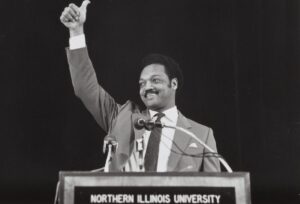
Opinion-shaping black elites’ embrace of underclass ideology during the 1980s and 1990s provided them a niche in the emerging neoliberal order in packaging punitive approaches to social policy as their special responsibility for racial rehabilitation and uplift, later recast as programmatic antiracism. It is also commonly overlooked that black political elites’ symbiotic allies in racial transition in urban politics in the 1960s and 1970s were mainly their redevelopment-oriented, proto-neoliberal white political elite counterparts.

Read More »

Race, Nationality and Art (1936)

As political reaction grows, every argument which supports the notion of fixed racial and national differences, acquires a new relevance. It provokes powerful divisions within the masses of the people, who are becoming more articulate and aggressive in their demands for a decent living and control over their own lives. The basic antagonism of worker toward capitalist, debtor toward creditor, is diverted into channels of racial antagonism, which weakens and confuses the masses, but leaves untouched the original relations of rich and poor.

Read More »

Breaking Beckmann’s Fall

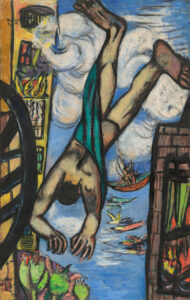
In both Max Beckmann’s Falling Man, painted in 1950 shortly before the artist’s death that same year, and throughout Carl Einstein’s early-twentieth century writings on art, the opposition between “ground” and “groundless” is complicated through a dialectical suspension of the two terms. Caught between falling and landing, Falling Man presents us with an image that neither plummets to earth nor hits the ground but floats between states. Much like Einstein’s reading of a sailor scaling the rigging in the sky of Hercules Seghers’ 1625 print Mountain Gorge by a Road, Beckmann’s not-quite falling man hovers midway between what Einstein calls the fixed ground of the “tectonic” and the unformed flux of the “liquid living movement” below. Beckmann and Einstein, it turns out, share common ground in the ungrounded abeyance that lies between falling and crashing down.

Read More »

Enigmatic Lines: Perspectives on Matisse

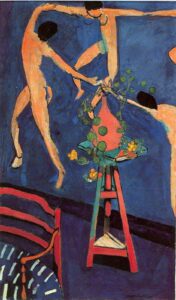
Just as external light is reflected on the surface of enamel until it becomes a blinding highlight, so too does the beholder’s retrospective view of the painting’s production. The insights into the painting process that pentimenti and other phenomena of reworking seem to provide are put to the test and prevented from entirely penetrating Matisse’s procedure. So, my argument is that the very insight we acquire from paintings like Nasturtiums (II) is an acknowledgment of the limits of interpretation. Such paintings help us to understand the challenges and the responsibility of interpreting art.

Read More »

Meyer Schapiro’s “Race, Nationality and Art”: An Introduction

Whether social or biological, the point of race, as Schapiro argues, is to provoke “powerful divisions within the masses of the people” at the moment when workers are beginning to organize around “demands for a decent living and control over their own lives.” For those “economically frustrated citizens” race provides capitalists with a tool to divert their “blind rage” away from them and towards “innocent and defenseless minorities.” If the central battle was between worker and capital, then the invented battle between “races” diverts the conflict “into channels of racial antagonism, which weakens and confuses the masses, but leaves untouched the original relations of rich and poor.”

Read More »

Helen Frankenthaler’s Paraphrase Paintings

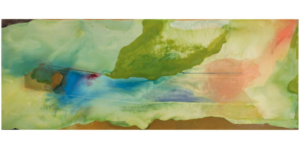
These borrowings raise the issue about what she marks as her own, and what she tells us comes from others. Beginning in a work like the 1951 Sightseers, in which she wrote her name—and continuing in abstract paintings with the self-inscription of the artist’s moving hand—the sense of her-painting-herself is echoed in some paraphrases of Old Master paintings, including her first, the 1956 Venus and the Mirror.

Read More »

From Rolling Mill to Drone Factory: The Sight of Work

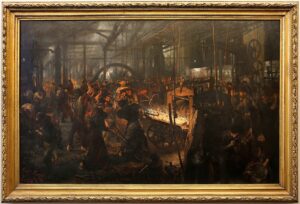
Between the VW by the water tower and the masked chicken processor, then, there seems to me a deep connection. The one prepares the ground for the other. Labor under capitalism can eventually proclaim its full visibility because labor is now so thoroughly elided and misrepresented, left behind as a lived conflicted reality—because it has been fully subsumed into the order of the commodity. Or such is the claim. I am with Castoriadis, needless to say, in believing the claim to be necessarily—or at least, empirically—false. We would all like to know what day-to-day detailed struggle of labor against capital goes on in the Deda Processing Plant.

Read More »