
“The museums are full of uprooted pictures,” Pierre Bonnard once said. The artist was anxious for his pictorial seedlings. They might be thrust out into galleries in which they would struggle for survival among alien life forms and in which the climate might prove too chill—above all, the light too bleak. In the light of the South of France, he said, everything is sharp and your painting shimmers. Take it to Paris and the blues turn to grey. And therefore, you can never paint violently enough. You must be violent with your colour; you must heighten the tones in order to counteract this problem of pictures dwindling away in their impact as they are transposed from one place to the other.
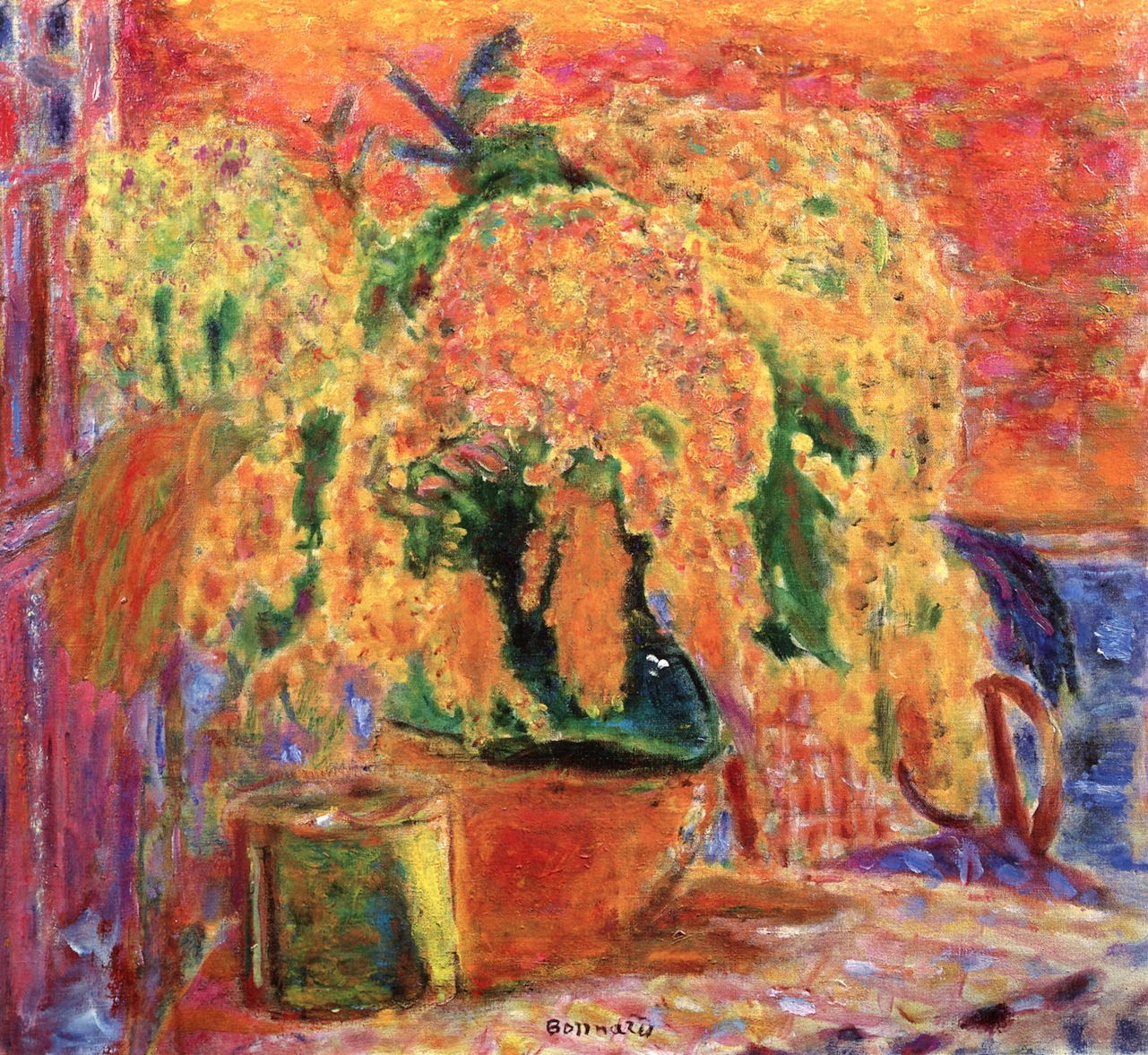
Discussing Bonnard in the lecture theatre or in print, this issue of uprooting remains. I want here to consider some aspects of the artist’s later work, in particular his interiors and still lives*: my point of departure will be the oil painting entitled Bouquet of Mimosas. The more or less two-foot-square object in question has an irregular surface that in places is thinly scuffed and stained, with the off-white of the canvas primer raw to the eye, and that in others is thick, ruckled, and bumpy, with blobby conglomerations of cadmium yellows and reds.
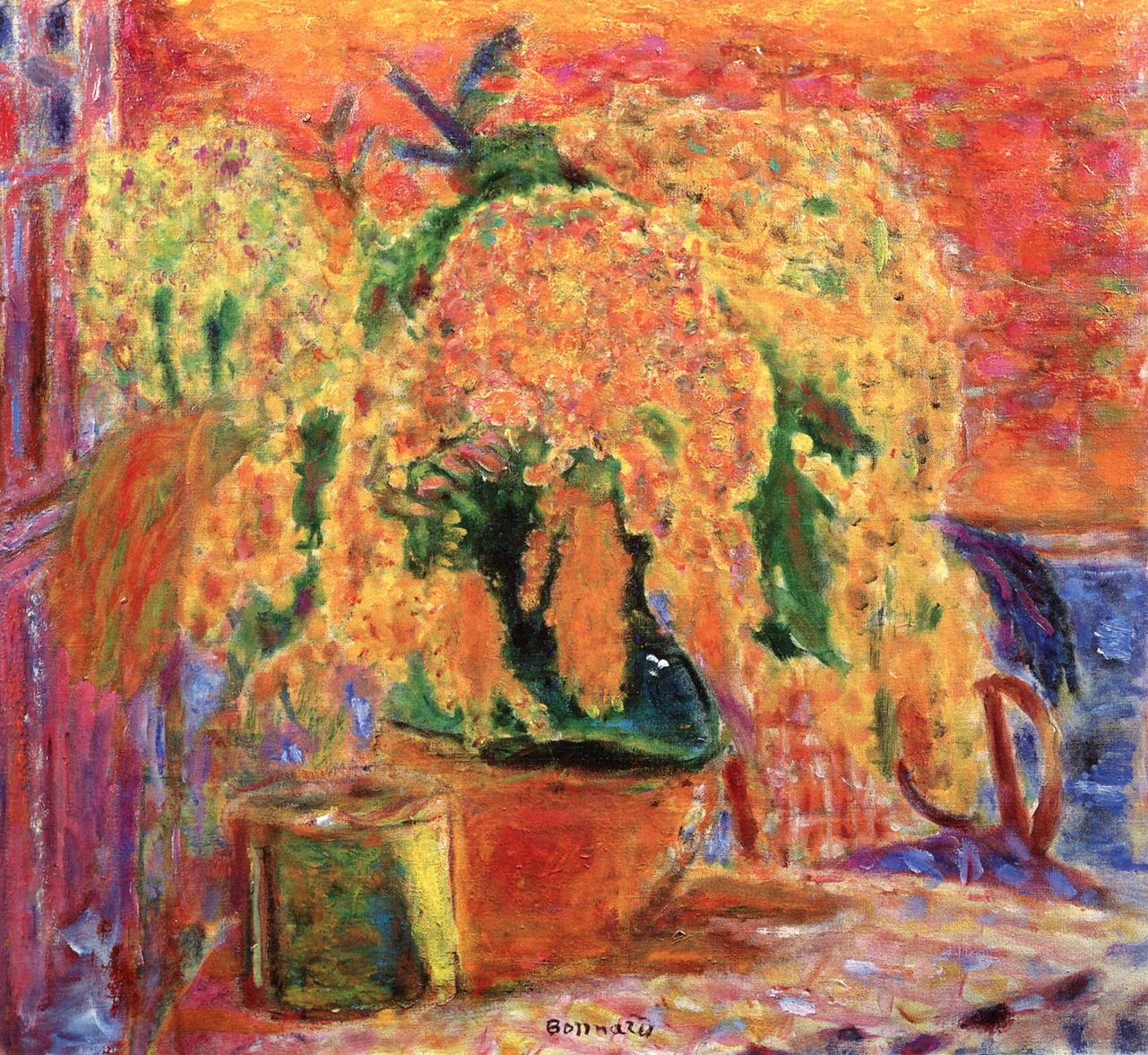
A violently produced object, indeed. The physical entity in question is radically dissimilar to the reproduction we are immediately looking at. That image has a sort of glamour that is alien to the awkward, hand-worked original of Bonnard: it beams at us as a self-assured, invulnerable fait accompli, and that makes it harder for us to conceive what it can have been like to be Bonnard and with what set of interests he could have worked to produce such an object. Which is the question I want to puzzle at, even if I cannot hope satisfactorily to resolve it.
Let us keep in mind the distinction between whatever we look at in this presentation and the objects that the artist himself produced. One of the reasons, it has often been noted, that Bonnard has had a lower profile in art history and in the collective memory than his friend Matisse—for all that the two artists evidently respected one another as equals—is that he is much less of an image maker. He creates extraordinarily absorbing objects to look at, and yet he fails—or is it that he declines?—to deliver resoundingly memorable, reproducible, poster-friendly designs. Even at their most majestic, his canvases are relatively elusive. And thus in most quickfire accounts of twentieth-century art history, Matisse ends up looking central and Bonnard peripheral.
I will suggest that this critical predicament is not exactly a mistake or an injustice done to Bonnard but rather a natural consequence of his whole artistic disposition. To advance that argument however—and to approach what went into that painting, the Bouquet of Mimosas—I need to perform further uprootings. My focus will move outward from this intricate and vehement object, painted some three years before Bonnard’s death in 1947, to consider its wider social and biographical context, before at last zooming back to the artist’s studio.
We are, then, presented with some sprays of mimosa stood in a jug on a table under electric light. In Bonnard paintings, we’re most often being shown things that Bonnard has seen in the solid actual world, arranged in roughly the configurations in which he happened to observe them. So it goes here. That Provençal half-glazed earthenware jug crops up in other pictures of Bonnard’s, while the mimosa sprays would have come from a tree in Bonnard’s garden that features in a majestic large canvas also painted during the artist’s seventies and now in the Pompidou in Paris. Bonnard would have seen what he painted in this canvas during the early months of 1944—those months being when mimosas bloom—and we can be confident about that dating because Henri Cartier-Bresson supplies it for a photo that he took of the artist seated in his dining room.
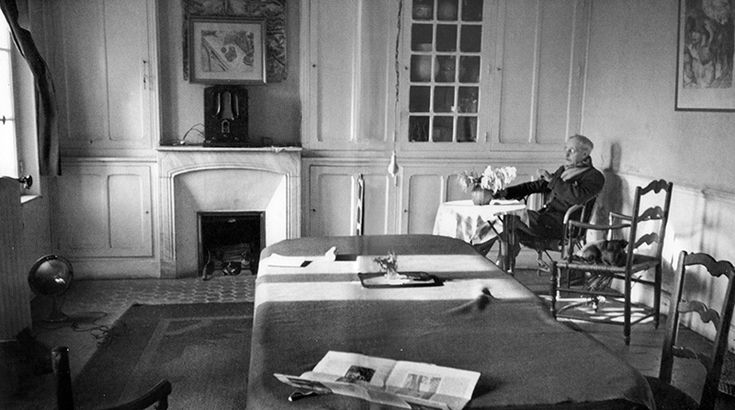
In this shot, what seem the self-same sprays are placed in the self-same jug, albeit in afternoon sunlight. For the purposes of the painting, the table on which the jug is perched must have stood to the left-hand side of this shot since on close examination of the canvas you can just make out the window, with the same window catch at the top left that the photo displays. To underline, then: there are all these anterior facts underpinning almost every mark in the canvas; and that is a characteristic referential hinge when it comes to Bonnard’s work. In this sense, his art is eminently “representational,” even if not in the way that a photograph is. For his part, Cartier-Bresson was training his camera on a seventy-six-year-old who had been alone for the past last two years—Marthe, his companion for most of the previous fifty, having died in January 1942—and perhaps we can read a hint of Bonnard’s widowerhood in the faintly dishevelled state of the room that the old man sits in.
That room lay on the ground floor of a two-storey house named the Villa du Bosquet, and this property’s small upstairs sitting room also provided frequent cues for Bonnard’s later still lives. The yet smaller bathroom next door generated a further wealth of pictorial material, one I shall not be attempting to focus on here. Moving around the house during the twenty-plus years that he lived there, Bonnard would scribble down, in a more or less private draughtsman’s shorthand, little apprehensions of the spaces he inhabited—configurations or visual events that had alerted his attention—with pencil on small slips of paper or else in his pocket diaries. If we want to come to terms with the canvases, however, we must appreciate that they were not worked directly in front of the scenes they represent. Paint would touch canvas in a separate space. In a separate time also, for Bonnard preferred not to use his oils while the visual event remained new and fresh in his mind. According to his housekeeper, he would never actually commit to paint flowers such as those mimosa sprays until after the blooms themselves had died.
Bonnard would remove himself, would pass through an alternative door on the first floor landing of his compact little mansion. And in doing so, would switch to a different plane of existence from the immediate, the transient, and the factual. Once he was facing the studio wall on which he liked to pin unstretched cuts of canvas, he was dealing with pictures—with tableaux. To quote a characteristic remark of his: “They’re always talking of surrendering to nature”—the “they” here being subscribers to the naturalist and impressionist doctrines common in the nineteenth century—“they’re all talking of surrendering to nature. There’s also surrendering to the picture.” The two realms, for Bonnard, were unalike. Outside that studio wall lay nature, the observable world—the common three-dimensional space through which all of us move. The tableau—the work of art, the object to which he devoted the best of his time, dabbing and smearing and scuffing at that firmly resistant granular two-dimensional surface with his oils—all that might relate to nature, but only at a certain oblique angle.
Rather than measure, for now, that angle—rather than attempt too precise a theorization of the still lives—let us quit the rooms that gave rise to them. What might “nature” consist of, once Bonnard stepped out the door of the Villa du Bosquet? A period map will help orient us.
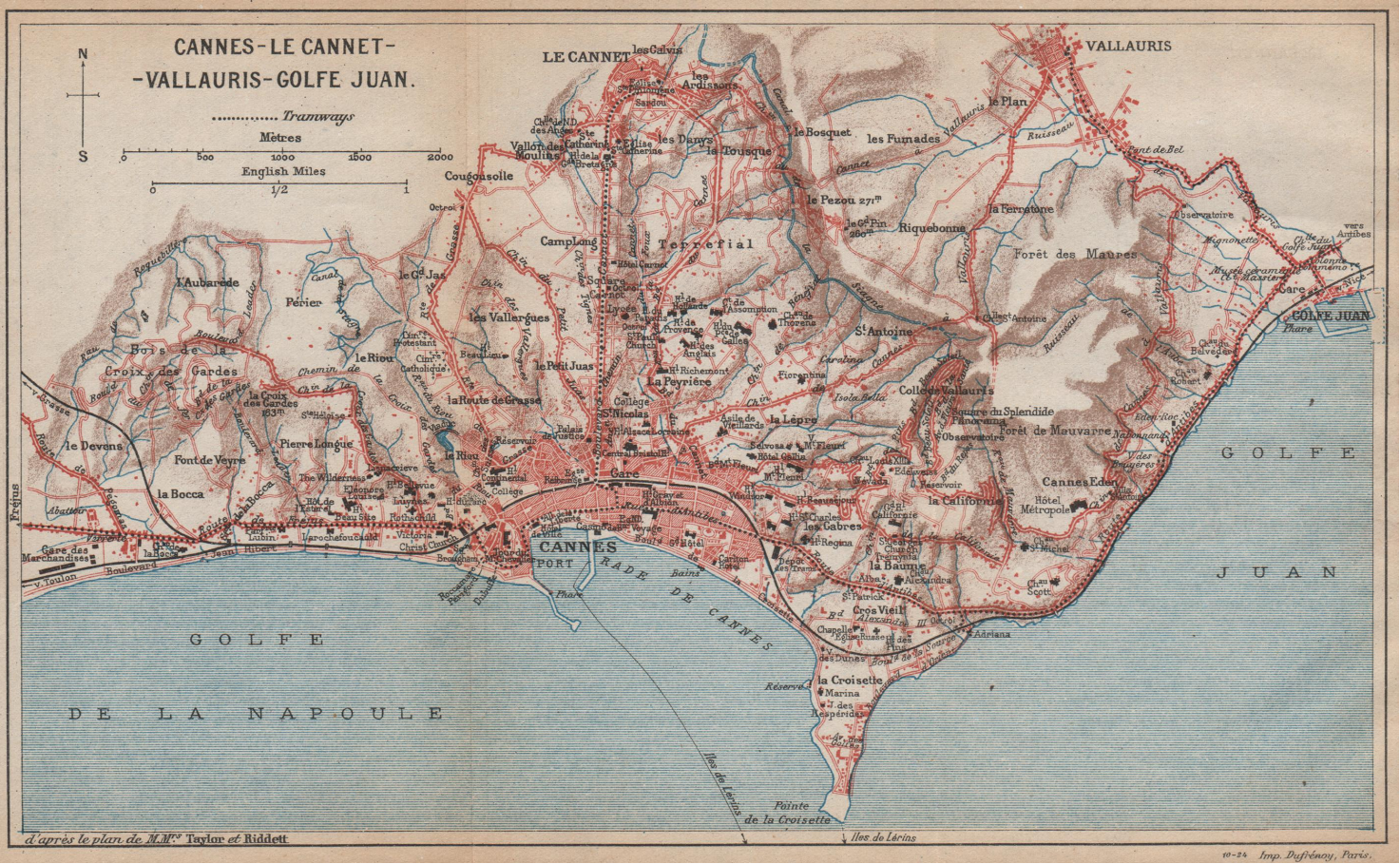
His house was located on the eastern flank of a natural amphitheatre that circles around Le Cannet—a onetime Provençal village on rising ground to the north of Cannes, of which it is nowadays effectively a suburb. As a dachshund owner, it was Bonnard’s daily habit to take his dog for a walk up the hill overlooking his house. The upward route would pass smallholdings tended by locals with whom this wiry, well-spoken old boy would exchange greetings, after which he would cross over the canal that supplied Cannes with water. If he turned and looked downhill, his gaze would drop from the Estoril mountains in the distance through lush palms, yuccas, olives, and eucalyptus down to the loud red roofs of other Le Cannet villas—increasingly punctuated, come the 1940s, by the white of modernist concrete apartment blocks. (Since Bonnard’s death in 1947, the concrete has, needless to say, gained a firmer grip.)
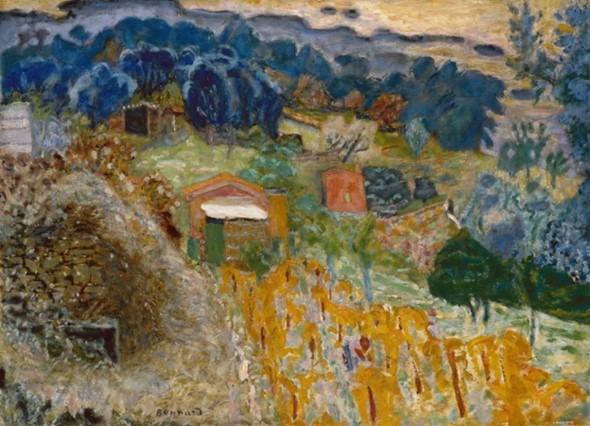
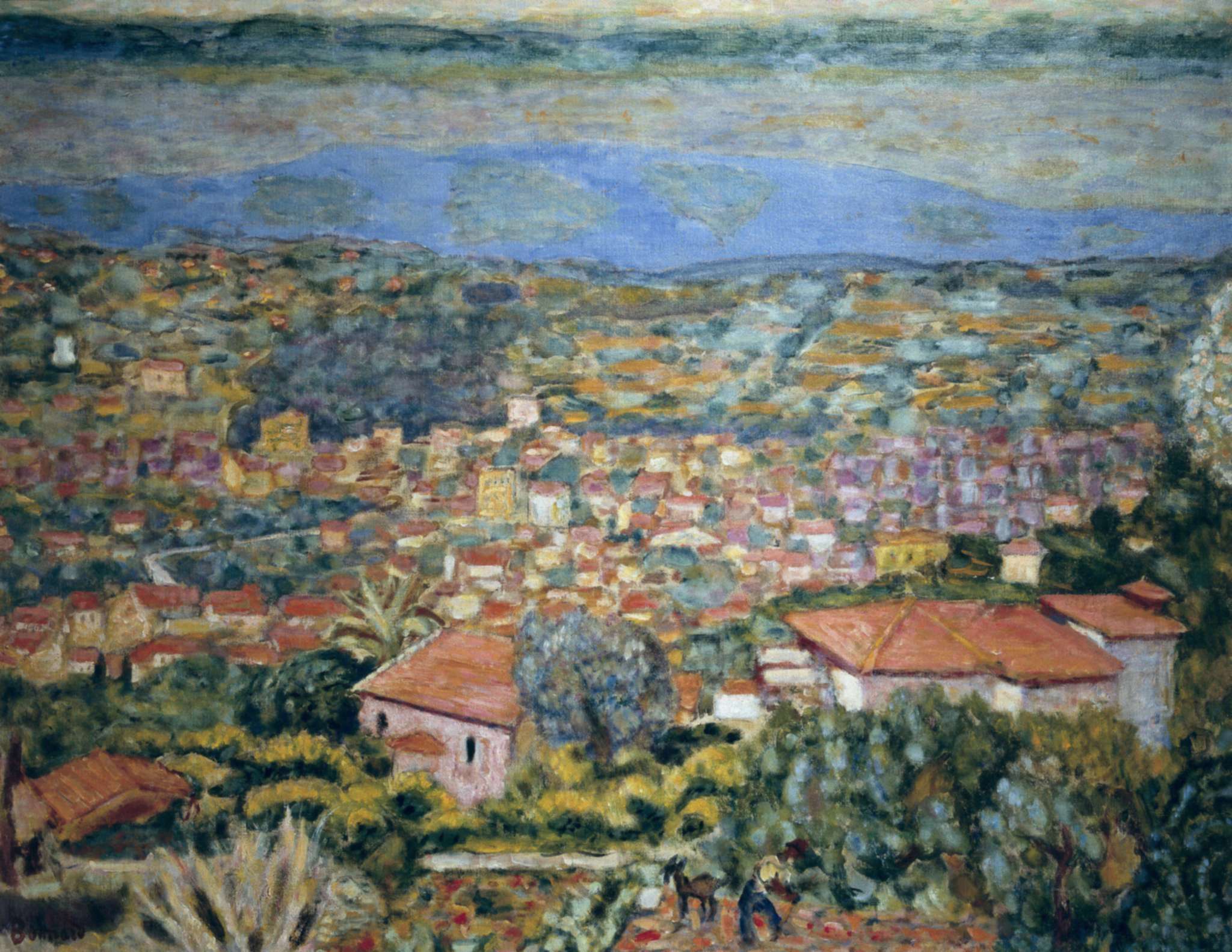
Now the sentimental allegiances with which Bonnard regarded these vistas are spelt out when he writes to his friend Matisse that he longs to see the land as the peasants up there in their smallholdings see it and when he complains to an interviewer in the late 1930s about too many people and too many ugly villa developments in the region. And yet the landscapes of his last twenty years engage not only with the romance of the Provençal pastoral but with its ongoing uglification. His heart may may be up in the hills with the guys tending those plots, but his feet are planted firmly on the developer tarmac in this view down Le Cannet’s Avenue Victoria.
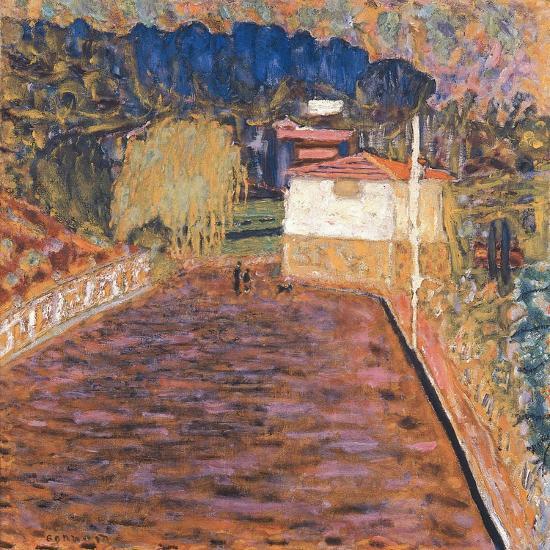
Bonnard is in fact one of the hundreds of thousands come down from the conurbations of northern France to seek a good life in the sun, and his ambivalent feelings are surely typical of those internal migrants. It happened that prior to their middle-aged flight south, the Parisian couple in question, Pierre and his partner Marthe, owned a country getaway in the Seine valley. The previous owner of this property had christened his place Ma Roulotte—and it pleased Bonnard to retain that name. “My caravan.” How piquant to insist that this bourgeois householder was at heart a roving bohemian! Just like the bourgeois householder who had lived there before him; just like, no doubt, those living all around him.
A comparable mindset sustained not only the municipality of Le Cannet but the whole hundred-mile strip of modern development on either side of it. The villas on the Avenue Victoria were part of a massive, burgeoning pleasure colony—a mocktopia, we might say—that had only taken off in the late 1880s as Bonnard turned twenty, the point in fact at which its salesman-spiel epithet “Côte d’Azur” was coined. It was at that point also that the landscape gardeners working on the new suburbs decided to jazz up the coastal hillsides of Provence—with all the cool blues of their indigenous pines and olives—by introducing the dazzling yellow of mimosa, imported from Australia, not to mention palms, eucalyptus, etc. Bonnard’s painting, I am saying, attends to an environment that has been created specifically to cater to homeowners’ dreams of “getting away from it all.” It latches onto that environment; it makes it its chosen home.
A perfectly standard destiny, one might say, for a scion of the professional classes, this relocation in middle age to a villa with all mod cons and a goodly sized garden. Bonnard, born in 1867, set out in life as the son of a head of department in the French Ministry of War, gaining the intellectual resources of a French classical education. Thus advantaged, this elliptical but shrewd young man, opting to make art, was able to leap to the forefront of the Parisian avant-garde only three or four years after he started committing himself to painting. He soon moreover began started to make a living from it, enabling him also to support his “Marthe”—that is to say, Maria Boursin, the woman of working-class origin who became his companion from 1893 onwards. Success came early: he established a certain social niche among patrons in the haut monde, bringing this female dependent along with him; financial struggles would never be a major issue.
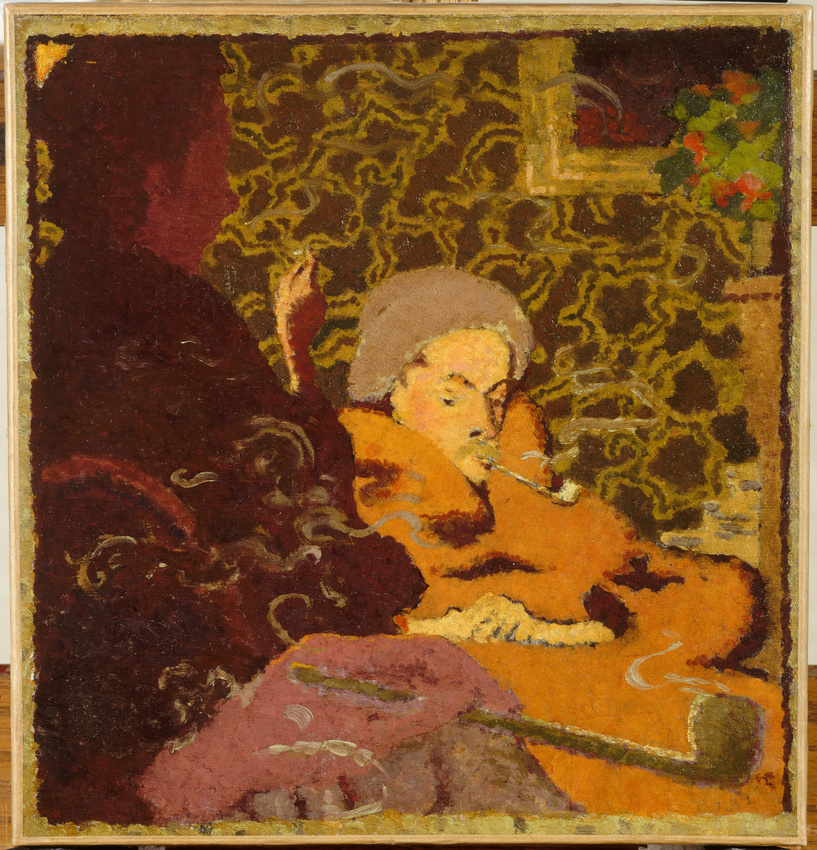
The debonair manners of the art that Bonnard began to put forward came with a conceptual weighting. In his essay, “A Desire for Dispossession: Portrait of the Artist as a Reader of Mallarmé,” Rémi Labrusse explores how Bonnard attuned himself to the nuances of that poet’s thinking. The questions at hand ran thus, insofar as we can simplify them. Are surface appearances—so atmospheric, so misty, so mazy, so puzzling as they may be—all we can ever know of the world? Will its essence forever elude us? Or alternately, is the appearance, the atmosphere itself, as it is apprehended and given form by the artist’s or the poet’s sensibility, none other than that essence itself? Speculations along these lines were aired by Mallarmé, who had picked up cues from the emerging Impressionist art of the 1870s. The young Bonnard who paints Intimité in 1891 responds to those speculations, weaving all phenomena, whether near or far, into a delicious and depthless delirium. At the same time, the image’s insistent play of patterns nods to a more recent agenda: that the art of a fresh era, of the century to come, should aestheticize whatever ambiences its urban audiences might occupy; that by way of decoration, poetic subtleties might converge with progressive aspirations, with the painter thus becoming society’s servant.
What if we fast-forward from those youthful desiderata to the completion of the career and ask how they relate to the words of eulogy that Charles Terrasse, a scholar of French art who was also Bonnard’s nephew, published soon after the painter’s death at the age of 79?
He has been called the enchanter, the magician, the painter of marvels. He wished to paint only happy things. One will find in his work neither sadness nor suffering, only the occasional trace of melancholy and then merely as an accompaniment to feminine grace.1
Now, Terrasse’s suavely phrased sentiments proved unhelpful to those who wished in subsequent decades to argue for the cogency of Bonnard’s art. “Happy things”—mere happy things!—were feeble credentials to apply for entry into the modernist canon, as that came to be critically defined. Somehow, an art adapted to twentieth-century priorities had to face down a new historical era that had turned out traumatic: in that light, appeals to “enchantment” and “grace” were not merely escapist but evasive. Contrast Terrasse’s characterization of Bonnard with the certificates of ferocious authenticity granted to Van Gogh, Cezanne, or Picasso—who, notoriously, was dismissive of his Parisian colleague—and combine it with this oeuvre’s already noted reluctance to submit to poster reproduction, and it is understandable that for much of the postwar period, Bonnard’s reputation was hobbled by a certain “image problem.”
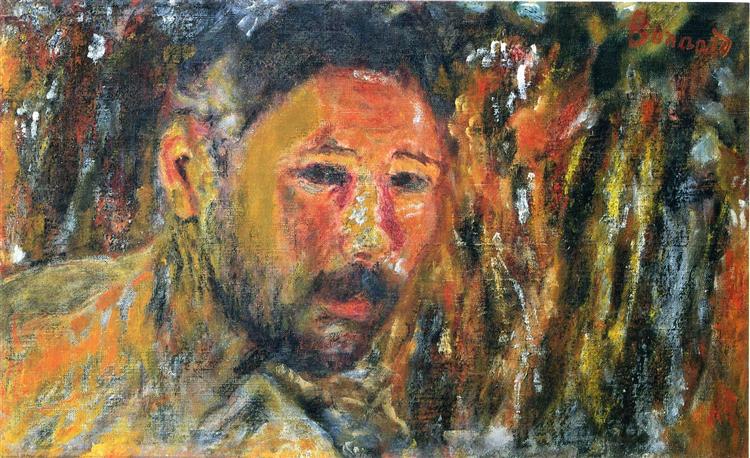
By reaction, those interpreters who wished to vindicate Bonnard argued that his art’s emotional range went beyond the confines indicated by Terrasse. Examining the aperçus committed to Bonnard’s diary, they found him remarking that “He who sings is not always happy.” Examining the works he chose never to exhibit, they noted this self-portrait from the mid-1920s in which, hunched ferally in some black and orange inferno, he looks less likely to sing than to howl: very plausibly, the iconography alludes to a midlife crisis, a juncture at which he was tempted to forsake Marthe for a younger woman.
Turning to some of the interiors Bonnard subsequently painted in the Villa du Bosquet (the house was acquired in 1926), Timothy Hyman went so far as to describe them in his 1998 book on the artist as “coded messages from prison.” Having settled for the known companion rather than the temptation, Bonnard found himself faced—as his letters to friends attest—with a depression into which Marthe in her later years sank, causing her to avoid social contact, and was thus pulled down into the same relative isolation, confined to their suburban coop, with the haut monde by this stage far distant. A reading along these lines emphasizes the autobiographical aspect of such a painting as the 1932 Porte-fenêtre—the insertion of the artist’s own reflection behind the foreground embroiderer, as an anomalous lurker in the domesticity. “This is the situation in which I find myself”: an assertion of that sort is undeniably there in the canvas’s mix. Or one might extrapolate further: “How strange, how remarkable, that this predicament should be mine!” And yet, how adequately have we spoken about the canvas and its many, many strangenesses, the extraordinary decisions it embodies, if we reduce it to quasi-confessional voiceovers such as these?
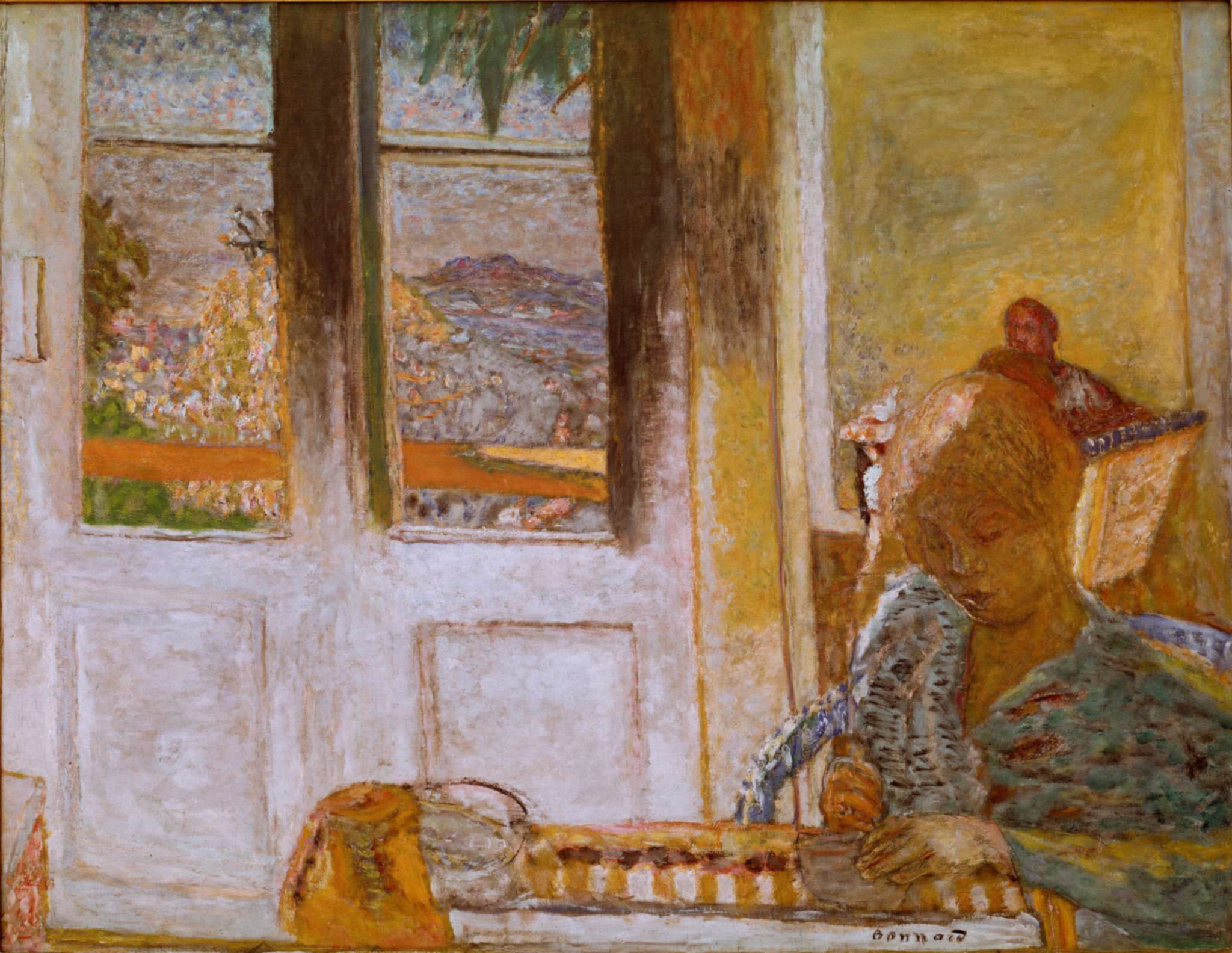
How then to get the balance right? What offering, happy or sad, what service to an audience, can we say that these paintings of Bonnard’s later life propose? To qualify Hyman’s provocative phrase, a painting can never simply be a “message”—as, indeed, Hyman’s own matchless close descriptions of this artist’s work make plain. Two-dimensional expanses of brushwork inevitably open themselves up to multiple readings-in, and we may quite as legitimately identify the interiors with Marthe as affirmations of her partner’s abiding affection for her, as scan them for signs of frustration or despair. And behind this, there is the consideration that the laying on of the paint itself—the “coding” of all the conceivable messages it might bear—is a form of skilled manual labour that the artist undertakes in hope, with a will to envisage, to explore, to see more fully. In that sense, Terrasse was onto something. To invert Bonnard’s apophthegm, he who is not happy may yet sing. Painting, as so many of us must know, is an activity fundamentally disposed towards pleasure for whoever participates in it—for all its incidental frustrations, for all its interminable difficulty. The dabbing and smearing and scuffing at that firm and granular surface were Bonnard’s palpable joy and are now by proxy our own, as his engaged viewers.
It all in a sense turns on that upper floor landing we were considering before. Go through one door, and you remain in nature: that is to say, in the solid shared world—with its interpersonal emotions, with its bills to pay, and who knows what else. Pass through an alternative door and you have migrated to Flatland, to the realm of the interesting rectangle asking to be charged with paint. The only reason you might forget to be happy in such a realm of rewarding and stimulating activity is if you were to confuse it with the world of nature: if you were trying to invest it with the status of photography; if you were striving after the forlorn objective of wholesale correspondence to the facts.
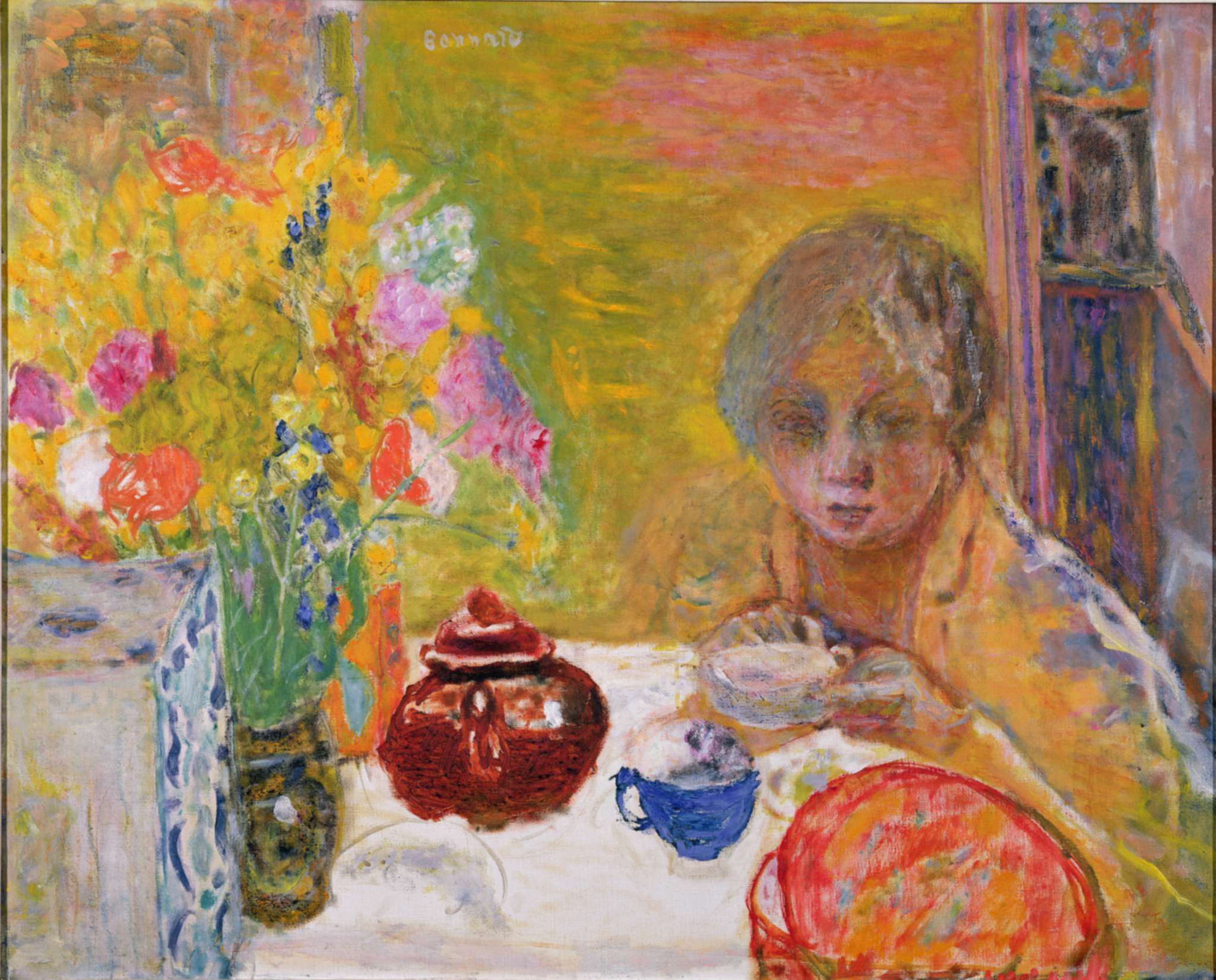
That, as we can discern from the fabric of markmaking reproduced in this image—we should see it yet more clearly if we stood before the canvas itself—is an impulse that Bonnard became distinctly intent to counter, even as he painted Marthe’s likeness very faithfully and tenderly, even as he introduced the surprise blurt of red that evidently represents her interlocutor (i.e., himself). He was concerned to knock her facial likeness back into the matrix of paint from which it had emerged. It bears a subordinate level of solidity to those of the vibrant teapot and cobalt blue cup, becoming a continuity with the wall behind. Bonnard’s preoccupation here has been how to transmute the data gained from his remembered apprehension of a private moment into a separate, self-contained object—a tableau.
It is in that attention devoted to the rectangle as a whole—to the internal dynamics of the tableau, to how its contents might harmonize logically or strike resonant discords—that Bonnard becomes heir to a French tradition that derives ultimately from Poussin. The authority of that tradition, its exportability, its worldwide impact, has lain in its concentration on pictorial means: on what one easel painting standing by itself is able to deliver. Poussin, the original pictor philosophus, painter-philosopher, facing the challenge of despatching his products from Rome to patrons in France, reasoned concertedly how to ensure their self-sufficiency. This is in effect the same challenge of transportation to northern light that Bonnard addressed with his remarks about painting “violently.”
Violently, but also with his intellect. Still life artists in the same great easel painting tradition—Chardin, Cezanne—had pondered what kinds of logic related appearances to objects. Chardin’s glazes and impastos and Cezanne’s so-called passages were in a sense structured answers to those enquiries. Bonnard, as an artist who remained a dedicated reader of Mallarmé, seems to have become sceptical that there was any structured answer at all. The more that he thinks, the more he aims to un-know. Appearances swing into view: that is a wonder and a miracle; don’t ask what underpins it. Or rather, find ways to re-stage the miraculousness, within the givens of the rectangle and your oils.
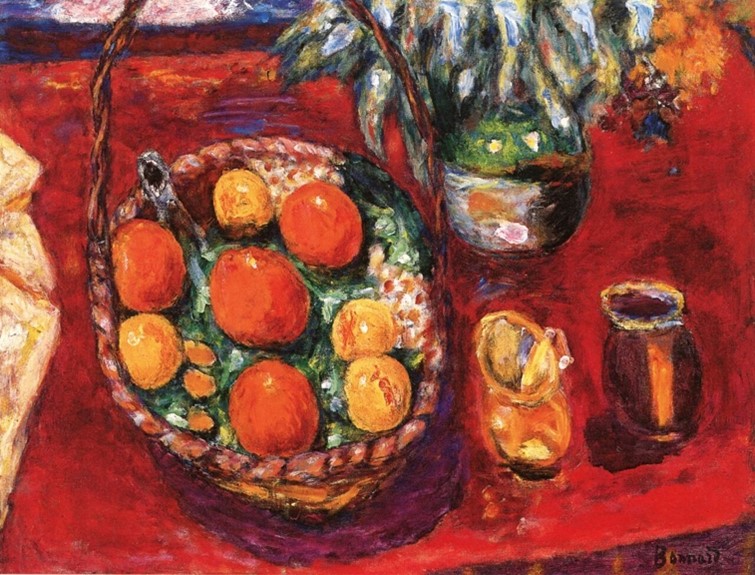
The later still lives, this is to say, seek for sheer surprise at the multiplicity of entities that appearance has to offer. In a sense, to work in this genre—to propose a still life—is customarily to consider not only that there are objects but that there are many of them—many stimuli—and that the mind is able to hold their multiplicity in suspense, overseeing it, scanning it. Move up to a larger, more incipiently narrative formula, the interior with figures, and the contents of a room become a kind of analogue for the mind’s contents and for its range: how it is able to reflect this way, with the woman sitting on the left, and then alternatively that way, with the figure he’s indicated on the right …
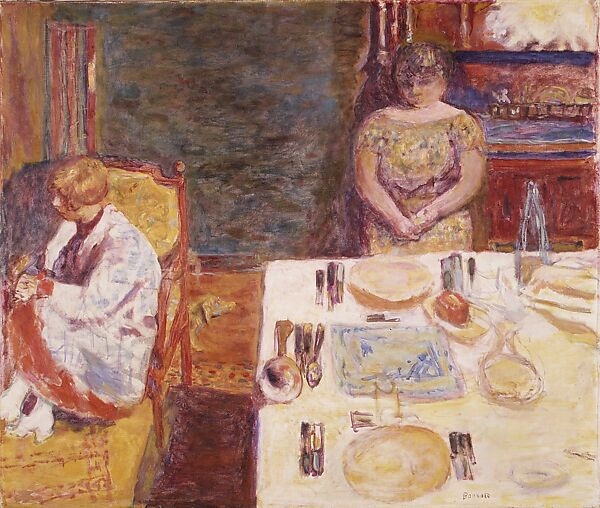
At the same time there is also, between those two figures, a great deal of not-very-much. Can an easel painting be exactly coextensive with an object or a stimulus? Not often. The portrayed item is placed inside a rectangle. A painting such as Cherries dramatizes this condition. It explores whether one can create a formally satisfying balance by conjoining a very palpable focus of attention to a near-unyielding blur: by yoking the likeness of something to the likeness of nothing. The canvas shows a remarkable, yet for Bonnard not untypical, disparity between its two main passages of paintwork. On the one hand, the hot and sensualized speed with which he goes at those exciting cherries—and then, the protracted, infinitely checked, questioned-and-then-restated fretting at the maybe-patterned-carpet above them.
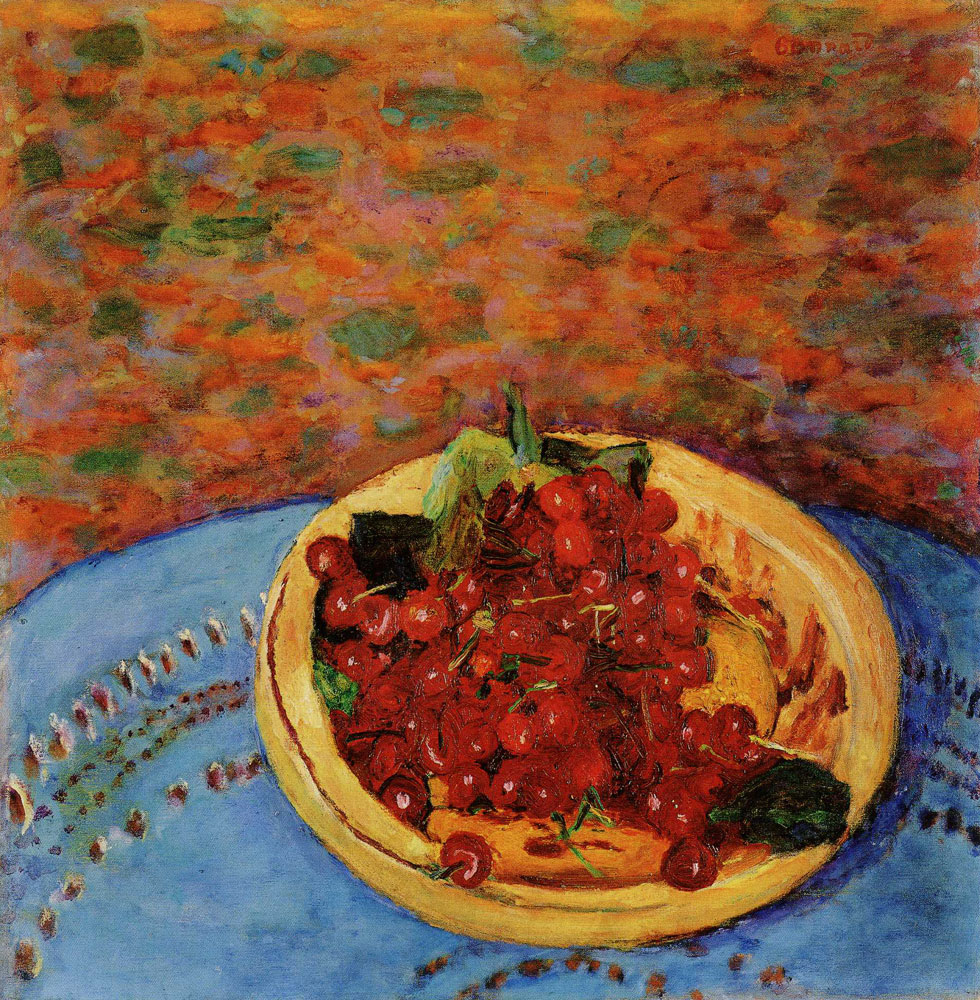
This handling of the cherries leads us into what increasingly becomes the heart of the matter, as Bonnard works on into his old age—the issue of colour. It is notable that in this later work there is rarely sheer darkness, just as there are few cues for recession into distance: there are chiefly different colours, coexisting on a surface. In this sense, some of the values of Impressionism, the predecessor movement to which Bonnard had turned his attention during his thirties, have been absorbed. The Impressionist palette is non-hierarchical—all the hues of the spectrum are brought into the optical dance of a Monet or a Renoir. Yet I feel that this is not exactly the case for Bonnard. I should like to suggest—albeit tentatively and schematically—where the polarities of his colour vision lie, and what symbolic weights they might carry.
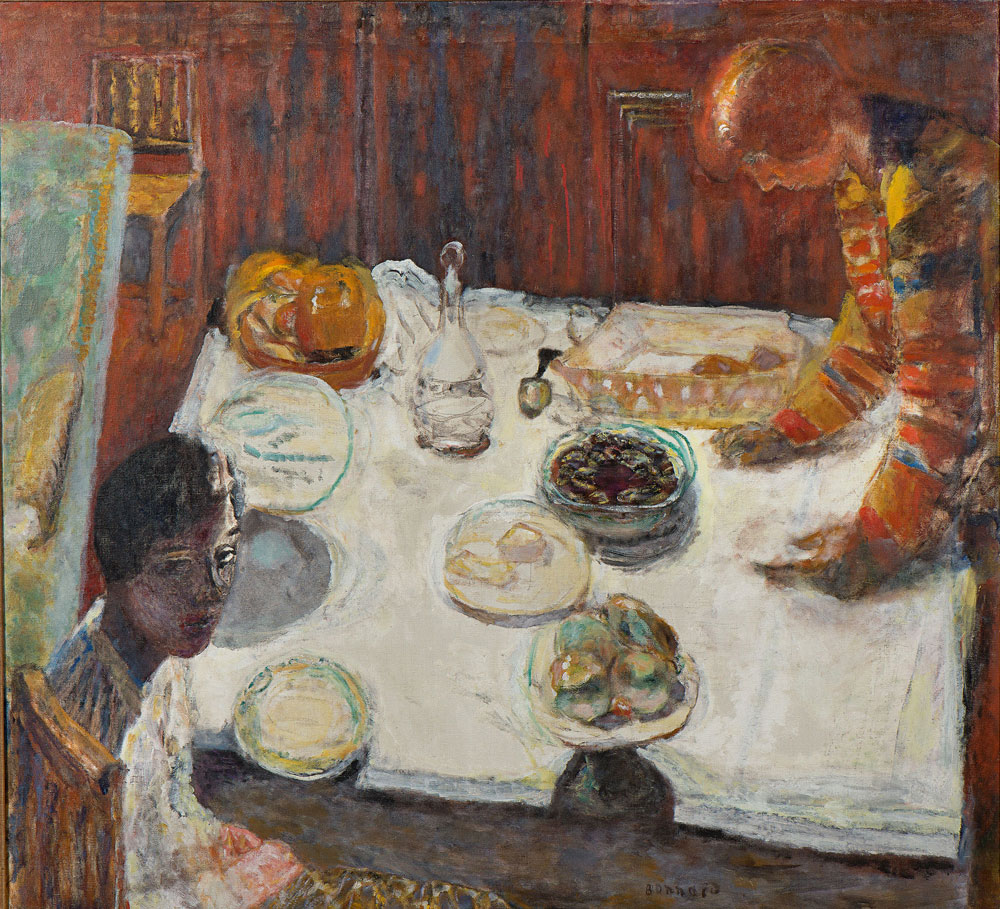
The dominant opposition is effectively a clash of metals. Iron against lead. To one side of Bonnard’s palette, we have the primary, instinctual, somatic herenesses: the ferrous oxides, the ochres, siennas, Mars and Indian reds. Beyond them, a yearning for added stimulus has him reaching for “violent” cadmium reds—for instance, in those cherries. While working with such hues, the painter is of a piece with what he paints: it flows with his blood. Swing the dial the other way, and you hit Cremnitz and flake whites, lead carbonate products. White, as Bonnard lays it down, is what does not pulse. It has to do with artifice and the snowfall-like effacement of nature and of immediate sensation. This cold brilliance, this anaesthetic absolute, corresponds to the intrinsic strangeness of Flatland, of the pictorial universe to which he commits himself in his work. Dita Amory has noted how Bonnard’s linen tablecloths can become analogues for the very pictures they sit within—these othernesses, arisen out of his own warm-blooded experience.2
Quite often, the rectangle’s contents descend from red towards white. Bonnard is fond of compositions that dangle, setting all the weight, all the immediacy, at the top: it’s one of the ways he likes to play with the given format. In the extremist White Interior of 1932, he explores how far a picture can be made over to the vacuity. The composition scrunches together a panoramic breadth of visual field around the inorganic, gloss-paint nothing-much-ness of opened doors, panelling, and radiator bars, their blanched expanses pitching more tactile and affection-laden constituents of his daily life into eerie occlusion.
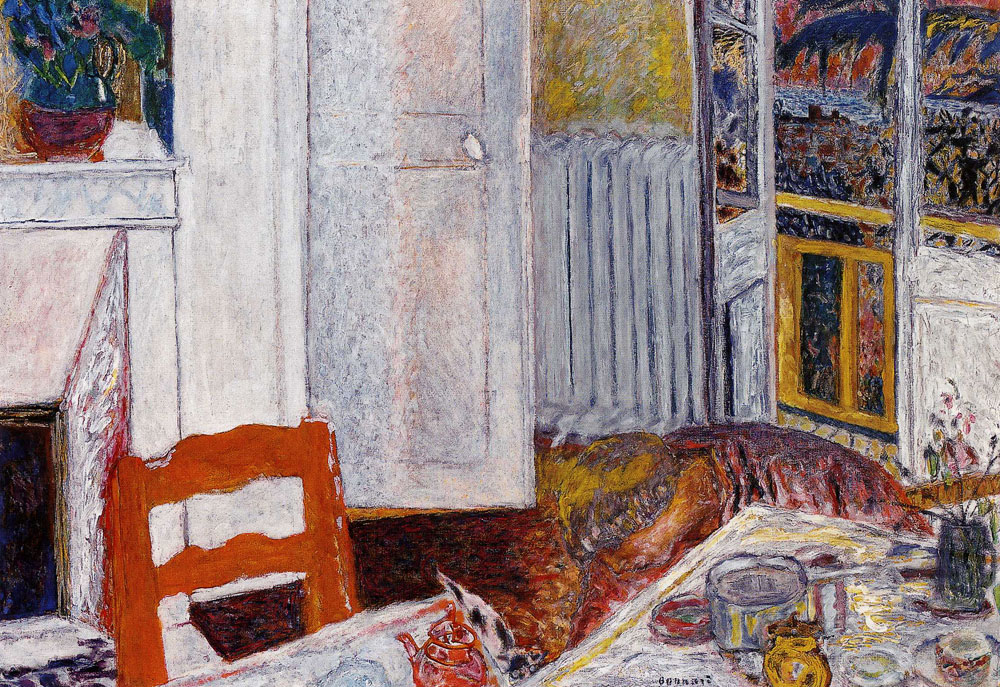
This plunge into “the feel of not to feel it” (the phrase is Keats’s) is the sixty-five-year-old at his gravest, for all the domesticity of its imagery: a dark white indeed. In subsequent years, Bonnard sought out a kind of redemptive alternative by laying a new emphasis on his yellows. The instinct with which a child uses its coloured pencils for the sun told him that the surest analogue for radiance was to be found elsewhere than in white. And standing for light itself, the golden pigments could carry all the metaphysical resonances that attach to that physical phenomenon. “Our God is light” was Bonnard’s reported comment, late in life, to a junior painter.3
And so it is that we return to the yellows of a confected, imported, exotic landscape-gardener’s dream of a flower, sitting in a tourist-trophy Provençal jug under the electric light of a dainty retirement villa, in the midst of a leisure-park mock-paradise. An image which, we may sense, crackles with a shattering power, even when it is uprooted for the sake of this presentation. Bonnard’s place in twentieth-century modernity becomes electively peripheral. He sets his single pair of eyes on a few familiar domestic objects, far away from the forefront of events. Yet he trusts that thereby he will deliver sustenance to the public at large, honouring his initial intentions. For through a hard-thought process of transmuting sensation, he’s retraced all those sidelong journeys by which he slipped away from the grey cloudy north to the vibrant Côte d’Azur, from the connubial interchanges of the living room to the solitary singing in the studio. Speaking up for late Bonnard, I pay my respects to the downtown of twentieth-century painting: we each have our nominations for who should occupy that zone. Yet I appeal to the suburbanite that each of us either is or has it in us to be. I ask us all to value and embrace that escapist, that private shuffler across the landing. Accept, if you will, this artist as the pictorial philosopher of our internal migrations.
Notes
*The present text is a revised version of a lecture originally given at the Metropolitan Museum, New York, on February 8, 2009. This was at a conference accompanying the exhibition, Pierre Bonnard: The Late Still Lives and Interiors, curated by Dita Amory.

“The museums are full of uprooted pictures,” Pierre Bonnard once said. The artist was anxious for his pictorial seedlings. They might be thrust out into galleries in which they would struggle for survival among alien life forms and in which the climate might prove too chill—above all, the light too bleak. In the light of the South of France, he said, everything is sharp and your painting shimmers. Take it to Paris and the blues turn to grey. And therefore, you can never paint violently enough. You must be violent with your colour; you must heighten the tones in order to counteract this problem of pictures dwindling away in their impact as they are transposed from one place to the other.
Discussing Bonnard in the lecture theatre or in print, this issue of uprooting remains. I want here to consider some aspects of the artist’s later work, in particular his interiors and still lives*: my point of departure will be the oil painting entitled Bouquet of Mimosas. The more or less two-foot-square object in question has an irregular surface that in places is thinly scuffed and stained, with the off-white of the canvas primer raw to the eye, and that in others is thick, ruckled, and bumpy, with blobby conglomerations of cadmium yellows and reds.
A violently produced object, indeed. The physical entity in question is radically dissimilar to the reproduction we are immediately looking at. That image has a sort of glamour that is alien to the awkward, hand-worked original of Bonnard: it beams at us as a self-assured, invulnerable fait accompli, and that makes it harder for us to conceive what it can have been like to be Bonnard and with what set of interests he could have worked to produce such an object. Which is the question I want to puzzle at, even if I cannot hope satisfactorily to resolve it.
Let us keep in mind the distinction between whatever we look at in this presentation and the objects that the artist himself produced. One of the reasons, it has often been noted, that Bonnard has had a lower profile in art history and in the collective memory than his friend Matisse—for all that the two artists evidently respected one another as equals—is that he is much less of an image maker. He creates extraordinarily absorbing objects to look at, and yet he fails—or is it that he declines?—to deliver resoundingly memorable, reproducible, poster-friendly designs. Even at their most majestic, his canvases are relatively elusive. And thus in most quickfire accounts of twentieth-century art history, Matisse ends up looking central and Bonnard peripheral.
I will suggest that this critical predicament is not exactly a mistake or an injustice done to Bonnard but rather a natural consequence of his whole artistic disposition. To advance that argument however—and to approach what went into that painting, the Bouquet of Mimosas—I need to perform further uprootings. My focus will move outward from this intricate and vehement object, painted some three years before Bonnard’s death in 1947, to consider its wider social and biographical context, before at last zooming back to the artist’s studio.
We are, then, presented with some sprays of mimosa stood in a jug on a table under electric light. In Bonnard paintings, we’re most often being shown things that Bonnard has seen in the solid actual world, arranged in roughly the configurations in which he happened to observe them. So it goes here. That Provençal half-glazed earthenware jug crops up in other pictures of Bonnard’s, while the mimosa sprays would have come from a tree in Bonnard’s garden that features in a majestic large canvas also painted during the artist’s seventies and now in the Pompidou in Paris. Bonnard would have seen what he painted in this canvas during the early months of 1944—those months being when mimosas bloom—and we can be confident about that dating because Henri Cartier-Bresson supplies it for a photo that he took of the artist seated in his dining room.
In this shot, what seem the self-same sprays are placed in the self-same jug, albeit in afternoon sunlight. For the purposes of the painting, the table on which the jug is perched must have stood to the left-hand side of this shot since on close examination of the canvas you can just make out the window, with the same window catch at the top left that the photo displays. To underline, then: there are all these anterior facts underpinning almost every mark in the canvas; and that is a characteristic referential hinge when it comes to Bonnard’s work. In this sense, his art is eminently “representational,” even if not in the way that a photograph is. For his part, Cartier-Bresson was training his camera on a seventy-six-year-old who had been alone for the past last two years—Marthe, his companion for most of the previous fifty, having died in January 1942—and perhaps we can read a hint of Bonnard’s widowerhood in the faintly dishevelled state of the room that the old man sits in.
That room lay on the ground floor of a two-storey house named the Villa du Bosquet, and this property’s small upstairs sitting room also provided frequent cues for Bonnard’s later still lives. The yet smaller bathroom next door generated a further wealth of pictorial material, one I shall not be attempting to focus on here. Moving around the house during the twenty-plus years that he lived there, Bonnard would scribble down, in a more or less private draughtsman’s shorthand, little apprehensions of the spaces he inhabited—configurations or visual events that had alerted his attention—with pencil on small slips of paper or else in his pocket diaries. If we want to come to terms with the canvases, however, we must appreciate that they were not worked directly in front of the scenes they represent. Paint would touch canvas in a separate space. In a separate time also, for Bonnard preferred not to use his oils while the visual event remained new and fresh in his mind. According to his housekeeper, he would never actually commit to paint flowers such as those mimosa sprays until after the blooms themselves had died.
Bonnard would remove himself, would pass through an alternative door on the first floor landing of his compact little mansion. And in doing so, would switch to a different plane of existence from the immediate, the transient, and the factual. Once he was facing the studio wall on which he liked to pin unstretched cuts of canvas, he was dealing with pictures—with tableaux. To quote a characteristic remark of his: “They’re always talking of surrendering to nature”—the “they” here being subscribers to the naturalist and impressionist doctrines common in the nineteenth century—“they’re all talking of surrendering to nature. There’s also surrendering to the picture.” The two realms, for Bonnard, were unalike. Outside that studio wall lay nature, the observable world—the common three-dimensional space through which all of us move. The tableau—the work of art, the object to which he devoted the best of his time, dabbing and smearing and scuffing at that firmly resistant granular two-dimensional surface with his oils—all that might relate to nature, but only at a certain oblique angle.
Rather than measure, for now, that angle—rather than attempt too precise a theorization of the still lives—let us quit the rooms that gave rise to them. What might “nature” consist of, once Bonnard stepped out the door of the Villa du Bosquet? A period map will help orient us.
His house was located on the eastern flank of a natural amphitheatre that circles around Le Cannet—a onetime Provençal village on rising ground to the north of Cannes, of which it is nowadays effectively a suburb. As a dachshund owner, it was Bonnard’s daily habit to take his dog for a walk up the hill overlooking his house. The upward route would pass smallholdings tended by locals with whom this wiry, well-spoken old boy would exchange greetings, after which he would cross over the canal that supplied Cannes with water. If he turned and looked downhill, his gaze would drop from the Estoril mountains in the distance through lush palms, yuccas, olives, and eucalyptus down to the loud red roofs of other Le Cannet villas—increasingly punctuated, come the 1940s, by the white of modernist concrete apartment blocks. (Since Bonnard’s death in 1947, the concrete has, needless to say, gained a firmer grip.)
Now the sentimental allegiances with which Bonnard regarded these vistas are spelt out when he writes to his friend Matisse that he longs to see the land as the peasants up there in their smallholdings see it and when he complains to an interviewer in the late 1930s about too many people and too many ugly villa developments in the region. And yet the landscapes of his last twenty years engage not only with the romance of the Provençal pastoral but with its ongoing uglification. His heart may may be up in the hills with the guys tending those plots, but his feet are planted firmly on the developer tarmac in this view down Le Cannet’s Avenue Victoria.
Bonnard is in fact one of the hundreds of thousands come down from the conurbations of northern France to seek a good life in the sun, and his ambivalent feelings are surely typical of those internal migrants. It happened that prior to their middle-aged flight south, the Parisian couple in question, Pierre and his partner Marthe, owned a country getaway in the Seine valley. The previous owner of this property had christened his place Ma Roulotte—and it pleased Bonnard to retain that name. “My caravan.” How piquant to insist that this bourgeois householder was at heart a roving bohemian! Just like the bourgeois householder who had lived there before him; just like, no doubt, those living all around him.
A comparable mindset sustained not only the municipality of Le Cannet but the whole hundred-mile strip of modern development on either side of it. The villas on the Avenue Victoria were part of a massive, burgeoning pleasure colony—a mocktopia, we might say—that had only taken off in the late 1880s as Bonnard turned twenty, the point in fact at which its salesman-spiel epithet “Côte d’Azur” was coined. It was at that point also that the landscape gardeners working on the new suburbs decided to jazz up the coastal hillsides of Provence—with all the cool blues of their indigenous pines and olives—by introducing the dazzling yellow of mimosa, imported from Australia, not to mention palms, eucalyptus, etc. Bonnard’s painting, I am saying, attends to an environment that has been created specifically to cater to homeowners’ dreams of “getting away from it all.” It latches onto that environment; it makes it its chosen home.
A perfectly standard destiny, one might say, for a scion of the professional classes, this relocation in middle age to a villa with all mod cons and a goodly sized garden. Bonnard, born in 1867, set out in life as the son of a head of department in the French Ministry of War, gaining the intellectual resources of a French classical education. Thus advantaged, this elliptical but shrewd young man, opting to make art, was able to leap to the forefront of the Parisian avant-garde only three or four years after he started committing himself to painting. He soon moreover began started to make a living from it, enabling him also to support his “Marthe”—that is to say, Maria Boursin, the woman of working-class origin who became his companion from 1893 onwards. Success came early: he established a certain social niche among patrons in the haut monde, bringing this female dependent along with him; financial struggles would never be a major issue.
The debonair manners of the art that Bonnard began to put forward came with a conceptual weighting. In his essay, “A Desire for Dispossession: Portrait of the Artist as a Reader of Mallarmé,” Rémi Labrusse explores how Bonnard attuned himself to the nuances of that poet’s thinking. The questions at hand ran thus, insofar as we can simplify them. Are surface appearances—so atmospheric, so misty, so mazy, so puzzling as they may be—all we can ever know of the world? Will its essence forever elude us? Or alternately, is the appearance, the atmosphere itself, as it is apprehended and given form by the artist’s or the poet’s sensibility, none other than that essence itself? Speculations along these lines were aired by Mallarmé, who had picked up cues from the emerging Impressionist art of the 1870s. The young Bonnard who paints Intimité in 1891 responds to those speculations, weaving all phenomena, whether near or far, into a delicious and depthless delirium. At the same time, the image’s insistent play of patterns nods to a more recent agenda: that the art of a fresh era, of the century to come, should aestheticize whatever ambiences its urban audiences might occupy; that by way of decoration, poetic subtleties might converge with progressive aspirations, with the painter thus becoming society’s servant.
What if we fast-forward from those youthful desiderata to the completion of the career and ask how they relate to the words of eulogy that Charles Terrasse, a scholar of French art who was also Bonnard’s nephew, published soon after the painter’s death at the age of 79?
He has been called the enchanter, the magician, the painter of marvels. He wished to paint only happy things. One will find in his work neither sadness nor suffering, only the occasional trace of melancholy and then merely as an accompaniment to feminine grace.1
Now, Terrasse’s suavely phrased sentiments proved unhelpful to those who wished in subsequent decades to argue for the cogency of Bonnard’s art. “Happy things”—mere happy things!—were feeble credentials to apply for entry into the modernist canon, as that came to be critically defined. Somehow, an art adapted to twentieth-century priorities had to face down a new historical era that had turned out traumatic: in that light, appeals to “enchantment” and “grace” were not merely escapist but evasive. Contrast Terrasse’s characterization of Bonnard with the certificates of ferocious authenticity granted to Van Gogh, Cezanne, or Picasso—who, notoriously, was dismissive of his Parisian colleague—and combine it with this oeuvre’s already noted reluctance to submit to poster reproduction, and it is understandable that for much of the postwar period, Bonnard’s reputation was hobbled by a certain “image problem.”
By reaction, those interpreters who wished to vindicate Bonnard argued that his art’s emotional range went beyond the confines indicated by Terrasse. Examining the aperçus committed to Bonnard’s diary, they found him remarking that “He who sings is not always happy.” Examining the works he chose never to exhibit, they noted this self-portrait from the mid-1920s in which, hunched ferally in some black and orange inferno, he looks less likely to sing than to howl: very plausibly, the iconography alludes to a midlife crisis, a juncture at which he was tempted to forsake Marthe for a younger woman.
Turning to some of the interiors Bonnard subsequently painted in the Villa du Bosquet (the house was acquired in 1926), Timothy Hyman went so far as to describe them in his 1998 book on the artist as “coded messages from prison.” Having settled for the known companion rather than the temptation, Bonnard found himself faced—as his letters to friends attest—with a depression into which Marthe in her later years sank, causing her to avoid social contact, and was thus pulled down into the same relative isolation, confined to their suburban coop, with the haut monde by this stage far distant. A reading along these lines emphasizes the autobiographical aspect of such a painting as the 1932 Porte-fenêtre—the insertion of the artist’s own reflection behind the foreground embroiderer, as an anomalous lurker in the domesticity. “This is the situation in which I find myself”: an assertion of that sort is undeniably there in the canvas’s mix. Or one might extrapolate further: “How strange, how remarkable, that this predicament should be mine!” And yet, how adequately have we spoken about the canvas and its many, many strangenesses, the extraordinary decisions it embodies, if we reduce it to quasi-confessional voiceovers such as these?
How then to get the balance right? What offering, happy or sad, what service to an audience, can we say that these paintings of Bonnard’s later life propose? To qualify Hyman’s provocative phrase, a painting can never simply be a “message”—as, indeed, Hyman’s own matchless close descriptions of this artist’s work make plain. Two-dimensional expanses of brushwork inevitably open themselves up to multiple readings-in, and we may quite as legitimately identify the interiors with Marthe as affirmations of her partner’s abiding affection for her, as scan them for signs of frustration or despair. And behind this, there is the consideration that the laying on of the paint itself—the “coding” of all the conceivable messages it might bear—is a form of skilled manual labour that the artist undertakes in hope, with a will to envisage, to explore, to see more fully. In that sense, Terrasse was onto something. To invert Bonnard’s apophthegm, he who is not happy may yet sing. Painting, as so many of us must know, is an activity fundamentally disposed towards pleasure for whoever participates in it—for all its incidental frustrations, for all its interminable difficulty. The dabbing and smearing and scuffing at that firm and granular surface were Bonnard’s palpable joy and are now by proxy our own, as his engaged viewers.
It all in a sense turns on that upper floor landing we were considering before. Go through one door, and you remain in nature: that is to say, in the solid shared world—with its interpersonal emotions, with its bills to pay, and who knows what else. Pass through an alternative door and you have migrated to Flatland, to the realm of the interesting rectangle asking to be charged with paint. The only reason you might forget to be happy in such a realm of rewarding and stimulating activity is if you were to confuse it with the world of nature: if you were trying to invest it with the status of photography; if you were striving after the forlorn objective of wholesale correspondence to the facts.
That, as we can discern from the fabric of markmaking reproduced in this image—we should see it yet more clearly if we stood before the canvas itself—is an impulse that Bonnard became distinctly intent to counter, even as he painted Marthe’s likeness very faithfully and tenderly, even as he introduced the surprise blurt of red that evidently represents her interlocutor (i.e., himself). He was concerned to knock her facial likeness back into the matrix of paint from which it had emerged. It bears a subordinate level of solidity to those of the vibrant teapot and cobalt blue cup, becoming a continuity with the wall behind. Bonnard’s preoccupation here has been how to transmute the data gained from his remembered apprehension of a private moment into a separate, self-contained object—a tableau.
It is in that attention devoted to the rectangle as a whole—to the internal dynamics of the tableau, to how its contents might harmonize logically or strike resonant discords—that Bonnard becomes heir to a French tradition that derives ultimately from Poussin. The authority of that tradition, its exportability, its worldwide impact, has lain in its concentration on pictorial means: on what one easel painting standing by itself is able to deliver. Poussin, the original pictor philosophus, painter-philosopher, facing the challenge of despatching his products from Rome to patrons in France, reasoned concertedly how to ensure their self-sufficiency. This is in effect the same challenge of transportation to northern light that Bonnard addressed with his remarks about painting “violently.”
Violently, but also with his intellect. Still life artists in the same great easel painting tradition—Chardin, Cezanne—had pondered what kinds of logic related appearances to objects. Chardin’s glazes and impastos and Cezanne’s so-called passages were in a sense structured answers to those enquiries. Bonnard, as an artist who remained a dedicated reader of Mallarmé, seems to have become sceptical that there was any structured answer at all. The more that he thinks, the more he aims to un-know. Appearances swing into view: that is a wonder and a miracle; don’t ask what underpins it. Or rather, find ways to re-stage the miraculousness, within the givens of the rectangle and your oils.
The later still lives, this is to say, seek for sheer surprise at the multiplicity of entities that appearance has to offer. In a sense, to work in this genre—to propose a still life—is customarily to consider not only that there are objects but that there are many of them—many stimuli—and that the mind is able to hold their multiplicity in suspense, overseeing it, scanning it. Move up to a larger, more incipiently narrative formula, the interior with figures, and the contents of a room become a kind of analogue for the mind’s contents and for its range: how it is able to reflect this way, with the woman sitting on the left, and then alternatively that way, with the figure he’s indicated on the right …
At the same time there is also, between those two figures, a great deal of not-very-much. Can an easel painting be exactly coextensive with an object or a stimulus? Not often. The portrayed item is placed inside a rectangle. A painting such as Cherries dramatizes this condition. It explores whether one can create a formally satisfying balance by conjoining a very palpable focus of attention to a near-unyielding blur: by yoking the likeness of something to the likeness of nothing. The canvas shows a remarkable, yet for Bonnard not untypical, disparity between its two main passages of paintwork. On the one hand, the hot and sensualized speed with which he goes at those exciting cherries—and then, the protracted, infinitely checked, questioned-and-then-restated fretting at the maybe-patterned-carpet above them.
This handling of the cherries leads us into what increasingly becomes the heart of the matter, as Bonnard works on into his old age—the issue of colour. It is notable that in this later work there is rarely sheer darkness, just as there are few cues for recession into distance: there are chiefly different colours, coexisting on a surface. In this sense, some of the values of Impressionism, the predecessor movement to which Bonnard had turned his attention during his thirties, have been absorbed. The Impressionist palette is non-hierarchical—all the hues of the spectrum are brought into the optical dance of a Monet or a Renoir. Yet I feel that this is not exactly the case for Bonnard. I should like to suggest—albeit tentatively and schematically—where the polarities of his colour vision lie, and what symbolic weights they might carry.
The dominant opposition is effectively a clash of metals. Iron against lead. To one side of Bonnard’s palette, we have the primary, instinctual, somatic herenesses: the ferrous oxides, the ochres, siennas, Mars and Indian reds. Beyond them, a yearning for added stimulus has him reaching for “violent” cadmium reds—for instance, in those cherries. While working with such hues, the painter is of a piece with what he paints: it flows with his blood. Swing the dial the other way, and you hit Cremnitz and flake whites, lead carbonate products. White, as Bonnard lays it down, is what does not pulse. It has to do with artifice and the snowfall-like effacement of nature and of immediate sensation. This cold brilliance, this anaesthetic absolute, corresponds to the intrinsic strangeness of Flatland, of the pictorial universe to which he commits himself in his work. Dita Amory has noted how Bonnard’s linen tablecloths can become analogues for the very pictures they sit within—these othernesses, arisen out of his own warm-blooded experience.2
Quite often, the rectangle’s contents descend from red towards white. Bonnard is fond of compositions that dangle, setting all the weight, all the immediacy, at the top: it’s one of the ways he likes to play with the given format. In the extremist White Interior of 1932, he explores how far a picture can be made over to the vacuity. The composition scrunches together a panoramic breadth of visual field around the inorganic, gloss-paint nothing-much-ness of opened doors, panelling, and radiator bars, their blanched expanses pitching more tactile and affection-laden constituents of his daily life into eerie occlusion.
This plunge into “the feel of not to feel it” (the phrase is Keats’s) is the sixty-five-year-old at his gravest, for all the domesticity of its imagery: a dark white indeed. In subsequent years, Bonnard sought out a kind of redemptive alternative by laying a new emphasis on his yellows. The instinct with which a child uses its coloured pencils for the sun told him that the surest analogue for radiance was to be found elsewhere than in white. And standing for light itself, the golden pigments could carry all the metaphysical resonances that attach to that physical phenomenon. “Our God is light” was Bonnard’s reported comment, late in life, to a junior painter.3
And so it is that we return to the yellows of a confected, imported, exotic landscape-gardener’s dream of a flower, sitting in a tourist-trophy Provençal jug under the electric light of a dainty retirement villa, in the midst of a leisure-park mock-paradise. An image which, we may sense, crackles with a shattering power, even when it is uprooted for the sake of this presentation. Bonnard’s place in twentieth-century modernity becomes electively peripheral. He sets his single pair of eyes on a few familiar domestic objects, far away from the forefront of events. Yet he trusts that thereby he will deliver sustenance to the public at large, honouring his initial intentions. For through a hard-thought process of transmuting sensation, he’s retraced all those sidelong journeys by which he slipped away from the grey cloudy north to the vibrant Côte d’Azur, from the connubial interchanges of the living room to the solitary singing in the studio. Speaking up for late Bonnard, I pay my respects to the downtown of twentieth-century painting: we each have our nominations for who should occupy that zone. Yet I appeal to the suburbanite that each of us either is or has it in us to be. I ask us all to value and embrace that escapist, that private shuffler across the landing. Accept, if you will, this artist as the pictorial philosopher of our internal migrations.
Notes
*The present text is a revised version of a lecture originally given at the Metropolitan Museum, New York, on February 8, 2009. This was at a conference accompanying the exhibition, Pierre Bonnard: The Late Still Lives and Interiors, curated by Dita Amory.