

This essay is concerned with the form, or forms, taken by labor under capitalism. The concern is an old one—it was already on the minds of capitalist industry’s first observers—and from the start theorists and commentators agreed that there was something peculiarly elusive to the forms in question. This elusiveness has not lessened with time. The problems may be easier to explore if we take the difficult word “form” to mean (for purposes of inquiry) preeminently visual appearance, or even simply visibility. Could we begin with the question: What does labor look like under conditions of industrial production—large-scale factory-based industry, that is, processing raw materials and producing commodities (harmless or deadly) for sale in a world market? Does work in such conditions open itself to be looked at? And if it is looked at directly, can it be described at all adequately in visual terms? Is the specific character of labor in industrial capitalism “representable?”
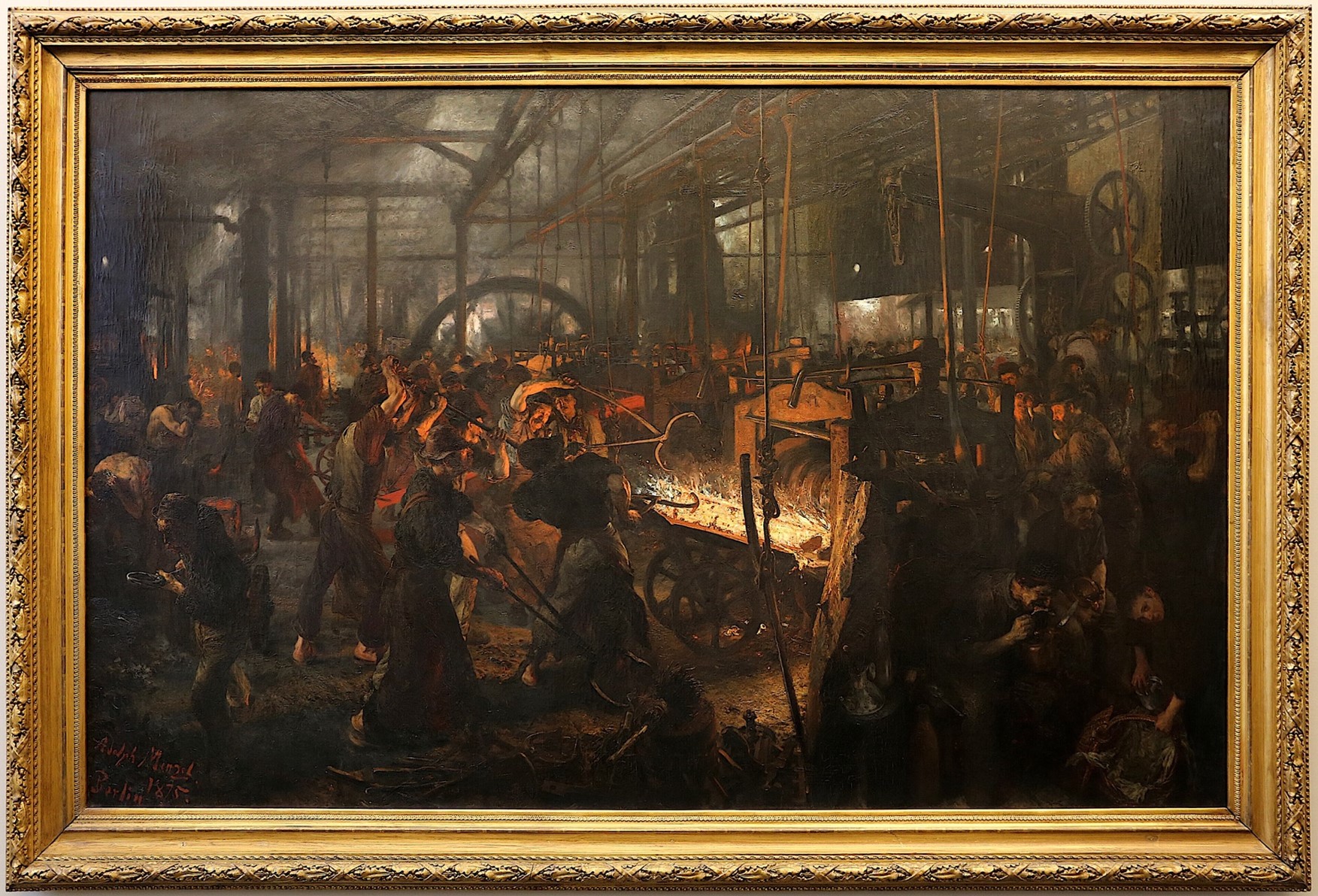
I begin from two images that have established themselves, one gradually and the other in short order, as classics. The first is Adolph Menzel’s Iron Rolling Mill, painted between 1872 and 1875, showing the interior of the Königshütte factory in Upper Silesia. The factory specialized in the production of rails for railway lines—a quintessential industrial activity, lying at the heart of capitalism’s high nineteenth-century dynamic. The painting, done for the banker Adolph von Liebermann, Menzel’s uncle, was meant partly as a celebration of German victory in the Franco-Prussian war: it gave concrete form to the “Eisen und Blut,” which Bismarck had predicted a decade earlier, in a phrase that became his signature, would “decide the great questions of the day.” Plenty of iron, obviously, in the Menzel. Blood is absent, though the red-hot line of a just-finished rail, cooling behind the group of men in the center, is a strong metaphorical substitute. Work and war are inseparable in Iron Rolling Mill, and in a sense, as we know to our cost, they have proved inseparable in the history of humanity in general, capitalist or otherwise. Marx’s “struggle with the realm of necessity,” which is certainly going on here in the light of the molten metal, has constantly tipped over into, or been propelled further by, the struggle with other nations and classes. Labor and capital, it follows (this would be my first thought on the subject as Menzel shows it), cannot be conceived of—or convincingly represented—apart from the matrix of human aggressiveness and our species’ deep love affair with death. Menzel finds means to suggest this. The dark hooded figure in front of the action by the rolling mill, leaning back from the mill’s white heat, is a deathly demonic double to the older worker opposite wielding the tongs, facing us, smiling, enjoying his mastery, teeth clenched on his pipe. The hooded figure by contrast—the man in black, with his weird ballooning profile—seems to have stepped out of an uncensored fairy story by the Brothers Grimm.
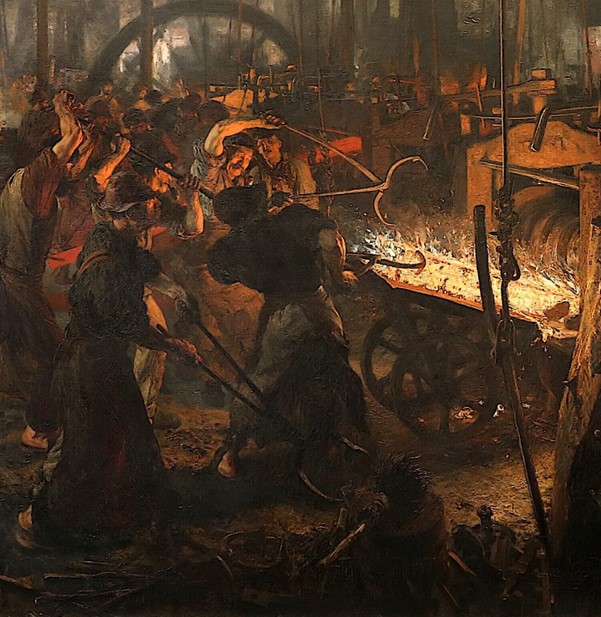
So the picture of factory production—even of such a seemingly simple matter as the physical business of hard work—is, in this image, double-edged. On the one hand, in the warm light of the furnace, we are asked to attend to the gallery of strong faces, involved and admiring: labor as comradeship, strength, experience, teaching by example. But on the other we are given, blocking our view of the action and dominating the picture’s visual center, labor as a kind of black conjuring in the face of fire. Wagner’s vision of capitalism in the Ring cycle seems close. We could imagine the man in black swiveling to face us, revealing himself to be Wagner’s merciless gold-obsessed dwarf.
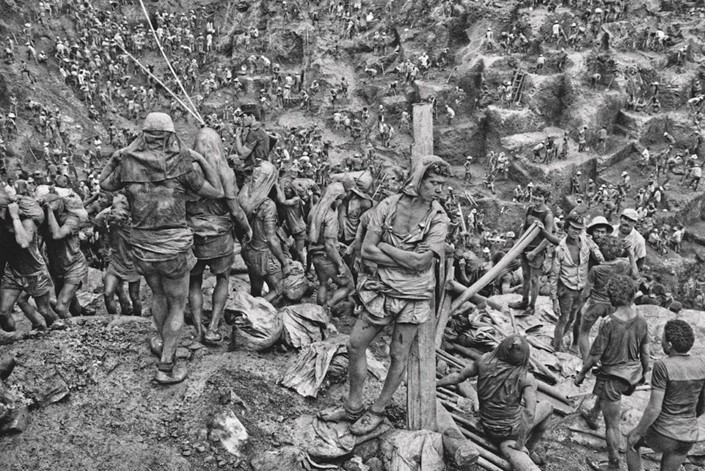
Labor and war go together, then; labor and the elements under the earth; labor and danger; labor as a theatre of human power over the elements. The mine is a master site of capitalism. Not for nothing did Sebastião Salgado’s photographs of Serra Pelada establish themselves, in the 1980s and 1990s, as our reminders of exploitation continuing, in the world “out there,” in its legendary, nightmare form.
So far, my stress has been on power and danger in Menzel’s thinking of his subject. But obviously this is only part of the story. The record suggests (it is not entirely clear) that Menzel made only one visit to the Königshütte factory in 1872. But he had time during that visit to immerse himself in the social reality of the place. “For weeks,” he wrote later, “from morning to night, I stood among those enormous hand wheels, conveyor belts and cast iron, and I sketched. … I ran the constant risk of being laminated myself, so to speak.”1 This is a touch self-aggrandizing, but there’s no reason to doubt the essence of the memory. And it leads to the second aspect of industry as Menzel represents it, to my mind just as deep an insight as the first. The factory in Menzel is a world—a social system, a set of improvised occasions, spaces, forms of human sociability. It may revolve around the central fire-lit drama of hand and raw material and incandescent machine, but that drama—that moment of “manufacture,” of iron becoming commodity—is unthinkable without a deep dividedness in the rest of the scene. Not just a “division of labor” but a set of multiple dividing lines that Menzel has chosen to show us drawn between labor and sociality—labor and rest, labor and bodily need, labor and creaturely being-together—drawn, necessarily, in the workplace itself. This is everywhere in the picture—for instance, in the trio of life-study workers stripped to the waist at far left, washing themselves at the end of their shift—but perhaps it is summed up most beautifully, close to us, in the buckled sheet of laminated iron propped as a barrier against the heat of the furnace in the right center-foreground.
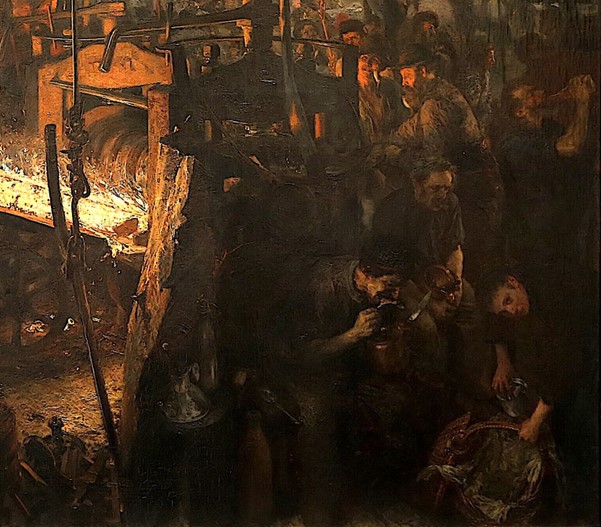
Behind the thin shield a trio of dog-tired workers takes shelter, one gnawing at a piece of meat, another pulling fiercely at a bottle of water or beer, and the third seemingly hunched in a frozen exhausted inwardness, bowl and pipe forgotten. The wrap-around sheet of iron that shelters the trio looks like pure improvisation on the workers’ part. It has nothing to do with the logic of industrial production—with the geometry of the cogwheels and steam pipes and vast openwork roof—but everything to do with this logic, in practice (in a world of actual bodies), continuing to function.
The contrast Menzel seems to intend between the lit space of production and the dark shelter of bodily recuperation is basic to large-scale industry. One strand of Marxism—of which, by the way, we can be fairly confident Menzel knew nothing—has always seen the contrast as one of the informing contradictions of capitalism. For me this line of thought is summed up best in the writings of the philosopher Cornelius Castoriadis, at the time of his engagement with the group Socialisme ou Barbarie in the late 1950s and early 1960s. (I shall never forget the impact of his text, “Modern Capitalism and Revolution,” when it appeared as a Solidarity pamphlet in English in 1963.) Castoriadis’s picture of capitalism is important for present purposes because it issued from an argument within the revolutionary movement, seventy-odd years ago, about the role of workers themselves—factory workers as actors as opposed to “factors” in an economic system—in any future movement of resistance. The notions of workers’ control and working-class “autonomy” were still active at the time Castoriadis was writing. And those ideas had been launched, or re-launched, in the postwar period against a still powerful Left model, Soviet and social democratic, which regarded public ownership of the means of production—state control and nationalization—as the royal road to socialism. All this will inevitably give Castoriadis’s text, when I quote it now, a strong period flavor. It is outdated, yes, but that does not mean its time will not come again. Here are the key declarative sentences:
The traditional socialist view of capitalism is false philosophically … [In other words, the view that saw the problems of capitalism and its crises as rooted in the “anarchy of the market” or its “inability to develop the productive processes.”] The understanding of capitalism and its crises is seen as the prerogative of specialists and theoreticians. The solution to such problems then becomes a simple question of making “objective” changes in capitalism’s structure—eliminating private property and the market—and no autonomous intervention of the proletariat is required …
But the fundamental contradiction of capitalism is to be found in production, in the labor process itself. This contradiction is intrinsic to the alienation experienced by every worker. It derives from the necessity for capitalism on the one hand to reduce workers to simple executors of tasks, and on the other hand, from the fact that capitalism would cease to function if it actually succeeded in doing so. In other words, capitalism needs to achieve mutually incompatible objectives: it needs the participation and the exclusion of the worker in the actual production process. The same goes, it follows, for citizens in the political sphere.2
Let’s leave aside the question of whether these tensions and paradoxes of the production process will prove in the long run crippling or disabling for the capitalist system as a whole. Castoriadis thought so. Maybe he still would. I want simply to fasten on his main descriptive point, developed from a reading of Marx: that factory production is a strange double-headed beast. On the one hand, it aggregates more human beings in a more elaborately socialized and finely calibrated community of work than ever before. And for such a complex process to continue functioning—however much of it is mechanized or automated, so Castoriadis believed—constant human response, judgment, local “supervision,” guesswork, improvisation in face of the unexpected or the accidental, and new forms of ad hoc combination with other human actors in the workplace are necessary. And yet the logic of the production line, and even more the logic of social subordination and class control (“state socialist” or otherwise), lead in the opposite direction. The division of labor is supposed in theory to be pursued, or pursuable, to the point where human beings become Taylorized bundles of repetitions, actions dictated by the structure of production itself—a structure conceived as autonomous and self-governing apart from insignificant “noise on the message.” Machines are supposed to do the job not just of turning production into predictable and unstoppable mechanism but of turning the worker into a set of functions of that mechanism. Marx, by the way, could be gloomy about the potential of that process. In a certain mood in Capital he certainly saw the machine as monster. He would not have been surprised by the specter of AI.
Always, then, the production line threatens—necessarily, as part of capitalism’s technological imperative—to convert labor into an utterly de-humanized doing-the-machine’s-bidding. But Castoriadis’s contradiction is still operative. We know that if workers actually decide, as a weapon of struggle, simply to “work to rule”—obeying only and fully the regulations and protocols spelt out in the work contract, or even restricting themselves to “workshop best practice”—then production on any kind of real-life conveyor belt grinds to a halt in a matter of hours. “Work to rule,” people of my generation will remember, was once the bugbear of the capitalist press. It is one of the signs of neo-liberalism’s triumph that both concept and reality have been largely marginalized, at least for the present—made almost unthinkable, in the age of defeated trade unions, outsourcing and off-shoring, and a globalized reserve army of labor. Plus, now, robotics … (Remember, however, that the dream/nightmare of “post-human” production has excited the military-industrial complex ever since Eisenhower coined the phrase but has gone on failing to materialize for seventy years. “Boots on the ground” and fingers on the software buttons—those recalcitrant, vulnerable embodied intelligences—never quite prove to be things of the past.)
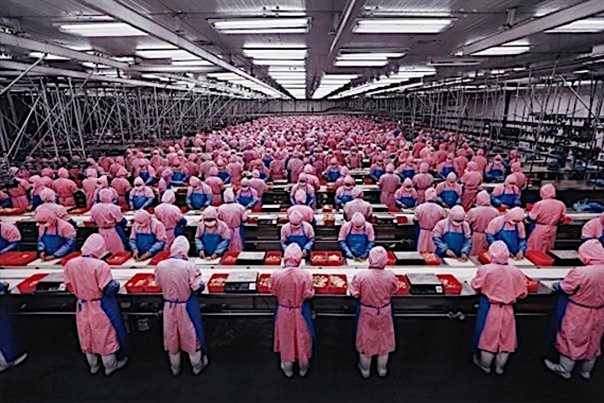
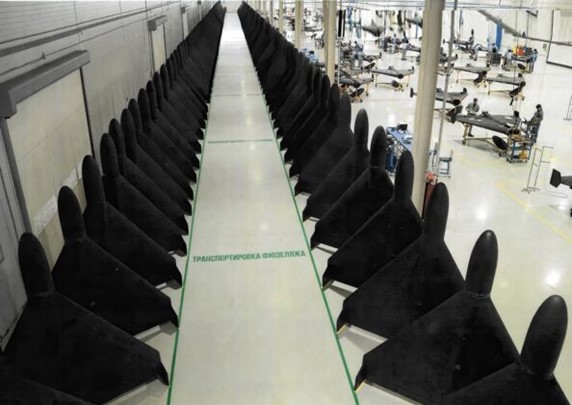
Let me now enter into the argument image number two: Edward Burtynsky’s photograph of the Deda Chicken Processing Plant in Jilin province, 2005. You could say that this seems like the post-human nightmare realized. Workers have been reduced, by the look of things, to identical uniformed components in a production process transformed into an ecstasy of repetition. But I did say “by the look of things.” Beware a new kind of Orientalism. What the signs of real difference are, within emerging new forms of work discipline, is always a matter of detailed local knowledge—hands-on ethnography of the factory—as opposed to the boss’s crude theater of sameness. I shall come back to this, but in the meantime, a last word on Iron Rolling Mill.
Menzel, I’ve been claiming, is an ethnographer: that is, certainly an outsider, looking at the factory ultimately from the point of view of power (remember his picture is painted for a banker), but one who enters, maybe in spite of himself, into the strange social system he is observing. His painter’s way of articulating Castoriadis’s issues—that is, the factory’s double nature when conceived of as a social system—is by feeling his way, instinctively, toward a picture of the factory’s twofold organization of space. On the one hand, he registers the sheer enormity of the Königshütte iron interior: the space of the grid, of repetition and standardization—especially clear in the painting’s upper reaches, going back and back into a ghostly infinity. On the other, close to us, he insists on the space of the working body, the moment of respite, shelter, appetite, self-absorption—the men huddled down in the darkness behind the laminated sheet. And I believe he even gently intimates that these two spaces—or two kinds of habitus—are class-specific. He certainly knew that in 1873, as what we call in retrospect the “second world economic crisis” worsened, Upper Silesia was a place of social and ideological struggle. The workforce at the Königshütte factory was, for the most part, made up of Polish Catholics. They hated Bismarck’s measures against their native church. In 1873, Prussian troops had to be brought in to put down anti-Bismarck rioting. I like the fact that off in the distance in Menzel’s picture, over to the left, there is a single bourgeois gentleman in coat and bowler, looking up and back into the uncluttered spatiality of the enormous workshop—the factory as technology, as logical structure, rather than the factory as contingency, improvised rooms and behaviors, made and unmade human thing. It is worth saying, by the way, that working conditions in Silesia were known to be “primitive” in comparison with best practices on the Ruhr and deplored for that reason. (There should be no need for the labor force to build a heat shelter out of scrap. “Sweatshop,” indeed!) But what else is new? Capitalism is always wringing its hands at the fact of uneven development, at what goes on in its name in Königshütte or Jilin province. (It is important, bearing Burtynsky in mind, that Rolling Mill is already a picture of a frontier zone, a German colony of sorts. Capitalism depends from the very beginning—and always—on relations between center and periphery.)
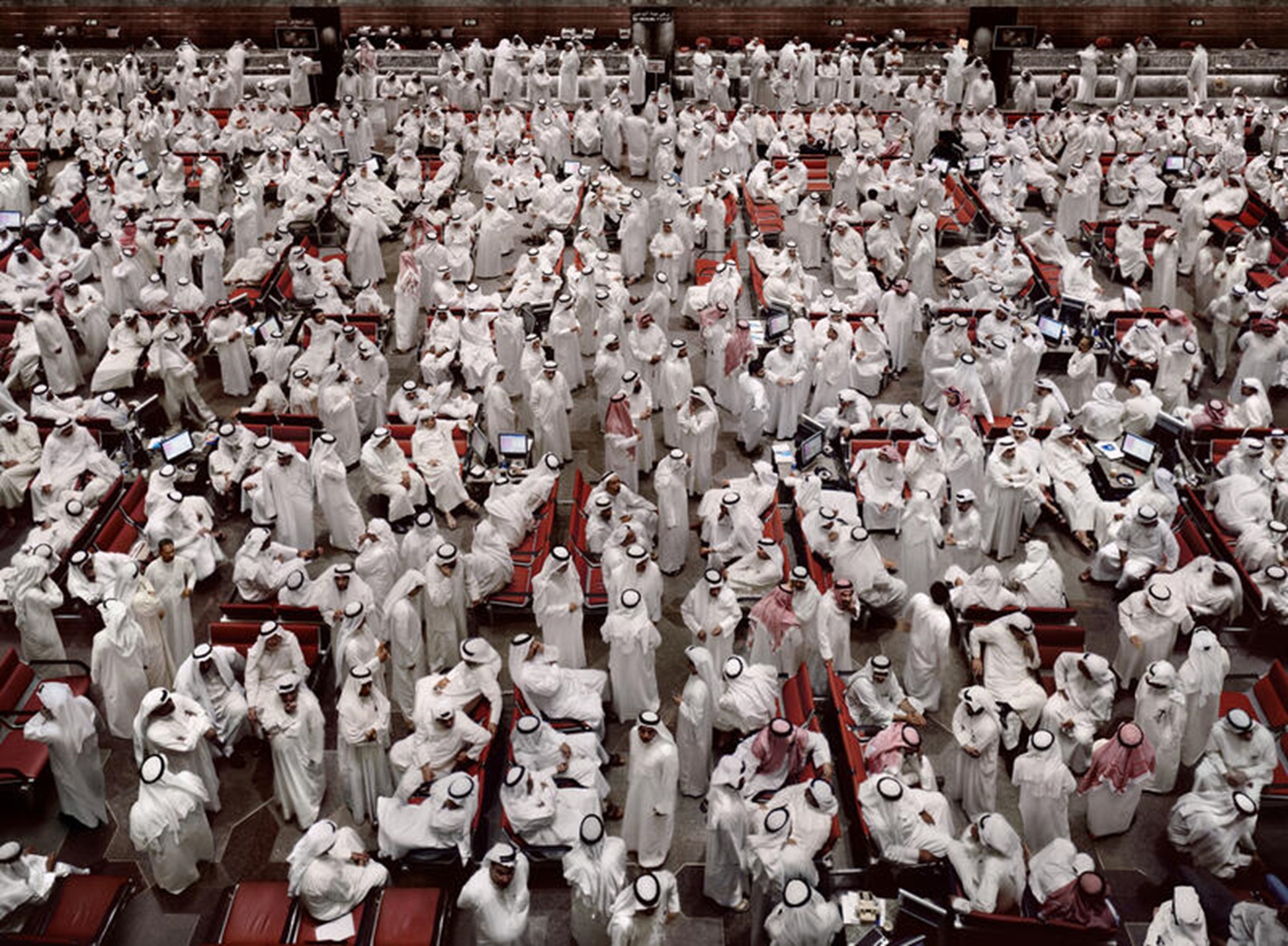
I am not quite done with Menzel’s Rolling Mill, but let me return to Burtynsky. The Deda Chicken Factory photograph has been exhibited in various sizes, but more than once in a format 11 feet long by 7 feet high. These dimensions no longer surprise us. And we have grown accustomed also to the idea that the arrival of the large-scale digital photograph in the world of art at the end of the last century resulted in a new attempt at history painting, with something of Menzel’s ambition to it—wishing like Menzel to sum up the moment, to penetrate the interior of production, to seek out the typical tempos and appearances of new forms of life. Labor became again a subject for art. Burtynsky’s image was one among many. I see it alongside Salgado’s Serra Pelada series; or Gursky’s basket weavers in Nha Trang, photographed the year before Burtynsky in Deda; or, never out of date, Gursky’s 2008 Stock Exchange in Kuwait.
Put Burtynsky’s Chicken Factory alongside Menzel’s Rolling Mill. Consider the claim to typicality made by the two—the claim to represent work under capitalism (Communist capitalism or Prussian state capitalism, it doesn’t greatly matter which) in its central representative form. What has changed?
Well, some of the answers are obvious. There is a notion (which may or may not be supported by the evidence) that heavy industry, though it certainly still exists, is no longer the essential motor of capitalist development. What matters more and more, we are told, is the apparatus of consumerism: the generation of small-scale consumer durables and of entirely disposable items of use and recreation, plus “services” to match. Cheap processed (or packaged and standardized) food is part of this. The young woman coming into the factory in Menzel at bottom right (sole female in a man’s world), hauling her basket of fresh produce, presumably for sale, and the worker gnawing at his chicken bone—the chicken presumably killed in a farm no more than a mile or two away and roasted that morning at home—are replaced by the hooded and rubber-gloved specialists, adding the last touch to the infinity of factory-farmed beasts. And this goes along, it may seem, with a change in the whole atmosphere and arrangement of the workplace. From the factory as place of sociability and improvisation we have moved to the factory as temple of hygiene, of uniformity, of the producer as one commodity among others, all of them partaking of the commodity’s “product reliability” and anonymous obedience to the consumer’s wishes. Labor here takes on the identity of the commodity.
What had once upon a time seemed an exotic, almost sinister, limit-case of the worker’s whole being and self-presentation merging with what he or she had to sell—I think of the deliberate impassiveness of the woman behind the counter in Manet’s Bar at the Folies-Bergère and Walter Benjamin’s famous (questionable) dictum that the whore is “seller and commodity in one”3—becomes, in our world, an entirely ordinary and general condition. And this in turn is bound up with the great new fact of Burtynsky’s and Gursky’s universe: that in it labor can be made fully visible and drawn into a regime of total transparency. Labor, in a word, is no longer a dark hidden territory to be occasionally explored by the artist, with always the feeling that the observer (the Menzel) has found his way toward a secret that society in general, or those in charge, wish to keep. Labor is no longer meant to be invisibilized by the commodity form, in whose perfection the social realities of production take on a seemingly self-sufficient life—the life of things, the life of exchange. No, labor now can be included in a spectrum of fully available appearances and behaviors of appearance: the factory is no different from the supermarket or the hospital or the mega-stadium or the endless rooms of the nearest big-box store. Labor, in a word, is to be made fully and irrevocably part of spectacle.
It ought to be a question for art historians, I think, whether the large-scale digital photo, as we have grown accustomed to it, turns out to have been a servant—an instrument—of this new regime of transparency and de-differentiation, or a mirror that allowed us to see what the regime amounted to and reflect on its truth-claims. The old great question, which applies so often to the avant-garde’s love affair with modernity’s appearances, recurs here with a vengeance. When Marx famously said, in The Critique of Hegel’s Philosophy of Right, that we should “teach the petrified social forms how to dance by singing them their own song,”4 he could hardly have anticipated how much the petrified social forms would come to enjoy the singing and profit from the avant-garde’s endless irony at fashion’s expense and how much and how quickly “singing them their own song” would become an end in itself for art, with less and less of the pretense of distance.
This may be the kind of question Burtynsky’s photography provokes, but I step back from it. It is in the end too apodictic—too much a matter of judgment. Let me concentrate instead on one aspect of the problem: labor’s previous invisibility. If we could understand more of what invisibility signified in the long period of capitalism’s heyday, we might get a better hold on its eventual coming-into-sight.
Let me remind you that Menzel’s penetration into the factory interior is exceptional. It seems to have been possible only at a peculiar moment of national “warring states” exaltation. In 1872, Eisen und Blut were so recently triumphant that for once they had to be—they could be—revealed in their inner workings. But by and large what is remarkable about the nineteenth and twentieth centuries is the paucity of representations of a factory’s inhabitants. Gleaners and ploughmen and men with a hoe; the boulevard and the café and the music hall; the old world of peasant production and the new emerging one of leisure and consumption—but not the actual motor that was, slowly but surely, converting the one into the other.
Factories appear, of course, in the art of high capitalism: they do so from very early on. But they appear for the most part as pure, and often strangely idyllic, outsides. I think, for example—it is another classic image, as strong in its way as the Menzel—of Corot’s House and Factory of M. Henry at Soissons, painted in 1833.
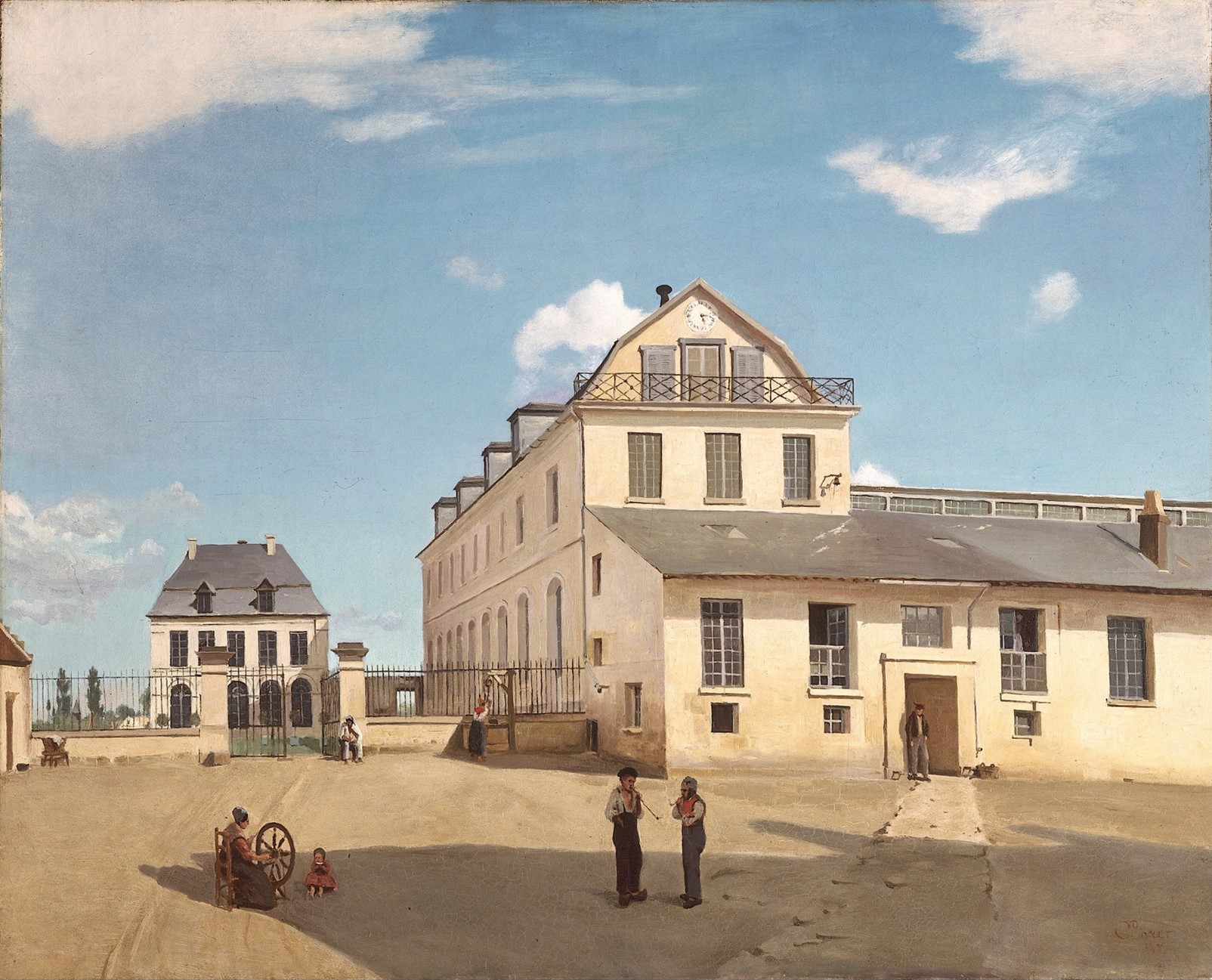
Philibert Henry’s factory had started production seven years earlier, in 1826. It produced high-grade textiles and tapestry and did so in the converted buildings of the Abbey of Saint-Crépin, whose last monks had been chased from the building in the French Revolution. Henry kept factory production costs low by using convicts from a neighboring prison as the main element of his labor force: they were marched to and from prison each morning and evening. It looks, from the state of the shadows and the overall beneficent atmosphere in Corot’s painting, as if evening is drawing in and prisoners are back in their cells. The clock on the abbey wall appears to show 5:15. (If so, I have my doubts that the convicts’ working day stopped so early. But maybe prison rules were paramount.) The remaining workers—apparently there were a few skilled textile operatives housed in the abbey buildings—saunter and smoke a pipe together. The only real sign of what goes on, or has gone on, inside the abbey—the reader can decide for herself if the metaphor is naïve or entirely knowing and duplicitous—is the woman sitting at the spinning wheel at the edge of the shade, complete with exquisite little girl winding the yarn.
Corot’s attitude to his subject is inscrutable. As with Menzel, he seems to have been directed to the job in hand by family circumstances: M. Henry was a friend of his father, and considering Corot a Sunday painter, he never got around to paying him. But in any case what interests me, and seems crucial and representative, is not Corot’s opinion of industry but simply his “point of view.” The factory, for him, is an entity to be seen from outside. Its interior space, let alone its labor force, is terra incognita. Production in its new form is not to be shown. The spinning wheel stands in for the power loom. And this invisibilization of labor remains an unquestioned protocol all through the ensuing century.
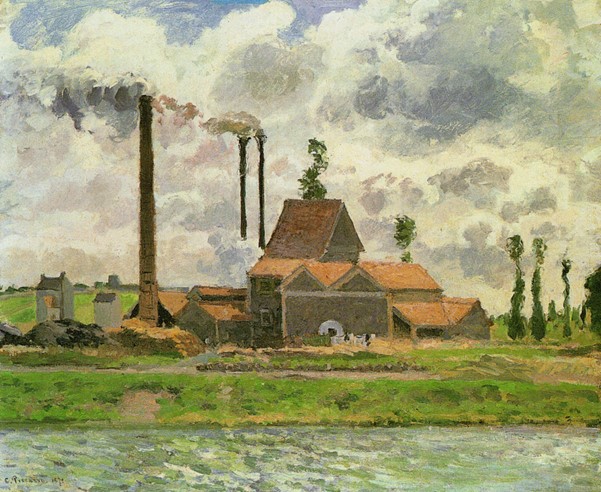
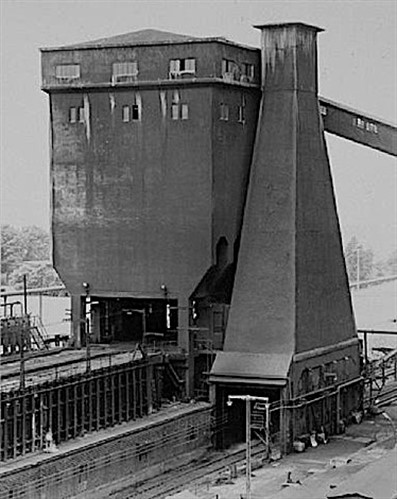
I leap through that century to the 1960s, to the photography of Hilla and Bernd Becher. In the Bechers, I want to argue, the question of labor’s invisibility is posed directly, insistently, and the question seems ultimately to determine the photographs’ form.5 Here, if you like, is Castoriadis’s “exclusion of the worker from the actual process of production” perfected. The logic of system and standardization—this has always been what the Bechers’ viewers have admired or shuddered at—enters and shapes the whole structure of the photographic illusion. Not only, that is, the simple (and all but total) absenting of the working body from the world of industrial artifacts on show, for which these pictures are notorious, but the painstaking creation of a point of view for the Bechers’ camera that seems to want to persuade us that its utter objectivity—its neither distancing from nor proximity to the object in front of it, neither isolating nor embedding, neither looking up at the giant or down at trapped specimen—this inimitable, elaborate, banal, uncanny non-stance is that of the artefact itself. Or maybe of the camera as the artefact’s double: one piece of industrial mechanism communicating, without any human noise on the message, with another. And therefore also repeating itself, grimly and endlessly, since duplication and typology are the mode of being-in-the-world of commodity production.
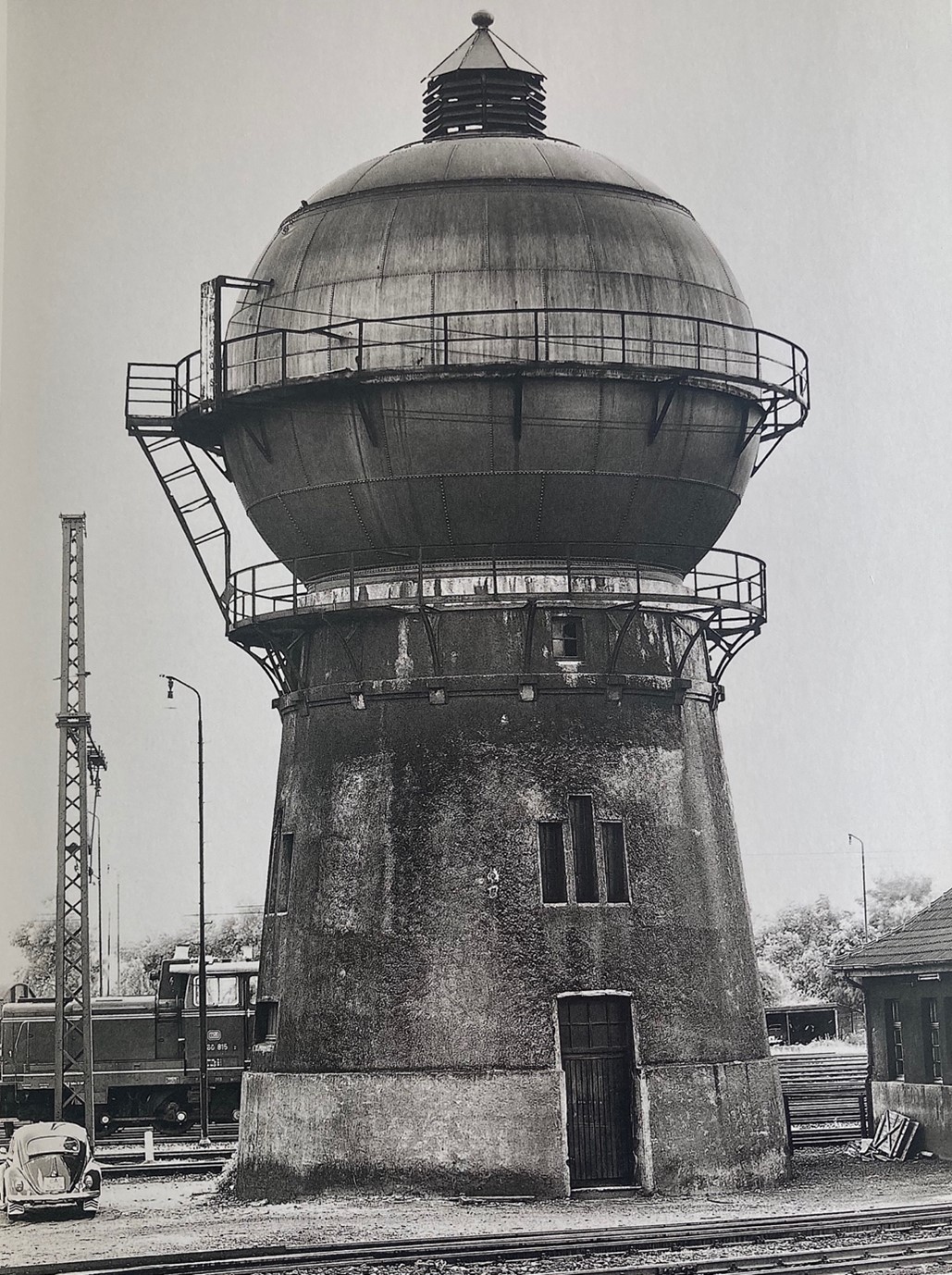
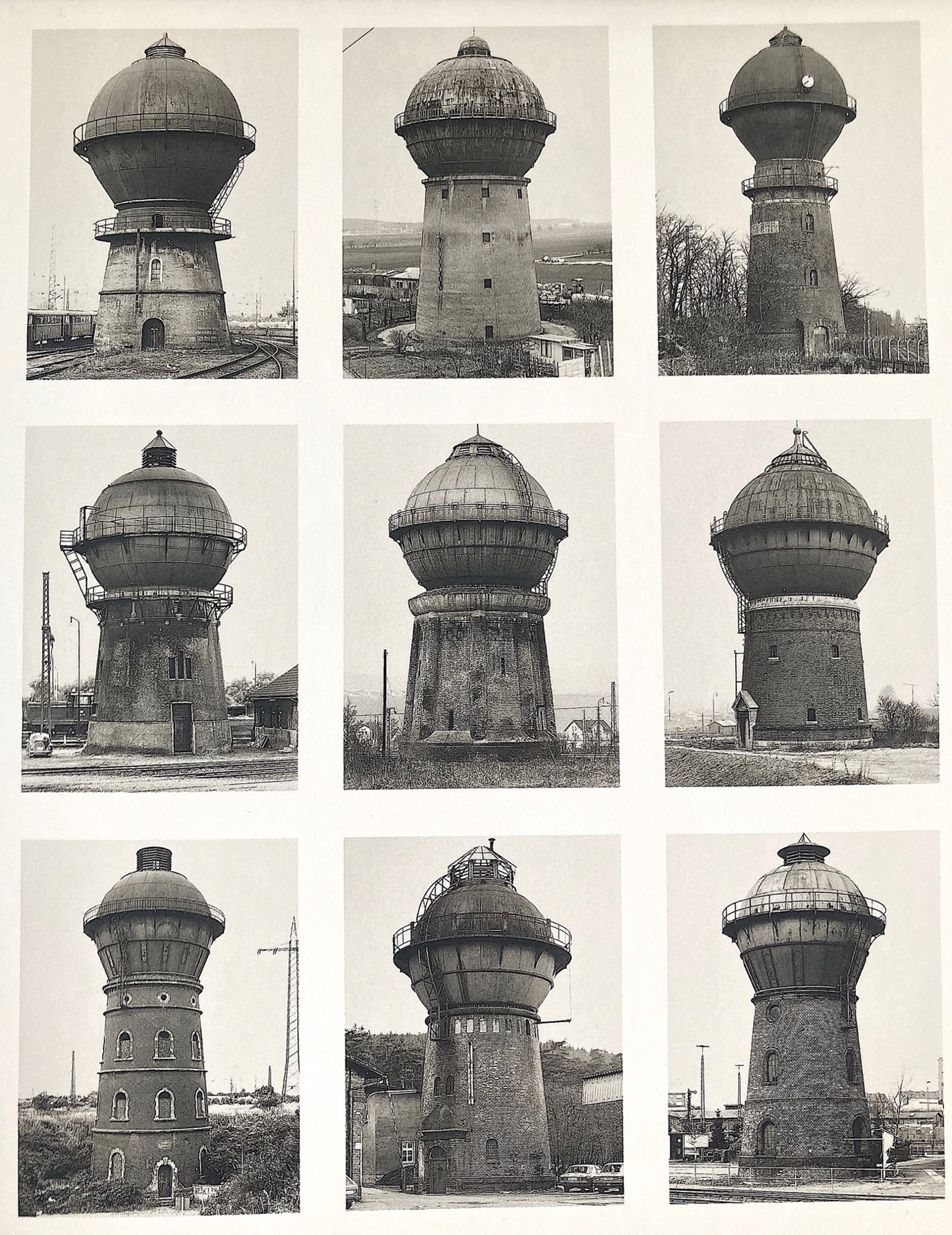
The Bechers’ achievement has provoked speculation going off in many directions. I shall restrict myself to the question that has been recurring in this essay, that of work’s invisibility. Invisibility, we could say, has become a principle in the Bechers: the absence of who or whatever it was made this strange world, let alone for what purpose, is the atmosphere—the tonality, almost the suspense—that gives the Bechers’ photographs their unique power. When, very occasionally, the invisibility principle is violated—when you see what appears to be the ghost trace of a working body alongside a coal bunker in Bochum in 1967—it hardly matters. The scale of the bunker makes the body irrelevant. And the bunker’s place in a grid of further bunkers makes incident—the shadow of the act—cede utterly to objectification.
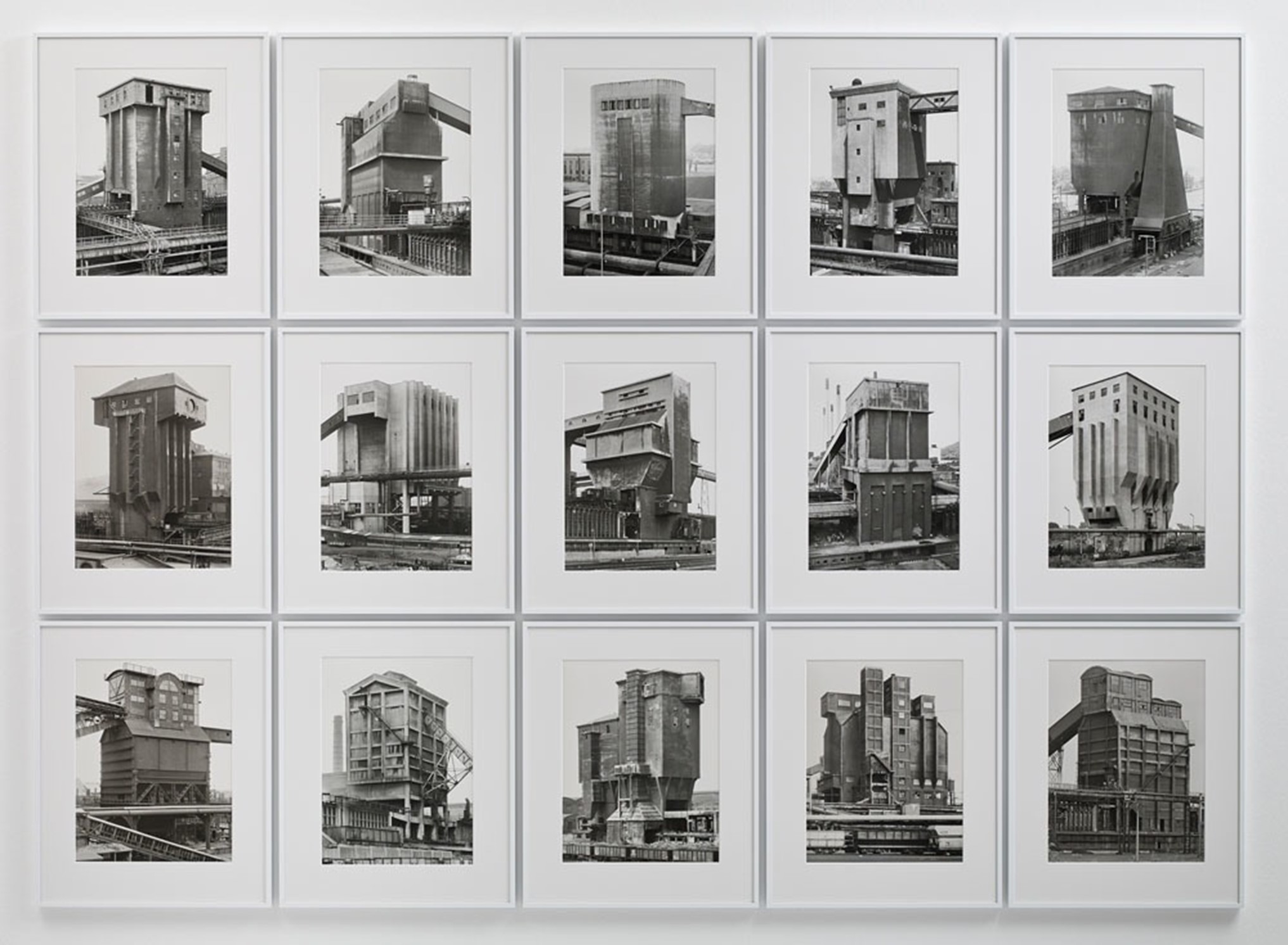
The Bechers’ photos deserve to be thought about dialectically. In one sense they are the triumphant expression of the crude, ruthless, seemingly self-governing materialism of industrial society. Never has the brute objectivity of the world made by industry been given such irresistible form. And yet the absorption of each peculiar made object into a logic of standardization and slight variation—into the form of the grid—conjures away the materiality as soon as it is posited. The Bechers’ grid speaks to the deeper reason for labor’s invisibility under capitalism: the fact, which Marx struggled with throughout Capital, that capitalism is a system of exchange as well as—or we might say, even more than—a system of production, and that in it labor power is “always already” other than itself, always an abstraction, always a physical reality becoming that will o’ the wisp, the commodity. The failure to show us the physical reality of work under capitalism is not, then, simply the result of condescension or distaste or cynical duplicity (though these are never in short supply). “Labor power”—the necessary form work takes in the new symbolic order—has non-appearance and untouchability written into it. Capitalism is the conversion of material intervention into nature—what we call, in a weird synecdoche, “manufacture”—into an invisible, self-sufficient, purely quantifiable set of abstractions.
The Bechers’ world is Part Five of Capital (the section dauntingly titled “The Production of Absolute and Relative Surplus-Value”) in pictures. It is the abstract materiality of capitalism given to us to inspect. But again, we should think the achievement dialectically. There is a pathos, an uncanniness, to the world the Bechers show us. Partly that has to do with its feeling of pastness.6 The objects the Bechers went in search of so often have the look, unmistakably, of old things, antiques, showing off their mechanism in a way that reeks of a recent but irretrievable past—a past before plastic, before streamlining, before white goods and consumer perfection.
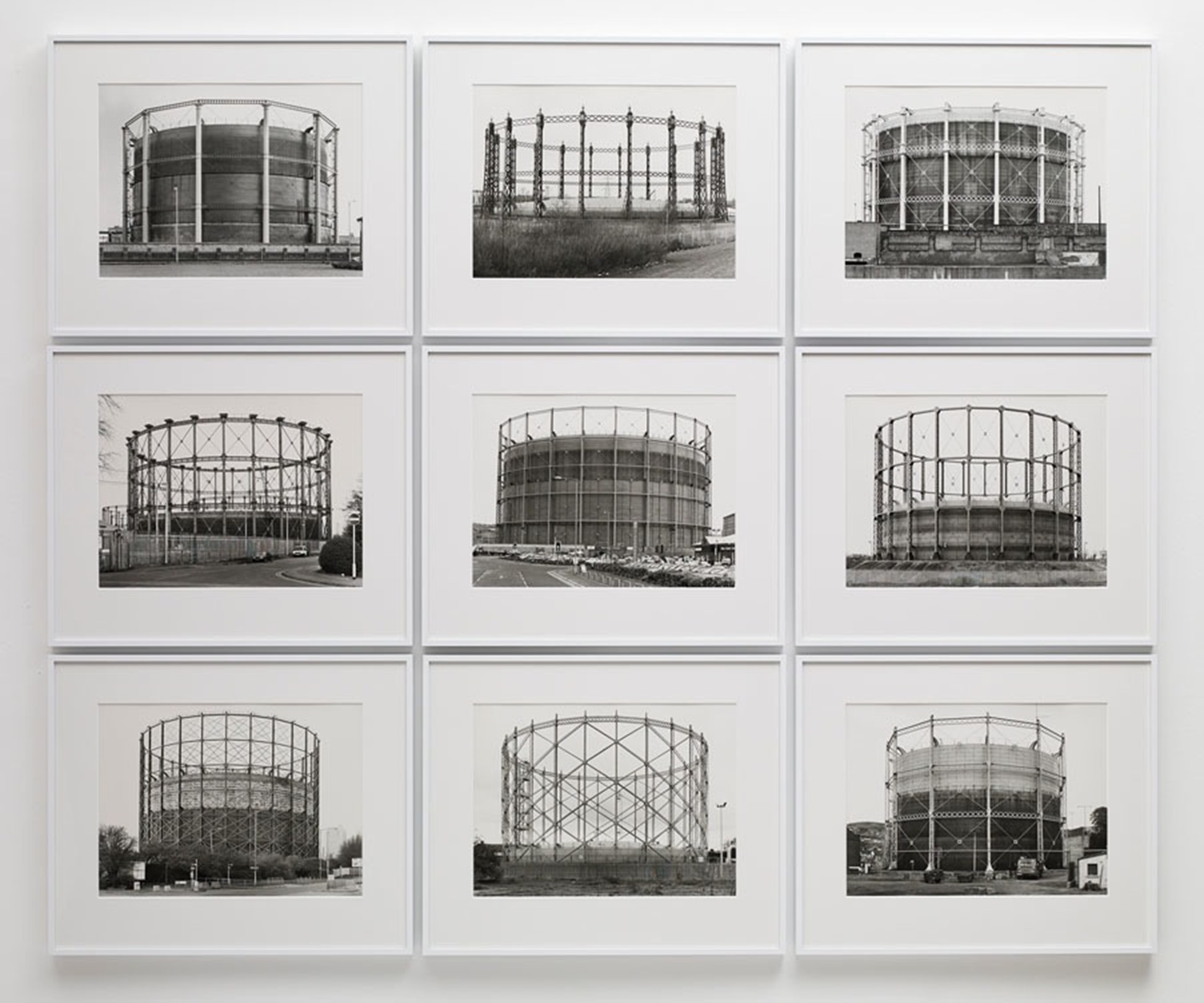
We look down from the water tower in Dorstfeld and recognize the “rolling mill” world on either side of it, and then we notice the little machine-on-wheels parked between the railroad tracks. And with the benefit of hindsight we feel sorry for the industrial revolution. We know that its supersize world of rails and brickwork and steam is about to be replaced by the individualized small-scale self-shaping—the People’s Cars, the “handy,” the “mobile”—of a new world of leisure. (There are parking lots across the road from the gas tanks. Are those Cortinas? My first car …)
Volkswagens or not, the longer we look at the Bechers’ imagery the more we become interested in the clues to the rest of the human world that are present, discreetly, in the margins and distances allowed by the camera set-up. The world in the frame, as it gradually reveals itself, is profoundly a thing of the past. Some form of catastrophe seems to have swept through it, leaving artifacts like Roman ruins in a post-Imperial sunset. We would not need to know, I think, that the Bechers were photographing a landscape in Germany, made by world war and carpet bombing and post-war “miracle” and wholesale creative destruction, to sense that what we are looking at in their Mnemosyne Atlas is over—with the camera’s deadpan a thin disguise for its operators’ deep melancholy. Labor, we could say, is invisible in the Bechers: history is not. The VW by the water tower is the invisibility of labor taking place in the world, becoming an ordinary principle of everyday life.
Between the VW by the water tower and the masked chicken processor, then, there seems to me a deep connection. The one prepares the ground for the other. Labor under capitalism can eventually proclaim its full visibility because labor is now so thoroughly elided and misrepresented, left behind as a lived conflicted reality, because it has been fully subsumed into the order of the commodity. Or such is the claim. I am with Castoriadis, needless to say, in believing the claim to be necessarily—or, at least, empirically—false. We would all like to know what day-to-day detailed struggle of labor against capital goes on in the Deda Processing Plant. Or in present-day Nha Trang, in Serra Pelada (sufficiently cleaned up), in Bochum and Dorstfeld (Dorstfeld is nowadays a neo-Nazi stronghold), and on the scaffolding of the oil refineries and mega-stadia being traded in Kuwait. Or even in the U.S. drone compounds. But, alas, the claim made by Burtynsky’s image—by his image in particular, and by a whole surrounding image world, seizing as it does on sameness, obedience and automatism as the markers of a working environment to come—has its own magic, its own plausibility. Capitalism never tires of futurology. Labor without laborers, war without warriors, intelligence without embodiment, work without human beings capable of feeling, resenting, and resisting the non-humanness of the “work” they are given to perform—surely that shareholders’ heaven is at last within reach.
Notes
A first version of this essay, “From Menzel to Burtynsky: Episodes from an Imagery of Capitalism,” was published in Malcolm Baker and Andrew Hemingway, eds., Art as Worldmaking: Critical Essays on Realism and Materialism (Manchester University Press, 2018).

This essay is concerned with the form, or forms, taken by labor under capitalism. The concern is an old one—it was already on the minds of capitalist industry’s first observers—and from the start theorists and commentators agreed that there was something peculiarly elusive to the forms in question. This elusiveness has not lessened with time. The problems may be easier to explore if we take the difficult word “form” to mean (for purposes of inquiry) preeminently visual appearance, or even simply visibility. Could we begin with the question: What does labor look like under conditions of industrial production—large-scale factory-based industry, that is, processing raw materials and producing commodities (harmless or deadly) for sale in a world market? Does work in such conditions open itself to be looked at? And if it is looked at directly, can it be described at all adequately in visual terms? Is the specific character of labor in industrial capitalism “representable?”
I begin from two images that have established themselves, one gradually and the other in short order, as classics. The first is Adolph Menzel’s Iron Rolling Mill, painted between 1872 and 1875, showing the interior of the Königshütte factory in Upper Silesia. The factory specialized in the production of rails for railway lines—a quintessential industrial activity, lying at the heart of capitalism’s high nineteenth-century dynamic. The painting, done for the banker Adolph von Liebermann, Menzel’s uncle, was meant partly as a celebration of German victory in the Franco-Prussian war: it gave concrete form to the “Eisen und Blut,” which Bismarck had predicted a decade earlier, in a phrase that became his signature, would “decide the great questions of the day.” Plenty of iron, obviously, in the Menzel. Blood is absent, though the red-hot line of a just-finished rail, cooling behind the group of men in the center, is a strong metaphorical substitute. Work and war are inseparable in Iron Rolling Mill, and in a sense, as we know to our cost, they have proved inseparable in the history of humanity in general, capitalist or otherwise. Marx’s “struggle with the realm of necessity,” which is certainly going on here in the light of the molten metal, has constantly tipped over into, or been propelled further by, the struggle with other nations and classes. Labor and capital, it follows (this would be my first thought on the subject as Menzel shows it), cannot be conceived of—or convincingly represented—apart from the matrix of human aggressiveness and our species’ deep love affair with death. Menzel finds means to suggest this. The dark hooded figure in front of the action by the rolling mill, leaning back from the mill’s white heat, is a deathly demonic double to the older worker opposite wielding the tongs, facing us, smiling, enjoying his mastery, teeth clenched on his pipe. The hooded figure by contrast—the man in black, with his weird ballooning profile—seems to have stepped out of an uncensored fairy story by the Brothers Grimm.
So the picture of factory production—even of such a seemingly simple matter as the physical business of hard work—is, in this image, double-edged. On the one hand, in the warm light of the furnace, we are asked to attend to the gallery of strong faces, involved and admiring: labor as comradeship, strength, experience, teaching by example. But on the other we are given, blocking our view of the action and dominating the picture’s visual center, labor as a kind of black conjuring in the face of fire. Wagner’s vision of capitalism in the Ring cycle seems close. We could imagine the man in black swiveling to face us, revealing himself to be Wagner’s merciless gold-obsessed dwarf.
Labor and war go together, then; labor and the elements under the earth; labor and danger; labor as a theatre of human power over the elements. The mine is a master site of capitalism. Not for nothing did Sebastião Salgado’s photographs of Serra Pelada establish themselves, in the 1980s and 1990s, as our reminders of exploitation continuing, in the world “out there,” in its legendary, nightmare form.
So far, my stress has been on power and danger in Menzel’s thinking of his subject. But obviously this is only part of the story. The record suggests (it is not entirely clear) that Menzel made only one visit to the Königshütte factory in 1872. But he had time during that visit to immerse himself in the social reality of the place. “For weeks,” he wrote later, “from morning to night, I stood among those enormous hand wheels, conveyor belts and cast iron, and I sketched. … I ran the constant risk of being laminated myself, so to speak.”1 This is a touch self-aggrandizing, but there’s no reason to doubt the essence of the memory. And it leads to the second aspect of industry as Menzel represents it, to my mind just as deep an insight as the first. The factory in Menzel is a world—a social system, a set of improvised occasions, spaces, forms of human sociability. It may revolve around the central fire-lit drama of hand and raw material and incandescent machine, but that drama—that moment of “manufacture,” of iron becoming commodity—is unthinkable without a deep dividedness in the rest of the scene. Not just a “division of labor” but a set of multiple dividing lines that Menzel has chosen to show us drawn between labor and sociality—labor and rest, labor and bodily need, labor and creaturely being-together—drawn, necessarily, in the workplace itself. This is everywhere in the picture—for instance, in the trio of life-study workers stripped to the waist at far left, washing themselves at the end of their shift—but perhaps it is summed up most beautifully, close to us, in the buckled sheet of laminated iron propped as a barrier against the heat of the furnace in the right center-foreground.
Behind the thin shield a trio of dog-tired workers takes shelter, one gnawing at a piece of meat, another pulling fiercely at a bottle of water or beer, and the third seemingly hunched in a frozen exhausted inwardness, bowl and pipe forgotten. The wrap-around sheet of iron that shelters the trio looks like pure improvisation on the workers’ part. It has nothing to do with the logic of industrial production—with the geometry of the cogwheels and steam pipes and vast openwork roof—but everything to do with this logic, in practice (in a world of actual bodies), continuing to function.
The contrast Menzel seems to intend between the lit space of production and the dark shelter of bodily recuperation is basic to large-scale industry. One strand of Marxism—of which, by the way, we can be fairly confident Menzel knew nothing—has always seen the contrast as one of the informing contradictions of capitalism. For me this line of thought is summed up best in the writings of the philosopher Cornelius Castoriadis, at the time of his engagement with the group Socialisme ou Barbarie in the late 1950s and early 1960s. (I shall never forget the impact of his text, “Modern Capitalism and Revolution,” when it appeared as a Solidarity pamphlet in English in 1963.) Castoriadis’s picture of capitalism is important for present purposes because it issued from an argument within the revolutionary movement, seventy-odd years ago, about the role of workers themselves—factory workers as actors as opposed to “factors” in an economic system—in any future movement of resistance. The notions of workers’ control and working-class “autonomy” were still active at the time Castoriadis was writing. And those ideas had been launched, or re-launched, in the postwar period against a still powerful Left model, Soviet and social democratic, which regarded public ownership of the means of production—state control and nationalization—as the royal road to socialism. All this will inevitably give Castoriadis’s text, when I quote it now, a strong period flavor. It is outdated, yes, but that does not mean its time will not come again. Here are the key declarative sentences:
The traditional socialist view of capitalism is false philosophically … [In other words, the view that saw the problems of capitalism and its crises as rooted in the “anarchy of the market” or its “inability to develop the productive processes.”] The understanding of capitalism and its crises is seen as the prerogative of specialists and theoreticians. The solution to such problems then becomes a simple question of making “objective” changes in capitalism’s structure—eliminating private property and the market—and no autonomous intervention of the proletariat is required …
But the fundamental contradiction of capitalism is to be found in production, in the labor process itself. This contradiction is intrinsic to the alienation experienced by every worker. It derives from the necessity for capitalism on the one hand to reduce workers to simple executors of tasks, and on the other hand, from the fact that capitalism would cease to function if it actually succeeded in doing so. In other words, capitalism needs to achieve mutually incompatible objectives: it needs the participation and the exclusion of the worker in the actual production process. The same goes, it follows, for citizens in the political sphere.2
Let’s leave aside the question of whether these tensions and paradoxes of the production process will prove in the long run crippling or disabling for the capitalist system as a whole. Castoriadis thought so. Maybe he still would. I want simply to fasten on his main descriptive point, developed from a reading of Marx: that factory production is a strange double-headed beast. On the one hand, it aggregates more human beings in a more elaborately socialized and finely calibrated community of work than ever before. And for such a complex process to continue functioning—however much of it is mechanized or automated, so Castoriadis believed—constant human response, judgment, local “supervision,” guesswork, improvisation in face of the unexpected or the accidental, and new forms of ad hoc combination with other human actors in the workplace are necessary. And yet the logic of the production line, and even more the logic of social subordination and class control (“state socialist” or otherwise), lead in the opposite direction. The division of labor is supposed in theory to be pursued, or pursuable, to the point where human beings become Taylorized bundles of repetitions, actions dictated by the structure of production itself—a structure conceived as autonomous and self-governing apart from insignificant “noise on the message.” Machines are supposed to do the job not just of turning production into predictable and unstoppable mechanism but of turning the worker into a set of functions of that mechanism. Marx, by the way, could be gloomy about the potential of that process. In a certain mood in Capital he certainly saw the machine as monster. He would not have been surprised by the specter of AI.
Always, then, the production line threatens—necessarily, as part of capitalism’s technological imperative—to convert labor into an utterly de-humanized doing-the-machine’s-bidding. But Castoriadis’s contradiction is still operative. We know that if workers actually decide, as a weapon of struggle, simply to “work to rule”—obeying only and fully the regulations and protocols spelt out in the work contract, or even restricting themselves to “workshop best practice”—then production on any kind of real-life conveyor belt grinds to a halt in a matter of hours. “Work to rule,” people of my generation will remember, was once the bugbear of the capitalist press. It is one of the signs of neo-liberalism’s triumph that both concept and reality have been largely marginalized, at least for the present—made almost unthinkable, in the age of defeated trade unions, outsourcing and off-shoring, and a globalized reserve army of labor. Plus, now, robotics … (Remember, however, that the dream/nightmare of “post-human” production has excited the military-industrial complex ever since Eisenhower coined the phrase but has gone on failing to materialize for seventy years. “Boots on the ground” and fingers on the software buttons—those recalcitrant, vulnerable embodied intelligences—never quite prove to be things of the past.)
Let me now enter into the argument image number two: Edward Burtynsky’s photograph of the Deda Chicken Processing Plant in Jilin province, 2005. You could say that this seems like the post-human nightmare realized. Workers have been reduced, by the look of things, to identical uniformed components in a production process transformed into an ecstasy of repetition. But I did say “by the look of things.” Beware a new kind of Orientalism. What the signs of real difference are, within emerging new forms of work discipline, is always a matter of detailed local knowledge—hands-on ethnography of the factory—as opposed to the boss’s crude theater of sameness. I shall come back to this, but in the meantime, a last word on Iron Rolling Mill.
Menzel, I’ve been claiming, is an ethnographer: that is, certainly an outsider, looking at the factory ultimately from the point of view of power (remember his picture is painted for a banker), but one who enters, maybe in spite of himself, into the strange social system he is observing. His painter’s way of articulating Castoriadis’s issues—that is, the factory’s double nature when conceived of as a social system—is by feeling his way, instinctively, toward a picture of the factory’s twofold organization of space. On the one hand, he registers the sheer enormity of the Königshütte iron interior: the space of the grid, of repetition and standardization—especially clear in the painting’s upper reaches, going back and back into a ghostly infinity. On the other, close to us, he insists on the space of the working body, the moment of respite, shelter, appetite, self-absorption—the men huddled down in the darkness behind the laminated sheet. And I believe he even gently intimates that these two spaces—or two kinds of habitus—are class-specific. He certainly knew that in 1873, as what we call in retrospect the “second world economic crisis” worsened, Upper Silesia was a place of social and ideological struggle. The workforce at the Königshütte factory was, for the most part, made up of Polish Catholics. They hated Bismarck’s measures against their native church. In 1873, Prussian troops had to be brought in to put down anti-Bismarck rioting. I like the fact that off in the distance in Menzel’s picture, over to the left, there is a single bourgeois gentleman in coat and bowler, looking up and back into the uncluttered spatiality of the enormous workshop—the factory as technology, as logical structure, rather than the factory as contingency, improvised rooms and behaviors, made and unmade human thing. It is worth saying, by the way, that working conditions in Silesia were known to be “primitive” in comparison with best practices on the Ruhr and deplored for that reason. (There should be no need for the labor force to build a heat shelter out of scrap. “Sweatshop,” indeed!) But what else is new? Capitalism is always wringing its hands at the fact of uneven development, at what goes on in its name in Königshütte or Jilin province. (It is important, bearing Burtynsky in mind, that Rolling Mill is already a picture of a frontier zone, a German colony of sorts. Capitalism depends from the very beginning—and always—on relations between center and periphery.)
I am not quite done with Menzel’s Rolling Mill, but let me return to Burtynsky. The Deda Chicken Factory photograph has been exhibited in various sizes, but more than once in a format 11 feet long by 7 feet high. These dimensions no longer surprise us. And we have grown accustomed also to the idea that the arrival of the large-scale digital photograph in the world of art at the end of the last century resulted in a new attempt at history painting, with something of Menzel’s ambition to it—wishing like Menzel to sum up the moment, to penetrate the interior of production, to seek out the typical tempos and appearances of new forms of life. Labor became again a subject for art. Burtynsky’s image was one among many. I see it alongside Salgado’s Serra Pelada series; or Gursky’s basket weavers in Nha Trang, photographed the year before Burtynsky in Deda; or, never out of date, Gursky’s 2008 Stock Exchange in Kuwait.
Put Burtynsky’s Chicken Factory alongside Menzel’s Rolling Mill. Consider the claim to typicality made by the two—the claim to represent work under capitalism (Communist capitalism or Prussian state capitalism, it doesn’t greatly matter which) in its central representative form. What has changed?
Well, some of the answers are obvious. There is a notion (which may or may not be supported by the evidence) that heavy industry, though it certainly still exists, is no longer the essential motor of capitalist development. What matters more and more, we are told, is the apparatus of consumerism: the generation of small-scale consumer durables and of entirely disposable items of use and recreation, plus “services” to match. Cheap processed (or packaged and standardized) food is part of this. The young woman coming into the factory in Menzel at bottom right (sole female in a man’s world), hauling her basket of fresh produce, presumably for sale, and the worker gnawing at his chicken bone—the chicken presumably killed in a farm no more than a mile or two away and roasted that morning at home—are replaced by the hooded and rubber-gloved specialists, adding the last touch to the infinity of factory-farmed beasts. And this goes along, it may seem, with a change in the whole atmosphere and arrangement of the workplace. From the factory as place of sociability and improvisation we have moved to the factory as temple of hygiene, of uniformity, of the producer as one commodity among others, all of them partaking of the commodity’s “product reliability” and anonymous obedience to the consumer’s wishes. Labor here takes on the identity of the commodity.
What had once upon a time seemed an exotic, almost sinister, limit-case of the worker’s whole being and self-presentation merging with what he or she had to sell—I think of the deliberate impassiveness of the woman behind the counter in Manet’s Bar at the Folies-Bergère and Walter Benjamin’s famous (questionable) dictum that the whore is “seller and commodity in one”3—becomes, in our world, an entirely ordinary and general condition. And this in turn is bound up with the great new fact of Burtynsky’s and Gursky’s universe: that in it labor can be made fully visible and drawn into a regime of total transparency. Labor, in a word, is no longer a dark hidden territory to be occasionally explored by the artist, with always the feeling that the observer (the Menzel) has found his way toward a secret that society in general, or those in charge, wish to keep. Labor is no longer meant to be invisibilized by the commodity form, in whose perfection the social realities of production take on a seemingly self-sufficient life—the life of things, the life of exchange. No, labor now can be included in a spectrum of fully available appearances and behaviors of appearance: the factory is no different from the supermarket or the hospital or the mega-stadium or the endless rooms of the nearest big-box store. Labor, in a word, is to be made fully and irrevocably part of spectacle.
It ought to be a question for art historians, I think, whether the large-scale digital photo, as we have grown accustomed to it, turns out to have been a servant—an instrument—of this new regime of transparency and de-differentiation, or a mirror that allowed us to see what the regime amounted to and reflect on its truth-claims. The old great question, which applies so often to the avant-garde’s love affair with modernity’s appearances, recurs here with a vengeance. When Marx famously said, in The Critique of Hegel’s Philosophy of Right, that we should “teach the petrified social forms how to dance by singing them their own song,”4 he could hardly have anticipated how much the petrified social forms would come to enjoy the singing and profit from the avant-garde’s endless irony at fashion’s expense and how much and how quickly “singing them their own song” would become an end in itself for art, with less and less of the pretense of distance.
This may be the kind of question Burtynsky’s photography provokes, but I step back from it. It is in the end too apodictic—too much a matter of judgment. Let me concentrate instead on one aspect of the problem: labor’s previous invisibility. If we could understand more of what invisibility signified in the long period of capitalism’s heyday, we might get a better hold on its eventual coming-into-sight.
Let me remind you that Menzel’s penetration into the factory interior is exceptional. It seems to have been possible only at a peculiar moment of national “warring states” exaltation. In 1872, Eisen und Blut were so recently triumphant that for once they had to be—they could be—revealed in their inner workings. But by and large what is remarkable about the nineteenth and twentieth centuries is the paucity of representations of a factory’s inhabitants. Gleaners and ploughmen and men with a hoe; the boulevard and the café and the music hall; the old world of peasant production and the new emerging one of leisure and consumption—but not the actual motor that was, slowly but surely, converting the one into the other.
Factories appear, of course, in the art of high capitalism: they do so from very early on. But they appear for the most part as pure, and often strangely idyllic, outsides. I think, for example—it is another classic image, as strong in its way as the Menzel—of Corot’s House and Factory of M. Henry at Soissons, painted in 1833.
Philibert Henry’s factory had started production seven years earlier, in 1826. It produced high-grade textiles and tapestry and did so in the converted buildings of the Abbey of Saint-Crépin, whose last monks had been chased from the building in the French Revolution. Henry kept factory production costs low by using convicts from a neighboring prison as the main element of his labor force: they were marched to and from prison each morning and evening. It looks, from the state of the shadows and the overall beneficent atmosphere in Corot’s painting, as if evening is drawing in and prisoners are back in their cells. The clock on the abbey wall appears to show 5:15. (If so, I have my doubts that the convicts’ working day stopped so early. But maybe prison rules were paramount.) The remaining workers—apparently there were a few skilled textile operatives housed in the abbey buildings—saunter and smoke a pipe together. The only real sign of what goes on, or has gone on, inside the abbey—the reader can decide for herself if the metaphor is naïve or entirely knowing and duplicitous—is the woman sitting at the spinning wheel at the edge of the shade, complete with exquisite little girl winding the yarn.
Corot’s attitude to his subject is inscrutable. As with Menzel, he seems to have been directed to the job in hand by family circumstances: M. Henry was a friend of his father, and considering Corot a Sunday painter, he never got around to paying him. But in any case what interests me, and seems crucial and representative, is not Corot’s opinion of industry but simply his “point of view.” The factory, for him, is an entity to be seen from outside. Its interior space, let alone its labor force, is terra incognita. Production in its new form is not to be shown. The spinning wheel stands in for the power loom. And this invisibilization of labor remains an unquestioned protocol all through the ensuing century.
I leap through that century to the 1960s, to the photography of Hilla and Bernd Becher. In the Bechers, I want to argue, the question of labor’s invisibility is posed directly, insistently, and the question seems ultimately to determine the photographs’ form.5 Here, if you like, is Castoriadis’s “exclusion of the worker from the actual process of production” perfected. The logic of system and standardization—this has always been what the Bechers’ viewers have admired or shuddered at—enters and shapes the whole structure of the photographic illusion. Not only, that is, the simple (and all but total) absenting of the working body from the world of industrial artifacts on show, for which these pictures are notorious, but the painstaking creation of a point of view for the Bechers’ camera that seems to want to persuade us that its utter objectivity—its neither distancing from nor proximity to the object in front of it, neither isolating nor embedding, neither looking up at the giant or down at trapped specimen—this inimitable, elaborate, banal, uncanny non-stance is that of the artefact itself. Or maybe of the camera as the artefact’s double: one piece of industrial mechanism communicating, without any human noise on the message, with another. And therefore also repeating itself, grimly and endlessly, since duplication and typology are the mode of being-in-the-world of commodity production.
The Bechers’ achievement has provoked speculation going off in many directions. I shall restrict myself to the question that has been recurring in this essay, that of work’s invisibility. Invisibility, we could say, has become a principle in the Bechers: the absence of who or whatever it was made this strange world, let alone for what purpose, is the atmosphere—the tonality, almost the suspense—that gives the Bechers’ photographs their unique power. When, very occasionally, the invisibility principle is violated—when you see what appears to be the ghost trace of a working body alongside a coal bunker in Bochum in 1967—it hardly matters. The scale of the bunker makes the body irrelevant. And the bunker’s place in a grid of further bunkers makes incident—the shadow of the act—cede utterly to objectification.
The Bechers’ photos deserve to be thought about dialectically. In one sense they are the triumphant expression of the crude, ruthless, seemingly self-governing materialism of industrial society. Never has the brute objectivity of the world made by industry been given such irresistible form. And yet the absorption of each peculiar made object into a logic of standardization and slight variation—into the form of the grid—conjures away the materiality as soon as it is posited. The Bechers’ grid speaks to the deeper reason for labor’s invisibility under capitalism: the fact, which Marx struggled with throughout Capital, that capitalism is a system of exchange as well as—or we might say, even more than—a system of production, and that in it labor power is “always already” other than itself, always an abstraction, always a physical reality becoming that will o’ the wisp, the commodity. The failure to show us the physical reality of work under capitalism is not, then, simply the result of condescension or distaste or cynical duplicity (though these are never in short supply). “Labor power”—the necessary form work takes in the new symbolic order—has non-appearance and untouchability written into it. Capitalism is the conversion of material intervention into nature—what we call, in a weird synecdoche, “manufacture”—into an invisible, self-sufficient, purely quantifiable set of abstractions.
The Bechers’ world is Part Five of Capital (the section dauntingly titled “The Production of Absolute and Relative Surplus-Value”) in pictures. It is the abstract materiality of capitalism given to us to inspect. But again, we should think the achievement dialectically. There is a pathos, an uncanniness, to the world the Bechers show us. Partly that has to do with its feeling of pastness.6 The objects the Bechers went in search of so often have the look, unmistakably, of old things, antiques, showing off their mechanism in a way that reeks of a recent but irretrievable past—a past before plastic, before streamlining, before white goods and consumer perfection.
We look down from the water tower in Dorstfeld and recognize the “rolling mill” world on either side of it, and then we notice the little machine-on-wheels parked between the railroad tracks. And with the benefit of hindsight we feel sorry for the industrial revolution. We know that its supersize world of rails and brickwork and steam is about to be replaced by the individualized small-scale self-shaping—the People’s Cars, the “handy,” the “mobile”—of a new world of leisure. (There are parking lots across the road from the gas tanks. Are those Cortinas? My first car …)
Volkswagens or not, the longer we look at the Bechers’ imagery the more we become interested in the clues to the rest of the human world that are present, discreetly, in the margins and distances allowed by the camera set-up. The world in the frame, as it gradually reveals itself, is profoundly a thing of the past. Some form of catastrophe seems to have swept through it, leaving artifacts like Roman ruins in a post-Imperial sunset. We would not need to know, I think, that the Bechers were photographing a landscape in Germany, made by world war and carpet bombing and post-war “miracle” and wholesale creative destruction, to sense that what we are looking at in their Mnemosyne Atlas is over—with the camera’s deadpan a thin disguise for its operators’ deep melancholy. Labor, we could say, is invisible in the Bechers: history is not. The VW by the water tower is the invisibility of labor taking place in the world, becoming an ordinary principle of everyday life.
Between the VW by the water tower and the masked chicken processor, then, there seems to me a deep connection. The one prepares the ground for the other. Labor under capitalism can eventually proclaim its full visibility because labor is now so thoroughly elided and misrepresented, left behind as a lived conflicted reality, because it has been fully subsumed into the order of the commodity. Or such is the claim. I am with Castoriadis, needless to say, in believing the claim to be necessarily—or, at least, empirically—false. We would all like to know what day-to-day detailed struggle of labor against capital goes on in the Deda Processing Plant. Or in present-day Nha Trang, in Serra Pelada (sufficiently cleaned up), in Bochum and Dorstfeld (Dorstfeld is nowadays a neo-Nazi stronghold), and on the scaffolding of the oil refineries and mega-stadia being traded in Kuwait. Or even in the U.S. drone compounds. But, alas, the claim made by Burtynsky’s image—by his image in particular, and by a whole surrounding image world, seizing as it does on sameness, obedience and automatism as the markers of a working environment to come—has its own magic, its own plausibility. Capitalism never tires of futurology. Labor without laborers, war without warriors, intelligence without embodiment, work without human beings capable of feeling, resenting, and resisting the non-humanness of the “work” they are given to perform—surely that shareholders’ heaven is at last within reach.
Notes
A first version of this essay, “From Menzel to Burtynsky: Episodes from an Imagery of Capitalism,” was published in Malcolm Baker and Andrew Hemingway, eds., Art as Worldmaking: Critical Essays on Realism and Materialism (Manchester University Press, 2018).