
I. Positivist search for the artist’s traces
In 2022, after nearly two years of technological analysis, the Museum of Modern Art shared the results of its attempt to uncover both interpictorial quotations and a multitude of secrets of the painting process embedded in Henri Matisse’s The Red Studio (1911).1 The conservation team shared its insights into “what’s underneath”2 in the exhibition catalogue and in a video on the museum’s website. Even with the naked eye, “little clues” could be seen on the surface of the painting: traces of revision and underpainting, which Matisse sometimes “deliberately left visible.”3 They refer to underlying layers of paint, while also seeming to preserve the artist’s auratic presence. The user comments in response to the video accordingly bear witness to either prosaic headshaking—“It’s called painting. Things aren’t working out you make changes, sometimes radical ones”4—or passionate enthusiasm. One user remembers the extraordinary closeness to the artist she experienced when discovering these clues on a previous occasion: “There was a Matisse exhibit in my city years ago. It was my first chance to see his paintings close up. When i saw some of those intricate passages it made me cry! Looking at those little clues he left can make the viewer feel a sense of intimacy with him. It’s kind of like a subtle vibration left behind.”5 The exhibition the user refers to is likely Matisse: Radical Invention, 1913–1917, which took place at the Art Institute of Chicago in 2010. The extent of the technological analysis in the catalogue was overwhelming. Connoisseurship has long been motivated both by the search for autographic evidence and the eagerness to discover more and more. As David Rosand has shown, the desire to gain an intimate insight into the proceedings behind closed studio doors arose in the sixteenth century. The focus was on especially fragile features or unintended peculiarities. Besides autographic drawings and sketches, not only odds and ends but even refuse—rejected by the artist and so seemingly especially authentic—found its way from the studio into private collections.6
Visible traces of revision in artworks belong to this category of residues, too. In painting, so-called pentimenti constitute regretted strokes (il pentimento = repentance) that have been painted over and thus disposed of but have reappeared as mistakes. They fuel the beholder’s illusion of overcoming temporal and physical boundaries. From 1757 onward (the term’s first reference in French art theory), the preoccupation with pentimenti (Fr. repentirs) has been attributed to one circle of experts in particular: “les curieux,”7 inquisitive amateurs interested in oddities.8 According to historical French dictionaries, these connoisseurs were capable of identifying pentimenti due to their trained eye (“les yeux exercés”9). In search of material autographic evidence of artists’ changes of mind, connoisseurship claimed its interpretive authority—ultimately asserting expertise in authorship and authenticity, as Christopher Wood has shown. By the end of the nineteenth century, pressure intensified when amateur knowledge began competing against technological methods.10 When Wilhelm Conrad Röntgen recognized the potential of electromagnetic waves in 1895, a euphoria broke out for analyzing peculiar objects, bodies, and artworks. Like pentimenti and similar marks of artistic revision, x-radiography generates an almost voyeuristic fantasy in the beholder of being able to see into the intimate “dessous d’un Matisse.”11 A fantasy that combines with the unfulfillable desire to reconstruct the painting’s complete genesis. Such desires are part of a much longer intellectual history of dreams of transparency.12
Today exhibitions are sometimes designed to align with these desires. They only become problematic if the positivist search for autographic marks ends with the modest assertion that revision has taken place. However, this is only the point of departure for a more interesting observation by curator Anny Aviram: Matisse “leaves clues, but at the same time he confuses you.” Visibility does not automatically promise clarity of meaning. On the contrary, the paths to reconstructing the painting process remain ambiguous. And precisely the fact that those paths, these clues, are visible seems to be responsible for both positive and negative reactions in viewers.
II. Epiphanic encounter
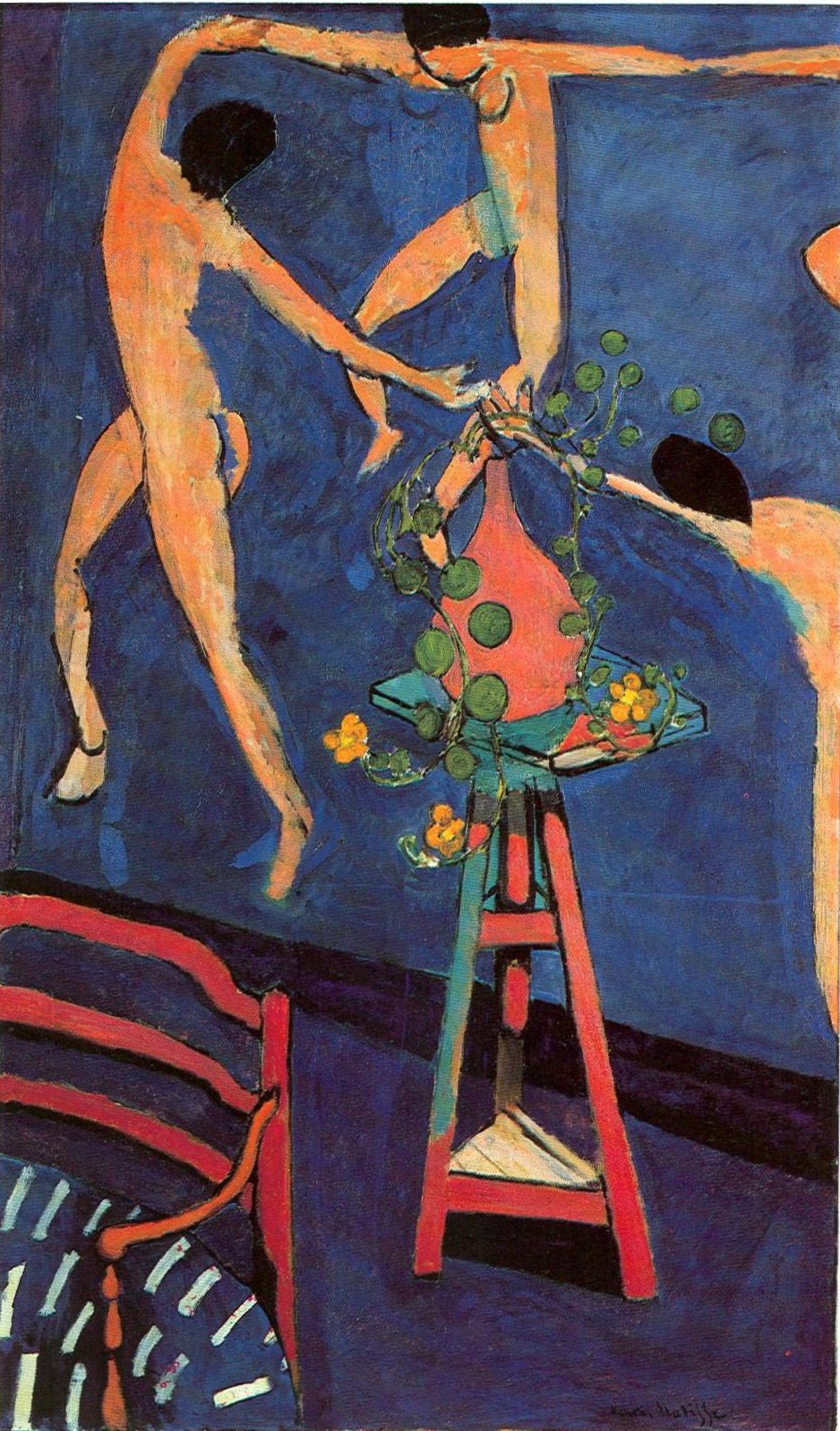
A diametrically opposed approach to visible traces of revision can be found in a review by the art critic Yakov Tugendhold from 1914. When entering the dining room of former Trubetskoy Palace in Moscow, he saw a “stained-glass window” on the opposite wall that made the “iconostasis” by Gauguin vanish like a “matte fresco.”13 What he saw was Henri Matisse’s painting, Nasturtiums with The Dance (II) (1912), which had just arrived in Moscow a few months earlier, completing a triptych with The Conversation (1908–1912) and Corner of the Artist’s Studio (1912). Tugendhold traced his immediate thought of a “cathedral” to the vibrancy of the dancing figures, which “flicker on the dark blue background.”14 The painting’s vivid luminosity is not only caused by the contrasts of Matisse’s color composition but also by the triptych’s treatment of the surface.
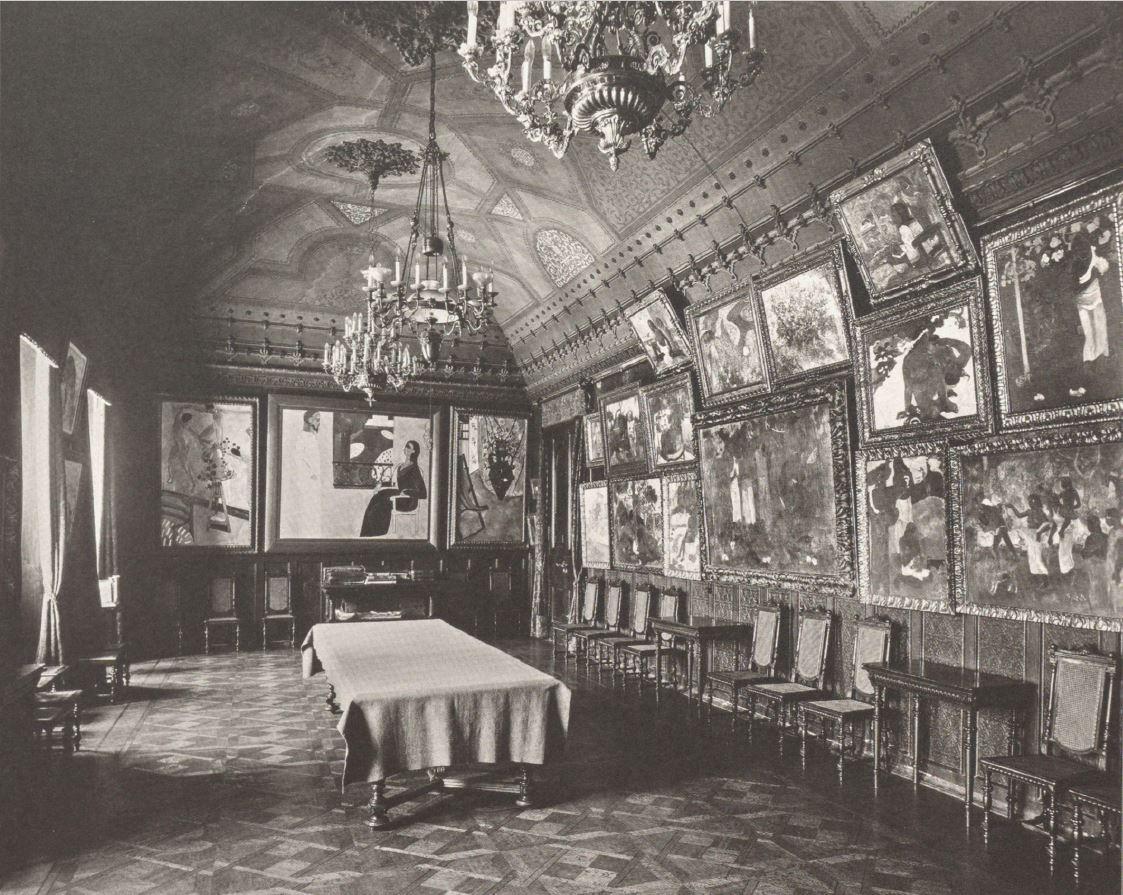
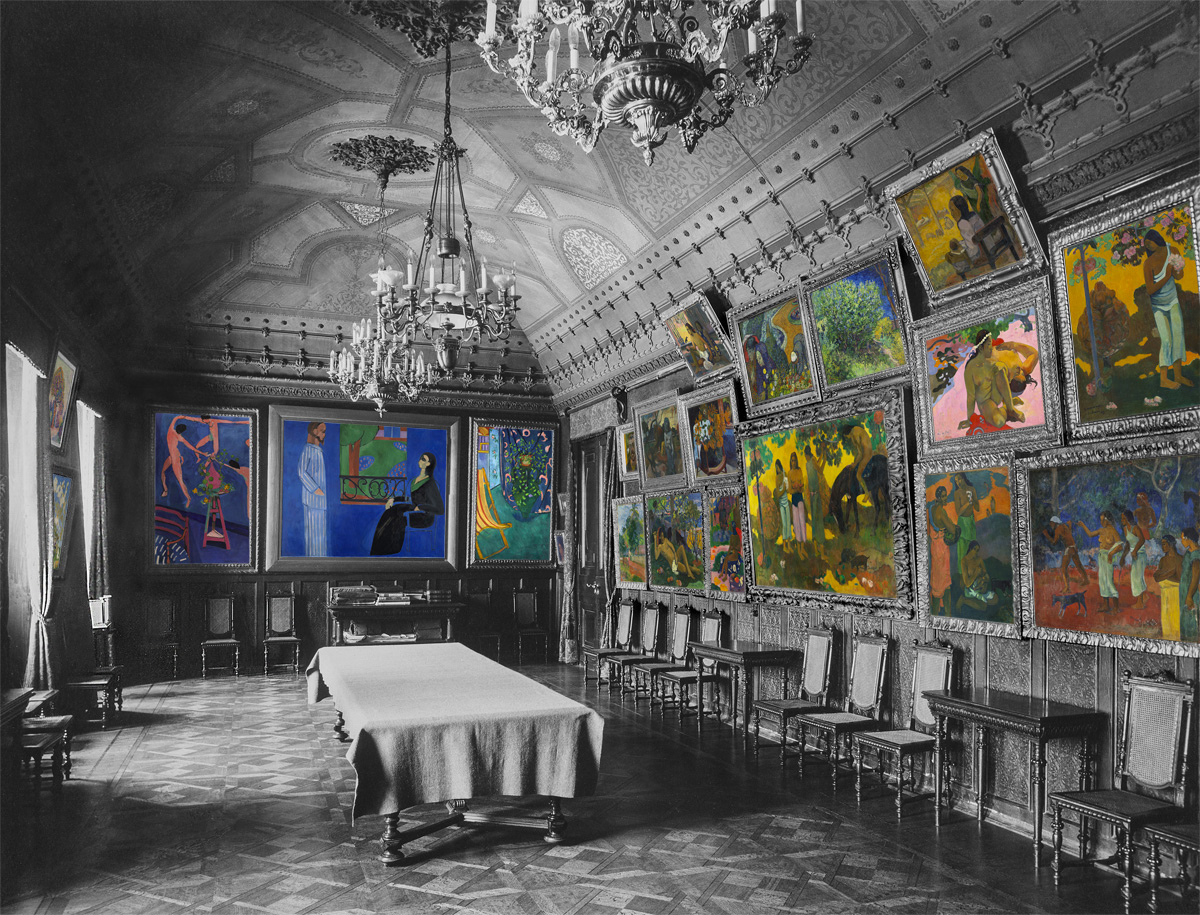
This would mean that one hundred years ago, the beholder’s attention must have been absorbed by a depth that only revealed itself upon approaching the canvas. Not only the dancers but also the dark blue background of Nasturtiums (II) is flickering: it seems to contain more than it reveals at first glance. Shadowy silhouettes surround the pink bodies in different shades of blue, thereby blending Matisse’s brushwork with the movement of the dancers. Similar to stained-glass windows, the painting conveys the impression of semitransparency. But instead of sunlight shining through, the beholder sees through to the submerged layers of paint and gains access to the sedimented past of the painting’s production. The numerous details of reworking (which are responsible for the flickering effect) constitute both a material and temporal element. They mediate between the artist’s change of intention, the final state of the painting, and the beholder. The retrospective view suggests a fascinating moment of (seeming) transparency. It is precisely this moment that contains the quasi-sacred luminosity of the painting. But Tugendhold’s approach differs from the positivist one. His encounter with art, and especially with pentimenti, becomes a revelatory experience of epiphanic quality beyond the human subject.
When Matisse visited Sergei Shchukin in November 1911, a Christian tapestry still hung on the triptych’s wall, The Adoration of the Magi (1886–1902) by Edward Burne-Jones (executed by William Morris).15 The fact that Matisse obviously intended his work, which depicts his studio, to replace the tapestry and positioned it directly next to Gauguin’s iconostasis anticipates his statement in Jazz (1947): “Do I believe in God? Yes, when I work.”16 The triptych poses a similar question about belief and knowledge to the beholder, although of a more profane kind.
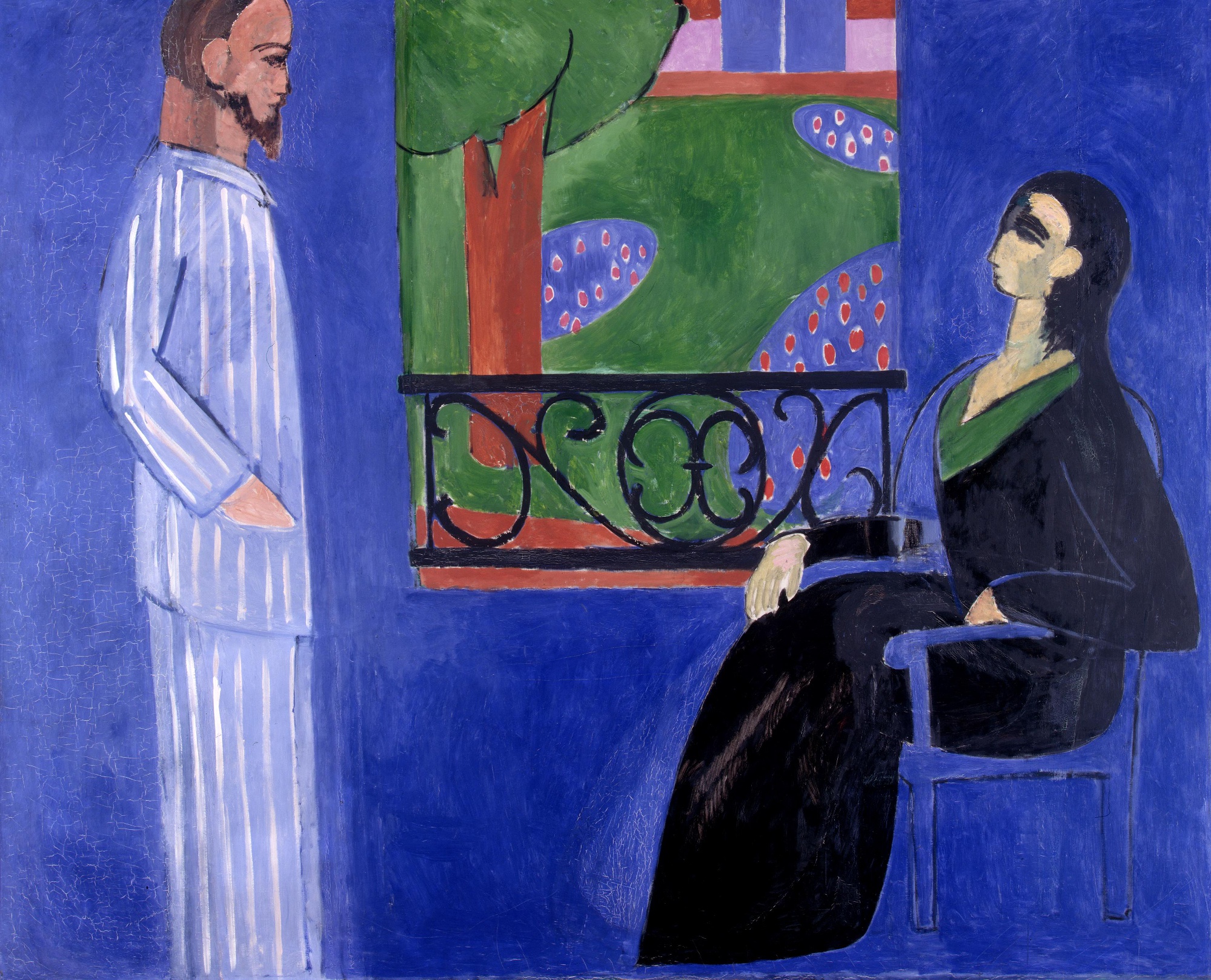
Even Tugendhold’s review implicitly raises this question. It contains a contradiction that addresses the nature of pentimenti. When opening a range of comparisons with earlier eras of art, the critic associates Matisse’s triptych not only with “the age of stained glass” but also with “shining enamels, and glazed tiles.”17 On the one hand, it impressed Tugendhold because of its luminosity, which seems to emanate from the depths of the semitransparent layers of paint. On the other hand, he remembers mirroring surface coatings. Just as external light is reflected on the surface of enamel until it becomes a blinding highlight, so too does the beholder’s retrospective view of the painting’s production. The insights into the painting process that pentimenti and other phenomena of reworking seem to provide are put to the test and prevented from entirely penetrating Matisse’s procedure. So, my argument is that the very insight we acquire from paintings like Nasturtiums (II) is an acknowledgment of the limits of interpretation. Such paintings help us to understand the challenges and the responsibility of interpreting art.
In what follows, I will suggest a third possible interpretation. It will focus on the fact that Matisse often deliberately made his reworking process visible in varying forms and media. As I will argue, this introduces a moral dimension that has always accompanied the conceptual history of pentimenti, although in different ways.
III. Suspicion of fraud
There is little doubt that process is the pivotal aspect of Matisse’s oeuvre. His writings and interviews thematize the significance of artistic revision and his desire to understand himself, that is, his artistic personnalité, decisions, and actions. This self-observation would enable “[s]on grand désir … de s’expliquer, de se démontrer, de se faire comprendre… par n’importe qui!”18
This aporetic investigation of the self consequentially went hand in hand with the threat of incomprehension. In 1913, when a Salon public was doubting the seriousness of Matisse’s artistic undertaking, Marcel Sembat stepped in as an advocate for him: “[I]l y a cent manières de singer l’originalité,”19 he prosaically noted in the Cahiers d’aujourd’hui. His observation responds to a deep uncertainty about modern art, which according to Stanley Cavell stems from a “threat of fraudulence.”20 Richard Shiff condenses this uncertainty in the following dilemma: “How was a critic to distinguish sincere from insincere expressiveness?”21 History defined the changing nature of the subject, which affected the reception and production of art. Cavell again: we “can no longer be sure that any artist is sincere—we haven’t convention or technique or appeal to go on any longer: anyone could fake it. And this means that modern art, if and where it exists, forces the issue of sincerity, depriving the artist and his audience of every measure except absolute attention to one’s experience and absolute honesty in expressing it.”22
Sincerity was (and is) at stake. Matisse introduces this concept in his first interviews, but it has hardly received attention in the scholarship. Nevertheless, Sembat focuses on its consequences: if others’ opinions can no longer serve as a reliable orientation, only a direct encounter between the beholder and the painting remains. Sembat therefore promotes individual analysis of art from close up. “Les toiles sont là! l’oeuvre est là! regardez!”23 Matisse’s Arab Coffeehouse (1913) was a suitable example for the training of the eye:
Tout Matisse y est! Si on regarde bien on l’y voit tout entier. Mais il faut regarder de près ….
Ces personnages étendus …, sachez qu’ils n’ont pas toujours été peints ainsi .… En examinant le bas du tableau on découvre, la trace d’une ancienne rangée de babouches qui, devant ce café, était très éloquente.
Pourquoi les babouches, la pipe, les traits des visages, les couleurs variées des burnous, pourquoi tout cela a-t-il fondu?
Parce que, pour Matisse, se parfaire, c’est simplifier! … Un psychologue ne s’y trompera pas: Matisse va d’instinct du concret vers l’abstrait, vers le général.24
Sembat recommends seeing with one’s own eyes how details are painted over and effaced. Like a psychoanalyst, the beholder should delve into the painting’s underlying layers—and so into the artist’s process of thinking and composing—through the traces that Matisse left behind on the painting’s surface. This leads to a crucial question: why did the artist efface so many details? Following a putative modernist logic, the artist must have undertaken a process of abstraction paralleled by compositional simplification.
But Sembat’s question misses a crucial point that contributes to the doubts concerning Matisse’s seriousness. The argument of simplification does not explain why Sembat was able to see the traces of formerly depicted objects with his naked eye. Also, the different shades of blue in Nasturtiums (II) must have been visible from the beginning.25 Artworks like these confront their viewer with a seemingly paradoxical question, which hasn’t lost its relevance: why does Matisse allow us to see that he has made depicted objects disappear? And more generally, what is the function of purposefully visualizing the process of reworking in the final painting? And what are the consequences for the status of pentimenti and the interpretation of such artworks?
To answer those questions, it is necessary to view the painting from Matisse’s perspective, the artist-beholder. This allows us to understand at least two different uses for the visualization of revision. First, in the case of Nasturtiums (II), there is a more unobtrusive, private use, which might have mattered the most to Matisse, although it also entails the possibility that the effacement might be recognized by others, too. Second, I will consider a didactic exhibition concept that documents the artistic process using photography. This type of exhibition made headlines in the French press shortly after the end of World War II. Without doubt, Matisse used it to initiate a training of the public’s eye that simultaneously contributed to shaping the reception of his art.
IV. An enigmatic line
Returning to the former Trubetskoy Palace in 1914: Shchukin’s guests encountered Matisse’s art even before entering the dining room. Numerous paintings accompanied the ascent to the second floor, among others The Dance (II) (1909–1910) in the staircase. On the threshold of the dining room, the triptych unfolds before the guests’ eyes. The yellow and red striped cloth of the chair in Corner of the Artist’s Studio seems to be imbued with Gauguin’s color range, inviting the beholder to contemplate the nearby iconostasis. But as soon as they have imaginatively entered the painting, they relax in Matisse’s studio.
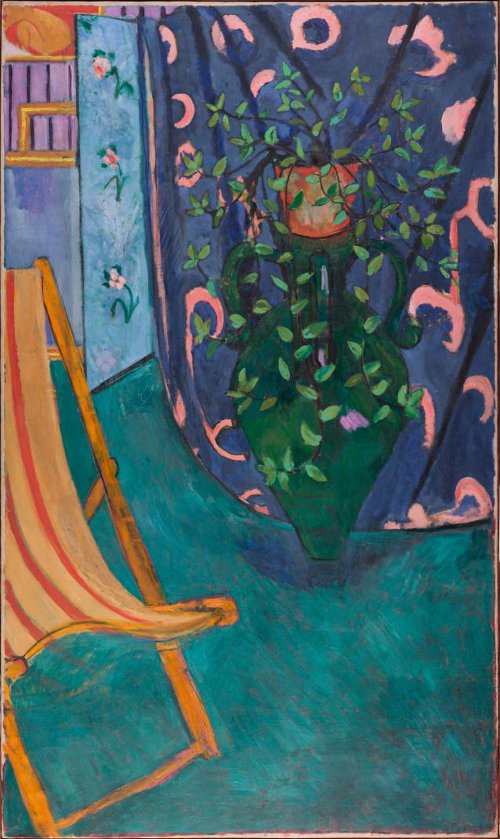
Chairs were frequently protagonists in the artist’s oeuvre, beginning with his famous armchair metaphor in “Notes of a Painter” (1908).26 Conversely, his portrait Fauteuil rocaille (1946), with its smeary color application and chaotic charcoal marks, evokes one thing: restlessness. Years later, Matisse confirmed to Georges Charbonnier that he required relaxation. “Mon rôle, je le crois, est de donner de l’apaisement. Parce que, moi, j’ai besoin d’apaisement.”27
As a main source of this ongoing self-questioning, Matisse identified his longstanding master Gustave Moreau. Moreau encouraged his students to depart from traditional paths to develop their own methods and solutions.28 Together with Albert Marquet, Matisse used the copy lessons to search for weaknesses in the Louvre’s masterpieces, a search for mistakes that he applied to his own works after realizing that weaknesses are ubiquitous in the masters’ paintings.29 On a more subtle level, this disquiet is recognizable in Corner of the Artist’s Studio—more specifically, in the cloth fixed to the chair. Composed of a wooden frame and linen cloth, the chair is an alter ego of the painting itself. On its front edge, the cloth lifts with a wavelike motion. The black line of the upper curve designates an abrupt stop to the red stripes, yet they continue their course underneath the green studio floor undeterred. Accordingly, the chair’s visible pentimenti suggest that the cloth has been pressed down by someone—possibly Matisse—who has just departed, leaving behind a wavelike cloth. This reflects the fact that during the painting process, Matisse would study his paintings from a distance, recognize an inconsistency, and finally hurry back to the canvas. In the 1930s Matisse declared: “À chaque étape, j’ai un équilibre, une conclusion. A la séance suivante, si je trouve qu’il y a une faiblesse dans mon ensemble, je me réintroduis dans mon tableau par cette faiblesse—je rentre par la brèche—et je reconçois le tout.”30
For the artist, identifying pictorial weaknesses turns out to be a gateway to the painting process itself. Matisse reenters the painting process through a crack or breach, disturbing the harmonic organization of the overall composition. The French phrase “entrer par la brèche” (to win through violent means, and more literally: to push through the breach) indicates an offensive, even aggressive gesture.31 Matisse is not fighting, however, against a foreign enemy but against himself, against his own mistakes but also with their help.
The fact that Matisse uses the term breach—that is, a deliberately produced opening in a wall—as a metaphor for inconsistencies and mistakes is revealing. Consider the classical form of pentimenti as mistakes an artist regrets and overpaints but that unintentionally reappear after centuries. If a latent fault becomes visible in the final layer of the painting where it shouldn’t resurface at all, it thwarts the painting’s surface opacity. The repented part acts as a gap, as a crack or break in the image. It connects the layers of paint by merging the work’s past with its present, the abandoned idea with the final solution. Pentimenti visually bring things together on one plane that are temporally, technically, or compositionally incompatible.
At the same time, the resulting gap, its anachronism, opens the image to an imaginary future; to unrealized possibilities, and to a creative excess, its latent and never fully realized becoming; or what’s more, to an intimation of what can never entirely be depicted but stimulates the production of art on a subliminal level. I will return to this idea when I address instances where Matisse deliberately integrates pentimenti in the final layers, thereby postponing and to an extent negating repentance itself, or rather, making what was repented something desirable.
As I have argued of Corner of the Artist’s Studio, Matisse has just left the image space to make corrections to a painting outside of the frame. The bicolored pattern of the draped curtain in the background together with the vase and potted plant on top of it suggest that the painting may be Nasturtiums (II), the triptych’s right wing. The depicted painting in this painting—The Dance, of which Shchukin’s guests already encountered the final version in the staircase—immediately attracts the beholder’s attention because of its vibrant background, the light blue shades around the dancing figures. Through parts that have not been completely painted over and the thin fissures of the craquelure, the underlying color scheme is visible to the naked eye. It corresponds in large part to the New York version, Nasturtiums with The Dance (I) (1912). And indeed, according to Rebecca Rabinow and Isabelle Duvernois’ technological analysis, Matisse developed the final version Nasturtiums (II) on the basis of the first composition.
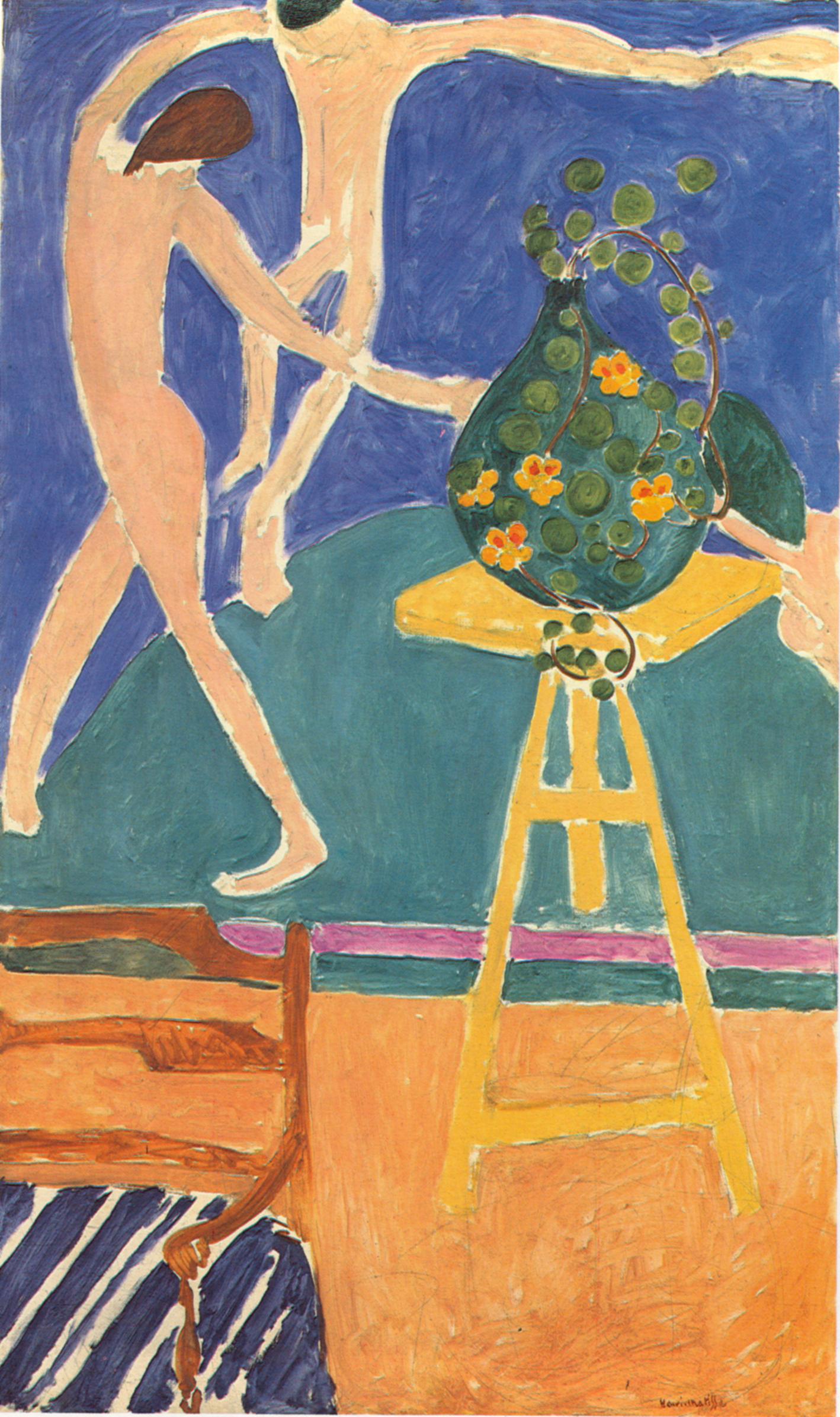
The frontal orientation of Nasturtiums (I) causes an overlapping of actual and virtual picture planes, resulting in a total flattening of the image space. Probably because of its simplified and hence seemingly more modern composition, the scholarship mistakenly classified Nasturtiums (I) as the final version until the 1990s.32 After beginning once again with this flat, frontal conception in Nasturtiums (II), Matisse must have shifted the perspective on The Dance to the right, as x-radiography and infrared reflectography suggest. This change of perspective during the process of reworking explains a large part of the multiplied foot and leg positions.33 In other words, Matisse uncoupled the painting in the painting from its abstract anchoring on the picture plane and made it tangible as an object with depicted edges in a small but noticeable image space. It appears as if he has stepped back from The Dance in the fictive studio of Nasturtiums (II) to take a new perspective on the painting and to reconsider the legitimacy of its radical flatness, since it was this quality in The Dance (II) that had been harshly criticized at the Salon d’Automne.
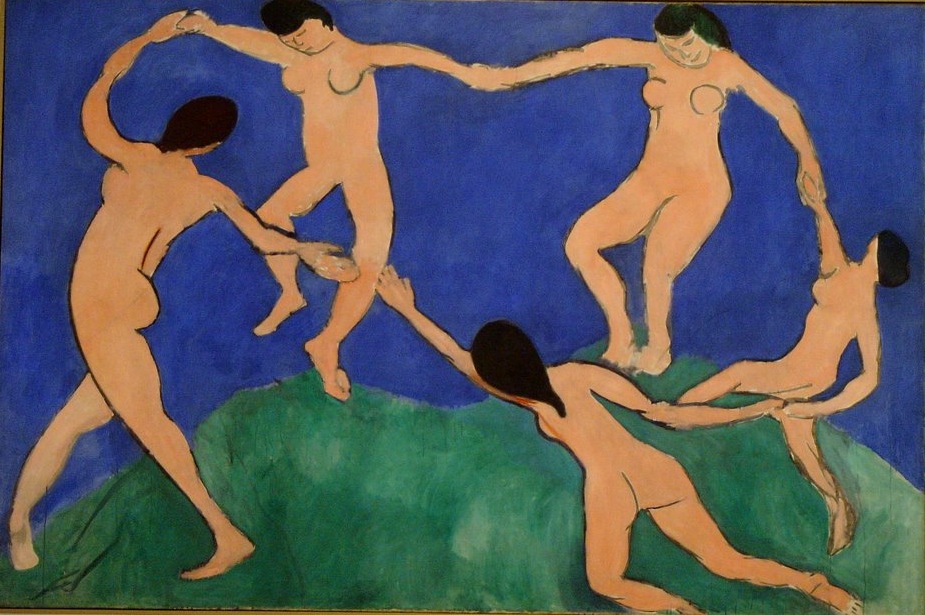
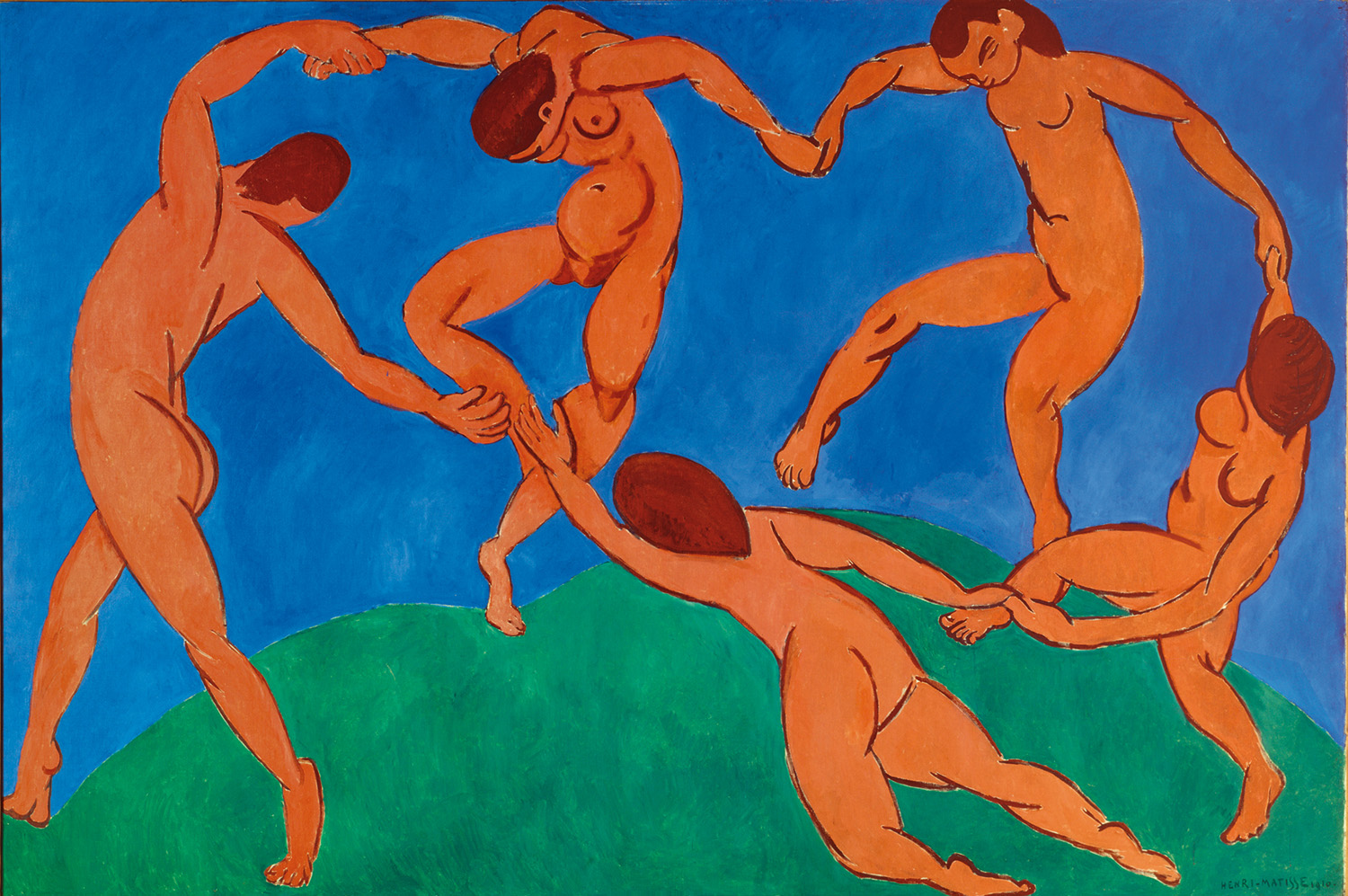
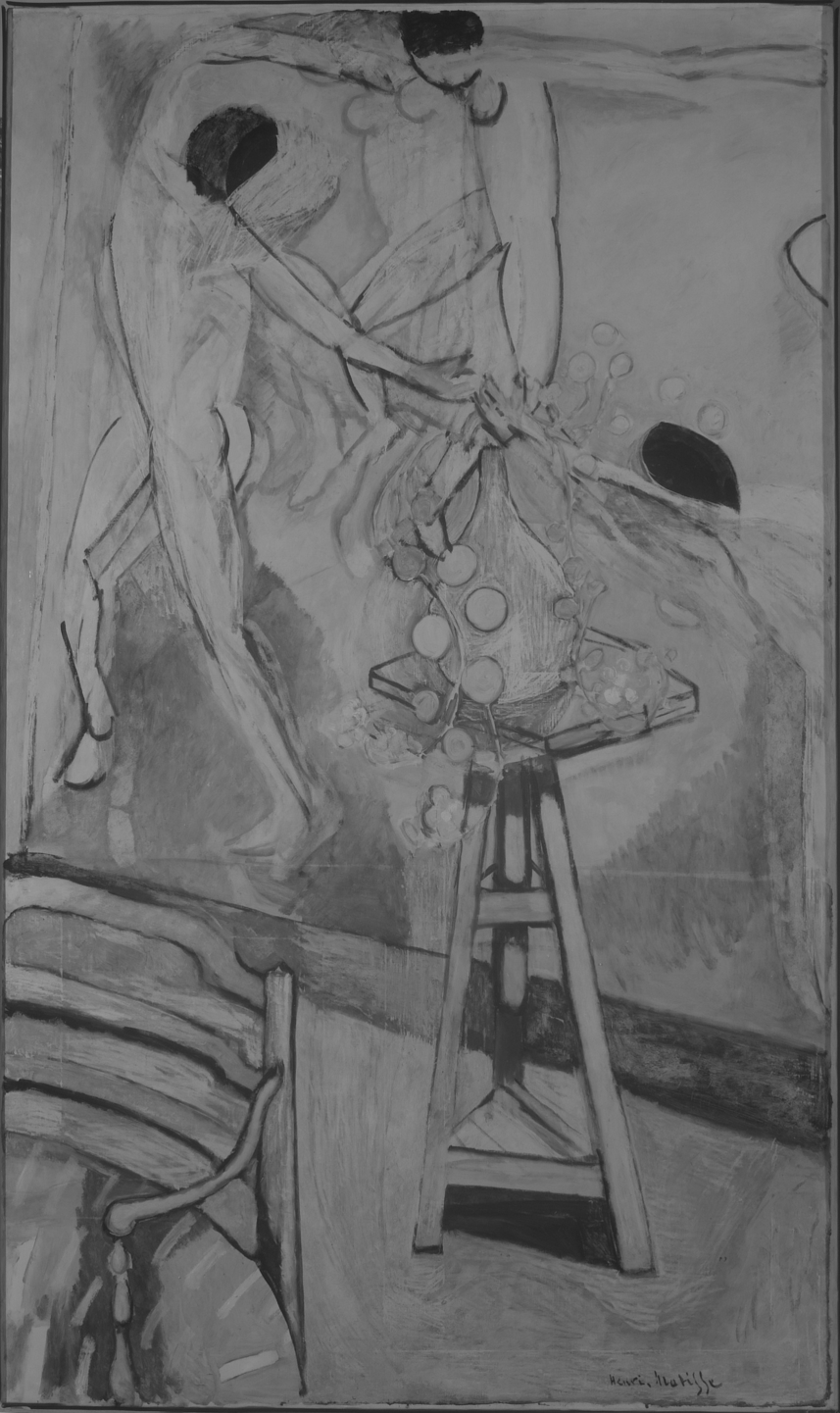
The visible traces of alteration in Nasturtiums (II), which led Tugendhold to notice a flickering impression, result in a dynamization of the dancing figures. In the context of the exhibition Radical Invention in Chicago, John Elderfield correctly observed a “rhythmic study of Bergsonian duration,”34 thereby connecting the painterly gesture to the subject of dance. But his observation contains a formulation that reminds us of the distrust of Sembat’s contemporaries. Considering the overt display of reworking (scrape marks, the use of solvents, overpainting) in Nasturtiums (II), Elderfield writes, “Matisse went so far as to fake alteration, creating false pentimenti around the figures.”35 Thus, the status of the pentimenti as traces of genuine reworkings is made precarious by their intentional visualization and integration into the final painting.36 They become questionable. This is not without good reason since it remains uncertain with a great number of these pentimenti whether they are caused by genuine corrections—that is, whether there really are flesh tones submerged under the figure’s extremities.37 In some cases Matisse seems to have translated the temporal logic of the artistic process into a painterly twist.
Consider, now, the narrow horizontal line that runs from the right-hand figure’s upper leg to the modeling table’s leg and then continues to the pink foot of the dancer on the left. Matisse applied the horizontal line with a lighter blue on the dark-blue background, so this supposed trace of reworking has been manufactured by the artist on purpose. Neither a genuine remainder of a regretted detail nor a reasonable part of the image’s motif, the horizontal light-blue line is an enigma even to the conservator Isabelle Duvernois: “Une ligne horizontale, bleu clair, peinte sur le fond bleu profond demeure énigmatique. Cette ligne ne représente pas d’élément particulier, même si elle est clairement visible.”38
Precisely this uncertainty or ambiguity reveals a lot about the painting and Matisse’s art in general. It demonstrates what happens if pentimenti are used intentionally: they are exposed to the suspicion of being rhetorical devices. And that problematizes not only painting as such but also the interpretation of art. To reject the work would be one possible reaction. Yet despite their uncertainty, Elderfield and Duvernois still strive to ascribe meaning to what is visible.
Tugendhold is not the only one to have been attracted by the vibrant background of the painting in Nasturtiums (II). Probably due to our knowledge of the artist’s interest in self-citation, it is tempting to see the depicted painting as one of the two versions (likely the first version) of The Dance (I: 1909; II: 1909/10).39 But as soon as we consider the light-blue pentimenti, a clear identification is no longer possible. Instead, the painting in the painting combines elements of both versions. For example, the left figure’s inflected, light-blue foot repeats the foot position of the first version, whereas its pink companion adopts the dancing pose of the final state. In a more brutal way, Matisse diminishes the figure’s right back, while overtly adding the right buttock—the blue paint interval leaves no doubt about this. Furthermore, the torso of the dancer in the middle is deprived of its frontal aspect (first version) in a very schematic manner. In the right-hand figure, this leads to an effacement of her breast, as if the blue ground were eating into her flesh. For these observations, it is unimportant whether the pentimenti are genuine or false. The only thing that matters is that we can see different postures side by side, as if Matisse had superimposed or layered the two versions of The Dance to check them against each other. With this in mind, we can understand Tugendhold’s association of the painting with a stained-glass window, particularly with its material quality, its semitransparency.
The suggestion of a partial superposition is suggested by medium of oil paint itself and so too Matisse’s examination of his artistic means. Against this background, Elderfield’s assumption that Nasturtiums (II) depicts the duration of the painting process is convincing. What his remarks do not explain, however, is the unsubtle and harsh execution of the reworked parts. They evoke the artist’s metaphor of breaches that provoke a violent reaction against his own failure. This implies that both classical pentimenti and the enigmatic horizontal line do not necessarily afford a meaningful integration into the content of the picture for the beholder, but maybe for the artist as self-observer. Enigmatic marks in a painting may be meaningful if viewed from another perspective, namely that of the painter-beholder, since the painter was the only one fully aware of the painting’s genesis.
To summarize the different explanations of Nasturtiums (II) so far: the technological analysis identifies a shift in perspective from a frontal to a more lateral view on The Dance, while a purely visual examination suggests a superposition of the two versions of The Dance, just as the simplified flat composition of Nasturtiums (I) is literally the basis for Nasturtiums (II). Additionally, an infrared reflectogram reveals another horizontal line, which, according to Duvernois, may depict the bottom edge of The Dance in its previous frontal orientation.40 It may also depict the former direction of the chair back’s topmost rod.
The crucial point is that the enigmatic horizontal blue line is positioned exactly at the same height as its double in the infrared reflectogram. Wouldn’t it be conceivable that Matisse traced the original course of the bottom edge of The Dance? Or rather that he was making the extension of the chair’s top rod present, that is, the function of the equally enigmatic “horizontal pink stripe that continues across the canvas” of Nasturtiums (I)?41 It is exactly this pink stripe that projects nothing but frontality and so flatness as such.
Isabelle Duvernois deems my argument plausible with a small reservation.42 On this account, the gesture of drawing the horizontal line resembles a closure, a final stroke that re-presents the radical flatness of The Dance (I and II) as well as Nasturtiums (I). Following this interpretation, Nasturtiums with The Dance (II) becomes a painting of remembrance that enables Matisse to compare the superimposed states, recapitulate his work, and transfer it into a third version. He treated The Dance as a painting that is literally frozen in the process of becoming. In this sense, both genuine and false pentimenti function as frictions and openings of the image to the future.
About thirty years later in an essay by Louis Aragon in Matisse’s Dessins: Thèmes et Variations (1943), Matisse interprets the skillful drawing of a line (trait) as a gesture of “conviction.”43 He specifies that it is a question of assurance (“pas … avec incertitude”44), “maitrîse,”45 and blind trust in one’s own artistic and technical capabilities. The horizontal light-blue line in Nasturtiums (II) thus records an early, rather cautious moment of an autonomously developed solution to a pictorial problem. It equals the positing of a personal stance, an intimate point of view, a kind of standing up for the decision of flatness, even though it remains in the implicit sphere of the supposedly senseless, at least for the beholder.
V. Self-confidence through another point of view
In 1913, Sembat’s analysis of Arab Coffeehouse led him to the conclusion of an ongoing simplification of the artwork’s composition. But this is not the only plausible explanation; on the contrary, it can also lead to a misinterpretation. Nevertheless, Sembat’s explanation survived for a reason: at least since the English-language publication of Roger Fry’s monograph on the artist (1935), which included for the first time a series of état photographs of the painting Pink Nude (1935) in the making, Matisse confirmed this conclusion with his publication strategy. Starting with the cut-out technique in the early 1930s (as with The Dance mural), Matisse used état photographs to document a painting’s development and to compare its various states.46 They took over an important function of pentimenti in earlier works. In different art magazines, the dated and published photographs invited the reader to act the part of the artist—that is, to study the artwork’s genesis, to glimpse behind closed studio doors, and to reconstruct the steps of Matisse’s production process.
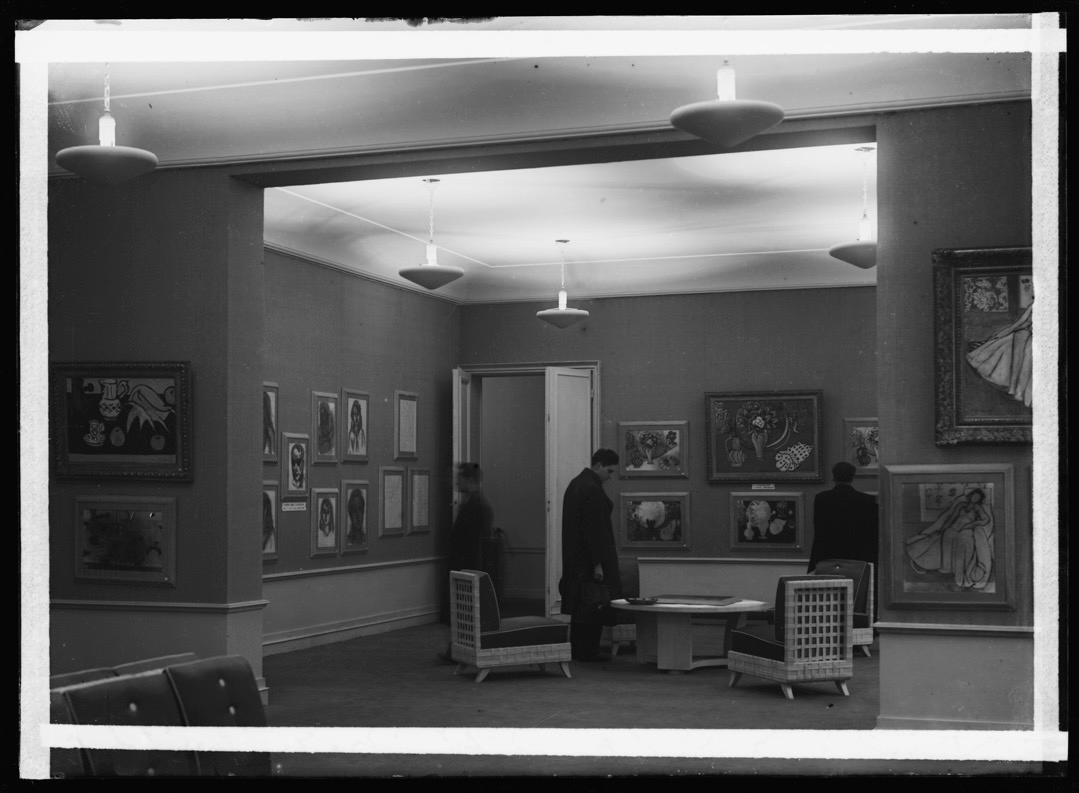
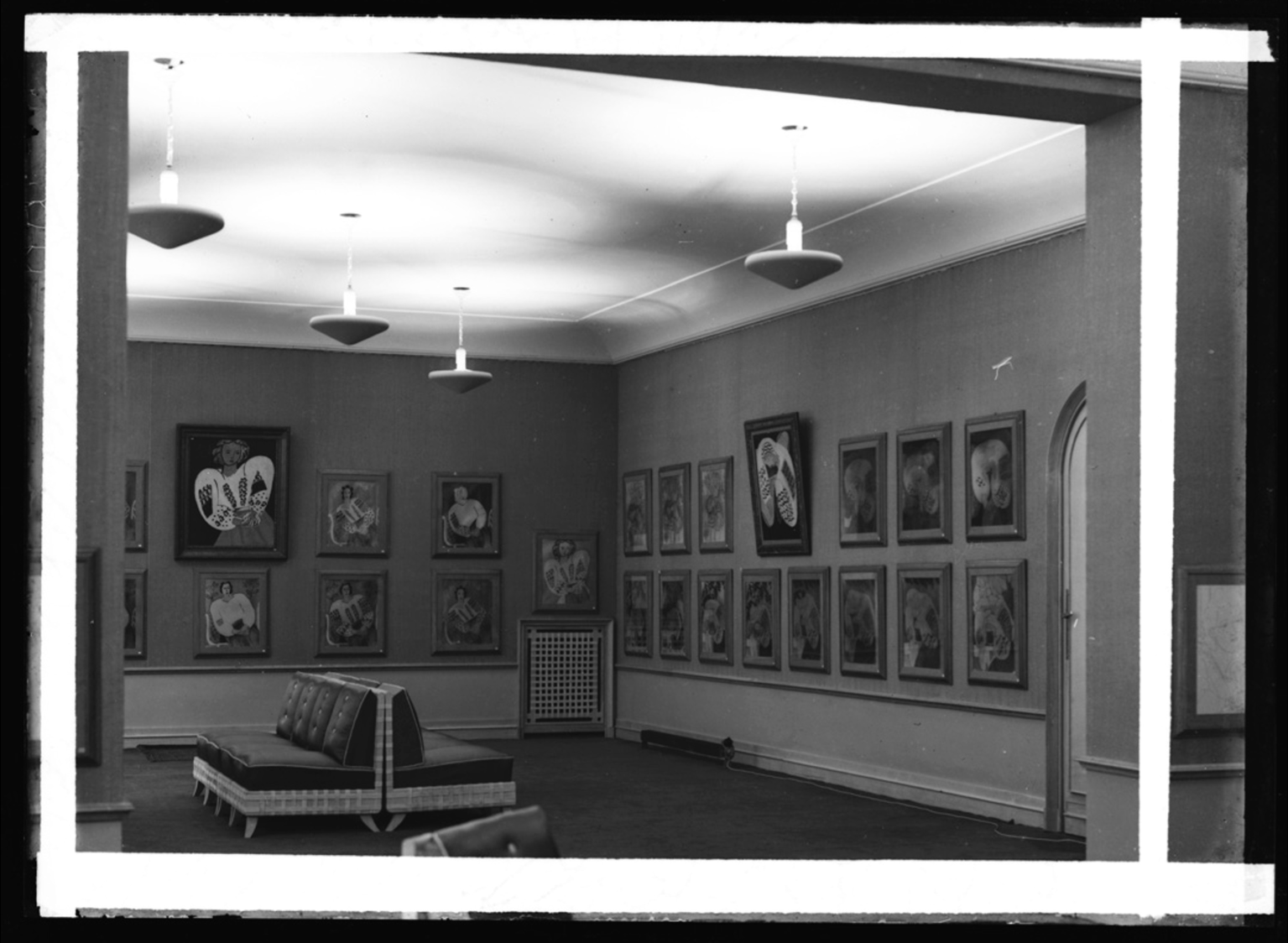
This strategy culminated in the inaugural exhibition of the Parisian Gallery Maeght in December 1945; on its walls hung several paintings surrounded by their histories in black and white. Several years ago Gaku Kondo made a remarkable discovery regarding the arrangement of the photographs at this exhibition. In the case of two artworks, The Romanian Blouse (1940) and The Dream (1940), Matisse did not hang the photographs chronologically, as it would be expected. To some extent, this decision refutes the hasty assumption of a logically progressing production process corresponding to a prior plan or idea.47 For those who registered Matisse’s implication, the exhibition opened the production process to reflection on unrealized possibilities. Suddenly not only executed alternative (but eventually rejected) final states by the artist were visible and thinkable, but the what-if question also became urgent for the viewers, asking for further potential images that have never been realized.
The chance to access earlier states was appreciated by the daily newspapers. They interpreted the exhibition as making an inclusive gesture of unveiling (“en dévoilant”48). One review by Jean Pierre was politically motivated. In contrast to the Matisse retrospective at the 1945 Salon d’Automne, which according to Pierre only delighted bourgeois insiders (“seul plaisir des initiés”49), the exhibition at the Gallery Maeght was exemplary for its new form of presentation. It would challenge, Pierre argues, the current state of society, which was characterized by a general lack of understanding, a response that had been looming before the war when a weekly journal had defamed a Cezanne retrospective as a “‘bluff monté par un gouvernement de gauche’ pour ‘l’avilissement artistique de tout un peuple!’” (E, 83). But Pierre was sure: “Peu nous importe l’attitude d’une bourgeoisie qui … refuse de comprendre .… [L]es masses populaires ont le droit d’être éclairées” (E, 84). What visiting the gallery would enable was a comprehension of “les principaux problèmes rencontrés en chemin” and thus of “la signification totale” of an artwork (E, 86, 85). On the one hand, Matisse opened a sphere of knowledge that had been reserved for the exclusive circle of initiates and therefore democratized the judgment of art. On the other, he broadened and expanded the meaning of an artwork to its production process, including the artist’s reflections and actions.
Jean Pierre’s words are remarkably affirmative, considering that Matisse scarcely expressed himself in politics, was considered the leader of bourgeois art, and had retreated into his ivory tower in southern France during the war. The gallery exhibition thus resembled a diplomatic stroke that rehabilitated Matisse’s oeuvre for the revolutionary esprit of the avant-garde: “Quand un artiste est … sensible à l’évolution du monde, il lui faut … créer un langage nouveau pour s’exprimer. Rompant la chaîne des abstractions familières, son œuvre est une invitation—parfois une summation—à pratiquer le principe cartésien: se défaire des opinions reçues et reconstruire, de nouveau et dès le fondement, tous les systèmes de ses connaissances” (E, 83). If we no longer rely on any previous categories of judgment, if there is a lack of both personal and interpersonal certainty, only a serious reappraisal and reconstruction of knowledge will help. Matisse’s art seems to demand the beholder to be active and participate in the reorganization and strengthening of knowledge.
Moreover, Pierre’s review bears witness to the success of the gallery’s underlying concept. With the title, “Travail d’Henri Matisse,” it advertised the exhibition as presenting nothing less than a basic condition of social existence: “Matisse retrouve la force à force d’exactitude. A force de volonté il nous donne la confiance.”50 According to this rhetoric, the artist regained his volition and independence through serious artistic work. And with the aid of his works, Matisse passes this self-assurance on to the beholder. Visiting the exhibition promised both a practical and an epistemological experience, a reenactment of Matisse’s process of working and decision-making with the lesson that the final painting doesn’t necessarily have to correspond to public taste: “l’artiste seul decide.”51 The exhibition made the visitor aware of how the artistic process of production is accompanied by serious decisions. Sometimes they are not successful; they always involve the possibility of failure. But only those who approach a problem from different perspectives will finally arrive at an artistic solution that can then be handed over to the beholder with confidence. Exactly this is what Matisse made clear to Louis Aragon in 1943: the final gesture of grasping one’s abilities, the spontaneous but skillful drawing of a line, is not about decisiveness but rather about conviction.
The états photographs—which make reworking visible—prove the necessity of an interminable process of production characterized by uncertain paths and the possibility of going astray. Given some of Matisse’s seemingly simplistic compositions, some of his critics had doubted this hard work at the Salon d’Automne in 1945. From the artist’s point of view, such a simplistic perception caused misunderstandings among a younger generation of artists.52 Consequently, the Gallery Maeght exhibition served as a pedagogical corrective to these misinterpretations.53
Even more significant is the fact that the reviews sometimes described the exhibited works as “confidences,”54 suggesting that the exhibition shared intimate knowledge and confessions of the artist with his contemporaries, an exchange that initiated a novel, demanding relation to the public. This is because Matisse’s gesture of truthful and sincere unveiling was bound to a reverse expectation: being entrusted, as the viewer, with the power of interpretation involved striving for a serious understanding, just as Matisse for his part produced art sincerely. The beholder had to move back and forth between the photographs; they had to reorient themself to develop a judgment—their own stance or point of view to Matisse’s final painting. The viewer repeated, to a certain extent, the artist’s production process and experienced what it means to interpret art, as a subject on the basis of an independently elaborated judgment. Only a few months after the end of the Second World War, French society must have been longing for such a training of the eye and self-confidence.
It is crucial to bear in mind that behind Matisse’s training of the beholder was an obvious strategy for guiding the reception of his art. After all, he was the one who took or ordered the état photographs and chose which ones should be published—a calculation that extends to the virtual paint layers. Lydia Delectorskaya makes a revealing observation in this regard:
De nos jours, les spécialistes fouillent aux rayons X les tableaux des maîtres—Rembrandt, Picasso et autres—pour essayer de percevoir quelques repères de ce chemin parcouru afin de tenter de le reconstituer.
Pour Matisse, ce procédé ne donnerait rien, car il superposait rarement les couleurs: il grattait les compartiments de la couleur indésirable …. Mais en ce qui concerne l’oeuvre de Matisse, nous avons ces documents photographiques dont il a laissé publier certains, convaincu donc de leur intérêt.55
As far as it was within his power, Matisse determined precisely what should be visible to posterity. His art—and especially the pentimenti he integrated into his works—confront us with the insight that we often approach paintings with our own desires and purposes and so see what we want to see. To keep this in mind while we look at a painting seems to be the proper lesson of Matisse’s oeuvre. One’s perspective on what one sees will always remain limited, but it may be broadened by other perspectives.
Notes

I. Positivist search for the artist’s traces
In 2022, after nearly two years of technological analysis, the Museum of Modern Art shared the results of its attempt to uncover both interpictorial quotations and a multitude of secrets of the painting process embedded in Henri Matisse’s The Red Studio (1911).1 The conservation team shared its insights into “what’s underneath”2 in the exhibition catalogue and in a video on the museum’s website. Even with the naked eye, “little clues” could be seen on the surface of the painting: traces of revision and underpainting, which Matisse sometimes “deliberately left visible.”3 They refer to underlying layers of paint, while also seeming to preserve the artist’s auratic presence. The user comments in response to the video accordingly bear witness to either prosaic headshaking—“It’s called painting. Things aren’t working out you make changes, sometimes radical ones”4—or passionate enthusiasm. One user remembers the extraordinary closeness to the artist she experienced when discovering these clues on a previous occasion: “There was a Matisse exhibit in my city years ago. It was my first chance to see his paintings close up. When i saw some of those intricate passages it made me cry! Looking at those little clues he left can make the viewer feel a sense of intimacy with him. It’s kind of like a subtle vibration left behind.”5 The exhibition the user refers to is likely Matisse: Radical Invention, 1913–1917, which took place at the Art Institute of Chicago in 2010. The extent of the technological analysis in the catalogue was overwhelming. Connoisseurship has long been motivated both by the search for autographic evidence and the eagerness to discover more and more. As David Rosand has shown, the desire to gain an intimate insight into the proceedings behind closed studio doors arose in the sixteenth century. The focus was on especially fragile features or unintended peculiarities. Besides autographic drawings and sketches, not only odds and ends but even refuse—rejected by the artist and so seemingly especially authentic—found its way from the studio into private collections.6
Visible traces of revision in artworks belong to this category of residues, too. In painting, so-called pentimenti constitute regretted strokes (il pentimento = repentance) that have been painted over and thus disposed of but have reappeared as mistakes. They fuel the beholder’s illusion of overcoming temporal and physical boundaries. From 1757 onward (the term’s first reference in French art theory), the preoccupation with pentimenti (Fr. repentirs) has been attributed to one circle of experts in particular: “les curieux,”7 inquisitive amateurs interested in oddities.8 According to historical French dictionaries, these connoisseurs were capable of identifying pentimenti due to their trained eye (“les yeux exercés”9). In search of material autographic evidence of artists’ changes of mind, connoisseurship claimed its interpretive authority—ultimately asserting expertise in authorship and authenticity, as Christopher Wood has shown. By the end of the nineteenth century, pressure intensified when amateur knowledge began competing against technological methods.10 When Wilhelm Conrad Röntgen recognized the potential of electromagnetic waves in 1895, a euphoria broke out for analyzing peculiar objects, bodies, and artworks. Like pentimenti and similar marks of artistic revision, x-radiography generates an almost voyeuristic fantasy in the beholder of being able to see into the intimate “dessous d’un Matisse.”11 A fantasy that combines with the unfulfillable desire to reconstruct the painting’s complete genesis. Such desires are part of a much longer intellectual history of dreams of transparency.12
Today exhibitions are sometimes designed to align with these desires. They only become problematic if the positivist search for autographic marks ends with the modest assertion that revision has taken place. However, this is only the point of departure for a more interesting observation by curator Anny Aviram: Matisse “leaves clues, but at the same time he confuses you.” Visibility does not automatically promise clarity of meaning. On the contrary, the paths to reconstructing the painting process remain ambiguous. And precisely the fact that those paths, these clues, are visible seems to be responsible for both positive and negative reactions in viewers.
II. Epiphanic encounter
A diametrically opposed approach to visible traces of revision can be found in a review by the art critic Yakov Tugendhold from 1914. When entering the dining room of former Trubetskoy Palace in Moscow, he saw a “stained-glass window” on the opposite wall that made the “iconostasis” by Gauguin vanish like a “matte fresco.”13 What he saw was Henri Matisse’s painting, Nasturtiums with The Dance (II) (1912), which had just arrived in Moscow a few months earlier, completing a triptych with The Conversation (1908–1912) and Corner of the Artist’s Studio (1912). Tugendhold traced his immediate thought of a “cathedral” to the vibrancy of the dancing figures, which “flicker on the dark blue background.”14 The painting’s vivid luminosity is not only caused by the contrasts of Matisse’s color composition but also by the triptych’s treatment of the surface.
This would mean that one hundred years ago, the beholder’s attention must have been absorbed by a depth that only revealed itself upon approaching the canvas. Not only the dancers but also the dark blue background of Nasturtiums (II) is flickering: it seems to contain more than it reveals at first glance. Shadowy silhouettes surround the pink bodies in different shades of blue, thereby blending Matisse’s brushwork with the movement of the dancers. Similar to stained-glass windows, the painting conveys the impression of semitransparency. But instead of sunlight shining through, the beholder sees through to the submerged layers of paint and gains access to the sedimented past of the painting’s production. The numerous details of reworking (which are responsible for the flickering effect) constitute both a material and temporal element. They mediate between the artist’s change of intention, the final state of the painting, and the beholder. The retrospective view suggests a fascinating moment of (seeming) transparency. It is precisely this moment that contains the quasi-sacred luminosity of the painting. But Tugendhold’s approach differs from the positivist one. His encounter with art, and especially with pentimenti, becomes a revelatory experience of epiphanic quality beyond the human subject.
When Matisse visited Sergei Shchukin in November 1911, a Christian tapestry still hung on the triptych’s wall, The Adoration of the Magi (1886–1902) by Edward Burne-Jones (executed by William Morris).15 The fact that Matisse obviously intended his work, which depicts his studio, to replace the tapestry and positioned it directly next to Gauguin’s iconostasis anticipates his statement in Jazz (1947): “Do I believe in God? Yes, when I work.”16 The triptych poses a similar question about belief and knowledge to the beholder, although of a more profane kind.
Even Tugendhold’s review implicitly raises this question. It contains a contradiction that addresses the nature of pentimenti. When opening a range of comparisons with earlier eras of art, the critic associates Matisse’s triptych not only with “the age of stained glass” but also with “shining enamels, and glazed tiles.”17 On the one hand, it impressed Tugendhold because of its luminosity, which seems to emanate from the depths of the semitransparent layers of paint. On the other hand, he remembers mirroring surface coatings. Just as external light is reflected on the surface of enamel until it becomes a blinding highlight, so too does the beholder’s retrospective view of the painting’s production. The insights into the painting process that pentimenti and other phenomena of reworking seem to provide are put to the test and prevented from entirely penetrating Matisse’s procedure. So, my argument is that the very insight we acquire from paintings like Nasturtiums (II) is an acknowledgment of the limits of interpretation. Such paintings help us to understand the challenges and the responsibility of interpreting art.
In what follows, I will suggest a third possible interpretation. It will focus on the fact that Matisse often deliberately made his reworking process visible in varying forms and media. As I will argue, this introduces a moral dimension that has always accompanied the conceptual history of pentimenti, although in different ways.
III. Suspicion of fraud
There is little doubt that process is the pivotal aspect of Matisse’s oeuvre. His writings and interviews thematize the significance of artistic revision and his desire to understand himself, that is, his artistic personnalité, decisions, and actions. This self-observation would enable “[s]on grand désir … de s’expliquer, de se démontrer, de se faire comprendre… par n’importe qui!”18
This aporetic investigation of the self consequentially went hand in hand with the threat of incomprehension. In 1913, when a Salon public was doubting the seriousness of Matisse’s artistic undertaking, Marcel Sembat stepped in as an advocate for him: “[I]l y a cent manières de singer l’originalité,”19 he prosaically noted in the Cahiers d’aujourd’hui. His observation responds to a deep uncertainty about modern art, which according to Stanley Cavell stems from a “threat of fraudulence.”20 Richard Shiff condenses this uncertainty in the following dilemma: “How was a critic to distinguish sincere from insincere expressiveness?”21 History defined the changing nature of the subject, which affected the reception and production of art. Cavell again: we “can no longer be sure that any artist is sincere—we haven’t convention or technique or appeal to go on any longer: anyone could fake it. And this means that modern art, if and where it exists, forces the issue of sincerity, depriving the artist and his audience of every measure except absolute attention to one’s experience and absolute honesty in expressing it.”22
Sincerity was (and is) at stake. Matisse introduces this concept in his first interviews, but it has hardly received attention in the scholarship. Nevertheless, Sembat focuses on its consequences: if others’ opinions can no longer serve as a reliable orientation, only a direct encounter between the beholder and the painting remains. Sembat therefore promotes individual analysis of art from close up. “Les toiles sont là! l’oeuvre est là! regardez!”23 Matisse’s Arab Coffeehouse (1913) was a suitable example for the training of the eye:
Tout Matisse y est! Si on regarde bien on l’y voit tout entier. Mais il faut regarder de près ….
Ces personnages étendus …, sachez qu’ils n’ont pas toujours été peints ainsi .… En examinant le bas du tableau on découvre, la trace d’une ancienne rangée de babouches qui, devant ce café, était très éloquente.
Pourquoi les babouches, la pipe, les traits des visages, les couleurs variées des burnous, pourquoi tout cela a-t-il fondu?
Parce que, pour Matisse, se parfaire, c’est simplifier! … Un psychologue ne s’y trompera pas: Matisse va d’instinct du concret vers l’abstrait, vers le général.24
Sembat recommends seeing with one’s own eyes how details are painted over and effaced. Like a psychoanalyst, the beholder should delve into the painting’s underlying layers—and so into the artist’s process of thinking and composing—through the traces that Matisse left behind on the painting’s surface. This leads to a crucial question: why did the artist efface so many details? Following a putative modernist logic, the artist must have undertaken a process of abstraction paralleled by compositional simplification.
But Sembat’s question misses a crucial point that contributes to the doubts concerning Matisse’s seriousness. The argument of simplification does not explain why Sembat was able to see the traces of formerly depicted objects with his naked eye. Also, the different shades of blue in Nasturtiums (II) must have been visible from the beginning.25 Artworks like these confront their viewer with a seemingly paradoxical question, which hasn’t lost its relevance: why does Matisse allow us to see that he has made depicted objects disappear? And more generally, what is the function of purposefully visualizing the process of reworking in the final painting? And what are the consequences for the status of pentimenti and the interpretation of such artworks?
To answer those questions, it is necessary to view the painting from Matisse’s perspective, the artist-beholder. This allows us to understand at least two different uses for the visualization of revision. First, in the case of Nasturtiums (II), there is a more unobtrusive, private use, which might have mattered the most to Matisse, although it also entails the possibility that the effacement might be recognized by others, too. Second, I will consider a didactic exhibition concept that documents the artistic process using photography. This type of exhibition made headlines in the French press shortly after the end of World War II. Without doubt, Matisse used it to initiate a training of the public’s eye that simultaneously contributed to shaping the reception of his art.
IV. An enigmatic line
Returning to the former Trubetskoy Palace in 1914: Shchukin’s guests encountered Matisse’s art even before entering the dining room. Numerous paintings accompanied the ascent to the second floor, among others The Dance (II) (1909–1910) in the staircase. On the threshold of the dining room, the triptych unfolds before the guests’ eyes. The yellow and red striped cloth of the chair in Corner of the Artist’s Studio seems to be imbued with Gauguin’s color range, inviting the beholder to contemplate the nearby iconostasis. But as soon as they have imaginatively entered the painting, they relax in Matisse’s studio.
Chairs were frequently protagonists in the artist’s oeuvre, beginning with his famous armchair metaphor in “Notes of a Painter” (1908).26 Conversely, his portrait Fauteuil rocaille (1946), with its smeary color application and chaotic charcoal marks, evokes one thing: restlessness. Years later, Matisse confirmed to Georges Charbonnier that he required relaxation. “Mon rôle, je le crois, est de donner de l’apaisement. Parce que, moi, j’ai besoin d’apaisement.”27
As a main source of this ongoing self-questioning, Matisse identified his longstanding master Gustave Moreau. Moreau encouraged his students to depart from traditional paths to develop their own methods and solutions.28 Together with Albert Marquet, Matisse used the copy lessons to search for weaknesses in the Louvre’s masterpieces, a search for mistakes that he applied to his own works after realizing that weaknesses are ubiquitous in the masters’ paintings.29 On a more subtle level, this disquiet is recognizable in Corner of the Artist’s Studio—more specifically, in the cloth fixed to the chair. Composed of a wooden frame and linen cloth, the chair is an alter ego of the painting itself. On its front edge, the cloth lifts with a wavelike motion. The black line of the upper curve designates an abrupt stop to the red stripes, yet they continue their course underneath the green studio floor undeterred. Accordingly, the chair’s visible pentimenti suggest that the cloth has been pressed down by someone—possibly Matisse—who has just departed, leaving behind a wavelike cloth. This reflects the fact that during the painting process, Matisse would study his paintings from a distance, recognize an inconsistency, and finally hurry back to the canvas. In the 1930s Matisse declared: “À chaque étape, j’ai un équilibre, une conclusion. A la séance suivante, si je trouve qu’il y a une faiblesse dans mon ensemble, je me réintroduis dans mon tableau par cette faiblesse—je rentre par la brèche—et je reconçois le tout.”30
For the artist, identifying pictorial weaknesses turns out to be a gateway to the painting process itself. Matisse reenters the painting process through a crack or breach, disturbing the harmonic organization of the overall composition. The French phrase “entrer par la brèche” (to win through violent means, and more literally: to push through the breach) indicates an offensive, even aggressive gesture.31 Matisse is not fighting, however, against a foreign enemy but against himself, against his own mistakes but also with their help.
The fact that Matisse uses the term breach—that is, a deliberately produced opening in a wall—as a metaphor for inconsistencies and mistakes is revealing. Consider the classical form of pentimenti as mistakes an artist regrets and overpaints but that unintentionally reappear after centuries. If a latent fault becomes visible in the final layer of the painting where it shouldn’t resurface at all, it thwarts the painting’s surface opacity. The repented part acts as a gap, as a crack or break in the image. It connects the layers of paint by merging the work’s past with its present, the abandoned idea with the final solution. Pentimenti visually bring things together on one plane that are temporally, technically, or compositionally incompatible.
At the same time, the resulting gap, its anachronism, opens the image to an imaginary future; to unrealized possibilities, and to a creative excess, its latent and never fully realized becoming; or what’s more, to an intimation of what can never entirely be depicted but stimulates the production of art on a subliminal level. I will return to this idea when I address instances where Matisse deliberately integrates pentimenti in the final layers, thereby postponing and to an extent negating repentance itself, or rather, making what was repented something desirable.
As I have argued of Corner of the Artist’s Studio, Matisse has just left the image space to make corrections to a painting outside of the frame. The bicolored pattern of the draped curtain in the background together with the vase and potted plant on top of it suggest that the painting may be Nasturtiums (II), the triptych’s right wing. The depicted painting in this painting—The Dance, of which Shchukin’s guests already encountered the final version in the staircase—immediately attracts the beholder’s attention because of its vibrant background, the light blue shades around the dancing figures. Through parts that have not been completely painted over and the thin fissures of the craquelure, the underlying color scheme is visible to the naked eye. It corresponds in large part to the New York version, Nasturtiums with The Dance (I) (1912). And indeed, according to Rebecca Rabinow and Isabelle Duvernois’ technological analysis, Matisse developed the final version Nasturtiums (II) on the basis of the first composition.
The frontal orientation of Nasturtiums (I) causes an overlapping of actual and virtual picture planes, resulting in a total flattening of the image space. Probably because of its simplified and hence seemingly more modern composition, the scholarship mistakenly classified Nasturtiums (I) as the final version until the 1990s.32 After beginning once again with this flat, frontal conception in Nasturtiums (II), Matisse must have shifted the perspective on The Dance to the right, as x-radiography and infrared reflectography suggest. This change of perspective during the process of reworking explains a large part of the multiplied foot and leg positions.33 In other words, Matisse uncoupled the painting in the painting from its abstract anchoring on the picture plane and made it tangible as an object with depicted edges in a small but noticeable image space. It appears as if he has stepped back from The Dance in the fictive studio of Nasturtiums (II) to take a new perspective on the painting and to reconsider the legitimacy of its radical flatness, since it was this quality in The Dance (II) that had been harshly criticized at the Salon d’Automne.
The visible traces of alteration in Nasturtiums (II), which led Tugendhold to notice a flickering impression, result in a dynamization of the dancing figures. In the context of the exhibition Radical Invention in Chicago, John Elderfield correctly observed a “rhythmic study of Bergsonian duration,”34 thereby connecting the painterly gesture to the subject of dance. But his observation contains a formulation that reminds us of the distrust of Sembat’s contemporaries. Considering the overt display of reworking (scrape marks, the use of solvents, overpainting) in Nasturtiums (II), Elderfield writes, “Matisse went so far as to fake alteration, creating false pentimenti around the figures.”35 Thus, the status of the pentimenti as traces of genuine reworkings is made precarious by their intentional visualization and integration into the final painting.36 They become questionable. This is not without good reason since it remains uncertain with a great number of these pentimenti whether they are caused by genuine corrections—that is, whether there really are flesh tones submerged under the figure’s extremities.37 In some cases Matisse seems to have translated the temporal logic of the artistic process into a painterly twist.
Consider, now, the narrow horizontal line that runs from the right-hand figure’s upper leg to the modeling table’s leg and then continues to the pink foot of the dancer on the left. Matisse applied the horizontal line with a lighter blue on the dark-blue background, so this supposed trace of reworking has been manufactured by the artist on purpose. Neither a genuine remainder of a regretted detail nor a reasonable part of the image’s motif, the horizontal light-blue line is an enigma even to the conservator Isabelle Duvernois: “Une ligne horizontale, bleu clair, peinte sur le fond bleu profond demeure énigmatique. Cette ligne ne représente pas d’élément particulier, même si elle est clairement visible.”38
Precisely this uncertainty or ambiguity reveals a lot about the painting and Matisse’s art in general. It demonstrates what happens if pentimenti are used intentionally: they are exposed to the suspicion of being rhetorical devices. And that problematizes not only painting as such but also the interpretation of art. To reject the work would be one possible reaction. Yet despite their uncertainty, Elderfield and Duvernois still strive to ascribe meaning to what is visible.
Tugendhold is not the only one to have been attracted by the vibrant background of the painting in Nasturtiums (II). Probably due to our knowledge of the artist’s interest in self-citation, it is tempting to see the depicted painting as one of the two versions (likely the first version) of The Dance (I: 1909; II: 1909/10).39 But as soon as we consider the light-blue pentimenti, a clear identification is no longer possible. Instead, the painting in the painting combines elements of both versions. For example, the left figure’s inflected, light-blue foot repeats the foot position of the first version, whereas its pink companion adopts the dancing pose of the final state. In a more brutal way, Matisse diminishes the figure’s right back, while overtly adding the right buttock—the blue paint interval leaves no doubt about this. Furthermore, the torso of the dancer in the middle is deprived of its frontal aspect (first version) in a very schematic manner. In the right-hand figure, this leads to an effacement of her breast, as if the blue ground were eating into her flesh. For these observations, it is unimportant whether the pentimenti are genuine or false. The only thing that matters is that we can see different postures side by side, as if Matisse had superimposed or layered the two versions of The Dance to check them against each other. With this in mind, we can understand Tugendhold’s association of the painting with a stained-glass window, particularly with its material quality, its semitransparency.
The suggestion of a partial superposition is suggested by medium of oil paint itself and so too Matisse’s examination of his artistic means. Against this background, Elderfield’s assumption that Nasturtiums (II) depicts the duration of the painting process is convincing. What his remarks do not explain, however, is the unsubtle and harsh execution of the reworked parts. They evoke the artist’s metaphor of breaches that provoke a violent reaction against his own failure. This implies that both classical pentimenti and the enigmatic horizontal line do not necessarily afford a meaningful integration into the content of the picture for the beholder, but maybe for the artist as self-observer. Enigmatic marks in a painting may be meaningful if viewed from another perspective, namely that of the painter-beholder, since the painter was the only one fully aware of the painting’s genesis.
To summarize the different explanations of Nasturtiums (II) so far: the technological analysis identifies a shift in perspective from a frontal to a more lateral view on The Dance, while a purely visual examination suggests a superposition of the two versions of The Dance, just as the simplified flat composition of Nasturtiums (I) is literally the basis for Nasturtiums (II). Additionally, an infrared reflectogram reveals another horizontal line, which, according to Duvernois, may depict the bottom edge of The Dance in its previous frontal orientation.40 It may also depict the former direction of the chair back’s topmost rod.
The crucial point is that the enigmatic horizontal blue line is positioned exactly at the same height as its double in the infrared reflectogram. Wouldn’t it be conceivable that Matisse traced the original course of the bottom edge of The Dance? Or rather that he was making the extension of the chair’s top rod present, that is, the function of the equally enigmatic “horizontal pink stripe that continues across the canvas” of Nasturtiums (I)?41 It is exactly this pink stripe that projects nothing but frontality and so flatness as such.
Isabelle Duvernois deems my argument plausible with a small reservation.42 On this account, the gesture of drawing the horizontal line resembles a closure, a final stroke that re-presents the radical flatness of The Dance (I and II) as well as Nasturtiums (I). Following this interpretation, Nasturtiums with The Dance (II) becomes a painting of remembrance that enables Matisse to compare the superimposed states, recapitulate his work, and transfer it into a third version. He treated The Dance as a painting that is literally frozen in the process of becoming. In this sense, both genuine and false pentimenti function as frictions and openings of the image to the future.
About thirty years later in an essay by Louis Aragon in Matisse’s Dessins: Thèmes et Variations (1943), Matisse interprets the skillful drawing of a line (trait) as a gesture of “conviction.”43 He specifies that it is a question of assurance (“pas … avec incertitude”44), “maitrîse,”45 and blind trust in one’s own artistic and technical capabilities. The horizontal light-blue line in Nasturtiums (II) thus records an early, rather cautious moment of an autonomously developed solution to a pictorial problem. It equals the positing of a personal stance, an intimate point of view, a kind of standing up for the decision of flatness, even though it remains in the implicit sphere of the supposedly senseless, at least for the beholder.
V. Self-confidence through another point of view
In 1913, Sembat’s analysis of Arab Coffeehouse led him to the conclusion of an ongoing simplification of the artwork’s composition. But this is not the only plausible explanation; on the contrary, it can also lead to a misinterpretation. Nevertheless, Sembat’s explanation survived for a reason: at least since the English-language publication of Roger Fry’s monograph on the artist (1935), which included for the first time a series of état photographs of the painting Pink Nude (1935) in the making, Matisse confirmed this conclusion with his publication strategy. Starting with the cut-out technique in the early 1930s (as with The Dance mural), Matisse used état photographs to document a painting’s development and to compare its various states.46 They took over an important function of pentimenti in earlier works. In different art magazines, the dated and published photographs invited the reader to act the part of the artist—that is, to study the artwork’s genesis, to glimpse behind closed studio doors, and to reconstruct the steps of Matisse’s production process.
This strategy culminated in the inaugural exhibition of the Parisian Gallery Maeght in December 1945; on its walls hung several paintings surrounded by their histories in black and white. Several years ago Gaku Kondo made a remarkable discovery regarding the arrangement of the photographs at this exhibition. In the case of two artworks, The Romanian Blouse (1940) and The Dream (1940), Matisse did not hang the photographs chronologically, as it would be expected. To some extent, this decision refutes the hasty assumption of a logically progressing production process corresponding to a prior plan or idea.47 For those who registered Matisse’s implication, the exhibition opened the production process to reflection on unrealized possibilities. Suddenly not only executed alternative (but eventually rejected) final states by the artist were visible and thinkable, but the what-if question also became urgent for the viewers, asking for further potential images that have never been realized.
The chance to access earlier states was appreciated by the daily newspapers. They interpreted the exhibition as making an inclusive gesture of unveiling (“en dévoilant”48). One review by Jean Pierre was politically motivated. In contrast to the Matisse retrospective at the 1945 Salon d’Automne, which according to Pierre only delighted bourgeois insiders (“seul plaisir des initiés”49), the exhibition at the Gallery Maeght was exemplary for its new form of presentation. It would challenge, Pierre argues, the current state of society, which was characterized by a general lack of understanding, a response that had been looming before the war when a weekly journal had defamed a Cezanne retrospective as a “‘bluff monté par un gouvernement de gauche’ pour ‘l’avilissement artistique de tout un peuple!’” (E, 83). But Pierre was sure: “Peu nous importe l’attitude d’une bourgeoisie qui … refuse de comprendre .… [L]es masses populaires ont le droit d’être éclairées” (E, 84). What visiting the gallery would enable was a comprehension of “les principaux problèmes rencontrés en chemin” and thus of “la signification totale” of an artwork (E, 86, 85). On the one hand, Matisse opened a sphere of knowledge that had been reserved for the exclusive circle of initiates and therefore democratized the judgment of art. On the other, he broadened and expanded the meaning of an artwork to its production process, including the artist’s reflections and actions.
Jean Pierre’s words are remarkably affirmative, considering that Matisse scarcely expressed himself in politics, was considered the leader of bourgeois art, and had retreated into his ivory tower in southern France during the war. The gallery exhibition thus resembled a diplomatic stroke that rehabilitated Matisse’s oeuvre for the revolutionary esprit of the avant-garde: “Quand un artiste est … sensible à l’évolution du monde, il lui faut … créer un langage nouveau pour s’exprimer. Rompant la chaîne des abstractions familières, son œuvre est une invitation—parfois une summation—à pratiquer le principe cartésien: se défaire des opinions reçues et reconstruire, de nouveau et dès le fondement, tous les systèmes de ses connaissances” (E, 83). If we no longer rely on any previous categories of judgment, if there is a lack of both personal and interpersonal certainty, only a serious reappraisal and reconstruction of knowledge will help. Matisse’s art seems to demand the beholder to be active and participate in the reorganization and strengthening of knowledge.
Moreover, Pierre’s review bears witness to the success of the gallery’s underlying concept. With the title, “Travail d’Henri Matisse,” it advertised the exhibition as presenting nothing less than a basic condition of social existence: “Matisse retrouve la force à force d’exactitude. A force de volonté il nous donne la confiance.”50 According to this rhetoric, the artist regained his volition and independence through serious artistic work. And with the aid of his works, Matisse passes this self-assurance on to the beholder. Visiting the exhibition promised both a practical and an epistemological experience, a reenactment of Matisse’s process of working and decision-making with the lesson that the final painting doesn’t necessarily have to correspond to public taste: “l’artiste seul decide.”51 The exhibition made the visitor aware of how the artistic process of production is accompanied by serious decisions. Sometimes they are not successful; they always involve the possibility of failure. But only those who approach a problem from different perspectives will finally arrive at an artistic solution that can then be handed over to the beholder with confidence. Exactly this is what Matisse made clear to Louis Aragon in 1943: the final gesture of grasping one’s abilities, the spontaneous but skillful drawing of a line, is not about decisiveness but rather about conviction.
The états photographs—which make reworking visible—prove the necessity of an interminable process of production characterized by uncertain paths and the possibility of going astray. Given some of Matisse’s seemingly simplistic compositions, some of his critics had doubted this hard work at the Salon d’Automne in 1945. From the artist’s point of view, such a simplistic perception caused misunderstandings among a younger generation of artists.52 Consequently, the Gallery Maeght exhibition served as a pedagogical corrective to these misinterpretations.53
Even more significant is the fact that the reviews sometimes described the exhibited works as “confidences,”54 suggesting that the exhibition shared intimate knowledge and confessions of the artist with his contemporaries, an exchange that initiated a novel, demanding relation to the public. This is because Matisse’s gesture of truthful and sincere unveiling was bound to a reverse expectation: being entrusted, as the viewer, with the power of interpretation involved striving for a serious understanding, just as Matisse for his part produced art sincerely. The beholder had to move back and forth between the photographs; they had to reorient themself to develop a judgment—their own stance or point of view to Matisse’s final painting. The viewer repeated, to a certain extent, the artist’s production process and experienced what it means to interpret art, as a subject on the basis of an independently elaborated judgment. Only a few months after the end of the Second World War, French society must have been longing for such a training of the eye and self-confidence.
It is crucial to bear in mind that behind Matisse’s training of the beholder was an obvious strategy for guiding the reception of his art. After all, he was the one who took or ordered the état photographs and chose which ones should be published—a calculation that extends to the virtual paint layers. Lydia Delectorskaya makes a revealing observation in this regard:
De nos jours, les spécialistes fouillent aux rayons X les tableaux des maîtres—Rembrandt, Picasso et autres—pour essayer de percevoir quelques repères de ce chemin parcouru afin de tenter de le reconstituer.
Pour Matisse, ce procédé ne donnerait rien, car il superposait rarement les couleurs: il grattait les compartiments de la couleur indésirable …. Mais en ce qui concerne l’oeuvre de Matisse, nous avons ces documents photographiques dont il a laissé publier certains, convaincu donc de leur intérêt.55
As far as it was within his power, Matisse determined precisely what should be visible to posterity. His art—and especially the pentimenti he integrated into his works—confront us with the insight that we often approach paintings with our own desires and purposes and so see what we want to see. To keep this in mind while we look at a painting seems to be the proper lesson of Matisse’s oeuvre. One’s perspective on what one sees will always remain limited, but it may be broadened by other perspectives.
Notes