
Author: Stephen Maher, Scott Aquanno

Triumph of Capital, Crisis of Democracy

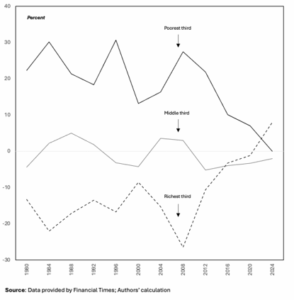
We argue that Trumpism arose from a political and social crisis generated by the success of accumulation. This crisis resulted not from the decline of capitalism or the exhaustion of accumulation but from the state’s inability to contain the fallout of capitalist triumph. Indeed, it only intensified with the economic recovery as profits reached record heights. Trumpism was therefore not a “card” played by a capitalist class seeking to reverse its declining fortunes but resulted from the mobilization of a contradictory class coalition amid an uncontrollable crisis situation.
Read More »

The Fall and Rise of American Finance: From J.P. Morgan to BlackRock

The central argument we make in the book, contrary to the received wisdom on the left, is that the rise of capitalist finance in the current period cannot be understood as a cause or symptom of the decline of the “real” industrial economy. Nor can it be considered as “separate” from production. Rather, finance is and has been utterly integral to the dynamism, flexibility, and strength of capital. Moreover, we show that it is precisely as a result of the role of finance that capitalist development has not led to increasing monopolistic stagnation but has increased the competitiveness of capital by facilitating its growing mobility across space and among economic sectors. Capitalist financialization has thus served to intensify the competitive discipline on all investments to maximize monetary returns.

Read More »