
It has become common sense to interpret the rise of far-right MAGA politics in the U.S. as a product of American decline. The period since the 2008 financial crisis, in particular, is depicted as marking another stage in the terminal decline of U.S. capitalism, often merely pushing earlier predictions of decline forward in time. As the possibilities for productive investment are exhausted, these accounts typically hold, capitalists increasingly make money by extracting rents from the broader economy through financial speculation, monopoly control over technologies and digital platforms, or simply plundering the public treasury. Such activities have supposedly not only harmed workers but also their bosses, undermining the competitiveness of American industrial firms while the “good jobs” that once supported the “middle class” disappeared alongside factory closures and the spread of precarious work across wider swaths of the working class. Some have even suggested that globalization itself, which was critically enabled by finance, eroded American economic might.1
The key to defeating MAGA, in this view, is to revive capitalism, albeit in a more progressive guise. Workers and industrial capitalists are cast as potential allies with a shared interest in restraining finance or breaking up tech monopolies and redistributing income. Rather than seeing market discipline as the main problem for workers, competitiveness is depicted as a common good for both labor and capital. In fact, the consolidation since 2008 of what we have called “the new finance capital” facilitated the rejuvenation of American capitalism in the wake of one of the deepest crises in modern history.2 Already by 2010, profit rates had returned to their post-2000 peak, and by 2020 the mass of profit reached historic highs. Corporate investment likewise remained strong—well above the post-war average.3 It was for these reasons that, on the eve of Trump’s 2024 return to power, The Economist proclaimed the U.S. economy “bigger and better than ever,” while the Financial Times declared that it was “soaring ahead of its rivals” and had become “the envy of the developed world.”4 It is therefore difficult to frame Trump as the product of economic malaise.
The post-2008 period in fact marked a third wave of reorganization of global capitalism since World War II, following the initial construction of the postwar U.S. empire and post-1970s neoliberal restructuring. Resolving the crises of the 1970s and 2008 intensified the antagonism between legitimation and accumulation, restoring the profitability of capital while leaving the working class ravaged by deindustrialization, wage stagnation, and increasing precarity. At the same time, the deepening integration of global capitalism narrowed the scope for distributional reform and class compromise while steadily hollowing out liberal democracy. The growing mobility of capital increasingly allowed it to avoid making concessions that might have supported legitimation, while the marginalization of parties, elections, and representative institutions from the key centers of state power further weakened the state’s capacity to secure popular consent for accumulation. In the absence of a credible left alternative, it was the MAGA far right that was able to capitalize on widespread discontent with a status quo that broad swaths of the population found intolerable.
We argue that Trumpism arose from a political and social crisis generated by the success of accumulation. This crisis resulted not from the decline of capitalism or the exhaustion of accumulation but from the state’s inability to contain the fallout of capitalist triumph. Indeed, it only intensified with the economic recovery as profits reached record heights. Trumpism was therefore not a “card” played by a capitalist class seeking to reverse its declining fortunes but resulted from the mobilization of a contradictory class coalition amid an uncontrollable crisis situation. Much of capital, in fact, remained skeptical of Trump, preferring the Democrats as neoliberal standard-bearers. If MAGA arose from the social and political effects of capitalist strength, in the absence of a substantial left grounded in the working class and capable of offering an alternative path out of the crisis, defeating it cannot mean revitalizing capitalism. Rather, it requires building the power necessary to put a credible socialist alternative on the agenda. The fight against the far right is therefore inseparable from the struggle against capitalism, empire, and environmental collapse.
The Third Reorganization of Global Capitalism
We are now living through a third reorganization of global capitalism since World War II. Each phase was precipitated by crisis and followed by a restoration of the power of capital. Yet each also intensified capital’s tendency to undermine the conditions of its own political legitimation. By generating inequality, unemployment, and insecurity, capitalism strains the state’s capacity to represent society as a community of equal citizens whose will it embodies. The successive reorganizations of global capitalism have sharpened this tension between accumulation and legitimation. Even as profits recovered from the crises of the 1970s and 2008, the U.S. state became increasingly unable to legitimate an economic order whose strength was bound up with the deterioration of living conditions and security for broad sections of the population. Substantial reform has therefore come to require moving beyond class compromise to take on capital as a whole, while sustaining any gains requires linking struggles for reform to a broader project of socialist transition.
The first wave of reorganization emerged after World War II as the American state took the lead in establishing a global monetary and trade order linking formally independent states into an informal empire bound together by cross-border flows of trade and investment. At home, this was accompanied by the incorporation of unions into a “productivist” settlement in which wage gains were tied to productivity growth. When productivity growth slowed in the 1970s, wage increases squeezed profits and imposed the need for a second reorganization. The transition to neoliberalism was inaugurated by the Federal Reserve’s crushing of defensive rebellions by workers with an iron fist through the “Volcker Shock”—raising interest rates to unprecedented heights and leading to skyrocketing unemployment. The constraints on capital mobility embedded within the Bretton Woods regime were then cast aside for a new era of global financial integration. As capital was freed to circulate globally in search of the highest profits and lowest costs, workers and states were forced to compete for investment and jobs by offering the most favorable conditions for accumulation.5
Rising wages, social programs, and formal democracy had helped legitimate capitalism during the postwar “Golden Age.” The restoration of accumulation after the prolonged 1970s crisis, however, devastated working class communities through deindustrialization, growing precarity, and wage stagnation and led to the formation of a more authoritarian state. Power was centralized within an “independent” Federal Reserve insulated from “political” intervention, affording it the flexibility to act as necessary to support accumulation. This meant enforcing class discipline by setting interest rates to maintain levels of unemployment sufficient to contain wage demands and combat inflation. Meanwhile, technocrats within the trade apparatus assumed a growing role in shaping policy through negotiations conducted far from public scrutiny. Politics was thus increasingly removed from legislatures and locked away in inaccessible bureaucracies. Legitimation was constrained by the imperatives of accumulation even as profits grew and wealth concentrated at the top. The constraints on redistribution and the deterioration of workers’ living conditions were not symptoms of capitalist decline but conditions of its strength.
Many saw the financialization that accompanied this reorganization as “hollowing out” the “real” economy and undermining industrial competitiveness. Workers and industrial capitalists, in this view, shared an interest in reining in finance, which, it was claimed, would return “good jobs” and lead to shared prosperity.6 Yet the decline such accounts anticipated never materialized. The rise of finance instead strengthened industry, restoring profits and providing the infrastructure for the global circulation of investment. There was no division between an industrial sector victimized by globalization and a financial sector that benefitted from it. Both were united in an alliance around liberalization.7 As the power of capital grew alongside its ability to “exit,” the capacity of workers to compel it to accept the kinds of class bargains that had underpinned the rising wages and social programs of the “Keynesian” era steadily eroded—what Leo Panitch defined as “the impasse of social democratic politics.”8 Workers were instead faced with what Sam Gindin calls “the polarization of options”: either make inroads toward democratizing investment or face the perpetuation of the status quo.9
The third reorganization followed the 2008 financial crisis, as state intervention sharply exacerbated the “accumulation of wealth at one pole” and the “accumulation of misery” at the other.10 On the one hand, this produced an unprecedented concentration of ownership, record profits, and a resurgent financial-industrial bloc; on the other, workers endured the destruction of millions of jobs, the loss of savings and homes, and the deterioration of wages and working conditions with little state support. Consequently, as the state intervened massively to rebuild the power of capital, the crisis was displaced from the terrain of the economic onto the political. Simmering discontent with a half-century of neoliberalism erupted into a full-blown crisis, as both parties were wracked by insurgencies from the MAGA right and democratic-socialist left. Yet capital remained unwilling to countenance even limited reforms that might have partially restored legitimacy, as evidenced in its near-total opposition to Bernie Sanders, and even to a lesser extent Elizabeth Warren, as well as in the subsequent limits of Bidenomics. In this context, Trump was able to channel widespread anger into a populist revolt expressed within a formally democratic state.
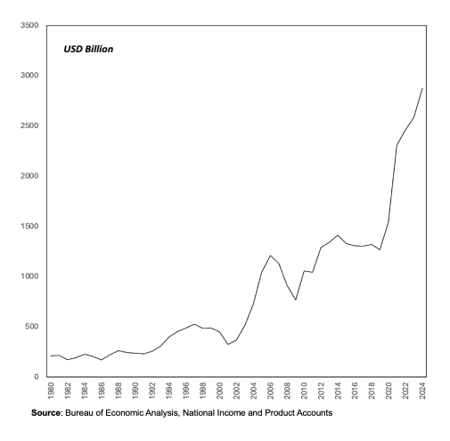
The new finance capital was consolidated through the unprecedented concentration and centralization of corporate ownership in the hands of the so-called “Big Three” asset management firms—BlackRock, State Street, and Vanguard—which emerged as the most powerful institutions within contemporary finance. They owned not merely specific groups of firms but rather the market itself, collectively becoming the largest shareholders in practically every publicly traded U.S. corporation.11 Far from sapping the competitiveness and dynamism of the corporations they owned, this unprecedented financial concentration coincided with U.S. corporate profits soaring to historic heights (fig. 1) and facilitated the ascent of dynamic new economic sectors, above all Big Tech and AI. This belied the persistent depiction of finance as a mere rentier parasite, along with longstanding claims that its rise was necessarily linked with a decline of productive investment.12 That the dynamism of the tech giants has been fuelled by what may be the largest investment boom in the history of capitalism should hammer the final nail in the coffin of such arguments.13
The power of asset management firms is associated with the growing significance of the so-called “shadow banking” system through which credit is generated and allocated within networks of non-bank institutions. As leading researchers observe, shadow banking has now become “the centrally important channel of credit for our times,” not merely “some troubling excrescence on the healthy body of traditional banking.”14 Asset management firms are the most important shadow banks, lending capital as well as supplying the securities that serve as collateral. While this system is increasingly interconnected with the state, especially the central bank, what we have termed the “statization of finance” has been a matter of supporting the ongoing competitive restructuring of capitalism. In fact, these supports for shadow banks closely parallel those extended to traditional banks after the 1929 crash. Yet few would argue that the creation of the FDIC and other agencies signalled that capitalism had entered terminal decline; rather, these were successful efforts to construct a more resilient financial order. The contemporary statization of finance is a similar process through which finance has been reorganized to overcome a major crisis and restore accumulation.
The formation of the new finance capital highlights the crucial point that, as Marx showed, concentration in no way suspends capitalist competition but rather intensifies it within new organizational forms. Competition has driven the asset management firms to allocate capital toward the strongest and most dynamic companies. The ascent of the tech giants illustrates this vividly. As QE drove asset inflation, the Big Three disproportionately directed capital toward the tech sector, allowing these firms the time and flexibility to build up their capital stocks as they emerged as “regulating capitals”—dominant firms whose scale and profitability allow them to set competitive conditions across entire sectors.15 In 2010, the six largest tech giants accounted for just over 5% of the S&P 500; by 2025, they accounted for about a third of it. Asset inflation thus did not impact all firms equally but reinforced shifts in corporate hierarchies based on relative profitability and long-term competitiveness. While this may result in overvaluation or overexpansion, and even precipitate a major crisis, such outcomes reflect the characteristic dynamics of technological development in capitalism, through which the violent destruction of value reorganizes competition and establishes the conditions for new cycles of investment and growth.16
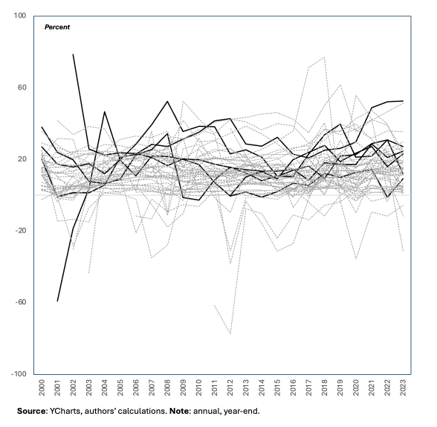
The ongoing competitiveness of this regime is further attested to by the fact that tech itself remained highly competitive despite tremendous concentration within the sector. Were these tech firms protected by monopolistic barriers to competition, as Democratic Party progressives such as Lina Khan and Elizabeth Warren have claimed, this should show up in their ability to persistently earn above-average profit rates, or so-called “monopoly rents.”17 Yet as Figure 2 shows, there is simply no indication that the profit rates of leading technology firms have at all been consistently exceptional; they have clearly gravitated around the social average. The black lines depict the return on capital invested for the largest tech firms—Amazon, Nvidia, Alphabet, Apple, Meta, and Microsoft—while the gray lines represent all other large U.S. firms. The chart shows a striking convergence of the profit rates of five of the “big six” toward the mean. Although the sixth, Apple, has enjoyed somewhat higher returns, these are not historically exceptional. In short, there is simply no evidence that competition in the tech sector has in any way been suspended as monopoly theories would suggest.
Concentration and centralization simply do not equate to monopolization, especially in the context of the power of big finance. The historical tendency of financialization has been to undermine monopoly, breaking down barriers to entry through developing the capacity to allocate capital at whatever scale is necessary to support profitable investment. Big Finance is able to provide large firms with the firepower needed to compete even in markets with staggeringly high capital requirements. The extreme concentration of capital within the large asset management firms has enabled them to undertake massive expenditures to finance firms and projects without excessively tying their financial stability to any single investment, while making it easier for existing market leaders as well as new firms to access financing for innovative projects. The result has been to intensify competitive pressures by encouraging the emergence of new market entrants and technologies. If this process has led to opportunities for speculation, it has also facilitated the growth of new firms and technologies, such as AI, which are coming to define a new epoch in the development of capitalism.
Monopoly theories can also carry problematic political implications. Criticizing big tech or asset management firms strictly on the grounds that they are supposedly monopolies, as mainstream progressives often do, can imply that one opposes them solely on the grounds that they distort market competition. In fact, these firms are harmful because they are competitive capitalist firms. Were it true that big tech or finance were parasitically draining rent from industrial capital, the latter would have a clear incentive to form an alliance with workers to restore competition and prevent such extraction. That there is no indication of this on the horizon points to the more likely conclusion that capital continues to benefit from both financialization, which enhances capital mobility and supports globalization, as well as tech, which has produced innovative technologies that enhance the exploitation of labor, compress circulation time, and support the realization of surplus value. Pining for a return to a bygone “competitive capitalism” through antitrust obscures the systemic sources of power in capitalism, reproducing rather than challenging the competitive imperatives that compel firms to maximize exploitation in the first place.
The rise of Trump, therefore, was not an outcome of economic dysfunction. Nor was it a reaction to the decline of the American empire. Of course, Trump has focused much ire on China, whose economic development has clearly enabled it to take on a larger role in shaping world order and the functioning of the American empire. That system has always been based on the “relatively autonomous” interaction among formally sovereign states. But this is a far cry from the old forms of “inter-imperial rivalry” that characterized the pre-WWII period or the external conflict between the U.S. and USSR during the Cold War era. The American empire has not only been about pillaging other states; rather, it has been organized around incorporating dynamic economies within a global capitalism it superintends—a system held together by globally integrated finance and the multinational corporation. Indeed, as much as 70% of world trade, and many countries’ leading exports, consists of MNCs moving unfinished goods through production processes that cross borders.18 Focusing on the quantitative growth of South–South trade, or the export of commodities from emerging economies, as indicators of U.S. decline can thus be deeply misleading.
China is certainly a major productive, technological, and even geopolitical rival to the U.S. However, there are structural limits to the challenge it can pose—or would want to pose—given the extensive dependence of its own economic ascent on the American empire. China’s development was significantly propelled by its insertion within global circuits of accumulation, including massive inflows of FDI and the offshoring strategies of corporations seeking to reduce costs. While U.S. capitalists initially invested in China to exploit cheap labor and produce absolute surplus value, increases in labor productivity alongside rising wages there have shifted the basis of this toward relative surplus value. Flows of FDI have continued because U.S. firms capture a significant share of these productivity gains. At the same time, these FDI inflows were structured by a planning regime that allowed the Chinese state to coordinate investment on a scale few other capitalist states could match. This regime depends entirely on the state’s ability to maintain capital controls that limit the movement of money into and out of China, thereby allowing it to allocate credit, shield the economy from destabilizing global financial flows, and protect domestic firms from foreign takeover.19
These same controls that supported China’s rise also limit the renminbi’s ability to rival the dollar.20 The renminbi can circulate regionally and play a role in trade between China and its partners as well as among states seeking insulation from U.S. sanctions. In order for it to serve as world money, however, China would have to liberalize its financial system, which would undermine the state’s ability to implement planning. China’s rise thus does not take the form of a self-contained, independent imperial order steadily displacing an American one but has depended on the liberalized dollar system, which allows it to access global finance without itself fully opening its capital account. Chinese firms finance accumulation by borrowing on global dollar markets where costs are substantially lower. Even Chinese development loans and grants through the Belt and Road Initiative are predominantly dollar-denominated—thus integrating recipients more deeply into the dollar system. The larger Chinese capitalism becomes, the more it participates in the dollar system.21
It is ironic that trade deficits and budget deficits, which have always been major pillars of the U.S. empire, have been interpreted by the MAGA right as markers of its weakness. In reality, trade deficits generate the dollar stockpiles abroad that allow it to function as the global reserve currency. Budget deficits, meanwhile, ensure the supply of Treasury bonds that enables dollar holdings to be converted into interest-bearing assets. Holding Treasuries also allows states with trade surpluses vis-à-vis the U.S. to avoid reconverting their export earnings back into their own currencies, which would consequently appreciate and thus make their exports less competitive. The U.S. empire, then, is structured around supplying dollars to the world market and importing goods—often produced by U.S. corporations—while exporting financial assets whose value is underpinned by the global centrality of U.S. capital. There is no reason to believe that trade deficits in goods are more important for the U.S. economy than trade surpluses in financial assets. On the contrary, given the internationalized nature of U.S. capital, both reflect the strength of the U.S. economy. To fixate on trade and budget deficits as indicators of decline is to buy into MAGA mythology.
The interpretation of many on the left that Trumpism represents an attempt by capital to reverse American decline therefore holds little water. Such accounts typically rest on an instrumentalist view of the state, portraying it as a mere tool in the hands of powerful firms, as well as on economism, in which politics and the state are reduced to mere reflections of an economic “base.” From this perspective, it becomes impossible to see Trumpism as rooted in a specifically political crisis that is not derivative of economic malaise. Rather, Trumpism is assumed to represent the direct expression of the “objective” interests of dominant fractions of capital, which directly wield the state in order to sustain their ability to accumulate wealth in the context of capitalist decline. In reality, a political and social crisis rooted in the contradictions of successful accumulation enabled Trump to mobilize a populist class coalition around “unfair trade deals,” while much of big capital has remained skeptical of Trump insofar as the chaos he generates disturbs a highly profitable status quo. If anything, Trump’s contradictory coalition has underpinned his exceptional autonomy from big capital.
From Economic to Political Crisis
Linking the growing immiseration of the working class at the root of the current political crisis to the decline of capital itself critically obscures what Clara Mattei has framed as the contradiction between “the logic of profit” and “the logic of need.”22 Such narratives imply that a strong, competitive capitalism inherently benefits workers and thus that the interests of workers and capitalists are not fundamentally opposed. But this obscures the reality that capital is founded on exploitation and gives rise to tendencies toward the immiseration of labour as well as the production of a surplus population that is superfluous to the momentary needs of accumulation. Just as finance strengthened capital and helped resolve the 1970s crisis by disciplining workers and providing the infrastructure for globalization, the concentration of ownership through the formation of the new finance capital following 2008 intensified pressures to maximize profits and market efficiency. By treating the degradation of the working class as a symptom of capitalism’s failure rather than a sign of its success, declinist accounts depoliticize the antagonism between need and profit, capital and labour. And by blaming the evils of accumulation on the “corruption” of finance, they deflect attention from the systemic violence of capital itself.23 The power of capital has always been predicated on the subordination of human needs to the imperative to profit.
It was the very strength of capital that provoked the social dislocations and political contradictions that gave rise to Trump. But the profitability of this order left capital unwilling to concede the kinds of reforms that might have restored legitimacy but would have required challenging globalization. The new finance capital did not signal the arrival of a capitalist fraction open to social democracy but entrenched the class-wide alliance around globalization.24 As such, it reinforced the “impasse of social democratic politics” Panitch had identified as welfare states and productivist compacts ran up against the structural limits of capitalist profitability during the 1970s. This undermined the ability of such parties to frame growing capitalist profits and rising working-class living standards as mutually beneficial components of a stable Keynesian settlement. Writing in the wake of the defeat of Tony Benn’s “democratic socialist” bid to be Labour Party Deputy Leader and amid the rise of Margaret Thatcher, Panitch insisted that socialists should resist the urge to simply defend social democracy or Keynesian managed capitalism. The impasse demonstrated, rather, that socialists must acknowledge its limits as the basis for articulating an alternative politics.25
As capital withdrew from class bargains, social democratic parties lacked the capacity to mobilize the working class behind an alternative to neoliberalism. Panitch attributed this not simply to external attacks or individual betrayals but to the internal limitations of social democratic politics itself. The top-down, bureaucratic character of social democratic parties and welfare states subordinated grassroots activism to the pursuit of class harmony, disciplining workers by imposing wage restraint and reducing politics to the electoral management of capitalism. Rather than pursuing the impossible task of resurrecting the crumbling postwar settlement, Panitch argued it was necessary to move beyond it. This meant developing democratic organizations that could connect immediate struggles to the formation of the working class as a political force able to radically transform the state and economy. The crucial question was not whether to pursue reform but how to do so without succumbing to social democratization. Yet even as the conditions that had supported class compromise evaporated over the ensuing decades, the left became still more marginal.
Panitch’s analysis has been powerfully vindicated in the decades since, as the second reorganization of global capitalism entrenched the impasse he identified by expanding capital’s freedom to circulate globally. The resulting intensification of competitive disciplines on states and workers alike gave rise to what Sam Gindin framed as a “polarization of options,” expressed among other things in the neoliberal restructuring of social democratic regimes across Europe. For Gindin, this pointed to the need to become more radical. Beyond a limited range of reforms, workers increasingly faced a choice between lowering their expectations and accepting social democratization or pursuing a more radical strategy to break with globalization and move toward democratic control of investment. In the absence of a substantial anti-capitalist left, therefore, alternation in power between the two major parties did little to reverse the continued deterioration in working-class life. Even when they appealed to workers’ frustrations, both remained firmly committed to the bipartisan neoliberal consensus, leading to accumulating dissatisfaction with the established order.26
If the second reorganization institutionalized the social democratic impasse through global liberalization, the third restored accumulation after 2008 while transforming that impasse into an acute political crisis. In the absence of significant working-class struggle, legitimation remained subordinate to the demands of globalized accumulation. This was evident in the state’s response to the financial crisis, as it intervened massively to rebuild finance while leaving a devastated working class to fend for itself. The emergence of Occupy, not to mention the Tea Party, reflected not the strength of the left but the weakness of the center in the context of a legitimation crisis. The unfocused nature of popular rage amid the discrediting of both parties underscored the absence of a left able to consolidate mass discontent into a mobilization that could shape political outcomes. Without a substantial left capable of placing a progressive path out of the crisis seriously on the agenda, the far right became the principal beneficiary of widespread anger at the inequities nakedly on display.
Trump displaced this resentment onto foreign competitors, immigrants, LGBTQ+ people, and other groups depicted as undeserving beneficiaries of social change, fusing anger over “unfair trade deals” with anxieties about the erosion of patriarchy and white privilege. Crucial for his success was the backing of a handful of reactionary billionaires who saw an opportunity to harness popular discontent to advance a far-right agenda. Yet the MAGA alliance consisted primarily of the “losers” of globalization: sections of small and medium capital, the petty bourgeoisie (self-employed persons and professionals), industrial workers, and the lumpenproletariat. The resulting alliance drew on an infrastructure constructed over decades by the organized right linking legal organizations, state Republican Parties, business associations, right-wing billionaires, and local activists.27 Activists drawn especially from the ranks of small capital and the petty bourgeoisie were thus able to mobilize a broader popular constituency through existing Republican, conservative, and community networks.
Sections of small capital and the petty bourgeoisie were radicalized in the aftermath of the 2008 crisis as they were denied the support doled out to big finance, even though they had been especially hard hit. The expansion of the construction sector over the neoliberal period had supported the incomes of extensive networks of contractors and sole proprietors. The impact of the housing market crash visited on these components of the petty bourgeoisie was exacerbated by the credit crunch that followed, as they often rely heavily on personal credit. Home-owning petty bourgeois professionals were also seriously impacted. In the years following the collapse, small capital and the petty bourgeoisie experienced a sharp increase in bankruptcy rates and substantial declines in incomes, while fixed investment by small business increasingly fell behind that of larger firms even amidst the economic recovery.28 Self-employment collapsed during the crisis, surpassing the subsequent impact of COVID-19, and had only partly recovered by the end of the decade.29 Many former sole proprietors sought waged employment. Although business formations picked up after 2013, and income growth for sole proprietors became more consistent, a longer-term trend toward more precarious “gig work” continued to reshape economic conditions for the petty bourgeoisie.30
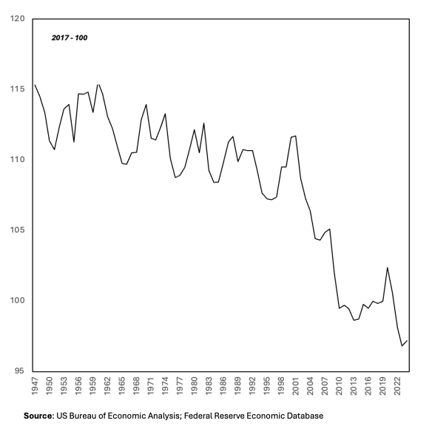
These dislocations turned segments of small capital and the petty bourgeoisie into leading forces of MAGA within their communities, drawing on local networks and business associations. They found a substantial base among the working class and lumpenproletariat that had also been severely affected by the crisis. Indeed, the financial crisis sharply accelerated the collapse in manufacturing employment already underway since the beginning of the century as a result of the “China shock.” From 1965 to 2000, manufacturing employment remained relatively constant at around seventeen million, though it steadily declined as a share of total employment due to a combination of “free trade” and technological development.31 Between 2000 and 2010, however, this figure plummeted by nearly one-third, falling below twelve million.32 The fact that these losses were geographically concentrated meant that entire regions were left utterly devastated. Even as the economic recovery was well underway, almost none of the new income flowed to the working class. On the eve of Trump’s 2016 election, labour’s share of national income had dropped to its lowest level in a quarter-century (fig. 3). Unsurprisingly, many of these communities became major bases for MAGA, often breaking with the Democratic Party despite substantial union density. The labour movement’s long retreat from deep organizing, mobilization, and education left it unable to present a substantial bulwark against these far-right inroads into the working class.
The downward mobility of the white petty bourgeoisie and working class did not generate a progressive anti-capitalist alliance with pauperized sections of the black working class or urban lumpenproletariat. On the contrary, it fuelled the racial resentments behind a neo-fascist politics aiming to restore “traditional” hierarchies.33 Critical for holding this alliance together was a discourse that merged a critique of globalization with the scapegoating of immigrants as the primary cause of white male lumpenization as well as the impacts of competition on small capitalists and the petty bourgeoisie.34 That the immigrant population was growing steadily in these years, increasing from 7.9% of the population to 13.5%, suggests that these economic pressures were not wholly imagined.35 But even those petty bourgeois contractors, real estate agents, and homeowners who were not directly exposed to competition from migrants were left searching for a target for their rage at their sense of diminished livelihoods. Especially in the absence of a left alternative, anti-immigrant politics offered a compelling ideological framework through which these class fractions could interpret the sharp economic decline—or at least relative losses compared to their expectations—over the decade following the crisis.36
To be sure, components of the professionalized petty bourgeoisie polarized toward the working class in the face of disappointed expectations for “middle class” living standards. This petty bourgeois layer provided much of the activist and intellectual leadership of the Bernie Sanders insurgency, which sharpened the class contradictions within the Democratic Party and strained its representational ties to big capital. It was also essential for the eruption of the Black Lives Matter movement (BLM). In neither case, however, were the petty bourgeois fractions leading these mobilizations able to penetrate and organize the working class on anything like the scale necessary to put a progressive resolution to the crisis seriously on the agenda. While BLM, like other Trump-era protest movements, left behind little in the way of a durable organizational or programmatic legacy, much of the “democratic socialist” left remained trapped within a narrow electoralism—and even the illusory goal of “transforming” the Democratic Party—that underestimated both the scale of the challenge as well as the long-term necessity of base-building. Given the impasse of social democratic politics and the inability of the centre to move past zombie-like repetition of discredited neoliberal slogans, the continued marginalization of the socialist left ensured that the MAGA hard right was the primary social force able to channel these resentments and anxieties.
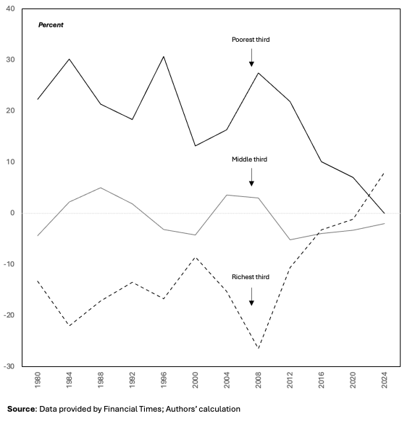
The strengthening of capital through the post-crisis economic recovery was thus marked by the “accumulation of wealth” at one pole and the “accumulation of misery” at the opposite pole.37 It was this intrinsic tension within capitalism between affluence and immiseration—not economic or imperial decline—which generated the legitimation crisis that paved the way for MAGA. While corporate profits skyrocketed—more than doubling from 2009 to 2015—conditions for broad swaths of the population became increasingly intolerable. In this context, the Democrats’ strategy of assembling the broadest coalition among big capital, running on the notion that “America is already great” while offering nothing to alleviate the social crisis, understandably ended in disaster. The period from 2008 to 2024 saw a collapse in marginal support for Democrats among the bottom third of income earners, plummeting from +28% to 0%, alongside an even more significant surge from the top third, which rose from -27% to +8% (fig. 4).38 Meanwhile, Trump performed especially well in areas marked by the combination of manufacturing job losses, economic distress, substance abuse, and suicide that plague the lumpenproletariat.39
Despite the support of a handful of ultra-rich billionaires, big capital as a whole clearly preferred the Democrats in both 2016 and 2024. This was in large part the result of Trump’s lambasting of the globalization regime from which it benefited handsomely, to say nothing of his relentless delegitimation of the liberal democratic state that had so effectively upheld its rule. Yet his ability to restructure world order was contained through his first presidency. Trump’s return to power has seen a much more ambitious effort. Far from being the instrument of giant monopolies that have seized control of the state, this has been a problem for capital, forcibly remaking the U.S. empire in a way that MNCs never asked for. Trump blamed the harmful impacts of empire at home on “bad trade deals” signed by previous administrations that had allowed others to “take advantage of” the United States. In what appeared to be an outright assault on free trade, on “Liberation Day” Trump imposed sweeping tariffs on allies and enemies alike. China was singled out above all, whose rise Trump had long presented as the clearest example of how the rules of world trade perpetuated American weakness—even placing it in a position of dependence on its principal rival. Threatening 100% tariffs on Chinese imports, as Trump did, seemed to signal that after decades of capitulation it was finally time to take action and make America great again.
Tariffs aimed to rebalance the costs of empire and consolidate the MAGA coalition into a national bloc that could support a political break toward the far right. Tariffs, it was hoped, would compel MNCs to shift to small U.S. supplier firms and support mid-sized manufacturers, especially steel. The expansion of domestic manufacturing by these firms, as well as through increased FDI inflows, would benefit workers along with petty bourgeois professionals, sole proprietors, and contractors. The interests of big capital, however, remained closely tied to globalization. Though business lobbied fiercely against tariffs, including at high-level meetings between top executives and the administration, Trump was unwilling to immediately back down—using the autonomy of the executive over trade policy, initially built up to deflect protectionist challenges to globalization, to push through a policy that seemed to threaten it.40 Nevertheless, tariff policy had to be executed so as not to jeopardize the competitiveness of MNCs by raising costs or undoing the globalization of supply chains. Many were rolled back in the face of bond market instability or wielded as leverage to compel other states to secure reduced trade barriers and investment commitments.
Of course, tariffs also have to do with the bipartisan objective of containing China. Yet if China is demanding a larger say in shaping the rules of world order, it is far from clear that it has anything like the capacity to replace the role of the U.S. as their overall guarantor. Efforts by Trump to use access to the U.S. market as geopolitical leverage may work for now, as the U.S. controls critical infrastructures that tie together global capitalism. To be sure, such strategies are bound to encourage other states to carve out more autonomous economic and political space, including by constructing alternative currency zones. Yet it must be emphasized that such projects are still a very long way off. While the BRICs are often pointed to as a possible rival, it will be very difficult—if not impossible—for such a disparate bloc of states, lacking any political or economic coherence, to engineer a rival to the dollar system. Similarly, the EU remains dependent on the U.S., lacks a fiscal union, and is wracked by internal tensions. Russia, for its part, has a relatively small economy and is more likely to emerge as a Chinese satellite than anything else. And China is unlikely to fulfill this role anytime soon since, as we have seen, its financial system remains tightly controlled by the state and lacks the liquidity that could allow the renminbi to function as world money.
The problems for the U.S. empire are not economic but political. Unprecedented concentration of economic power on the one side has been mirrored by unprecedented dysfunction of the mechanisms of political rule on the other. While key representatives of finance capital served as top advisors in the Biden administration, where they worked to craft his “twenty-first-century industrial policy,” this clearly failed to stabilize political hegemony.41 These individuals are notably absent from the Trump regime. Trump does seem to be aware of the need to build support among capital, offsetting damaging tariffs with massive tax breaks for corporations and the wealthy while imposing class discipline more draconian than even the most ruthless Republican administrations have dared. And there has been little significant opposition to Trump’s shockingly authoritarian restructuring of the state from any section of big capital, which has largely adopted a “wait-and-see” attitude. However much Trump may now be on the back foot, it would be extraordinarily naive to trust, as Kamala Harris apparently did, that capital will provide “guardrails” against authoritarian consolidation—at least so long as it does not excessively interfere with business.42
Socialism or Barbarism
The political crisis has enabled Trump to bend, or even reject, liberal democratic norms and initiate a significant reorganization of state power with little direct ruling class support. Trumpism is an authoritarian project that builds on and modifies longer-term trends within the neoliberal state. But it is not simply a continuation of neoliberal authoritarianism, which was above all characterized by impersonal bureaucratic power centralized in “neutral” and “apolitical” institutions such as the Fed and the courts. Rather, Trumpism signals the deepening crisis of that order. Trump has personalized state power, politicizing the judiciary and remaking the coercive apparatus—redefining its scope of action, dramatically expanding ICE, and enhancing the role of the military and its links to law enforcement. Along with purges of key agencies and the imposition of new forms of discipline to ensure “loyalty,” this has facilitated the empowerment of reactionary elements across the bureaucracy. Yet the project is fraught with contradictions, including the ineptitude of those attempting to lead it. It is this political instability, not fascism as a completed project, that defines the current period—exacerbating the environment of uncertainty and crisis that makes MAGA so very dangerous.
This danger is amplified by the economic storm clouds now gathering on the horizon. If Trump’s rise was not the result of economic malaise, the political chaos he has unleashed has exacerbated economic stresses. While tariffs have reignited inflationary pressures, soaring fiscal deficits have sustained demand. Trump’s attacks on the Fed’s independence, however, have raised questions about its ability to contain inflation, provoking significant instability in Treasury markets. This has raised the cost of borrowing, increasing pressure for fiscal consolidation through raising taxes or severe austerity. If raising taxes risks conflict with business, austerity would further squeeze workers already dealing with a severe affordability crisis. Meanwhile, historic investment in AI infrastructure raises the spectre of serious overexpansion. Unlike the dot-com bubble, the boom is centered on established firms with strong earnings, but this does not eliminate the threat of violent devaluations and sharp economic contraction. Instability in Treasury markets could also complicate the Fed’s ability to manage such a crisis. Whether a deeply dysfunctional Trump regime is capable of managing another global financial crisis is thus a serious question. All this underscores once again that the risks of the present moment are not merely economic but political.
Regardless of what Trump and his associates may have in mind—or how successful their plans may prove to be—the regime’s unpredictability and its willingness to cross one “red line” after another raise the possibility that it could precipitate a significant rupture and sharply escalate the political crisis. The consequences of this would be impossible to foresee, depending on how forces within and outside the state respond and what political alignments emerge. The authoritarian threat does not arise only from Trumpism itself but also from a “centrist” response that may seek to contain the crisis and restore political order. There is no reason to assume that such an effort would defend democratic space rather than further restrict it, perpetuating attacks on the left even as it moved against the hard right. Either way, the tightening grip of the Republican Party on the electoral apparatus has made it an increasingly uphill battle for Democrats to make substantial electoral gains.43 If and when Democrats do recapture power, the immediate danger would be that the left breathes a sigh of relief and lowers its expectations until the next electoral cycle. However, this is hardly likely to resolve the deeper political crisis, address the accelerating climate catastrophe, manage the spiraling situation in the Middle East, or resolve rising tensions with China and Russia.
The instability of the liberal democratic state will therefore persist. It is here that the longer-term danger of a convergence between concentrated capital and far-right authoritarian politics lies—a danger that will surely outlast Trump himself and only become more acute as the mounting ecological breakdown intensifies the instabilities, crises, and social dislocations on which authoritarian politics feeds. What is clear, as demonstrated by the second and third reorganizations, is that capital has no fundamental attachment to democracy—and indeed that even the limited democracy afforded within the American state may actually get in the way of managing global capitalism.44 The willingness of large parts of capital to move sharply to the right amid a crisis was evident in the embrace of Reaganite reaction as a pathway out of the 1970s doldrums. Its current ambivalence towards naked authoritarianism and open attacks on what remains of democratic institutions after a half-century of the de-democratization of the state should dispel any illusion that its attitude has changed.45 These experiences suggest it is far from impossible that “the markets” could learn to live with the consolidation of a neo-fascist regime provided it can secure order and does not excessively threaten profits.
To be clear, none of this suggests that an authoritarian break is inevitable or that a return of the Democrats could not temporarily stabilize political rule. Limited reforms—expanding social provision, strengthening labor rights, reversing the most egregious Trump giveaways, or imposing greater burdens on wealth—could somewhat alleviate the crisis of legitimation for a time. Simply not being Trump and “restoring democracy” would go some way toward achieving such stabilization. But, as when Barack Obama replaced George Bush II, the effect would prove short-lived without a deeper shift in the balance of class forces. Reform is certainly possible today; a stable Keynesian welfare state is not. Record profits and exploding inequality suggest that capitalism can afford significant redistribution, but they do not remove the political limits imposed by global integration and class power. As reform runs up against profitability, competitiveness, and capitalist control over investment, the left must either accommodate itself to those constraints and accept its social democratization or adopt a more radical strategy aimed at building the power to transform them.
This does not mean counterposing reform to revolution or abstaining from immediate struggles to improve the lives of workers in the here and now. Rather, it means fighting for reform in ways that shift the balance of forces, develop working-class capacities, and raise the necessity of democratic control over the economy. Electing “democratic socialists” can certainly be helpful in this regard. But although electoral campaigns may mobilize support around concrete issues, socialism cannot be reduced to an electoral label. There is no shortcut around the slow, careful work of building an organic social base for anti-capitalist politics. Without such a base, elected socialists remain isolated within institutions structured around reproducing capitalism and are predictably drawn toward administering an order that imposes sharp constraints on political possibilities. The genuine pursuit of state power thus means far more than winning office. It involves the formation of the working class as a political force capable of counteracting the “social democratization” of those within the state and advancing a widening struggle for democracy that increasingly challenges capital.
That project must confront the crisis of the labor movement, which has for decades largely limited its political engagement to making donations to Democratic candidates. Clearly, this has not served workers and has failed to seriously challenge the entrenchment of neoliberalism within that party. The perpetuation of this strategy reflects the deep need to reckon with the impasse of social democratic politics and the polarization of options. Electing establishment Democrats will not address workers’ issues or prevent the continued slide into ecological and social catastrophe. Unions must be transformed to support the broader project of class formation. In this respect, seriously taking on Amazon, the country’s largest employer, represents an opportunity to reverse the steady decline of organized labor and impact the entire working class in a way not unlike the auto sector in the 1930s. This project is far too large for any one union to achieve. While the flexibility of Amazon’s logistics system allows it to circumvent disruption at individual “choke points,” its massive warehouses employ thousands of workers. Success requires a crusade across the labor movement and demands that unions themselves change—moving on from the business unionism in which they have atrophied and adopting a class struggle orientation.
Important as it may be to encourage workers to fight again, militancy alone is not sufficient. There is a need for politics to connect workplace struggles to a broader challenge to capital. Socialist politics begins from the recognition that competitiveness is the problem, not a solution. Anti-trust action against Amazon and other tech giants may be appealing, but it is hard to see how the objective of intensifying competition could benefit workers. Indeed, anti-trust politics focuses not on workers but on consumers, aiming to “restore competition” and thereby bring down monopoly prices. But Amazon is already fiercely competitive. Its low prices and rapid delivery are achieved through relentless pressure to cut costs, accelerate circulation, discipline suppliers, and intensify work. Amazon is bad for workers not because it is a monopoly but because it is a ruthlessly competitive capitalist firm. Automation, surveillance, and work discipline are weapons in the warlike struggle among capitalists for profits, not consequences of monopoly power. More broadly, competition has driven the rollback of welfare states and environmental and labor protections alongside wage stagnation and expanding insecurity. Workers must come to understand these not as symptoms of capitalist malfunctioning but as outcomes of accumulation itself.
Moving away from an economy structured around market dependence means breaking with globalization. But doing so involves challenging capital in a way that goes well beyond tariffs. The argument that workers “automatically” benefit from tariffs as tighter labour markets lead to higher wages avoids the fundamental task of building the power of the working class, a large portion of which is now employed in the service sector. And it leaves aside the fact that Trump’s tariffs are integrated with a right-wing politics that demonizes migrant workers while driving conflicts that greatly threaten international peace. It is workers who will bear the costs of tariffs through inflated consumer prices as well as the austerity that will be imposed to protect the value of the dollar and the stability of global supply chains. Nor do high tariffs on particular goods inherently lead to expanded or onshoring production of those goods. In order to have a substantial effect on production, at least in the short term, tariffs would have to be coordinated with a state industrial policy aimed at supporting the growth of specific sectors of the economy. Even then, such onshoring would truly benefit workers only if paired with a policy regime supportive of labour rights. And the institutionalization of such a regime, of course, depends on class struggle.
It must also be recognized that capitalist industrial policy is distinct from socialism. While the former may lead to economic restructuring and even create some space for popular intervention into investment decisions, barring a strong left—which cannot simply be wished into existence—such policies are certain to reinforce, not challenge, the power of capital. Capitalist industrial policy is oriented around the state collaborating with capital on favorable terms to maximize profits and develop the capacities to compete in the world market. Although such industrial policies involve the non-market allocation of resources by the state, this is geared toward strategically boosting “national competitiveness” by constructing comparative advantages, not meeting social or ecological needs. Achieving the objectives of such policies depends on increasing market efficiency by cutting costs and maximizing labor exploitation. Similarly, this framework rules out global cooperation to meet the existential challenge of the climate crisis. Indeed, addressing the ecological crisis raises particularly daunting challenges for industrial policy, as it involves a wide-ranging, permanent transformation of how we produce, consume, and live. This can only be accomplished by moving toward collective, democratic control of the economy and thus challenging property rights. It is hard to imagine capital signing on to such an agenda unless it was forced to. Any green transition adequate to the task will have to be a socialist one.
Ecosocialist transition pivots on democratizing control of investment. The existence of capitalism does not hinge on which specific individuals manage particular firms, however “democratically” they may be chosen; rather, it is the outcome of the cold and impersonal compulsion of the law of value. Overcoming this requires replacing market dependence with democratic macro-coordination. A “market socialism” that merely socializes ownership while retaining competition among autonomous firms fails to escape this problem.46 So long as enterprises depend on market success for access to inputs and investment, they remain subject to the law of value and are compelled to behave as capitals. Democracy at the level of the individual firm, including through workers’ cooperatives, in no way alleviates the discipline imposed as firms compete to sell commodities and raise capital, compelling them to restrain wages and externalize the costs of environmental destruction.47 “Democratized” financial firms in no way offer a path out of this bind.48 Regardless of who oversees them, such firms must maintain a portfolio of financial assets that generate returns in order to remain viable. While they may be able to undertake small-scale projects, it is impossible to imagine that these institutions could mobilize capital at anywhere near the scale necessary to address the environmental crisis and other social challenges.
The only way to address this gap would be to create something akin to what Saule Omarova has called a National Investment Authority (NIA).49 The NIA would move past the limits of implementing “democratic” reforms within individual firms that remain subject to the anti-democratic rule of abstract market forces, offering one way to begin building the state planning capacities necessary to extend public control over investment. The NIA would draw on the financing power provided by the full faith and credit of the U.S. state to channel investment to meet public priorities. The Fed would stand ready to purchase NIA bonds, thereby effectively granting them risk-free status. However, only public pensions would be permitted to invest in these assets. This architecture would allow the NIA to mobilize the vast pools of capital in pension funds—the major foundation of the new finance capital—to finance green reconstruction, while simultaneously insulating workers’ retirement incomes from the vicissitudes of Wall Street. NIA purchases of “green bonds” issued by “green banks” could create a federally backed national market for these instruments, massively boosting the balance sheet capacities of these institutions. Additionally, the NIA could take equity stakes in any firms it finances, thereby expanding public ownership of the economy while removing individual firms, or even entire sectors, from market discipline.
Omarova’s program is not a socialist one, nor is it certain that it could avoid the pitfalls of traditional industrial policy. But it offers a useful starting point for thinking about the link between transforming the state and socialist transition. The gaps in Omarova’s blueprint, however, highlight the fact that this project involves two distinct, if interrelated, dimensions. First, it involves overcoming the “relative autonomy” of the state from the economy that demarcates the public and private “spheres” and thereby institutionalizes private (capitalist) control of investment. The socialist transformation of the state thus entails constructing the institutional capacities to directly manage the economy and plan investment in the public interest. But socialism also demands the democratization of the state through the radical expansion of popular participation in economic and political decision-making. While the nationalization of key industries is crucial—beginning with those firms that possess the capacities necessary to address the environmental challenge—state-owned firms must also be fundamentally transformed to become models of bottom-up participation, worker control over the labor process, and accountability to a democratically formulated national plan.
The polarization of options has thus sharpened such that we are now faced with a choice of socialism or barbarism. It is essential to avoid falling into the trap of treating socialist politics as a matter of gesturing toward a horizon that is endlessly deferred. We must lay out a credible path toward the transition we insist is necessary. Yet today, very little is said about what is meant by socialism or how it might realistically be brought into being.50 Instead, it is either framed as an outgrowth of social democracy, thus ignoring the historic impasse that has driven such regimes, one after the other, to turn not toward socialism but neoliberalism, or else confined to a politics that proclaims the need to “smash” the state but says little about what is to come after. The immediate task is to confront a dangerous neo-fascist right now in power. But this cannot simply mean “going back to normal” and restoring the status quo ante. The challenge, rather, is to defend and expand democratic space in ways that build working-class organization, develop socialists, and shift the balance of power against capital. Only by connecting the defense of existing democratic rights to the need to transform the state and economy can resistance to MAGA address the social and political crises from which it emerged and to which Democrats offer no resolution.
Notes


It has become common sense to interpret the rise of far-right MAGA politics in the U.S. as a product of American decline. The period since the 2008 financial crisis, in particular, is depicted as marking another stage in the terminal decline of U.S. capitalism, often merely pushing earlier predictions of decline forward in time. As the possibilities for productive investment are exhausted, these accounts typically hold, capitalists increasingly make money by extracting rents from the broader economy through financial speculation, monopoly control over technologies and digital platforms, or simply plundering the public treasury. Such activities have supposedly not only harmed workers but also their bosses, undermining the competitiveness of American industrial firms while the “good jobs” that once supported the “middle class” disappeared alongside factory closures and the spread of precarious work across wider swaths of the working class. Some have even suggested that globalization itself, which was critically enabled by finance, eroded American economic might.1
The key to defeating MAGA, in this view, is to revive capitalism, albeit in a more progressive guise. Workers and industrial capitalists are cast as potential allies with a shared interest in restraining finance or breaking up tech monopolies and redistributing income. Rather than seeing market discipline as the main problem for workers, competitiveness is depicted as a common good for both labor and capital. In fact, the consolidation since 2008 of what we have called “the new finance capital” facilitated the rejuvenation of American capitalism in the wake of one of the deepest crises in modern history.2 Already by 2010, profit rates had returned to their post-2000 peak, and by 2020 the mass of profit reached historic highs. Corporate investment likewise remained strong—well above the post-war average.3 It was for these reasons that, on the eve of Trump’s 2024 return to power, The Economist proclaimed the U.S. economy “bigger and better than ever,” while the Financial Times declared that it was “soaring ahead of its rivals” and had become “the envy of the developed world.”4 It is therefore difficult to frame Trump as the product of economic malaise.
The post-2008 period in fact marked a third wave of reorganization of global capitalism since World War II, following the initial construction of the postwar U.S. empire and post-1970s neoliberal restructuring. Resolving the crises of the 1970s and 2008 intensified the antagonism between legitimation and accumulation, restoring the profitability of capital while leaving the working class ravaged by deindustrialization, wage stagnation, and increasing precarity. At the same time, the deepening integration of global capitalism narrowed the scope for distributional reform and class compromise while steadily hollowing out liberal democracy. The growing mobility of capital increasingly allowed it to avoid making concessions that might have supported legitimation, while the marginalization of parties, elections, and representative institutions from the key centers of state power further weakened the state’s capacity to secure popular consent for accumulation. In the absence of a credible left alternative, it was the MAGA far right that was able to capitalize on widespread discontent with a status quo that broad swaths of the population found intolerable.
We argue that Trumpism arose from a political and social crisis generated by the success of accumulation. This crisis resulted not from the decline of capitalism or the exhaustion of accumulation but from the state’s inability to contain the fallout of capitalist triumph. Indeed, it only intensified with the economic recovery as profits reached record heights. Trumpism was therefore not a “card” played by a capitalist class seeking to reverse its declining fortunes but resulted from the mobilization of a contradictory class coalition amid an uncontrollable crisis situation. Much of capital, in fact, remained skeptical of Trump, preferring the Democrats as neoliberal standard-bearers. If MAGA arose from the social and political effects of capitalist strength, in the absence of a substantial left grounded in the working class and capable of offering an alternative path out of the crisis, defeating it cannot mean revitalizing capitalism. Rather, it requires building the power necessary to put a credible socialist alternative on the agenda. The fight against the far right is therefore inseparable from the struggle against capitalism, empire, and environmental collapse.
The Third Reorganization of Global Capitalism
We are now living through a third reorganization of global capitalism since World War II. Each phase was precipitated by crisis and followed by a restoration of the power of capital. Yet each also intensified capital’s tendency to undermine the conditions of its own political legitimation. By generating inequality, unemployment, and insecurity, capitalism strains the state’s capacity to represent society as a community of equal citizens whose will it embodies. The successive reorganizations of global capitalism have sharpened this tension between accumulation and legitimation. Even as profits recovered from the crises of the 1970s and 2008, the U.S. state became increasingly unable to legitimate an economic order whose strength was bound up with the deterioration of living conditions and security for broad sections of the population. Substantial reform has therefore come to require moving beyond class compromise to take on capital as a whole, while sustaining any gains requires linking struggles for reform to a broader project of socialist transition.
The first wave of reorganization emerged after World War II as the American state took the lead in establishing a global monetary and trade order linking formally independent states into an informal empire bound together by cross-border flows of trade and investment. At home, this was accompanied by the incorporation of unions into a “productivist” settlement in which wage gains were tied to productivity growth. When productivity growth slowed in the 1970s, wage increases squeezed profits and imposed the need for a second reorganization. The transition to neoliberalism was inaugurated by the Federal Reserve’s crushing of defensive rebellions by workers with an iron fist through the “Volcker Shock”—raising interest rates to unprecedented heights and leading to skyrocketing unemployment. The constraints on capital mobility embedded within the Bretton Woods regime were then cast aside for a new era of global financial integration. As capital was freed to circulate globally in search of the highest profits and lowest costs, workers and states were forced to compete for investment and jobs by offering the most favorable conditions for accumulation.5
Rising wages, social programs, and formal democracy had helped legitimate capitalism during the postwar “Golden Age.” The restoration of accumulation after the prolonged 1970s crisis, however, devastated working class communities through deindustrialization, growing precarity, and wage stagnation and led to the formation of a more authoritarian state. Power was centralized within an “independent” Federal Reserve insulated from “political” intervention, affording it the flexibility to act as necessary to support accumulation. This meant enforcing class discipline by setting interest rates to maintain levels of unemployment sufficient to contain wage demands and combat inflation. Meanwhile, technocrats within the trade apparatus assumed a growing role in shaping policy through negotiations conducted far from public scrutiny. Politics was thus increasingly removed from legislatures and locked away in inaccessible bureaucracies. Legitimation was constrained by the imperatives of accumulation even as profits grew and wealth concentrated at the top. The constraints on redistribution and the deterioration of workers’ living conditions were not symptoms of capitalist decline but conditions of its strength.
Many saw the financialization that accompanied this reorganization as “hollowing out” the “real” economy and undermining industrial competitiveness. Workers and industrial capitalists, in this view, shared an interest in reining in finance, which, it was claimed, would return “good jobs” and lead to shared prosperity.6 Yet the decline such accounts anticipated never materialized. The rise of finance instead strengthened industry, restoring profits and providing the infrastructure for the global circulation of investment. There was no division between an industrial sector victimized by globalization and a financial sector that benefitted from it. Both were united in an alliance around liberalization.7 As the power of capital grew alongside its ability to “exit,” the capacity of workers to compel it to accept the kinds of class bargains that had underpinned the rising wages and social programs of the “Keynesian” era steadily eroded—what Leo Panitch defined as “the impasse of social democratic politics.”8 Workers were instead faced with what Sam Gindin calls “the polarization of options”: either make inroads toward democratizing investment or face the perpetuation of the status quo.9
The third reorganization followed the 2008 financial crisis, as state intervention sharply exacerbated the “accumulation of wealth at one pole” and the “accumulation of misery” at the other.10 On the one hand, this produced an unprecedented concentration of ownership, record profits, and a resurgent financial-industrial bloc; on the other, workers endured the destruction of millions of jobs, the loss of savings and homes, and the deterioration of wages and working conditions with little state support. Consequently, as the state intervened massively to rebuild the power of capital, the crisis was displaced from the terrain of the economic onto the political. Simmering discontent with a half-century of neoliberalism erupted into a full-blown crisis, as both parties were wracked by insurgencies from the MAGA right and democratic-socialist left. Yet capital remained unwilling to countenance even limited reforms that might have partially restored legitimacy, as evidenced in its near-total opposition to Bernie Sanders, and even to a lesser extent Elizabeth Warren, as well as in the subsequent limits of Bidenomics. In this context, Trump was able to channel widespread anger into a populist revolt expressed within a formally democratic state.
The new finance capital was consolidated through the unprecedented concentration and centralization of corporate ownership in the hands of the so-called “Big Three” asset management firms—BlackRock, State Street, and Vanguard—which emerged as the most powerful institutions within contemporary finance. They owned not merely specific groups of firms but rather the market itself, collectively becoming the largest shareholders in practically every publicly traded U.S. corporation.11 Far from sapping the competitiveness and dynamism of the corporations they owned, this unprecedented financial concentration coincided with U.S. corporate profits soaring to historic heights (fig. 1) and facilitated the ascent of dynamic new economic sectors, above all Big Tech and AI. This belied the persistent depiction of finance as a mere rentier parasite, along with longstanding claims that its rise was necessarily linked with a decline of productive investment.12 That the dynamism of the tech giants has been fuelled by what may be the largest investment boom in the history of capitalism should hammer the final nail in the coffin of such arguments.13
The power of asset management firms is associated with the growing significance of the so-called “shadow banking” system through which credit is generated and allocated within networks of non-bank institutions. As leading researchers observe, shadow banking has now become “the centrally important channel of credit for our times,” not merely “some troubling excrescence on the healthy body of traditional banking.”14 Asset management firms are the most important shadow banks, lending capital as well as supplying the securities that serve as collateral. While this system is increasingly interconnected with the state, especially the central bank, what we have termed the “statization of finance” has been a matter of supporting the ongoing competitive restructuring of capitalism. In fact, these supports for shadow banks closely parallel those extended to traditional banks after the 1929 crash. Yet few would argue that the creation of the FDIC and other agencies signalled that capitalism had entered terminal decline; rather, these were successful efforts to construct a more resilient financial order. The contemporary statization of finance is a similar process through which finance has been reorganized to overcome a major crisis and restore accumulation.
The formation of the new finance capital highlights the crucial point that, as Marx showed, concentration in no way suspends capitalist competition but rather intensifies it within new organizational forms. Competition has driven the asset management firms to allocate capital toward the strongest and most dynamic companies. The ascent of the tech giants illustrates this vividly. As QE drove asset inflation, the Big Three disproportionately directed capital toward the tech sector, allowing these firms the time and flexibility to build up their capital stocks as they emerged as “regulating capitals”—dominant firms whose scale and profitability allow them to set competitive conditions across entire sectors.15 In 2010, the six largest tech giants accounted for just over 5% of the S&P 500; by 2025, they accounted for about a third of it. Asset inflation thus did not impact all firms equally but reinforced shifts in corporate hierarchies based on relative profitability and long-term competitiveness. While this may result in overvaluation or overexpansion, and even precipitate a major crisis, such outcomes reflect the characteristic dynamics of technological development in capitalism, through which the violent destruction of value reorganizes competition and establishes the conditions for new cycles of investment and growth.16
The ongoing competitiveness of this regime is further attested to by the fact that tech itself remained highly competitive despite tremendous concentration within the sector. Were these tech firms protected by monopolistic barriers to competition, as Democratic Party progressives such as Lina Khan and Elizabeth Warren have claimed, this should show up in their ability to persistently earn above-average profit rates, or so-called “monopoly rents.”17 Yet as Figure 2 shows, there is simply no indication that the profit rates of leading technology firms have at all been consistently exceptional; they have clearly gravitated around the social average. The black lines depict the return on capital invested for the largest tech firms—Amazon, Nvidia, Alphabet, Apple, Meta, and Microsoft—while the gray lines represent all other large U.S. firms. The chart shows a striking convergence of the profit rates of five of the “big six” toward the mean. Although the sixth, Apple, has enjoyed somewhat higher returns, these are not historically exceptional. In short, there is simply no evidence that competition in the tech sector has in any way been suspended as monopoly theories would suggest.
Concentration and centralization simply do not equate to monopolization, especially in the context of the power of big finance. The historical tendency of financialization has been to undermine monopoly, breaking down barriers to entry through developing the capacity to allocate capital at whatever scale is necessary to support profitable investment. Big Finance is able to provide large firms with the firepower needed to compete even in markets with staggeringly high capital requirements. The extreme concentration of capital within the large asset management firms has enabled them to undertake massive expenditures to finance firms and projects without excessively tying their financial stability to any single investment, while making it easier for existing market leaders as well as new firms to access financing for innovative projects. The result has been to intensify competitive pressures by encouraging the emergence of new market entrants and technologies. If this process has led to opportunities for speculation, it has also facilitated the growth of new firms and technologies, such as AI, which are coming to define a new epoch in the development of capitalism.
Monopoly theories can also carry problematic political implications. Criticizing big tech or asset management firms strictly on the grounds that they are supposedly monopolies, as mainstream progressives often do, can imply that one opposes them solely on the grounds that they distort market competition. In fact, these firms are harmful because they are competitive capitalist firms. Were it true that big tech or finance were parasitically draining rent from industrial capital, the latter would have a clear incentive to form an alliance with workers to restore competition and prevent such extraction. That there is no indication of this on the horizon points to the more likely conclusion that capital continues to benefit from both financialization, which enhances capital mobility and supports globalization, as well as tech, which has produced innovative technologies that enhance the exploitation of labor, compress circulation time, and support the realization of surplus value. Pining for a return to a bygone “competitive capitalism” through antitrust obscures the systemic sources of power in capitalism, reproducing rather than challenging the competitive imperatives that compel firms to maximize exploitation in the first place.
The rise of Trump, therefore, was not an outcome of economic dysfunction. Nor was it a reaction to the decline of the American empire. Of course, Trump has focused much ire on China, whose economic development has clearly enabled it to take on a larger role in shaping world order and the functioning of the American empire. That system has always been based on the “relatively autonomous” interaction among formally sovereign states. But this is a far cry from the old forms of “inter-imperial rivalry” that characterized the pre-WWII period or the external conflict between the U.S. and USSR during the Cold War era. The American empire has not only been about pillaging other states; rather, it has been organized around incorporating dynamic economies within a global capitalism it superintends—a system held together by globally integrated finance and the multinational corporation. Indeed, as much as 70% of world trade, and many countries’ leading exports, consists of MNCs moving unfinished goods through production processes that cross borders.18 Focusing on the quantitative growth of South–South trade, or the export of commodities from emerging economies, as indicators of U.S. decline can thus be deeply misleading.
China is certainly a major productive, technological, and even geopolitical rival to the U.S. However, there are structural limits to the challenge it can pose—or would want to pose—given the extensive dependence of its own economic ascent on the American empire. China’s development was significantly propelled by its insertion within global circuits of accumulation, including massive inflows of FDI and the offshoring strategies of corporations seeking to reduce costs. While U.S. capitalists initially invested in China to exploit cheap labor and produce absolute surplus value, increases in labor productivity alongside rising wages there have shifted the basis of this toward relative surplus value. Flows of FDI have continued because U.S. firms capture a significant share of these productivity gains. At the same time, these FDI inflows were structured by a planning regime that allowed the Chinese state to coordinate investment on a scale few other capitalist states could match. This regime depends entirely on the state’s ability to maintain capital controls that limit the movement of money into and out of China, thereby allowing it to allocate credit, shield the economy from destabilizing global financial flows, and protect domestic firms from foreign takeover.19
These same controls that supported China’s rise also limit the renminbi’s ability to rival the dollar.20 The renminbi can circulate regionally and play a role in trade between China and its partners as well as among states seeking insulation from U.S. sanctions. In order for it to serve as world money, however, China would have to liberalize its financial system, which would undermine the state’s ability to implement planning. China’s rise thus does not take the form of a self-contained, independent imperial order steadily displacing an American one but has depended on the liberalized dollar system, which allows it to access global finance without itself fully opening its capital account. Chinese firms finance accumulation by borrowing on global dollar markets where costs are substantially lower. Even Chinese development loans and grants through the Belt and Road Initiative are predominantly dollar-denominated—thus integrating recipients more deeply into the dollar system. The larger Chinese capitalism becomes, the more it participates in the dollar system.21
It is ironic that trade deficits and budget deficits, which have always been major pillars of the U.S. empire, have been interpreted by the MAGA right as markers of its weakness. In reality, trade deficits generate the dollar stockpiles abroad that allow it to function as the global reserve currency. Budget deficits, meanwhile, ensure the supply of Treasury bonds that enables dollar holdings to be converted into interest-bearing assets. Holding Treasuries also allows states with trade surpluses vis-à-vis the U.S. to avoid reconverting their export earnings back into their own currencies, which would consequently appreciate and thus make their exports less competitive. The U.S. empire, then, is structured around supplying dollars to the world market and importing goods—often produced by U.S. corporations—while exporting financial assets whose value is underpinned by the global centrality of U.S. capital. There is no reason to believe that trade deficits in goods are more important for the U.S. economy than trade surpluses in financial assets. On the contrary, given the internationalized nature of U.S. capital, both reflect the strength of the U.S. economy. To fixate on trade and budget deficits as indicators of decline is to buy into MAGA mythology.
The interpretation of many on the left that Trumpism represents an attempt by capital to reverse American decline therefore holds little water. Such accounts typically rest on an instrumentalist view of the state, portraying it as a mere tool in the hands of powerful firms, as well as on economism, in which politics and the state are reduced to mere reflections of an economic “base.” From this perspective, it becomes impossible to see Trumpism as rooted in a specifically political crisis that is not derivative of economic malaise. Rather, Trumpism is assumed to represent the direct expression of the “objective” interests of dominant fractions of capital, which directly wield the state in order to sustain their ability to accumulate wealth in the context of capitalist decline. In reality, a political and social crisis rooted in the contradictions of successful accumulation enabled Trump to mobilize a populist class coalition around “unfair trade deals,” while much of big capital has remained skeptical of Trump insofar as the chaos he generates disturbs a highly profitable status quo. If anything, Trump’s contradictory coalition has underpinned his exceptional autonomy from big capital.
From Economic to Political Crisis
Linking the growing immiseration of the working class at the root of the current political crisis to the decline of capital itself critically obscures what Clara Mattei has framed as the contradiction between “the logic of profit” and “the logic of need.”22 Such narratives imply that a strong, competitive capitalism inherently benefits workers and thus that the interests of workers and capitalists are not fundamentally opposed. But this obscures the reality that capital is founded on exploitation and gives rise to tendencies toward the immiseration of labour as well as the production of a surplus population that is superfluous to the momentary needs of accumulation. Just as finance strengthened capital and helped resolve the 1970s crisis by disciplining workers and providing the infrastructure for globalization, the concentration of ownership through the formation of the new finance capital following 2008 intensified pressures to maximize profits and market efficiency. By treating the degradation of the working class as a symptom of capitalism’s failure rather than a sign of its success, declinist accounts depoliticize the antagonism between need and profit, capital and labour. And by blaming the evils of accumulation on the “corruption” of finance, they deflect attention from the systemic violence of capital itself.23 The power of capital has always been predicated on the subordination of human needs to the imperative to profit.
It was the very strength of capital that provoked the social dislocations and political contradictions that gave rise to Trump. But the profitability of this order left capital unwilling to concede the kinds of reforms that might have restored legitimacy but would have required challenging globalization. The new finance capital did not signal the arrival of a capitalist fraction open to social democracy but entrenched the class-wide alliance around globalization.24 As such, it reinforced the “impasse of social democratic politics” Panitch had identified as welfare states and productivist compacts ran up against the structural limits of capitalist profitability during the 1970s. This undermined the ability of such parties to frame growing capitalist profits and rising working-class living standards as mutually beneficial components of a stable Keynesian settlement. Writing in the wake of the defeat of Tony Benn’s “democratic socialist” bid to be Labour Party Deputy Leader and amid the rise of Margaret Thatcher, Panitch insisted that socialists should resist the urge to simply defend social democracy or Keynesian managed capitalism. The impasse demonstrated, rather, that socialists must acknowledge its limits as the basis for articulating an alternative politics.25
As capital withdrew from class bargains, social democratic parties lacked the capacity to mobilize the working class behind an alternative to neoliberalism. Panitch attributed this not simply to external attacks or individual betrayals but to the internal limitations of social democratic politics itself. The top-down, bureaucratic character of social democratic parties and welfare states subordinated grassroots activism to the pursuit of class harmony, disciplining workers by imposing wage restraint and reducing politics to the electoral management of capitalism. Rather than pursuing the impossible task of resurrecting the crumbling postwar settlement, Panitch argued it was necessary to move beyond it. This meant developing democratic organizations that could connect immediate struggles to the formation of the working class as a political force able to radically transform the state and economy. The crucial question was not whether to pursue reform but how to do so without succumbing to social democratization. Yet even as the conditions that had supported class compromise evaporated over the ensuing decades, the left became still more marginal.
Panitch’s analysis has been powerfully vindicated in the decades since, as the second reorganization of global capitalism entrenched the impasse he identified by expanding capital’s freedom to circulate globally. The resulting intensification of competitive disciplines on states and workers alike gave rise to what Sam Gindin framed as a “polarization of options,” expressed among other things in the neoliberal restructuring of social democratic regimes across Europe. For Gindin, this pointed to the need to become more radical. Beyond a limited range of reforms, workers increasingly faced a choice between lowering their expectations and accepting social democratization or pursuing a more radical strategy to break with globalization and move toward democratic control of investment. In the absence of a substantial anti-capitalist left, therefore, alternation in power between the two major parties did little to reverse the continued deterioration in working-class life. Even when they appealed to workers’ frustrations, both remained firmly committed to the bipartisan neoliberal consensus, leading to accumulating dissatisfaction with the established order.26
If the second reorganization institutionalized the social democratic impasse through global liberalization, the third restored accumulation after 2008 while transforming that impasse into an acute political crisis. In the absence of significant working-class struggle, legitimation remained subordinate to the demands of globalized accumulation. This was evident in the state’s response to the financial crisis, as it intervened massively to rebuild finance while leaving a devastated working class to fend for itself. The emergence of Occupy, not to mention the Tea Party, reflected not the strength of the left but the weakness of the center in the context of a legitimation crisis. The unfocused nature of popular rage amid the discrediting of both parties underscored the absence of a left able to consolidate mass discontent into a mobilization that could shape political outcomes. Without a substantial left capable of placing a progressive path out of the crisis seriously on the agenda, the far right became the principal beneficiary of widespread anger at the inequities nakedly on display.
Trump displaced this resentment onto foreign competitors, immigrants, LGBTQ+ people, and other groups depicted as undeserving beneficiaries of social change, fusing anger over “unfair trade deals” with anxieties about the erosion of patriarchy and white privilege. Crucial for his success was the backing of a handful of reactionary billionaires who saw an opportunity to harness popular discontent to advance a far-right agenda. Yet the MAGA alliance consisted primarily of the “losers” of globalization: sections of small and medium capital, the petty bourgeoisie (self-employed persons and professionals), industrial workers, and the lumpenproletariat. The resulting alliance drew on an infrastructure constructed over decades by the organized right linking legal organizations, state Republican Parties, business associations, right-wing billionaires, and local activists.27 Activists drawn especially from the ranks of small capital and the petty bourgeoisie were thus able to mobilize a broader popular constituency through existing Republican, conservative, and community networks.
Sections of small capital and the petty bourgeoisie were radicalized in the aftermath of the 2008 crisis as they were denied the support doled out to big finance, even though they had been especially hard hit. The expansion of the construction sector over the neoliberal period had supported the incomes of extensive networks of contractors and sole proprietors. The impact of the housing market crash visited on these components of the petty bourgeoisie was exacerbated by the credit crunch that followed, as they often rely heavily on personal credit. Home-owning petty bourgeois professionals were also seriously impacted. In the years following the collapse, small capital and the petty bourgeoisie experienced a sharp increase in bankruptcy rates and substantial declines in incomes, while fixed investment by small business increasingly fell behind that of larger firms even amidst the economic recovery.28 Self-employment collapsed during the crisis, surpassing the subsequent impact of COVID-19, and had only partly recovered by the end of the decade.29 Many former sole proprietors sought waged employment. Although business formations picked up after 2013, and income growth for sole proprietors became more consistent, a longer-term trend toward more precarious “gig work” continued to reshape economic conditions for the petty bourgeoisie.30
These dislocations turned segments of small capital and the petty bourgeoisie into leading forces of MAGA within their communities, drawing on local networks and business associations. They found a substantial base among the working class and lumpenproletariat that had also been severely affected by the crisis. Indeed, the financial crisis sharply accelerated the collapse in manufacturing employment already underway since the beginning of the century as a result of the “China shock.” From 1965 to 2000, manufacturing employment remained relatively constant at around seventeen million, though it steadily declined as a share of total employment due to a combination of “free trade” and technological development.31 Between 2000 and 2010, however, this figure plummeted by nearly one-third, falling below twelve million.32 The fact that these losses were geographically concentrated meant that entire regions were left utterly devastated. Even as the economic recovery was well underway, almost none of the new income flowed to the working class. On the eve of Trump’s 2016 election, labour’s share of national income had dropped to its lowest level in a quarter-century (fig. 3). Unsurprisingly, many of these communities became major bases for MAGA, often breaking with the Democratic Party despite substantial union density. The labour movement’s long retreat from deep organizing, mobilization, and education left it unable to present a substantial bulwark against these far-right inroads into the working class.
The downward mobility of the white petty bourgeoisie and working class did not generate a progressive anti-capitalist alliance with pauperized sections of the black working class or urban lumpenproletariat. On the contrary, it fuelled the racial resentments behind a neo-fascist politics aiming to restore “traditional” hierarchies.33 Critical for holding this alliance together was a discourse that merged a critique of globalization with the scapegoating of immigrants as the primary cause of white male lumpenization as well as the impacts of competition on small capitalists and the petty bourgeoisie.34 That the immigrant population was growing steadily in these years, increasing from 7.9% of the population to 13.5%, suggests that these economic pressures were not wholly imagined.35 But even those petty bourgeois contractors, real estate agents, and homeowners who were not directly exposed to competition from migrants were left searching for a target for their rage at their sense of diminished livelihoods. Especially in the absence of a left alternative, anti-immigrant politics offered a compelling ideological framework through which these class fractions could interpret the sharp economic decline—or at least relative losses compared to their expectations—over the decade following the crisis.36
To be sure, components of the professionalized petty bourgeoisie polarized toward the working class in the face of disappointed expectations for “middle class” living standards. This petty bourgeois layer provided much of the activist and intellectual leadership of the Bernie Sanders insurgency, which sharpened the class contradictions within the Democratic Party and strained its representational ties to big capital. It was also essential for the eruption of the Black Lives Matter movement (BLM). In neither case, however, were the petty bourgeois fractions leading these mobilizations able to penetrate and organize the working class on anything like the scale necessary to put a progressive resolution to the crisis seriously on the agenda. While BLM, like other Trump-era protest movements, left behind little in the way of a durable organizational or programmatic legacy, much of the “democratic socialist” left remained trapped within a narrow electoralism—and even the illusory goal of “transforming” the Democratic Party—that underestimated both the scale of the challenge as well as the long-term necessity of base-building. Given the impasse of social democratic politics and the inability of the centre to move past zombie-like repetition of discredited neoliberal slogans, the continued marginalization of the socialist left ensured that the MAGA hard right was the primary social force able to channel these resentments and anxieties.
The strengthening of capital through the post-crisis economic recovery was thus marked by the “accumulation of wealth” at one pole and the “accumulation of misery” at the opposite pole.37 It was this intrinsic tension within capitalism between affluence and immiseration—not economic or imperial decline—which generated the legitimation crisis that paved the way for MAGA. While corporate profits skyrocketed—more than doubling from 2009 to 2015—conditions for broad swaths of the population became increasingly intolerable. In this context, the Democrats’ strategy of assembling the broadest coalition among big capital, running on the notion that “America is already great” while offering nothing to alleviate the social crisis, understandably ended in disaster. The period from 2008 to 2024 saw a collapse in marginal support for Democrats among the bottom third of income earners, plummeting from +28% to 0%, alongside an even more significant surge from the top third, which rose from -27% to +8% (fig. 4).38 Meanwhile, Trump performed especially well in areas marked by the combination of manufacturing job losses, economic distress, substance abuse, and suicide that plague the lumpenproletariat.39
Despite the support of a handful of ultra-rich billionaires, big capital as a whole clearly preferred the Democrats in both 2016 and 2024. This was in large part the result of Trump’s lambasting of the globalization regime from which it benefited handsomely, to say nothing of his relentless delegitimation of the liberal democratic state that had so effectively upheld its rule. Yet his ability to restructure world order was contained through his first presidency. Trump’s return to power has seen a much more ambitious effort. Far from being the instrument of giant monopolies that have seized control of the state, this has been a problem for capital, forcibly remaking the U.S. empire in a way that MNCs never asked for. Trump blamed the harmful impacts of empire at home on “bad trade deals” signed by previous administrations that had allowed others to “take advantage of” the United States. In what appeared to be an outright assault on free trade, on “Liberation Day” Trump imposed sweeping tariffs on allies and enemies alike. China was singled out above all, whose rise Trump had long presented as the clearest example of how the rules of world trade perpetuated American weakness—even placing it in a position of dependence on its principal rival. Threatening 100% tariffs on Chinese imports, as Trump did, seemed to signal that after decades of capitulation it was finally time to take action and make America great again.
Tariffs aimed to rebalance the costs of empire and consolidate the MAGA coalition into a national bloc that could support a political break toward the far right. Tariffs, it was hoped, would compel MNCs to shift to small U.S. supplier firms and support mid-sized manufacturers, especially steel. The expansion of domestic manufacturing by these firms, as well as through increased FDI inflows, would benefit workers along with petty bourgeois professionals, sole proprietors, and contractors. The interests of big capital, however, remained closely tied to globalization. Though business lobbied fiercely against tariffs, including at high-level meetings between top executives and the administration, Trump was unwilling to immediately back down—using the autonomy of the executive over trade policy, initially built up to deflect protectionist challenges to globalization, to push through a policy that seemed to threaten it.40 Nevertheless, tariff policy had to be executed so as not to jeopardize the competitiveness of MNCs by raising costs or undoing the globalization of supply chains. Many were rolled back in the face of bond market instability or wielded as leverage to compel other states to secure reduced trade barriers and investment commitments.
Of course, tariffs also have to do with the bipartisan objective of containing China. Yet if China is demanding a larger say in shaping the rules of world order, it is far from clear that it has anything like the capacity to replace the role of the U.S. as their overall guarantor. Efforts by Trump to use access to the U.S. market as geopolitical leverage may work for now, as the U.S. controls critical infrastructures that tie together global capitalism. To be sure, such strategies are bound to encourage other states to carve out more autonomous economic and political space, including by constructing alternative currency zones. Yet it must be emphasized that such projects are still a very long way off. While the BRICs are often pointed to as a possible rival, it will be very difficult—if not impossible—for such a disparate bloc of states, lacking any political or economic coherence, to engineer a rival to the dollar system. Similarly, the EU remains dependent on the U.S., lacks a fiscal union, and is wracked by internal tensions. Russia, for its part, has a relatively small economy and is more likely to emerge as a Chinese satellite than anything else. And China is unlikely to fulfill this role anytime soon since, as we have seen, its financial system remains tightly controlled by the state and lacks the liquidity that could allow the renminbi to function as world money.
The problems for the U.S. empire are not economic but political. Unprecedented concentration of economic power on the one side has been mirrored by unprecedented dysfunction of the mechanisms of political rule on the other. While key representatives of finance capital served as top advisors in the Biden administration, where they worked to craft his “twenty-first-century industrial policy,” this clearly failed to stabilize political hegemony.41 These individuals are notably absent from the Trump regime. Trump does seem to be aware of the need to build support among capital, offsetting damaging tariffs with massive tax breaks for corporations and the wealthy while imposing class discipline more draconian than even the most ruthless Republican administrations have dared. And there has been little significant opposition to Trump’s shockingly authoritarian restructuring of the state from any section of big capital, which has largely adopted a “wait-and-see” attitude. However much Trump may now be on the back foot, it would be extraordinarily naive to trust, as Kamala Harris apparently did, that capital will provide “guardrails” against authoritarian consolidation—at least so long as it does not excessively interfere with business.42
Socialism or Barbarism
The political crisis has enabled Trump to bend, or even reject, liberal democratic norms and initiate a significant reorganization of state power with little direct ruling class support. Trumpism is an authoritarian project that builds on and modifies longer-term trends within the neoliberal state. But it is not simply a continuation of neoliberal authoritarianism, which was above all characterized by impersonal bureaucratic power centralized in “neutral” and “apolitical” institutions such as the Fed and the courts. Rather, Trumpism signals the deepening crisis of that order. Trump has personalized state power, politicizing the judiciary and remaking the coercive apparatus—redefining its scope of action, dramatically expanding ICE, and enhancing the role of the military and its links to law enforcement. Along with purges of key agencies and the imposition of new forms of discipline to ensure “loyalty,” this has facilitated the empowerment of reactionary elements across the bureaucracy. Yet the project is fraught with contradictions, including the ineptitude of those attempting to lead it. It is this political instability, not fascism as a completed project, that defines the current period—exacerbating the environment of uncertainty and crisis that makes MAGA so very dangerous.
This danger is amplified by the economic storm clouds now gathering on the horizon. If Trump’s rise was not the result of economic malaise, the political chaos he has unleashed has exacerbated economic stresses. While tariffs have reignited inflationary pressures, soaring fiscal deficits have sustained demand. Trump’s attacks on the Fed’s independence, however, have raised questions about its ability to contain inflation, provoking significant instability in Treasury markets. This has raised the cost of borrowing, increasing pressure for fiscal consolidation through raising taxes or severe austerity. If raising taxes risks conflict with business, austerity would further squeeze workers already dealing with a severe affordability crisis. Meanwhile, historic investment in AI infrastructure raises the spectre of serious overexpansion. Unlike the dot-com bubble, the boom is centered on established firms with strong earnings, but this does not eliminate the threat of violent devaluations and sharp economic contraction. Instability in Treasury markets could also complicate the Fed’s ability to manage such a crisis. Whether a deeply dysfunctional Trump regime is capable of managing another global financial crisis is thus a serious question. All this underscores once again that the risks of the present moment are not merely economic but political.
Regardless of what Trump and his associates may have in mind—or how successful their plans may prove to be—the regime’s unpredictability and its willingness to cross one “red line” after another raise the possibility that it could precipitate a significant rupture and sharply escalate the political crisis. The consequences of this would be impossible to foresee, depending on how forces within and outside the state respond and what political alignments emerge. The authoritarian threat does not arise only from Trumpism itself but also from a “centrist” response that may seek to contain the crisis and restore political order. There is no reason to assume that such an effort would defend democratic space rather than further restrict it, perpetuating attacks on the left even as it moved against the hard right. Either way, the tightening grip of the Republican Party on the electoral apparatus has made it an increasingly uphill battle for Democrats to make substantial electoral gains.43 If and when Democrats do recapture power, the immediate danger would be that the left breathes a sigh of relief and lowers its expectations until the next electoral cycle. However, this is hardly likely to resolve the deeper political crisis, address the accelerating climate catastrophe, manage the spiraling situation in the Middle East, or resolve rising tensions with China and Russia.
The instability of the liberal democratic state will therefore persist. It is here that the longer-term danger of a convergence between concentrated capital and far-right authoritarian politics lies—a danger that will surely outlast Trump himself and only become more acute as the mounting ecological breakdown intensifies the instabilities, crises, and social dislocations on which authoritarian politics feeds. What is clear, as demonstrated by the second and third reorganizations, is that capital has no fundamental attachment to democracy—and indeed that even the limited democracy afforded within the American state may actually get in the way of managing global capitalism.44 The willingness of large parts of capital to move sharply to the right amid a crisis was evident in the embrace of Reaganite reaction as a pathway out of the 1970s doldrums. Its current ambivalence towards naked authoritarianism and open attacks on what remains of democratic institutions after a half-century of the de-democratization of the state should dispel any illusion that its attitude has changed.45 These experiences suggest it is far from impossible that “the markets” could learn to live with the consolidation of a neo-fascist regime provided it can secure order and does not excessively threaten profits.
To be clear, none of this suggests that an authoritarian break is inevitable or that a return of the Democrats could not temporarily stabilize political rule. Limited reforms—expanding social provision, strengthening labor rights, reversing the most egregious Trump giveaways, or imposing greater burdens on wealth—could somewhat alleviate the crisis of legitimation for a time. Simply not being Trump and “restoring democracy” would go some way toward achieving such stabilization. But, as when Barack Obama replaced George Bush II, the effect would prove short-lived without a deeper shift in the balance of class forces. Reform is certainly possible today; a stable Keynesian welfare state is not. Record profits and exploding inequality suggest that capitalism can afford significant redistribution, but they do not remove the political limits imposed by global integration and class power. As reform runs up against profitability, competitiveness, and capitalist control over investment, the left must either accommodate itself to those constraints and accept its social democratization or adopt a more radical strategy aimed at building the power to transform them.
This does not mean counterposing reform to revolution or abstaining from immediate struggles to improve the lives of workers in the here and now. Rather, it means fighting for reform in ways that shift the balance of forces, develop working-class capacities, and raise the necessity of democratic control over the economy. Electing “democratic socialists” can certainly be helpful in this regard. But although electoral campaigns may mobilize support around concrete issues, socialism cannot be reduced to an electoral label. There is no shortcut around the slow, careful work of building an organic social base for anti-capitalist politics. Without such a base, elected socialists remain isolated within institutions structured around reproducing capitalism and are predictably drawn toward administering an order that imposes sharp constraints on political possibilities. The genuine pursuit of state power thus means far more than winning office. It involves the formation of the working class as a political force capable of counteracting the “social democratization” of those within the state and advancing a widening struggle for democracy that increasingly challenges capital.
That project must confront the crisis of the labor movement, which has for decades largely limited its political engagement to making donations to Democratic candidates. Clearly, this has not served workers and has failed to seriously challenge the entrenchment of neoliberalism within that party. The perpetuation of this strategy reflects the deep need to reckon with the impasse of social democratic politics and the polarization of options. Electing establishment Democrats will not address workers’ issues or prevent the continued slide into ecological and social catastrophe. Unions must be transformed to support the broader project of class formation. In this respect, seriously taking on Amazon, the country’s largest employer, represents an opportunity to reverse the steady decline of organized labor and impact the entire working class in a way not unlike the auto sector in the 1930s. This project is far too large for any one union to achieve. While the flexibility of Amazon’s logistics system allows it to circumvent disruption at individual “choke points,” its massive warehouses employ thousands of workers. Success requires a crusade across the labor movement and demands that unions themselves change—moving on from the business unionism in which they have atrophied and adopting a class struggle orientation.
Important as it may be to encourage workers to fight again, militancy alone is not sufficient. There is a need for politics to connect workplace struggles to a broader challenge to capital. Socialist politics begins from the recognition that competitiveness is the problem, not a solution. Anti-trust action against Amazon and other tech giants may be appealing, but it is hard to see how the objective of intensifying competition could benefit workers. Indeed, anti-trust politics focuses not on workers but on consumers, aiming to “restore competition” and thereby bring down monopoly prices. But Amazon is already fiercely competitive. Its low prices and rapid delivery are achieved through relentless pressure to cut costs, accelerate circulation, discipline suppliers, and intensify work. Amazon is bad for workers not because it is a monopoly but because it is a ruthlessly competitive capitalist firm. Automation, surveillance, and work discipline are weapons in the warlike struggle among capitalists for profits, not consequences of monopoly power. More broadly, competition has driven the rollback of welfare states and environmental and labor protections alongside wage stagnation and expanding insecurity. Workers must come to understand these not as symptoms of capitalist malfunctioning but as outcomes of accumulation itself.
Moving away from an economy structured around market dependence means breaking with globalization. But doing so involves challenging capital in a way that goes well beyond tariffs. The argument that workers “automatically” benefit from tariffs as tighter labour markets lead to higher wages avoids the fundamental task of building the power of the working class, a large portion of which is now employed in the service sector. And it leaves aside the fact that Trump’s tariffs are integrated with a right-wing politics that demonizes migrant workers while driving conflicts that greatly threaten international peace. It is workers who will bear the costs of tariffs through inflated consumer prices as well as the austerity that will be imposed to protect the value of the dollar and the stability of global supply chains. Nor do high tariffs on particular goods inherently lead to expanded or onshoring production of those goods. In order to have a substantial effect on production, at least in the short term, tariffs would have to be coordinated with a state industrial policy aimed at supporting the growth of specific sectors of the economy. Even then, such onshoring would truly benefit workers only if paired with a policy regime supportive of labour rights. And the institutionalization of such a regime, of course, depends on class struggle.
It must also be recognized that capitalist industrial policy is distinct from socialism. While the former may lead to economic restructuring and even create some space for popular intervention into investment decisions, barring a strong left—which cannot simply be wished into existence—such policies are certain to reinforce, not challenge, the power of capital. Capitalist industrial policy is oriented around the state collaborating with capital on favorable terms to maximize profits and develop the capacities to compete in the world market. Although such industrial policies involve the non-market allocation of resources by the state, this is geared toward strategically boosting “national competitiveness” by constructing comparative advantages, not meeting social or ecological needs. Achieving the objectives of such policies depends on increasing market efficiency by cutting costs and maximizing labor exploitation. Similarly, this framework rules out global cooperation to meet the existential challenge of the climate crisis. Indeed, addressing the ecological crisis raises particularly daunting challenges for industrial policy, as it involves a wide-ranging, permanent transformation of how we produce, consume, and live. This can only be accomplished by moving toward collective, democratic control of the economy and thus challenging property rights. It is hard to imagine capital signing on to such an agenda unless it was forced to. Any green transition adequate to the task will have to be a socialist one.
Ecosocialist transition pivots on democratizing control of investment. The existence of capitalism does not hinge on which specific individuals manage particular firms, however “democratically” they may be chosen; rather, it is the outcome of the cold and impersonal compulsion of the law of value. Overcoming this requires replacing market dependence with democratic macro-coordination. A “market socialism” that merely socializes ownership while retaining competition among autonomous firms fails to escape this problem.46 So long as enterprises depend on market success for access to inputs and investment, they remain subject to the law of value and are compelled to behave as capitals. Democracy at the level of the individual firm, including through workers’ cooperatives, in no way alleviates the discipline imposed as firms compete to sell commodities and raise capital, compelling them to restrain wages and externalize the costs of environmental destruction.47 “Democratized” financial firms in no way offer a path out of this bind.48 Regardless of who oversees them, such firms must maintain a portfolio of financial assets that generate returns in order to remain viable. While they may be able to undertake small-scale projects, it is impossible to imagine that these institutions could mobilize capital at anywhere near the scale necessary to address the environmental crisis and other social challenges.
The only way to address this gap would be to create something akin to what Saule Omarova has called a National Investment Authority (NIA).49 The NIA would move past the limits of implementing “democratic” reforms within individual firms that remain subject to the anti-democratic rule of abstract market forces, offering one way to begin building the state planning capacities necessary to extend public control over investment. The NIA would draw on the financing power provided by the full faith and credit of the U.S. state to channel investment to meet public priorities. The Fed would stand ready to purchase NIA bonds, thereby effectively granting them risk-free status. However, only public pensions would be permitted to invest in these assets. This architecture would allow the NIA to mobilize the vast pools of capital in pension funds—the major foundation of the new finance capital—to finance green reconstruction, while simultaneously insulating workers’ retirement incomes from the vicissitudes of Wall Street. NIA purchases of “green bonds” issued by “green banks” could create a federally backed national market for these instruments, massively boosting the balance sheet capacities of these institutions. Additionally, the NIA could take equity stakes in any firms it finances, thereby expanding public ownership of the economy while removing individual firms, or even entire sectors, from market discipline.
Omarova’s program is not a socialist one, nor is it certain that it could avoid the pitfalls of traditional industrial policy. But it offers a useful starting point for thinking about the link between transforming the state and socialist transition. The gaps in Omarova’s blueprint, however, highlight the fact that this project involves two distinct, if interrelated, dimensions. First, it involves overcoming the “relative autonomy” of the state from the economy that demarcates the public and private “spheres” and thereby institutionalizes private (capitalist) control of investment. The socialist transformation of the state thus entails constructing the institutional capacities to directly manage the economy and plan investment in the public interest. But socialism also demands the democratization of the state through the radical expansion of popular participation in economic and political decision-making. While the nationalization of key industries is crucial—beginning with those firms that possess the capacities necessary to address the environmental challenge—state-owned firms must also be fundamentally transformed to become models of bottom-up participation, worker control over the labor process, and accountability to a democratically formulated national plan.
The polarization of options has thus sharpened such that we are now faced with a choice of socialism or barbarism. It is essential to avoid falling into the trap of treating socialist politics as a matter of gesturing toward a horizon that is endlessly deferred. We must lay out a credible path toward the transition we insist is necessary. Yet today, very little is said about what is meant by socialism or how it might realistically be brought into being.50 Instead, it is either framed as an outgrowth of social democracy, thus ignoring the historic impasse that has driven such regimes, one after the other, to turn not toward socialism but neoliberalism, or else confined to a politics that proclaims the need to “smash” the state but says little about what is to come after. The immediate task is to confront a dangerous neo-fascist right now in power. But this cannot simply mean “going back to normal” and restoring the status quo ante. The challenge, rather, is to defend and expand democratic space in ways that build working-class organization, develop socialists, and shift the balance of power against capital. Only by connecting the defense of existing democratic rights to the need to transform the state and economy can resistance to MAGA address the social and political crises from which it emerged and to which Democrats offer no resolution.
Notes