
LUC DELAHAYE, Le bruit du monde
Exhibition at the Jeu de Paume, October 10, 2025 – January 25, 2026
Curated by Quentin Bajac
The following text is of an email “conversation” between Luc Delahaye and myself, which appears in the English version of Delahaye’s catalogue for his current exhibition at the Jeu de Paume, entitled “Le bruit du monde.” I wrote about Delahaye in my book Why Photography Matters as Art as Never Before (2008) and have remained in close touch with him and his work ever since. It’s probably unnecessary for me to say this, but I regard Delahaye’s remarks as among the most brilliant commentaries on photography as an art I have ever read. (In our “conversation,” Delahaye’s replies were in French; they were translated into English by Sharon Kerman.)
— Michael Fried
It’s been twenty years since your exhibition at La Maison Rouge. That was my first encounter with your work and it also marked a radical turning-point for the photographer you were at the time. How do you see that exhibition today?
It was an important moment because, after four years, there was enough material to take stock of the work from that first period. Showing it in France also had a particular meaning for me as a statement. I was very conscious of the singular nature of my position, neither in one world nor the other. But the exhibition also marked the beginning of a new cycle because the two most recent photographs had been produced on a computer; I was initiating a new approach that was added to the direct documentary one of the first stage. This duality, which became part of my work at that point, corresponds to two ways of conceiving the role of the imagination. One utilises the unlimited, uncontrollable possibilities of the real; the other draws on the resources of the mind, which are more or less under control but limited. I had given myself a precise definition of this work on the computer: composing a picture from fragments of the real, captured within the conditions of reportage and captured to that end. I sensed that this was my path, and yet, at the beginning, it gave me the impression of doing work that wasn’t my own. Touching the image, altering the image, entering the image. I didn’t exactly see where I was going or what I could gain, but I knew what I might lose. And for me, this approach was not any more artistic than the first. This redefinition of the word “author” was a profound challenge to what I had always done.
That clearly brought you closer to photographers who had started using this method long before you. And yet, in the pictures you make this way, you remain grounded in the real. Unlike photographers who construct their images, where everything is arranged, plotted, you seem to want or need the resistance of the real, the difficult, the unplotted.
The resistance of the real, yes. And a confrontation, a toughness. That’s how I experience things. I don’t maintain the distance from reality that would permit an analytical understanding of it; nothing exists other than what can be seen and touched. Seeing and touching are the same, moreover. The gaze is an engagement of presence; it’s an act. For me, this engagement is often frontal and harsh. It’s made up of desire and apprehension. That’s why I felt in my element when I was a reporter and, later, covering war. In reportage, everything is a struggle, and especially getting access, the simple fact of arriving on the scene of the event. Photography is not just a means, a technique in the art of representation; it is first and foremost a possibility of being in the real. But even though I found what I was looking for in reporting, I found even more: I saw that the true place of the imagination is within the real itself. That my imagination doesn’t exist. Or, if it exists, that it’s only a relay, a transmission belt for the “engine of images” that is the real. I can’t do without the “difficult”.
That’s why my “constructed” photographs are always based on reportage. They are made up of fragments of the real, moments of experience, which have the value of photographic documents for me. Even the ones that are the most invented, like Trading Floor [cat. 41] or COP 26 [cat. 68]. This is also true for the staged photographs I started making in 2013, where this dimension is very present: they emerge from an encounter or else from something seen, and that experience always provides the base, although necessarily in a deferred way. They have a history, formed by the movement of human relations and running parallel to the “official” history of the image, and that will inscribe itself on the image’s reverse side. And the moment of shooting these staged scenes is a moment of inner tension that, for me, is exactly equivalent to shooting in the conditions of reportage. I’m not photographing a fictional character but the external reality of a person, in fragments, methodically, patiently and ardently. I document. My staged pictures are really very simple, made with modest means, but they need that base in order to have a legitimate existence in my eyes.
If you don’t mind, I’d like to go back a little. In looking through the photographs of the first period, I was once again struck by some of the panoramic pictures, in particular the ones that “operate” at a great distance from the subject—Jenin Refugee Camp [fig. 1, cat. 7], for example. The shadowed foreground with its traces of destruction, then the successive planes bathed in sunlight with figures too far away for us to read their expressions, but whose presence nevertheless suggests a world of subjectivities; and finally, the blue sky and the delicate, peaceful clouds. And, obviously, there’s the “reverse” of this image, to borrow the term you just used, which summons our knowledge of the political significance of the scene. All of this is made possible, not just framed but somehow enabled, by the panoramic format. What do you think about those early panoramic photographs today?
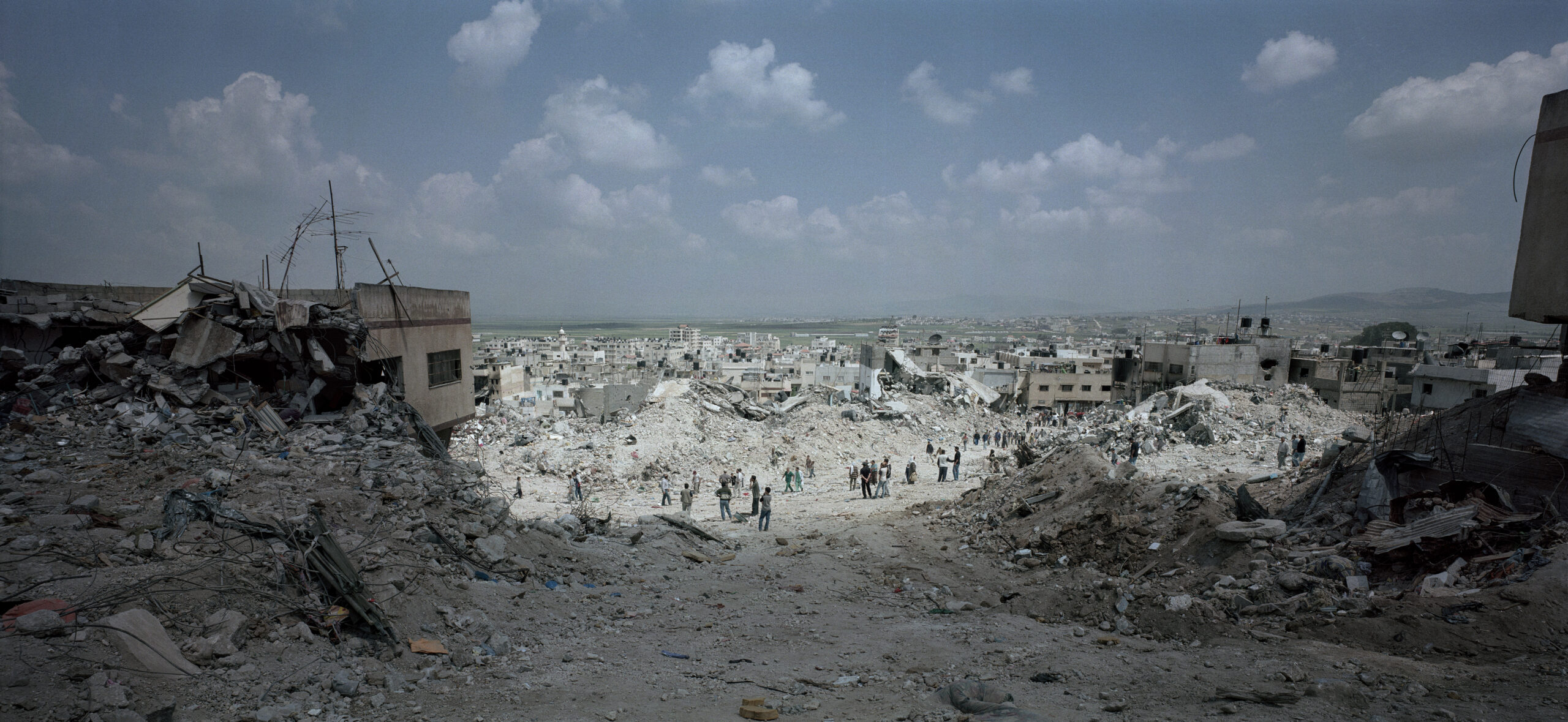
The format lends itself to standing back and representing a landscape in all its complexity. But I have to say that I didn’t really want it—it was, in a way, imposed on me by a camera I had chosen for other reasons that were more important: a medium-format one equipped with a large-format lens—which is very specific—of minimalist design. Compact and sturdy, it can be taken everywhere. Its 1:2 aspect ratio was precisely the only shortcoming it had for me; it felt too predetermined. But I have a somewhat peculiar relationship with technique. For me, the camera isn’t an instrument or a function, much less an inert or neutral object. On the contrary, it’s charged with everything I project onto it, which relates as much to intention as to less rational things. I would almost say that it is charged with a kind of warlike determination. And that it’s the powerful symbol of an impetus, an openness. This camera—and it was almost in spite of its format that I began the work—was a Linhof Technorama 612. I liked the severity of this instrument, its minimal functions and its austere edges. Very quickly, as soon as I had the camera in my hand, I made it my own. Not in the usual sense—as symbolised by the Leica, where the device disappears, becomes an extension of the body, and through this shortcut captures the instant—but rather because, with its basic ergonomics, it offered resistance. A foreign body, it marked its presence, and “making it my own” only meant giving myself up to the trick by which in getting used to the tool you believe you have softened its angles, when in fact it’s the tool that makes you.
It’s a special object that the photographer holds in his hands, both external and very close, a semi-otherness that sets off a complex play of displacements and mirrored exchanges. For in the photographer’s relation to the real—the very thing whose formula the photographer unknowingly seeks—the camera occupies a middle position. It’s a distinct term that stands for more than its nominal function. And because it contains an idea, an image, it’s the metaphor of a rationalised visual perception. What the photographer can recognise in the coldness of the manufactured object is a diagram of his own gaze. Geometry says nothing about the real experience of vision. If the camera was designed in this language, it’s only because light lends itself to such abstraction; it travels in a straight line. And one doesn’t seek any proof of true correspondence in this schema. But it’s enough for it to be a telling image. Beyond the common representation of the camera as a mechanical eye or that of its symmetrical ideal, the “man-camera,” the mere thought that through a formula of lines and angles the camera contains the field of projection and the picture plane at the same time has the effect of a symbol. Between visible reality, which is ever-changing and overflowing with signs, and the biological body, ever-changing and labyrinthine, the camera is, for the photographer, a site of transfers and a point of invariance at the threshold of the mental operation.
Are you just talking about the photographic act here or also the underlying intention?
I was at that time—I’m talking about that two- or three-year period at the beginning of the work—particularly attentive to these questions, the structural relationship between the most technical aspects of photography and the mode of representation I was trying to establish through intuitions and approximations. I won’t try to say what is actually going on in the mind at the moment of the photograph because I still don’t know, except perhaps that it proceeds from recognition, the intuitive recognition of a form or a thing that is still poorly defined but seems to be moving towards its resolution—and the wait for that, which is accompanied by successive shutter releases. To designate through the shutter release the moment of a more or less certain, more or less remote correspondence—that is, in truth, about all the photographer does. What gives rise to this recognition, however, is made of many things, of which idea and intention are only the manifest part, the narrowest, and the one I can talk about. I wanted to represent the event in a new way. I was expecting that a certain position, and then a certain structural clarity, a high degree of detail and the openness I mentioned earlier, would allow for the space to be rendered. This even before the question of the tableau. To render space, to emphasise its depth and put its component parts to work. To reveal the spatial relations, which are the expression of the relations between the protagonists. The picture had to draw its force from the number and complexity of those lines that connect places to people and people to one another. Before going any further, I have to point out that within the pictures themselves, you won’t find the fulfilment of the wish, the intention I’m describing. Of course, it’s not easy to carry out one’s programme in situations where uncertainty and confusion are the rule, but the real reason is that in my endless searching, I have often gone astray.
Were these thoughts on the representation of the event based on a critique of the media? I’m thinking of your past as a photojournalist.
No, I never felt concerned by these questions. And I would have found it trivial to concentrate on an objective like that. I thought about those things without looking back on my practice as a reporter; I wasn’t trying to widen the gap, to introduce one form in opposition to another. But while these kinds of comparison have always seemed to me to be an ineffective way of discussing my work, it’s interesting today to note two differences. One is the conceptual shift by which the protagonist of a news event becomes an actor in history. The other concerns the question of point of view and contrasts two opposite models. On the scene of the event to be covered, the reporter moves in a circle whose centre, in his eyes, is the action that condenses it. He revolves around this irresistible point, constantly shifting places to find an access, an angle through which to grasp his subject. The angles aren’t all the same but all are legitimate for the reporter, in relation to the centrality of the subject—the subject of the photograph. The reporter is multifaceted and the angle—that journalistic term—denotes the relativism of his position.
As for me, I’ve always been frontal. Frontality is part of me. I always see what presents itself to me as its face. I can’t detach myself from its immediate appearance and my experience of it: one and insistent. It’s perhaps this shortcoming, this lack of imagination, that has let me understand that, in photography, point of view is a complex notion. It doesn’t only designate a point in space, the choice of which is the initial act of any work of representation and which for others, like the painter, can be virtual, but also the point of actual presence. I mean the point—or rather, the unit—of presence, within the time of the action, made not only of what happens to the being through the senses but also what it expresses, signifies, and which will inevitably be inscribed in the image. The position, behaviour, attitude, way of being, form of existence—awaiting a word to better express what both proceeds from a relationship to the world and is its expression in physical space—is the essential condition for the production of a photograph. Something like a century ago, the camera, freed of the tripod, found its place in the photographer’s hands, and this phenomenology was added to the original givens of photography. I think that remains to be studied, and if we want to go beyond its manifest evidence, it’s precisely this evidence that will have to be considered, this almost tautological proximity to the point of existence that only belongs to photography.
But in addition to the frontality you’re talking about, there’s also the question of distance that I mentioned in relation to panoramic images.
Yes, and later on I realised the usefulness of that panoramic period: the format encourages a distancing that allowed me to “calibrate” my own distances. There’s the minimum distance, that of the reporter, which I knew well, and the maximum distance beyond which the figures disappear, and that establishes the measurable space of the distances common to everyone. And then there’s the photographer’s mental distance and that point of real presence. The panoramic format helped me clarify this question. But I must say that this word, “panoramic,” that was attached to my pictures irritated me for a long time, as if the format were the key to the work. I was trying to make tableaux, which is quite another matter.
You pointed out that the figures of Jenin Refugee Camp “suggest a world of subjectivities.” It’s often what remains undefined in a photograph that calls on the viewer’s imagination in a compensatory movement. And that’s proper to photography, I think, by the very fact of its indexation to the real, especially when the technique reveals its flaws. In trying to discern unclear figures, the viewer brings the photographic document closer to their own affects. But this part of the photograph’s “work,” the part that hinges on what is lacking, missing, by definition escapes its author. The questions I was asking myself at the time were of a different nature. Was it really enough to stand back in order to say things better? What I was doing felt limited. But I think I needed this displacement from the reporter’s proximity during that first period to a widening of the field in order to see things differently and, a bit later, to come closer again. It was necessary to push the protagonists of the event away in order to bring them back as a person or a character.
So, I opted for the distance that was, or seemed, determined by the openness and readability I was looking for. Most often, “the figure in the landscape of an event” was the motif of these pictures. The physical distance was also the mark of an intellectual distancing from my subject. This desire for clarity and objectivation of vision also corresponded to the need for a clarification of the means in what was still an experiment, the verification of an intuition. But detachment, no, because it’s impossible for me to be outside of what I see, and among the various ways the gaze is exercised, that of the observer is foreign to me. It was rather a form of attention within contemplation. This dual state in slight tension was the operational moment. And through the idea that any intervention other than those necessary for printing the negative would only disturb the result—an idea that is in fact untenable but very ingrained, longstanding, and whose value I’d come to recognise through my years as a reporter—this distance became a device of enunciation.
That the image should possess a distinct, new charge—through the conditions of its making and through the positive reality of the tableau—was what I had been looking for. I also expected distance to stabilise the representation by grounding its structure in the fixed elements of the environment. But something else was happening. The image seemed to retain the most raucous aspect of the event, to contain it, and, in a play of mutual constraints, to take on a paradoxical form.
This “adjusting” of the different degrees of distance is quite evident in many of your pictures. To cite one example that I find interesting in this respect, in A Mass Grave near Snagovo [fig. 2, cat. 26], we see four archaeologists exhuming the remains of people murdered in Srebrenica. The distance might be determined by the motif; it’s just enough to reveal the extent of the open pit. But it also has the effect of making the viewer aware of their absence of connection with those exhuming the remains and therefore with the tragic event that the picture evokes. (In a prose poem I wrote about this picture, I suggest that these four persons at work resemble four letters composing a word in an unknown language that would mean “horror.”) But I want to continue with a photograph that produces a distancing effect in another way: House to House [fig. 3, cat. 38]. The image is frontal (albeit not entirely), and we see the façade of a simple house with stucco walls, square columns on the right, and several large empty flower pots on the left. The drama of the scene is largely conveyed by the contrast between bright sunlight and shadow, which sets the stage for another kind of event: a young man in jeans and a purple tee shirt, holding a weapon in his right hand (we can hardly see it, but it’s there), caught as he enters the house, pushing the door with his left hand. That’s all, and yet it’s enough to capture the viewers’ attention, the sense of motion and balance of the young soldier being all the more vivid as we see him from behind. At the time, you told me you used the computer to remove the parallax effects on the façade, but was the image modified in any other way?
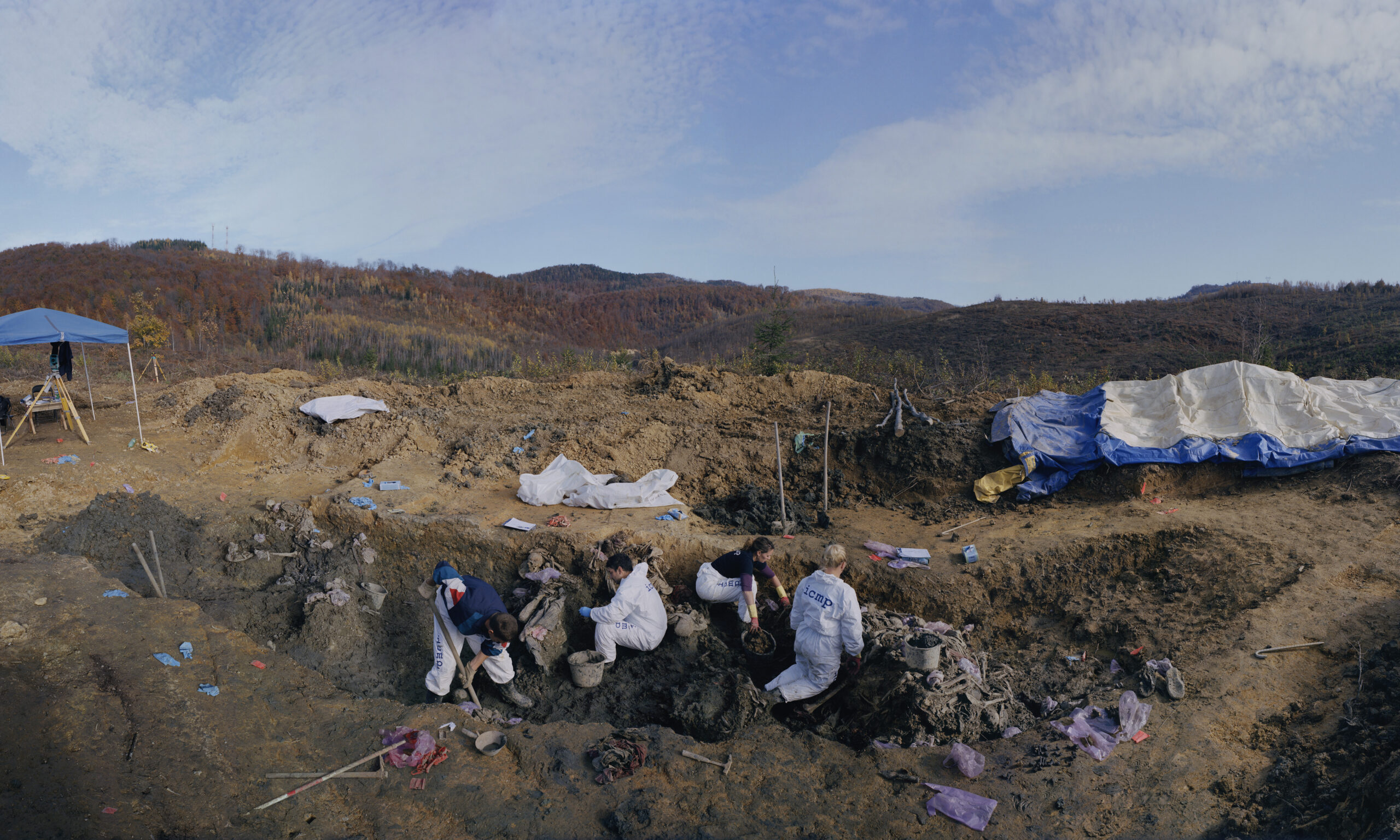
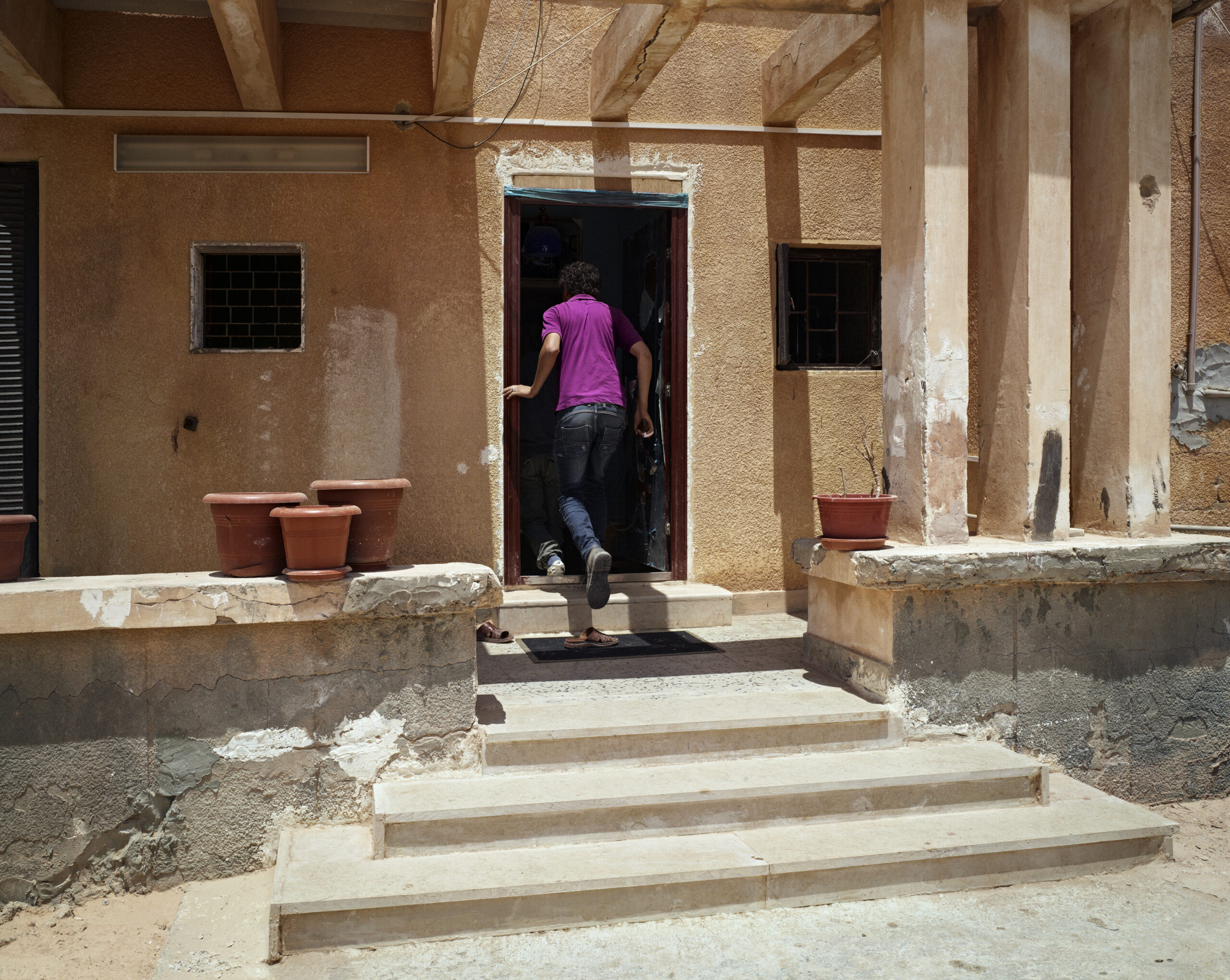
Placing a figure with its back to us, alone, in a large-scale tableau produces a paradox: you don’t say very much, but you say it loud. Contained, anti-expressive form interests me, and yet I’ve rarely used it—as is the case here, so overtly that it becomes the motif of the picture. Most of my photographs are made in the context of current events and propose a representation of them. They are indexed to the event, tied in one way or another to its “drama.” If my distance from the event is too great, if I stray too far from what might be called its literalness, then I enter another territory—one that’s more vast, but not really mine. My territory is limited, a marginal part of the real, one that ties me to the necessity of remaining within some form of narrative. Obviously, the contained form, the unspoken, doesn’t work very well for representing the event …. Simply stated, I can’t do without the face. Putting aside the fact that it has always been for me a kind of passion that I can’t explain, it is on the face that history is written, with all the problems that poses. More precisely, those related to expressiveness in the representation of an action through a still image. Human expression is inseparable from action, part of its very logic; the face reflects it or announces it. But it tends to neutralise it if it says too clearly what is already said by the movement of the body. It’s difficult to find a form of active ambiguity and not fall into the simplification and exaggeration that appear as soon as the expression, mobile by its very nature, is frozen in the image. The art of portraiture, moreover, relies on what’s undecidable in a face, an ambivalence that suggests the “depth” of the being. I’ve rarely used very pronounced expressions; I usually try to contain them. In a tableau, the difficulty lies in suggesting the meaning and movement of the action through composition alone. But beyond the question of the face, if there’s really a border between the spoken and the unspoken, I’m—almost in spite of myself—on the side of the spoken.
The town was deserted; the government forces had fled. In small groups, to secure the area, the rebels spread through the quiet streets, entered each house. I made the photograph in those circumstances. With the computer, I changed the colour of the tee shirt. It was faded orange, like the walls of the house, and it became that deep purple. I removed one element, a kind of shelf on the wall. And I corrected the optical distortions that appear when you photograph architecture. It is necessary to rid the image of these flaws that mark it as a photograph in a thankless way by giving free rein to the shortcomings of the technique. And to that end, one can rely on a geometrical convention of representation, which of course doesn’t correspond to our vision either but has the advantage, as a convention, of being tacitly accepted. Photographic distortion is a visual obstacle; it seemed impossible to me that the militiaman could cross the doorstep of such a house.
So he enters, and in a second, we won’t see him anymore. House to House is closely related to the photograph I made a few minutes later in the courtyard of another house: Death of a Mercenary [fig. 4, cat. 39] is its reverse. Outside, inside. While the first is a metaphor of disappearance or absence—and perhaps, but on a personal level, a metaphor of my position as photographer and my calculated absences—the second is an image of appearance. The militiaman’s effacement is opposed to the mercenary’s frontal and painful presence, the evidence, the concrete reality of a face at the moment of death.
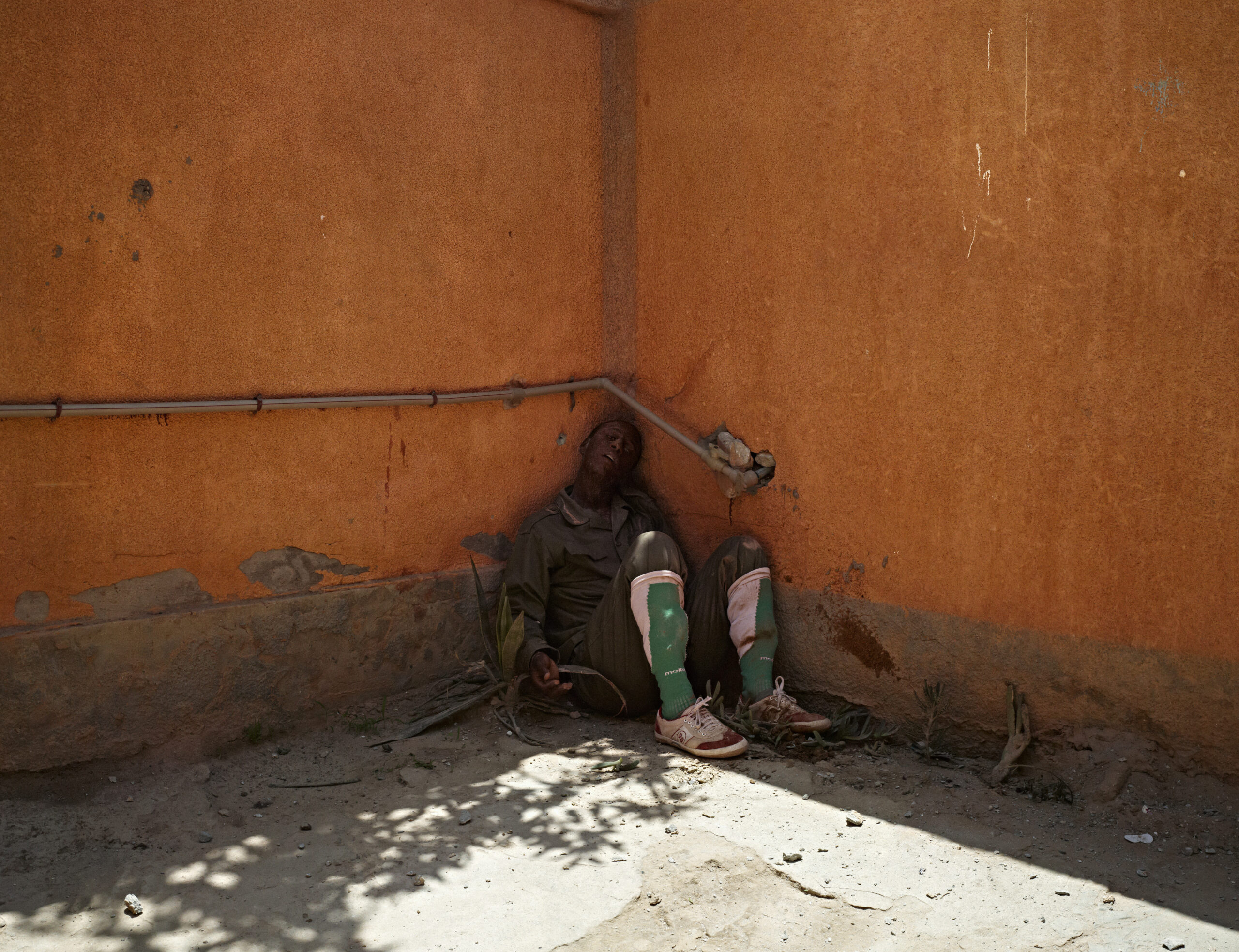
Death of a Mercenary is an intensely tragic photograph, and as such, it raises an essential question. In order to be affected by this picture, the viewer has to understand it as genuine, as a testimony. I assume you agree with that. How do you approach the question of the “effect of truth” when the extreme nature of the subject represented goes far beyond the parameters of art?
Photographing ordinary subjects with no particular drama, as I did in India and Senegal by looking at village life, was a response to what sometimes appeared to me as a limit: the fact that the photographs I made in the context of news events drew their strength from that of the situations themselves. I thought this was too simple, that ultimately a powerful subject weakens the image. Of course, in those moments of doubt I was forgetting that photography escapes the usual parameters of representation, that it displaces the author’s status. What creates the irreducibility of the photograph is the mechanical trace of the experience, which gives it a value of enunciation. A photograph is the product of a gaze, a moment, and things; it’s the actualisation of presence. But the technical determination of the photographic tool on the one hand and the subordination to the contingencies of the real on the other reduce the perimeter of “making” and give the unconscious a major role. In a way, all that remains for the photographer is the unconscious …. There’s something radically mad in photography: a photograph can’t really proceed from an intention (but only from a mise en situation, which is to say, the photographer’s idea of his position and of the act itself), and it is completed the moment the light-sensitive surface has been exposed. Once the act is accomplished, it’s “there,” definitive, an external entity the photographer now has to contend with. This means that, for the photographer, there are two times—that of taking the picture and that of realising what’s been taken, in the two senses of the word realise: becoming aware of what has been done, recognising it, designating it, and in this way, becoming its author.
To explain what happened in Tawergha that day, I’ll quote a few lines from something I wrote shortly afterwards:
A militiaman fires a burst of shots at arm’s length over the wall of a courtyard and goes away. Another one opens the iron door a little, fires again, and goes away. I push the gate, alone, I enter the courtyard. It’s perhaps five by three meters, there’s an old shoe, a plastic bucket, a dusty plant, and a man in fatigues sitting on the ground against the wall. I’m a shadow, a kind of ghost. Now, without transition, I’m on the other side of the courtyard, facing him: he’s a young man, head tilted, palm open, and he’s looking at me. A faint moan comes from his throat but there’s no sign of a wound. Is it just a trick? I’m a shadow, the militiamen out in the street are my kind. I set the focus and take one or two pictures. Then I move a step closer—you have to be tough now. I set the focus again, I frame—you have to see it through to the end. I make one photo, then another—the end of a certain logic, not hiding behind a lie but instead accepting the infamy, being honest, paying this final instalment.
I’m including these personal notes because they give an idea of the contradictory thoughts one can have in such a moment and suggest a definition of what I call the “impossible position.” There’s obviously no room at that point for pictorial concerns. But I think that the “effect of truth” you’re speaking about comes precisely from this crisis of position, which the photographer passes on to the viewer in turn. The truth is unmistakable, but here it unsettles and brings out the moral question.
The description of this encounter highlights the extent of your field, with such a situation as a kind of borderline case. The image doesn’t linger on the wound of the dying man; what we see first of all is his gaze and his hand. But another element, which acts almost unknowingly on the viewer, is the deep orange of the walls. Whether or not you intensified it with the computer, it reinforces the feeling of oppression. The viewer can’t help being struck by this confrontation and, as you say, unsettled. It’s hard to know whether the impression of “presence” comes from that of the photographer or, conversely, from his transparency. In Father and Daughter [fig. 5, cat. 45], which is of a totally different nature, the photographer’s presence is felt ever so slightly, like a discreet indicator. If I’m not mistaken, the format is smaller than most of your photographs. The time of day, which seems to be dusk, is beautifully chosen, as is the distance between the two figures and the looks they exchange. I imagine you staged it, but the result goes beyond any idea of formal arrangement—what we feel is rather the tranquil disclosure of a deep connection. It’s a modest but powerful image that I find just as characteristic of your work as Death of a Mercenary.
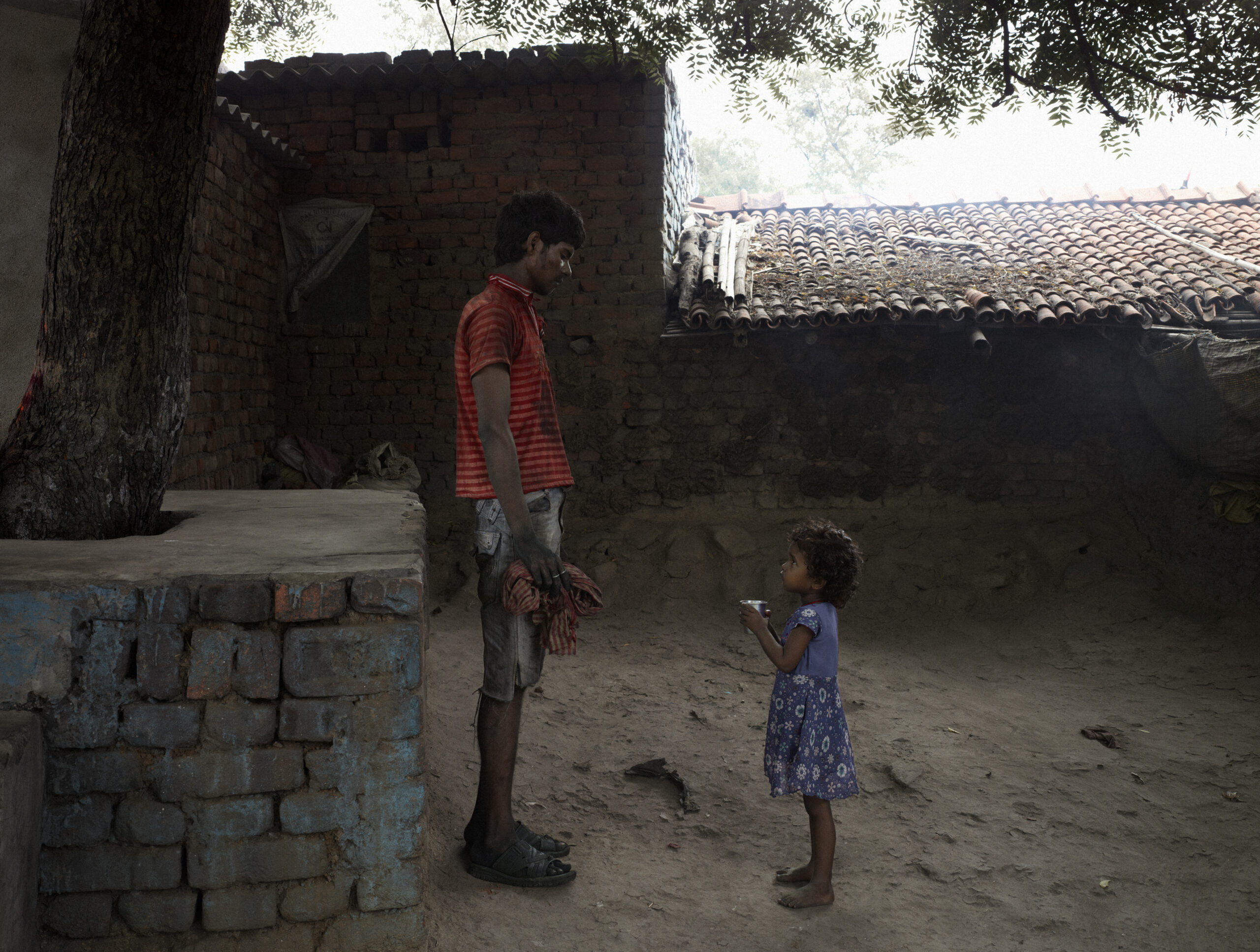
Father and Daughter is the first photograph I staged. Jharkhand is a region of intensive coal mining. For the inhabitants of Jokta, the quarry appeared one day, rather far away, and gradually expanded until it reached the extraordinary size of more than one kilometre in diameter when I was there. Nothing seemed capable of stopping this thing that was advancing towards the village, and I think it doesn’t exist anymore. As elsewhere, nearly all the inhabitants earn their livelihoods by collecting coal. They are modern-day gleaners, using their hands to take what the machines have left behind. On their scale, they participate in the programmed disappearance of their village, their way of life. I had photographed the young man at work in the mine and, at the end of the morning, went with him to where he lived. His daughter came out of the house, like she did every day I think, to hand him a cup. Trying to capture a fragile, wavering instant is futile when it vanishes with the slightest breath. For those three seconds, standing still, I only hoped to not disturb anything. You can choose to do nothing. With the mercenary, I had chosen to take a photograph; here, I missed it, deliberately. In any case, the missed opportunity, the sense of lack, accompanies the photographer. But perhaps there was also the desire to cultivate it in Jokta precisely, far from the arenas of current events, where it takes another form.
Can you say more about that?
Lack and chance go together in photography. The photographer himself knows little about the real reasons that lead him to an image, and if, in order to observe him, you were to remove what belongs to his conscious will—the confidence he has in his means and everything through which he forms an intention and believes that he is in control of his actions—you would see that the most constant part in him is that lack: the empty place of the thing he is waiting for and not knowing what that thing is.
Such is his situation: he has entered the changing landscape of the real, which is made and unmade at every instant; he’s faced with the uncertainty of the present and, through the precariousness of his position and the strangeness of his quest—the object of which he doesn’t know—he leaves behind the system of conventions known as “reality.” The physical world appears to him as a set of equal but discontinuous occurrences. Taken in and of themselves, things have no meaning; they simply exist. The schematic figure of the photographer described here is detached from social imperatives; it belongs to no formal category and serves no function. And for the new possibilities it holds, one could also say that it’s a poetic figure. But the photographer doesn’t occupy those heights; he only knows the modesty of his position. What is defined in him—intention—constantly draws him towards firmer ground, but he knows what he’d lose if he gave in to it too much: the fragility—receptiveness, openness—his main working tool. So, he adjusts this setting; he tries to keep a balance between the withdrawal he sought and what in him is more established, what asserts and accompanies him everywhere inevitably. What he would like is to be able to think and feel at the same time. Or better, to give sensation the form of a thought. But there is no existence without a manifestation of existence, and to reach that point, the initial impetus must have come from a choice, a decision. That same thing will take place again to justify the path taken, and for him, who wants to be part of what surrounds him, to justify the name “photographer”: he will make a picture.
So, I think we need to look for another definition of the word “chance” in photography. What we call “chance” in the continuous movement of the world is the encounter with something whose presence or trajectory was unknown to us, which fell outside the scope of our perception. And, in a photograph, the part of accident, the unforeseen that inevitably forms it and which is said to contribute to its interest or its beauty. All of this corresponds to the overly simple idea that the photographic act is a conscious, determined gesture, which is accomplished against or with these external forces. Using them or rejecting them would therefore be a matter of skill or, worse, talent. This conception of the act, which presents the photograph as a fixed given, can only be inadequate. I’m referring here to its most insipid version, the mystique of the lucky coincidence, as well as the one that seeks to dominate the real by presenting it in turn as a fixed given. There are as many accidents and chance events in the photographer’s mind as there are in this unstable reality. I mean this elusive tangle of incomplete thoughts, bits of feelings that come from nowhere and immediately disappear, things he sees without seeing them, hears without hearing them. American street photographers of the 1960s and 1970s may have sketched the form of that. For the photographer, the real only offers potential situations. They are there for him—someone else would see others—and they call for his involvement. In other words, that he asserts his self and calls it into question in the same move. If the photographer has something to do, that’s what it is, in the presence of one form or another of otherness. This definition of the self at the risk of the other is the meaning of his act. And to come back to the lack, perhaps this is also where it is found. What he lacks and awaits would only be within himself, would only be that tiny bit of presence of mind or sensitivity that failed him in the rigour of engagement.
But with Father and Daughter, it’s something else again. What had led me there, in reaction to the role of the current event in my work, was the idea that any lost place could be the centre of the world, that designating it as such is enough to make it true. At the centre of this centre, there was the thing I had just seen, whose vision I had preferred to receive intact, without the cut of the shutter release. But from then on, I “missed” this picture. I brushed aside—just as a test, I told myself—the ordinary condition of the photographer bound to the present moment and returned to the village a month later, with the idea of reconstituting the memory as faithfully as possible. I wanted something simple, without preparation. We shot the photographs in a few minutes, less than an hour for sure. I didn’t want my characters to settle into the situation but rather, to remain a bit surprised, perhaps slightly intimidated. It was calm, light-hearted. The villagers were around us; there was laughter. I think the young man was quite conscious of the meaning of all that, which resembled an improvised ceremony. I wasn’t aiming for “naturalness,” which in photography always rings so false and which would have distanced the image from its idea. I mean from the idea of the image.


LUC DELAHAYE, Le bruit du monde
Exhibition at the Jeu de Paume, October 10, 2025 – January 25, 2026
Curated by Quentin Bajac
The following text is of an email “conversation” between Luc Delahaye and myself, which appears in the English version of Delahaye’s catalogue for his current exhibition at the Jeu de Paume, entitled “Le bruit du monde.” I wrote about Delahaye in my book Why Photography Matters as Art as Never Before (2008) and have remained in close touch with him and his work ever since. It’s probably unnecessary for me to say this, but I regard Delahaye’s remarks as among the most brilliant commentaries on photography as an art I have ever read. (In our “conversation,” Delahaye’s replies were in French; they were translated into English by Sharon Kerman.)
— Michael Fried
It’s been twenty years since your exhibition at La Maison Rouge. That was my first encounter with your work and it also marked a radical turning-point for the photographer you were at the time. How do you see that exhibition today?
It was an important moment because, after four years, there was enough material to take stock of the work from that first period. Showing it in France also had a particular meaning for me as a statement. I was very conscious of the singular nature of my position, neither in one world nor the other. But the exhibition also marked the beginning of a new cycle because the two most recent photographs had been produced on a computer; I was initiating a new approach that was added to the direct documentary one of the first stage. This duality, which became part of my work at that point, corresponds to two ways of conceiving the role of the imagination. One utilises the unlimited, uncontrollable possibilities of the real; the other draws on the resources of the mind, which are more or less under control but limited. I had given myself a precise definition of this work on the computer: composing a picture from fragments of the real, captured within the conditions of reportage and captured to that end. I sensed that this was my path, and yet, at the beginning, it gave me the impression of doing work that wasn’t my own. Touching the image, altering the image, entering the image. I didn’t exactly see where I was going or what I could gain, but I knew what I might lose. And for me, this approach was not any more artistic than the first. This redefinition of the word “author” was a profound challenge to what I had always done.
That clearly brought you closer to photographers who had started using this method long before you. And yet, in the pictures you make this way, you remain grounded in the real. Unlike photographers who construct their images, where everything is arranged, plotted, you seem to want or need the resistance of the real, the difficult, the unplotted.
The resistance of the real, yes. And a confrontation, a toughness. That’s how I experience things. I don’t maintain the distance from reality that would permit an analytical understanding of it; nothing exists other than what can be seen and touched. Seeing and touching are the same, moreover. The gaze is an engagement of presence; it’s an act. For me, this engagement is often frontal and harsh. It’s made up of desire and apprehension. That’s why I felt in my element when I was a reporter and, later, covering war. In reportage, everything is a struggle, and especially getting access, the simple fact of arriving on the scene of the event. Photography is not just a means, a technique in the art of representation; it is first and foremost a possibility of being in the real. But even though I found what I was looking for in reporting, I found even more: I saw that the true place of the imagination is within the real itself. That my imagination doesn’t exist. Or, if it exists, that it’s only a relay, a transmission belt for the “engine of images” that is the real. I can’t do without the “difficult”.
That’s why my “constructed” photographs are always based on reportage. They are made up of fragments of the real, moments of experience, which have the value of photographic documents for me. Even the ones that are the most invented, like Trading Floor [cat. 41] or COP 26 [cat. 68]. This is also true for the staged photographs I started making in 2013, where this dimension is very present: they emerge from an encounter or else from something seen, and that experience always provides the base, although necessarily in a deferred way. They have a history, formed by the movement of human relations and running parallel to the “official” history of the image, and that will inscribe itself on the image’s reverse side. And the moment of shooting these staged scenes is a moment of inner tension that, for me, is exactly equivalent to shooting in the conditions of reportage. I’m not photographing a fictional character but the external reality of a person, in fragments, methodically, patiently and ardently. I document. My staged pictures are really very simple, made with modest means, but they need that base in order to have a legitimate existence in my eyes.
If you don’t mind, I’d like to go back a little. In looking through the photographs of the first period, I was once again struck by some of the panoramic pictures, in particular the ones that “operate” at a great distance from the subject—Jenin Refugee Camp [fig. 1, cat. 7], for example. The shadowed foreground with its traces of destruction, then the successive planes bathed in sunlight with figures too far away for us to read their expressions, but whose presence nevertheless suggests a world of subjectivities; and finally, the blue sky and the delicate, peaceful clouds. And, obviously, there’s the “reverse” of this image, to borrow the term you just used, which summons our knowledge of the political significance of the scene. All of this is made possible, not just framed but somehow enabled, by the panoramic format. What do you think about those early panoramic photographs today?
The format lends itself to standing back and representing a landscape in all its complexity. But I have to say that I didn’t really want it—it was, in a way, imposed on me by a camera I had chosen for other reasons that were more important: a medium-format one equipped with a large-format lens—which is very specific—of minimalist design. Compact and sturdy, it can be taken everywhere. Its 1:2 aspect ratio was precisely the only shortcoming it had for me; it felt too predetermined. But I have a somewhat peculiar relationship with technique. For me, the camera isn’t an instrument or a function, much less an inert or neutral object. On the contrary, it’s charged with everything I project onto it, which relates as much to intention as to less rational things. I would almost say that it is charged with a kind of warlike determination. And that it’s the powerful symbol of an impetus, an openness. This camera—and it was almost in spite of its format that I began the work—was a Linhof Technorama 612. I liked the severity of this instrument, its minimal functions and its austere edges. Very quickly, as soon as I had the camera in my hand, I made it my own. Not in the usual sense—as symbolised by the Leica, where the device disappears, becomes an extension of the body, and through this shortcut captures the instant—but rather because, with its basic ergonomics, it offered resistance. A foreign body, it marked its presence, and “making it my own” only meant giving myself up to the trick by which in getting used to the tool you believe you have softened its angles, when in fact it’s the tool that makes you.
It’s a special object that the photographer holds in his hands, both external and very close, a semi-otherness that sets off a complex play of displacements and mirrored exchanges. For in the photographer’s relation to the real—the very thing whose formula the photographer unknowingly seeks—the camera occupies a middle position. It’s a distinct term that stands for more than its nominal function. And because it contains an idea, an image, it’s the metaphor of a rationalised visual perception. What the photographer can recognise in the coldness of the manufactured object is a diagram of his own gaze. Geometry says nothing about the real experience of vision. If the camera was designed in this language, it’s only because light lends itself to such abstraction; it travels in a straight line. And one doesn’t seek any proof of true correspondence in this schema. But it’s enough for it to be a telling image. Beyond the common representation of the camera as a mechanical eye or that of its symmetrical ideal, the “man-camera,” the mere thought that through a formula of lines and angles the camera contains the field of projection and the picture plane at the same time has the effect of a symbol. Between visible reality, which is ever-changing and overflowing with signs, and the biological body, ever-changing and labyrinthine, the camera is, for the photographer, a site of transfers and a point of invariance at the threshold of the mental operation.
Are you just talking about the photographic act here or also the underlying intention?
I was at that time—I’m talking about that two- or three-year period at the beginning of the work—particularly attentive to these questions, the structural relationship between the most technical aspects of photography and the mode of representation I was trying to establish through intuitions and approximations. I won’t try to say what is actually going on in the mind at the moment of the photograph because I still don’t know, except perhaps that it proceeds from recognition, the intuitive recognition of a form or a thing that is still poorly defined but seems to be moving towards its resolution—and the wait for that, which is accompanied by successive shutter releases. To designate through the shutter release the moment of a more or less certain, more or less remote correspondence—that is, in truth, about all the photographer does. What gives rise to this recognition, however, is made of many things, of which idea and intention are only the manifest part, the narrowest, and the one I can talk about. I wanted to represent the event in a new way. I was expecting that a certain position, and then a certain structural clarity, a high degree of detail and the openness I mentioned earlier, would allow for the space to be rendered. This even before the question of the tableau. To render space, to emphasise its depth and put its component parts to work. To reveal the spatial relations, which are the expression of the relations between the protagonists. The picture had to draw its force from the number and complexity of those lines that connect places to people and people to one another. Before going any further, I have to point out that within the pictures themselves, you won’t find the fulfilment of the wish, the intention I’m describing. Of course, it’s not easy to carry out one’s programme in situations where uncertainty and confusion are the rule, but the real reason is that in my endless searching, I have often gone astray.
Were these thoughts on the representation of the event based on a critique of the media? I’m thinking of your past as a photojournalist.
No, I never felt concerned by these questions. And I would have found it trivial to concentrate on an objective like that. I thought about those things without looking back on my practice as a reporter; I wasn’t trying to widen the gap, to introduce one form in opposition to another. But while these kinds of comparison have always seemed to me to be an ineffective way of discussing my work, it’s interesting today to note two differences. One is the conceptual shift by which the protagonist of a news event becomes an actor in history. The other concerns the question of point of view and contrasts two opposite models. On the scene of the event to be covered, the reporter moves in a circle whose centre, in his eyes, is the action that condenses it. He revolves around this irresistible point, constantly shifting places to find an access, an angle through which to grasp his subject. The angles aren’t all the same but all are legitimate for the reporter, in relation to the centrality of the subject—the subject of the photograph. The reporter is multifaceted and the angle—that journalistic term—denotes the relativism of his position.
As for me, I’ve always been frontal. Frontality is part of me. I always see what presents itself to me as its face. I can’t detach myself from its immediate appearance and my experience of it: one and insistent. It’s perhaps this shortcoming, this lack of imagination, that has let me understand that, in photography, point of view is a complex notion. It doesn’t only designate a point in space, the choice of which is the initial act of any work of representation and which for others, like the painter, can be virtual, but also the point of actual presence. I mean the point—or rather, the unit—of presence, within the time of the action, made not only of what happens to the being through the senses but also what it expresses, signifies, and which will inevitably be inscribed in the image. The position, behaviour, attitude, way of being, form of existence—awaiting a word to better express what both proceeds from a relationship to the world and is its expression in physical space—is the essential condition for the production of a photograph. Something like a century ago, the camera, freed of the tripod, found its place in the photographer’s hands, and this phenomenology was added to the original givens of photography. I think that remains to be studied, and if we want to go beyond its manifest evidence, it’s precisely this evidence that will have to be considered, this almost tautological proximity to the point of existence that only belongs to photography.
But in addition to the frontality you’re talking about, there’s also the question of distance that I mentioned in relation to panoramic images.
Yes, and later on I realised the usefulness of that panoramic period: the format encourages a distancing that allowed me to “calibrate” my own distances. There’s the minimum distance, that of the reporter, which I knew well, and the maximum distance beyond which the figures disappear, and that establishes the measurable space of the distances common to everyone. And then there’s the photographer’s mental distance and that point of real presence. The panoramic format helped me clarify this question. But I must say that this word, “panoramic,” that was attached to my pictures irritated me for a long time, as if the format were the key to the work. I was trying to make tableaux, which is quite another matter.
You pointed out that the figures of Jenin Refugee Camp “suggest a world of subjectivities.” It’s often what remains undefined in a photograph that calls on the viewer’s imagination in a compensatory movement. And that’s proper to photography, I think, by the very fact of its indexation to the real, especially when the technique reveals its flaws. In trying to discern unclear figures, the viewer brings the photographic document closer to their own affects. But this part of the photograph’s “work,” the part that hinges on what is lacking, missing, by definition escapes its author. The questions I was asking myself at the time were of a different nature. Was it really enough to stand back in order to say things better? What I was doing felt limited. But I think I needed this displacement from the reporter’s proximity during that first period to a widening of the field in order to see things differently and, a bit later, to come closer again. It was necessary to push the protagonists of the event away in order to bring them back as a person or a character.
So, I opted for the distance that was, or seemed, determined by the openness and readability I was looking for. Most often, “the figure in the landscape of an event” was the motif of these pictures. The physical distance was also the mark of an intellectual distancing from my subject. This desire for clarity and objectivation of vision also corresponded to the need for a clarification of the means in what was still an experiment, the verification of an intuition. But detachment, no, because it’s impossible for me to be outside of what I see, and among the various ways the gaze is exercised, that of the observer is foreign to me. It was rather a form of attention within contemplation. This dual state in slight tension was the operational moment. And through the idea that any intervention other than those necessary for printing the negative would only disturb the result—an idea that is in fact untenable but very ingrained, longstanding, and whose value I’d come to recognise through my years as a reporter—this distance became a device of enunciation.
That the image should possess a distinct, new charge—through the conditions of its making and through the positive reality of the tableau—was what I had been looking for. I also expected distance to stabilise the representation by grounding its structure in the fixed elements of the environment. But something else was happening. The image seemed to retain the most raucous aspect of the event, to contain it, and, in a play of mutual constraints, to take on a paradoxical form.
This “adjusting” of the different degrees of distance is quite evident in many of your pictures. To cite one example that I find interesting in this respect, in A Mass Grave near Snagovo [fig. 2, cat. 26], we see four archaeologists exhuming the remains of people murdered in Srebrenica. The distance might be determined by the motif; it’s just enough to reveal the extent of the open pit. But it also has the effect of making the viewer aware of their absence of connection with those exhuming the remains and therefore with the tragic event that the picture evokes. (In a prose poem I wrote about this picture, I suggest that these four persons at work resemble four letters composing a word in an unknown language that would mean “horror.”) But I want to continue with a photograph that produces a distancing effect in another way: House to House [fig. 3, cat. 38]. The image is frontal (albeit not entirely), and we see the façade of a simple house with stucco walls, square columns on the right, and several large empty flower pots on the left. The drama of the scene is largely conveyed by the contrast between bright sunlight and shadow, which sets the stage for another kind of event: a young man in jeans and a purple tee shirt, holding a weapon in his right hand (we can hardly see it, but it’s there), caught as he enters the house, pushing the door with his left hand. That’s all, and yet it’s enough to capture the viewers’ attention, the sense of motion and balance of the young soldier being all the more vivid as we see him from behind. At the time, you told me you used the computer to remove the parallax effects on the façade, but was the image modified in any other way?
Placing a figure with its back to us, alone, in a large-scale tableau produces a paradox: you don’t say very much, but you say it loud. Contained, anti-expressive form interests me, and yet I’ve rarely used it—as is the case here, so overtly that it becomes the motif of the picture. Most of my photographs are made in the context of current events and propose a representation of them. They are indexed to the event, tied in one way or another to its “drama.” If my distance from the event is too great, if I stray too far from what might be called its literalness, then I enter another territory—one that’s more vast, but not really mine. My territory is limited, a marginal part of the real, one that ties me to the necessity of remaining within some form of narrative. Obviously, the contained form, the unspoken, doesn’t work very well for representing the event …. Simply stated, I can’t do without the face. Putting aside the fact that it has always been for me a kind of passion that I can’t explain, it is on the face that history is written, with all the problems that poses. More precisely, those related to expressiveness in the representation of an action through a still image. Human expression is inseparable from action, part of its very logic; the face reflects it or announces it. But it tends to neutralise it if it says too clearly what is already said by the movement of the body. It’s difficult to find a form of active ambiguity and not fall into the simplification and exaggeration that appear as soon as the expression, mobile by its very nature, is frozen in the image. The art of portraiture, moreover, relies on what’s undecidable in a face, an ambivalence that suggests the “depth” of the being. I’ve rarely used very pronounced expressions; I usually try to contain them. In a tableau, the difficulty lies in suggesting the meaning and movement of the action through composition alone. But beyond the question of the face, if there’s really a border between the spoken and the unspoken, I’m—almost in spite of myself—on the side of the spoken.
The town was deserted; the government forces had fled. In small groups, to secure the area, the rebels spread through the quiet streets, entered each house. I made the photograph in those circumstances. With the computer, I changed the colour of the tee shirt. It was faded orange, like the walls of the house, and it became that deep purple. I removed one element, a kind of shelf on the wall. And I corrected the optical distortions that appear when you photograph architecture. It is necessary to rid the image of these flaws that mark it as a photograph in a thankless way by giving free rein to the shortcomings of the technique. And to that end, one can rely on a geometrical convention of representation, which of course doesn’t correspond to our vision either but has the advantage, as a convention, of being tacitly accepted. Photographic distortion is a visual obstacle; it seemed impossible to me that the militiaman could cross the doorstep of such a house.
So he enters, and in a second, we won’t see him anymore. House to House is closely related to the photograph I made a few minutes later in the courtyard of another house: Death of a Mercenary [fig. 4, cat. 39] is its reverse. Outside, inside. While the first is a metaphor of disappearance or absence—and perhaps, but on a personal level, a metaphor of my position as photographer and my calculated absences—the second is an image of appearance. The militiaman’s effacement is opposed to the mercenary’s frontal and painful presence, the evidence, the concrete reality of a face at the moment of death.
Death of a Mercenary is an intensely tragic photograph, and as such, it raises an essential question. In order to be affected by this picture, the viewer has to understand it as genuine, as a testimony. I assume you agree with that. How do you approach the question of the “effect of truth” when the extreme nature of the subject represented goes far beyond the parameters of art?
Photographing ordinary subjects with no particular drama, as I did in India and Senegal by looking at village life, was a response to what sometimes appeared to me as a limit: the fact that the photographs I made in the context of news events drew their strength from that of the situations themselves. I thought this was too simple, that ultimately a powerful subject weakens the image. Of course, in those moments of doubt I was forgetting that photography escapes the usual parameters of representation, that it displaces the author’s status. What creates the irreducibility of the photograph is the mechanical trace of the experience, which gives it a value of enunciation. A photograph is the product of a gaze, a moment, and things; it’s the actualisation of presence. But the technical determination of the photographic tool on the one hand and the subordination to the contingencies of the real on the other reduce the perimeter of “making” and give the unconscious a major role. In a way, all that remains for the photographer is the unconscious …. There’s something radically mad in photography: a photograph can’t really proceed from an intention (but only from a mise en situation, which is to say, the photographer’s idea of his position and of the act itself), and it is completed the moment the light-sensitive surface has been exposed. Once the act is accomplished, it’s “there,” definitive, an external entity the photographer now has to contend with. This means that, for the photographer, there are two times—that of taking the picture and that of realising what’s been taken, in the two senses of the word realise: becoming aware of what has been done, recognising it, designating it, and in this way, becoming its author.
To explain what happened in Tawergha that day, I’ll quote a few lines from something I wrote shortly afterwards:
A militiaman fires a burst of shots at arm’s length over the wall of a courtyard and goes away. Another one opens the iron door a little, fires again, and goes away. I push the gate, alone, I enter the courtyard. It’s perhaps five by three meters, there’s an old shoe, a plastic bucket, a dusty plant, and a man in fatigues sitting on the ground against the wall. I’m a shadow, a kind of ghost. Now, without transition, I’m on the other side of the courtyard, facing him: he’s a young man, head tilted, palm open, and he’s looking at me. A faint moan comes from his throat but there’s no sign of a wound. Is it just a trick? I’m a shadow, the militiamen out in the street are my kind. I set the focus and take one or two pictures. Then I move a step closer—you have to be tough now. I set the focus again, I frame—you have to see it through to the end. I make one photo, then another—the end of a certain logic, not hiding behind a lie but instead accepting the infamy, being honest, paying this final instalment.
I’m including these personal notes because they give an idea of the contradictory thoughts one can have in such a moment and suggest a definition of what I call the “impossible position.” There’s obviously no room at that point for pictorial concerns. But I think that the “effect of truth” you’re speaking about comes precisely from this crisis of position, which the photographer passes on to the viewer in turn. The truth is unmistakable, but here it unsettles and brings out the moral question.
The description of this encounter highlights the extent of your field, with such a situation as a kind of borderline case. The image doesn’t linger on the wound of the dying man; what we see first of all is his gaze and his hand. But another element, which acts almost unknowingly on the viewer, is the deep orange of the walls. Whether or not you intensified it with the computer, it reinforces the feeling of oppression. The viewer can’t help being struck by this confrontation and, as you say, unsettled. It’s hard to know whether the impression of “presence” comes from that of the photographer or, conversely, from his transparency. In Father and Daughter [fig. 5, cat. 45], which is of a totally different nature, the photographer’s presence is felt ever so slightly, like a discreet indicator. If I’m not mistaken, the format is smaller than most of your photographs. The time of day, which seems to be dusk, is beautifully chosen, as is the distance between the two figures and the looks they exchange. I imagine you staged it, but the result goes beyond any idea of formal arrangement—what we feel is rather the tranquil disclosure of a deep connection. It’s a modest but powerful image that I find just as characteristic of your work as Death of a Mercenary.
Father and Daughter is the first photograph I staged. Jharkhand is a region of intensive coal mining. For the inhabitants of Jokta, the quarry appeared one day, rather far away, and gradually expanded until it reached the extraordinary size of more than one kilometre in diameter when I was there. Nothing seemed capable of stopping this thing that was advancing towards the village, and I think it doesn’t exist anymore. As elsewhere, nearly all the inhabitants earn their livelihoods by collecting coal. They are modern-day gleaners, using their hands to take what the machines have left behind. On their scale, they participate in the programmed disappearance of their village, their way of life. I had photographed the young man at work in the mine and, at the end of the morning, went with him to where he lived. His daughter came out of the house, like she did every day I think, to hand him a cup. Trying to capture a fragile, wavering instant is futile when it vanishes with the slightest breath. For those three seconds, standing still, I only hoped to not disturb anything. You can choose to do nothing. With the mercenary, I had chosen to take a photograph; here, I missed it, deliberately. In any case, the missed opportunity, the sense of lack, accompanies the photographer. But perhaps there was also the desire to cultivate it in Jokta precisely, far from the arenas of current events, where it takes another form.
Can you say more about that?
Lack and chance go together in photography. The photographer himself knows little about the real reasons that lead him to an image, and if, in order to observe him, you were to remove what belongs to his conscious will—the confidence he has in his means and everything through which he forms an intention and believes that he is in control of his actions—you would see that the most constant part in him is that lack: the empty place of the thing he is waiting for and not knowing what that thing is.
Such is his situation: he has entered the changing landscape of the real, which is made and unmade at every instant; he’s faced with the uncertainty of the present and, through the precariousness of his position and the strangeness of his quest—the object of which he doesn’t know—he leaves behind the system of conventions known as “reality.” The physical world appears to him as a set of equal but discontinuous occurrences. Taken in and of themselves, things have no meaning; they simply exist. The schematic figure of the photographer described here is detached from social imperatives; it belongs to no formal category and serves no function. And for the new possibilities it holds, one could also say that it’s a poetic figure. But the photographer doesn’t occupy those heights; he only knows the modesty of his position. What is defined in him—intention—constantly draws him towards firmer ground, but he knows what he’d lose if he gave in to it too much: the fragility—receptiveness, openness—his main working tool. So, he adjusts this setting; he tries to keep a balance between the withdrawal he sought and what in him is more established, what asserts and accompanies him everywhere inevitably. What he would like is to be able to think and feel at the same time. Or better, to give sensation the form of a thought. But there is no existence without a manifestation of existence, and to reach that point, the initial impetus must have come from a choice, a decision. That same thing will take place again to justify the path taken, and for him, who wants to be part of what surrounds him, to justify the name “photographer”: he will make a picture.
So, I think we need to look for another definition of the word “chance” in photography. What we call “chance” in the continuous movement of the world is the encounter with something whose presence or trajectory was unknown to us, which fell outside the scope of our perception. And, in a photograph, the part of accident, the unforeseen that inevitably forms it and which is said to contribute to its interest or its beauty. All of this corresponds to the overly simple idea that the photographic act is a conscious, determined gesture, which is accomplished against or with these external forces. Using them or rejecting them would therefore be a matter of skill or, worse, talent. This conception of the act, which presents the photograph as a fixed given, can only be inadequate. I’m referring here to its most insipid version, the mystique of the lucky coincidence, as well as the one that seeks to dominate the real by presenting it in turn as a fixed given. There are as many accidents and chance events in the photographer’s mind as there are in this unstable reality. I mean this elusive tangle of incomplete thoughts, bits of feelings that come from nowhere and immediately disappear, things he sees without seeing them, hears without hearing them. American street photographers of the 1960s and 1970s may have sketched the form of that. For the photographer, the real only offers potential situations. They are there for him—someone else would see others—and they call for his involvement. In other words, that he asserts his self and calls it into question in the same move. If the photographer has something to do, that’s what it is, in the presence of one form or another of otherness. This definition of the self at the risk of the other is the meaning of his act. And to come back to the lack, perhaps this is also where it is found. What he lacks and awaits would only be within himself, would only be that tiny bit of presence of mind or sensitivity that failed him in the rigour of engagement.
But with Father and Daughter, it’s something else again. What had led me there, in reaction to the role of the current event in my work, was the idea that any lost place could be the centre of the world, that designating it as such is enough to make it true. At the centre of this centre, there was the thing I had just seen, whose vision I had preferred to receive intact, without the cut of the shutter release. But from then on, I “missed” this picture. I brushed aside—just as a test, I told myself—the ordinary condition of the photographer bound to the present moment and returned to the village a month later, with the idea of reconstituting the memory as faithfully as possible. I wanted something simple, without preparation. We shot the photographs in a few minutes, less than an hour for sure. I didn’t want my characters to settle into the situation but rather, to remain a bit surprised, perhaps slightly intimidated. It was calm, light-hearted. The villagers were around us; there was laughter. I think the young man was quite conscious of the meaning of all that, which resembled an improvised ceremony. I wasn’t aiming for “naturalness,” which in photography always rings so false and which would have distanced the image from its idea. I mean from the idea of the image.