
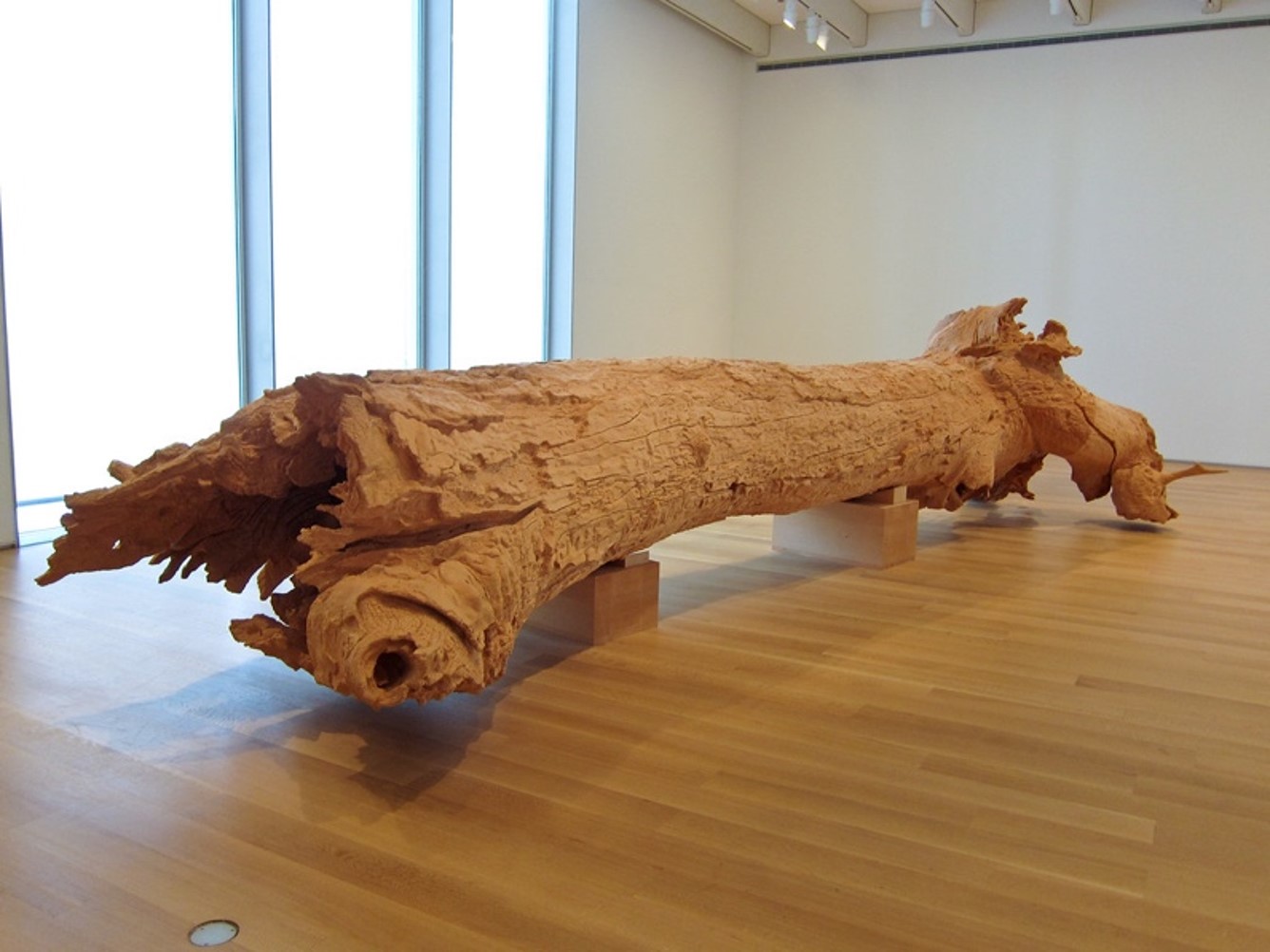
nonsite is a journal primarily interested in art and political economy, so although there’s only a little art in them, the topic of our next three issues—Capitalism 1996–2026—is not exactly a new one for us. Insofar as much of what we’ve published about art has been involved with the critique of neoliberal aesthetics, and insofar as we take neoliberalism to be what Sam Gindin calls a “deepening” of capitalism, our focus on art has also characteristically been a way of thinking about capitalism. Furthermore, in thinking in particular about contemporary art, the periodization of that focus has been almost exactly the same, as is evident in the fact that one of the original names we talked about for what became nonsite was “hinoki,” after Charles Ray’s sculpture Hinoki, which was first shown in 2007 but which he had begun to make in 1997.
Why was Hinoki important to us?1 Of course, the log is beautiful, which is why Ray was struck by it in the first place while driving along the California coast. But it’s the making of the sculpture—the partially rotted thirty-two-foot-long log, cut into pieces before being hauled away, reproduced and reassembled in fiberglass in his studio, then cut up again into five pieces and shipped to Japan to be remade by Osaka woodcarvers in Japanese cypress and returned (years later) to the U.S.—that does the work. Every natural aspect of its material being has been turned into a made (and remade) aspect of its artificial being and thus made also into something both material and immaterial—a meaning. Indeed, the fact that it was partially rotted out meant that the sculpture Ray made from it was hollow, and the fact that the sculpture (unlike the log) was meant to be hollow makes the air (the only part that’s not manmade) flowing through it into a fundamental element in its composition, as if the work were made what it was by what Ray thought of as its pneuma—air made into breath, breath made into concept. So, its production was a continual reproduction and transposition of its materiality, an action turning the effects of “light and wind and rain and bugs” into the embodiment of intention. And this effort of making seemed to us more generally to embody the ambition of an art committed to acknowledging but also overcoming the accidents, experiences, and identities celebrated in neoliberal aesthetics.
But it’s been easier to find happy beginnings in art than in politics. Indeed, insofar as the best gloss on Gindin’s description of neoliberalism as the deepening of capitalism is Adolph Reed’s description of it as capitalism without the opposition of the working class, the period is basically defined by the absence of good news. So, why 1996? Because if you think of Trumpism as a symptom—or, more precisely, as the expression of a moment when capitalism is ceasing to be able to meet its demands for both accumulation and democratic legitimation, and where the forced choice between them is increasingly for accumulation—then liberal or even social democratic resistance (however attractive it might seem) is no longer an even remotely plausible solution. The opposition of the working class has been missing, but it’s the opposition of the working class that is ever more obviously essential. And it was in 1996 that the only modern political party committed to “building a broad movement of working-class institutions, leaders, and activists” officially began its brief, only marginally successful but, we think, crucially instructive life.
Instructive because the terms in which the Labor Party conceived success—building power for working people—are even more vividly relevant now, if only because the power of working people has continued to diminish and the left resistance to capitalism has too often looked elsewhere.
By looking elsewhere, we mean that as capital literally extracts more and more from labor (in 2025 labor took home its smallest share of GDP since the BLS started keeping track), an increasing portion of the left has focused on discrimination, not exploitation. As if the crucial point were not that workers shouldn’t be exploited but that black workers, women workers, queer workers, and trans workers shouldn’t be disproportionately exploited. So, while liberals insist that everything would be basically okay if we just got rid of Trump, much of the left thinks the more fundamental project is the defense of marginalized identities. This is obviously true of those who continue to describe capitalism as racial capitalism or to defend DEI as if it were an egalitarian program rather than a tool for managing inequality. But it’s perhaps more strikingly true of those who attack them on behalf of a commitment to “core working class values.” It’s easy to make fun of the speaker at the socialist conference complaining about “body fascism” and the “policing of fat black flesh,” but turning the working class into another insulted identity is just another version of the problem.
But the problem for the left is most vivid when we think about our biggest success stories. The DSA includes both defenders of flesh and of working-class values, but Zohran Mamdani’s redescription of working-class power as affordability and his rediscovery of sewer socialism have at least partially decoupled him from identitarian fantasies about his constituency. Which also has made him and the DSA more successful electorally, and that’s the biggest fantasy of all. If we take seriously, as the contributors to this issue argue we must, the idea that capital has reached the point where it can no longer afford to (and so no longer understands itself as needing to) legitimate itself in the terms of liberal democracy, then we must also take seriously the idea that the most we can currently get out of our elections is what the ruling class will allow us to get.
The point here is not that capitalism is failing on its own terms. It’s rather that the (successful) pursuit of profit has changed those terms. Neoliberal victories over the working class (like NAFTA and Clinton’s bipartisan welfare reform) have increased inequality and insecurity and helped to mobilize many of the defeated on behalf of the authoritarian right. And the liberal and/or social democratic opponents of that authoritarianism have sought to argue for a chastened or reformed capital. But there is no such thing as capitalism without profit, and if there’s any advantage 2026 has over 1996 it’s the ability to see that more clearly.
Or anyway to see it as clearly as Rosa Luxemburg did in 1915 when she wrote that “A look around us at this moment shows what the regression of bourgeois society into barbarism means.”2 Her alternative to barbarism was socialism, and although intermittent periods of prosperity for a temporarily enlarged middle class and at least portions of the working class made the opposition sometimes seem a little less stark, the brutality of the Trumpist version of the right’s standard divide-and-conquer fallback plan has been clarifying. We don’t have the millions dead of World War I, but for starters, we have close to a million deported and seventy-five thousand currently in detention while, of course, we’ve collaborated in the murder of another seventy-five thousand in Palestine. All of this accompanied, of course, by unprecedented returns on investment since 2008 and by the increased transformation of workers’ earnings into capital gains mentioned earlier. As if the “affordability” crisis were produced by Mexican workers instead of by the profits going to landlords, pharmaceutical corporations, and insurance companies, not to mention the promise of profits now creating a new cohort of AI billionaires.
We’ve put together these issues in the hope of coming to a better understanding of where we are now and, insofar as that better understanding really amounts to a firmer grasp on the truth of the “socialism or barbarism” proposition, we hope also to make a contribution to the kind of organizing we think is essential to choosing socialism. Toward that end, our partner in putting the issue together has been the Debs-Jones-Douglass Institute, which works with unions building a commitment to a world in which “good jobs, health care, education, and other resources” are rights “rather than commodities sold on the market.”
Obviously that world is not much like the one we’ve actually got, and it wouldn’t be even if liberalism (in this context, the ambition not to go beyond the market but to equalize access to it) were more successful. And even more obviously, trying now to get to that world, as veterans of the Labor Party have acknowledged, can look like “a fool’s errand.”3 But “there is no alternative,” Mark Dudzic and Katherine Isaac say, and the burden of the analysis presented in this issue is that they’re right and that only a politics based in labor can show that the original “there is no alternative” was wrong.
But Thatcher wasn’t just out to make an economic point. In arguing that there was no alternative to neoliberalism, she understood the scope of her ambition. “Economics were the method,” she said; the object was “to change the soul.” Our own efforts embrace the ambition but challenge the terms of the distinction. When Ray first saw the rotted-out log that became Hinoki and saw the way its form was constituted by the air (“pneuma,” “breath”) inside it, it was, he says, “like a theological event.” Making that air into the expression of his intention, he makes the form of the log into the form of his sculpture. The physical causes that produced the one are transposed into the teleological structure that produced the other.
Even though an intelligent idealism really is better than a stupid materialism, our political efforts are not exactly theological. But the ambition to restore labor to itself is also not just economic. As Jed Dodd (former officer in the International Brotherhood of Teamsters) has said, the current job is to “turn class rage into class consciousness,” and that will require some soul changing. We begin with the unions that Thatcher and subsequent generations have sought to destroy, but we can’t possibly end with them. Revolutionary change can’t take place until workers who don’t belong to unions, or who don’t even have jobs, or who don’t understand themselves as workers or their desires as expressions of their being workers begin to look at the world a little differently. But revolutionary change remains the goal.
We’re definitely not Maoists. Declaring oneself a revolutionary in the current moment is possible in print but ludicrous in action. And even in print, it’s mainly typographic; the capital “U” in “the George Floyd Uprising” does as much revolutionary work as the supposed uprising did. But, embarking on a fool’s errand that is nonetheless absolutely essential, we do think that Mao offered some good advice:
There is an ancient Chinese fable called “The Foolish Old Man Who Removed the Mountains”. It tells of an old man who lived in northern China long, long ago and was known as the Foolish Old Man of North Mountain. His house faced south and beyond his doorway stood the two great peaks, Taihang and Wangwu, obstructing the way. He called his sons, and hoe in hand they began to dig up these mountains with great determination. Another graybeard, known as the Wise Old Man, saw them and said derisively, “How silly of you to do this! It is quite impossible for you few to dig up those two huge mountains.” The Foolish Old Man replied, “When I die, my sons will carry on; when they die, there will be my grandsons, and then their sons and grandsons, and so on to infinity. High as they are, the mountains cannot grow any higher and with every bit we dig, they will be that much lower. Why can’t we clear them away?” Having refuted the Wise Old Man’s wrong view, he went on digging every day, unshaken in his conviction. God was moved by this, and he sent down two angels, who carried the mountains away on their backs. Today, two big mountains lie like a dead weight on the Chinese people. One is imperialism, the other is feudalism. The Chinese Communist Party has long made up its mind to dig them up. We must persevere and work unceasingly, and we, too, will touch God’s heart. Our God is none other than the masses of the Chinese people. If they stand up and dig together with us, why can’t these two mountains be cleared away?4
This issue will be published in three installments over the next few months. This first installment, focused on “The Three Periods in Postwar Capitalism and the Framework of Class Struggle,” includes essays by Sam Gindin, Damien Cahill, Stephen Maher and Scott Aquanno, and Clara E. Mattei. The second installment, “Responses, Constitutive Elements, and Entailments—Political,” includes essays by Samir Sonti, William Mello, Virginia Leavell, and Adolph Reed, Jr. The final installment, “Responses, Constitutive Elements, and Entailments—Cultural,” includes essays by Lisa Siraganian, Preston Smith, Daniel Moak and Kenneth Warren, Guillaume Orignac, Daniel Zamora, and Katherine Isaac.
Notes

nonsite is a journal primarily interested in art and political economy, so although there’s only a little art in them, the topic of our next three issues—Capitalism 1996–2026—is not exactly a new one for us. Insofar as much of what we’ve published about art has been involved with the critique of neoliberal aesthetics, and insofar as we take neoliberalism to be what Sam Gindin calls a “deepening” of capitalism, our focus on art has also characteristically been a way of thinking about capitalism. Furthermore, in thinking in particular about contemporary art, the periodization of that focus has been almost exactly the same, as is evident in the fact that one of the original names we talked about for what became nonsite was “hinoki,” after Charles Ray’s sculpture Hinoki, which was first shown in 2007 but which he had begun to make in 1997.
Why was Hinoki important to us?1 Of course, the log is beautiful, which is why Ray was struck by it in the first place while driving along the California coast. But it’s the making of the sculpture—the partially rotted thirty-two-foot-long log, cut into pieces before being hauled away, reproduced and reassembled in fiberglass in his studio, then cut up again into five pieces and shipped to Japan to be remade by Osaka woodcarvers in Japanese cypress and returned (years later) to the U.S.—that does the work. Every natural aspect of its material being has been turned into a made (and remade) aspect of its artificial being and thus made also into something both material and immaterial—a meaning. Indeed, the fact that it was partially rotted out meant that the sculpture Ray made from it was hollow, and the fact that the sculpture (unlike the log) was meant to be hollow makes the air (the only part that’s not manmade) flowing through it into a fundamental element in its composition, as if the work were made what it was by what Ray thought of as its pneuma—air made into breath, breath made into concept. So, its production was a continual reproduction and transposition of its materiality, an action turning the effects of “light and wind and rain and bugs” into the embodiment of intention. And this effort of making seemed to us more generally to embody the ambition of an art committed to acknowledging but also overcoming the accidents, experiences, and identities celebrated in neoliberal aesthetics.
But it’s been easier to find happy beginnings in art than in politics. Indeed, insofar as the best gloss on Gindin’s description of neoliberalism as the deepening of capitalism is Adolph Reed’s description of it as capitalism without the opposition of the working class, the period is basically defined by the absence of good news. So, why 1996? Because if you think of Trumpism as a symptom—or, more precisely, as the expression of a moment when capitalism is ceasing to be able to meet its demands for both accumulation and democratic legitimation, and where the forced choice between them is increasingly for accumulation—then liberal or even social democratic resistance (however attractive it might seem) is no longer an even remotely plausible solution. The opposition of the working class has been missing, but it’s the opposition of the working class that is ever more obviously essential. And it was in 1996 that the only modern political party committed to “building a broad movement of working-class institutions, leaders, and activists” officially began its brief, only marginally successful but, we think, crucially instructive life.
Instructive because the terms in which the Labor Party conceived success—building power for working people—are even more vividly relevant now, if only because the power of working people has continued to diminish and the left resistance to capitalism has too often looked elsewhere.
By looking elsewhere, we mean that as capital literally extracts more and more from labor (in 2025 labor took home its smallest share of GDP since the BLS started keeping track), an increasing portion of the left has focused on discrimination, not exploitation. As if the crucial point were not that workers shouldn’t be exploited but that black workers, women workers, queer workers, and trans workers shouldn’t be disproportionately exploited. So, while liberals insist that everything would be basically okay if we just got rid of Trump, much of the left thinks the more fundamental project is the defense of marginalized identities. This is obviously true of those who continue to describe capitalism as racial capitalism or to defend DEI as if it were an egalitarian program rather than a tool for managing inequality. But it’s perhaps more strikingly true of those who attack them on behalf of a commitment to “core working class values.” It’s easy to make fun of the speaker at the socialist conference complaining about “body fascism” and the “policing of fat black flesh,” but turning the working class into another insulted identity is just another version of the problem.
But the problem for the left is most vivid when we think about our biggest success stories. The DSA includes both defenders of flesh and of working-class values, but Zohran Mamdani’s redescription of working-class power as affordability and his rediscovery of sewer socialism have at least partially decoupled him from identitarian fantasies about his constituency. Which also has made him and the DSA more successful electorally, and that’s the biggest fantasy of all. If we take seriously, as the contributors to this issue argue we must, the idea that capital has reached the point where it can no longer afford to (and so no longer understands itself as needing to) legitimate itself in the terms of liberal democracy, then we must also take seriously the idea that the most we can currently get out of our elections is what the ruling class will allow us to get.
The point here is not that capitalism is failing on its own terms. It’s rather that the (successful) pursuit of profit has changed those terms. Neoliberal victories over the working class (like NAFTA and Clinton’s bipartisan welfare reform) have increased inequality and insecurity and helped to mobilize many of the defeated on behalf of the authoritarian right. And the liberal and/or social democratic opponents of that authoritarianism have sought to argue for a chastened or reformed capital. But there is no such thing as capitalism without profit, and if there’s any advantage 2026 has over 1996 it’s the ability to see that more clearly.
Or anyway to see it as clearly as Rosa Luxemburg did in 1915 when she wrote that “A look around us at this moment shows what the regression of bourgeois society into barbarism means.”2 Her alternative to barbarism was socialism, and although intermittent periods of prosperity for a temporarily enlarged middle class and at least portions of the working class made the opposition sometimes seem a little less stark, the brutality of the Trumpist version of the right’s standard divide-and-conquer fallback plan has been clarifying. We don’t have the millions dead of World War I, but for starters, we have close to a million deported and seventy-five thousand currently in detention while, of course, we’ve collaborated in the murder of another seventy-five thousand in Palestine. All of this accompanied, of course, by unprecedented returns on investment since 2008 and by the increased transformation of workers’ earnings into capital gains mentioned earlier. As if the “affordability” crisis were produced by Mexican workers instead of by the profits going to landlords, pharmaceutical corporations, and insurance companies, not to mention the promise of profits now creating a new cohort of AI billionaires.
We’ve put together these issues in the hope of coming to a better understanding of where we are now and, insofar as that better understanding really amounts to a firmer grasp on the truth of the “socialism or barbarism” proposition, we hope also to make a contribution to the kind of organizing we think is essential to choosing socialism. Toward that end, our partner in putting the issue together has been the Debs-Jones-Douglass Institute, which works with unions building a commitment to a world in which “good jobs, health care, education, and other resources” are rights “rather than commodities sold on the market.”
Obviously that world is not much like the one we’ve actually got, and it wouldn’t be even if liberalism (in this context, the ambition not to go beyond the market but to equalize access to it) were more successful. And even more obviously, trying now to get to that world, as veterans of the Labor Party have acknowledged, can look like “a fool’s errand.”3 But “there is no alternative,” Mark Dudzic and Katherine Isaac say, and the burden of the analysis presented in this issue is that they’re right and that only a politics based in labor can show that the original “there is no alternative” was wrong.
But Thatcher wasn’t just out to make an economic point. In arguing that there was no alternative to neoliberalism, she understood the scope of her ambition. “Economics were the method,” she said; the object was “to change the soul.” Our own efforts embrace the ambition but challenge the terms of the distinction. When Ray first saw the rotted-out log that became Hinoki and saw the way its form was constituted by the air (“pneuma,” “breath”) inside it, it was, he says, “like a theological event.” Making that air into the expression of his intention, he makes the form of the log into the form of his sculpture. The physical causes that produced the one are transposed into the teleological structure that produced the other.
Even though an intelligent idealism really is better than a stupid materialism, our political efforts are not exactly theological. But the ambition to restore labor to itself is also not just economic. As Jed Dodd (former officer in the International Brotherhood of Teamsters) has said, the current job is to “turn class rage into class consciousness,” and that will require some soul changing. We begin with the unions that Thatcher and subsequent generations have sought to destroy, but we can’t possibly end with them. Revolutionary change can’t take place until workers who don’t belong to unions, or who don’t even have jobs, or who don’t understand themselves as workers or their desires as expressions of their being workers begin to look at the world a little differently. But revolutionary change remains the goal.
We’re definitely not Maoists. Declaring oneself a revolutionary in the current moment is possible in print but ludicrous in action. And even in print, it’s mainly typographic; the capital “U” in “the George Floyd Uprising” does as much revolutionary work as the supposed uprising did. But, embarking on a fool’s errand that is nonetheless absolutely essential, we do think that Mao offered some good advice:
There is an ancient Chinese fable called “The Foolish Old Man Who Removed the Mountains”. It tells of an old man who lived in northern China long, long ago and was known as the Foolish Old Man of North Mountain. His house faced south and beyond his doorway stood the two great peaks, Taihang and Wangwu, obstructing the way. He called his sons, and hoe in hand they began to dig up these mountains with great determination. Another graybeard, known as the Wise Old Man, saw them and said derisively, “How silly of you to do this! It is quite impossible for you few to dig up those two huge mountains.” The Foolish Old Man replied, “When I die, my sons will carry on; when they die, there will be my grandsons, and then their sons and grandsons, and so on to infinity. High as they are, the mountains cannot grow any higher and with every bit we dig, they will be that much lower. Why can’t we clear them away?” Having refuted the Wise Old Man’s wrong view, he went on digging every day, unshaken in his conviction. God was moved by this, and he sent down two angels, who carried the mountains away on their backs. Today, two big mountains lie like a dead weight on the Chinese people. One is imperialism, the other is feudalism. The Chinese Communist Party has long made up its mind to dig them up. We must persevere and work unceasingly, and we, too, will touch God’s heart. Our God is none other than the masses of the Chinese people. If they stand up and dig together with us, why can’t these two mountains be cleared away?4
This issue will be published in three installments over the next few months. This first installment, focused on “The Three Periods in Postwar Capitalism and the Framework of Class Struggle,” includes essays by Sam Gindin, Damien Cahill, Stephen Maher and Scott Aquanno, and Clara E. Mattei. The second installment, “Responses, Constitutive Elements, and Entailments—Political,” includes essays by Samir Sonti, William Mello, Virginia Leavell, and Adolph Reed, Jr. The final installment, “Responses, Constitutive Elements, and Entailments—Cultural,” includes essays by Lisa Siraganian, Preston Smith, Daniel Moak and Kenneth Warren, Guillaume Orignac, Daniel Zamora, and Katherine Isaac.
Notes
