
Matisse, 1941–1954, Grand Palais, Paris, March 24–July 26, 2026 and Louise Rogers Lalaurie, Matisse: The Books (The University of Chicago Press, 2020)
You want to do painting? Are you happy in life? Then don’t do it.
—Matisse, Notebook 3 for Jazz
“I’m paralyzed by a kind of conventionality that prevents me from expressing myself as I should like in painting,” Henri Matisse told fellow painter Pierre Bonnard in 1940. The conventionality is, in a sense, modernist painting itself and something he helped author. He feels constricted by “the new conventions of expanses of pure color through which I must express myself fully … with no shade or modeling, and which must react with one another to suggest light, and spiritual space.” One of the key achievements of modernism—expanses of pure color—was now felt to restrain his capacity to express himself.
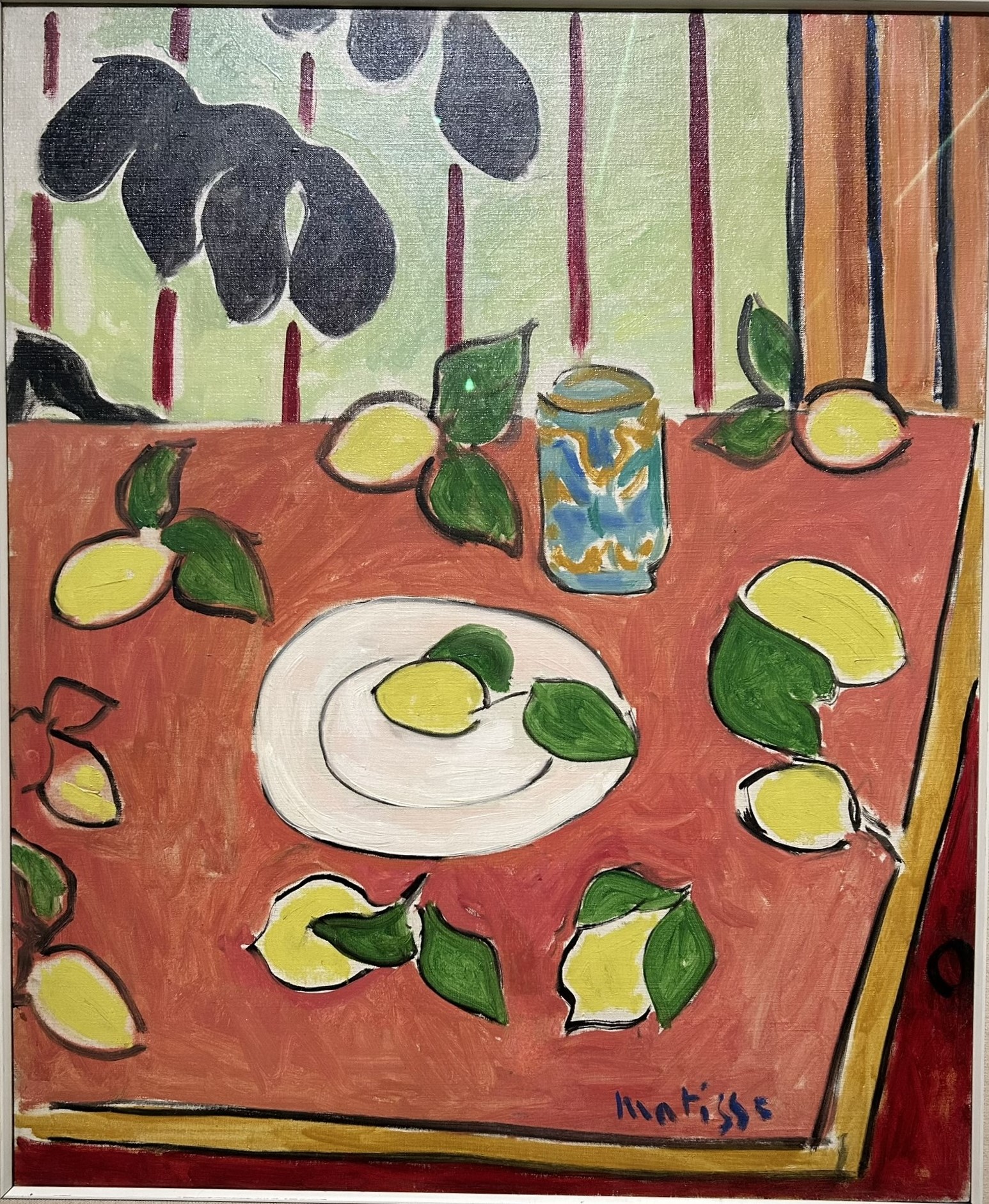
Near the start of Henri Matisse, 1941–1954 at the Grand Palais in Paris—featuring nearly 300 paintings, drawings, books and cut-out gouaches—is a seemingly modest still life entitled Black Philodendron and Lemons of 1943 (fig. 1). Above, a philodendron is reduced to a few stemless leaves dangling in space. Below, set out on a nearly square surface, are nine lemons, many with stems and leaves attached. The lemons appear to be circling the white plate with a lemon at its center. The lone lemon is contained by the plate, one of its leaves touching the plate’s edge, breaking its enclosing contour. It is hard not to read the stranded lemon—at the center of the frame within a frame—as (vainly) attempting to free itself from its containers.
Matisse disdained the idea that a still life was a nature morte, insisting they were as alive as his figures. “Everything that is alive and original in works of art is always the portrait of something,” he wrote near the end of his life. Matisse seemed to give freest rein to his figurative intentions with his still lifes, while his human figures tend towards inanimate props (Harmony in Red, 1908, is perhaps the ultimate expression of this reverse polarity).
Matisse often used still life to express his sense of life under threat, as though it were only by indirection that he could convey this basic human idea. The still-life creatures that inhabit his universe often appear harried and threatened and vulnerable. Many of his late still lifes are insistently partitioned. The vertical wallpaper and curtain in Black Philodendron appear, at first, as decorative motifs, but they are also, on second glance, bars of a cage. Notice how the first bar of the curtain at right severs the leaves from a lemon at the upper edge of the table. It appears that the lemons on the table are less circling the plate than fleeing their containment within frames (table, dish, and picture). Mirroring the lemon at the edge of the plate, the stem of a lemon at right has broken through the edge of the table contour, a pictorial event that appears more “hopeful” than the jailbird lemon on the plate.
Fleeing from what, exactly? The leaves of the black philodendron take on the look of a hand, or fist, bearing down on the sensuous figures below. Are the lemons trapped on the surface awaiting their fate from the encroaching monstera above? Are those Matisse’s “hands” seeking to mold and shape the sensuous colors and shapes below into “pure form”? (This is Matisse in the role of The Knife Thrower or The Cowboy with lasso in Jazz, or the King with the head of John the Baptist in the monumental Sorrows of the King.) Do they await their “aesthetic transformation” into surface decoration?
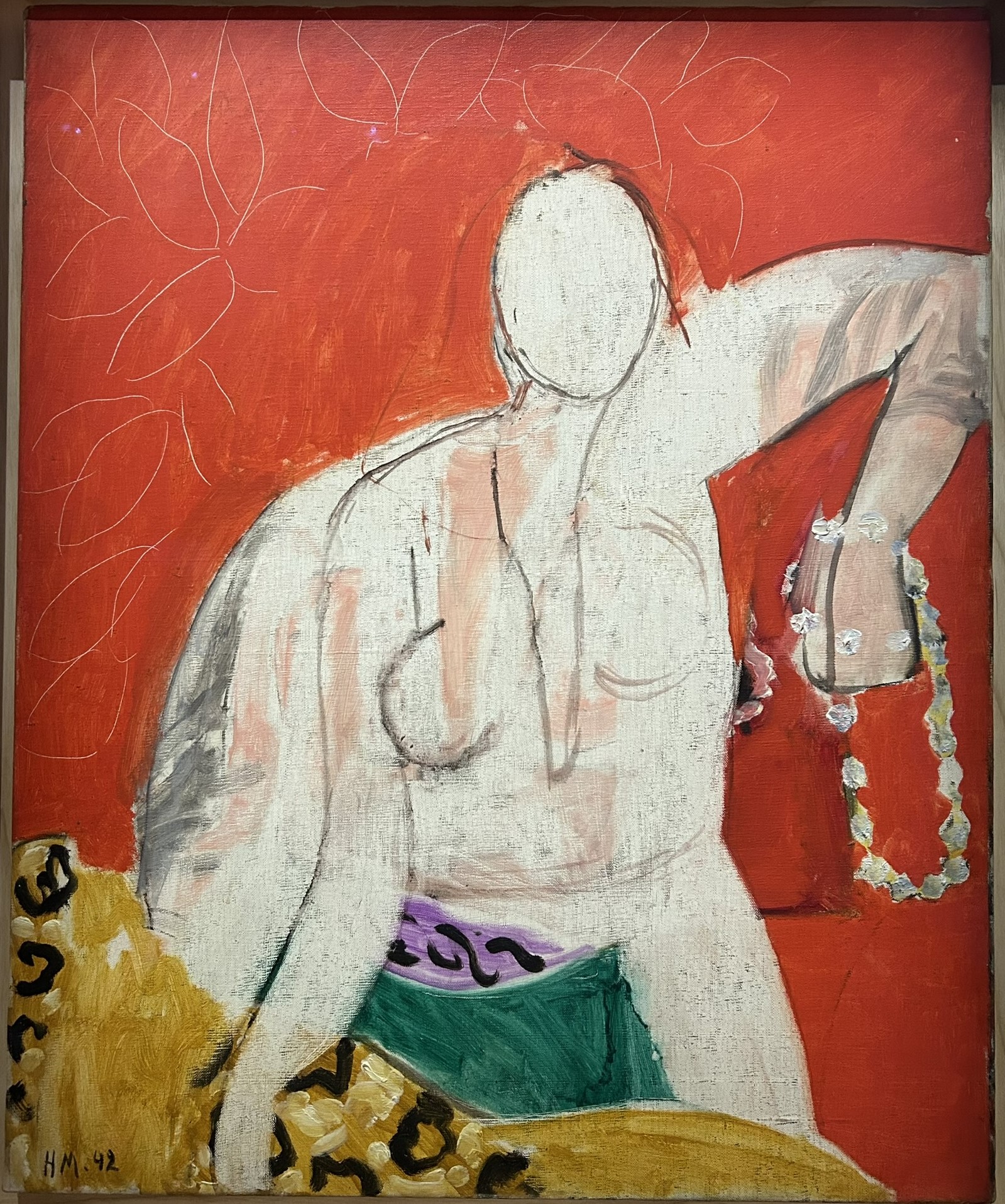
A related set of problems is on display in Young Woman with Necklace of 1942 (fig. 2). Here, a figure has been wrenched into an order on the surface: the woman’s body is made over into a design to match the necklace, not the other way around. Isn’t this what Matisse meant when he told an interviewer in 1948 that his works were always a “pictorial and moral” synthesis?
Matisse returns to Black Philodendron in the first of his astonishing series of late interiors of 1946–48 (the group of twelve painted interiors is the highlight of the show). The first of these, Interior in Yellow and Blue of 1946 (fig. 3), repeats, in reduced form, the tabletop motif of lemons and plate at the bottom left of the picture. Three lemons now surround the plate with the lemon at the center. Once again, the lemons seem pressed into the flat of an ethereal—or is it sterilized?—blue surface. At top right, the blue rectangle reappears, but the perfect circles are replaced with frenetic zigzags of the world “outside.” Along the lower edges of the upper rectangle, a humanoid chair seems to crawl into the room from outdoors. Sandwiched between the two blue rectangles is a still life in yellow dominated by a tabletop with vase and melons. The melons recapitulate the image as a whole: spherical enclosures filled with zigzag lines of frenetic animation.
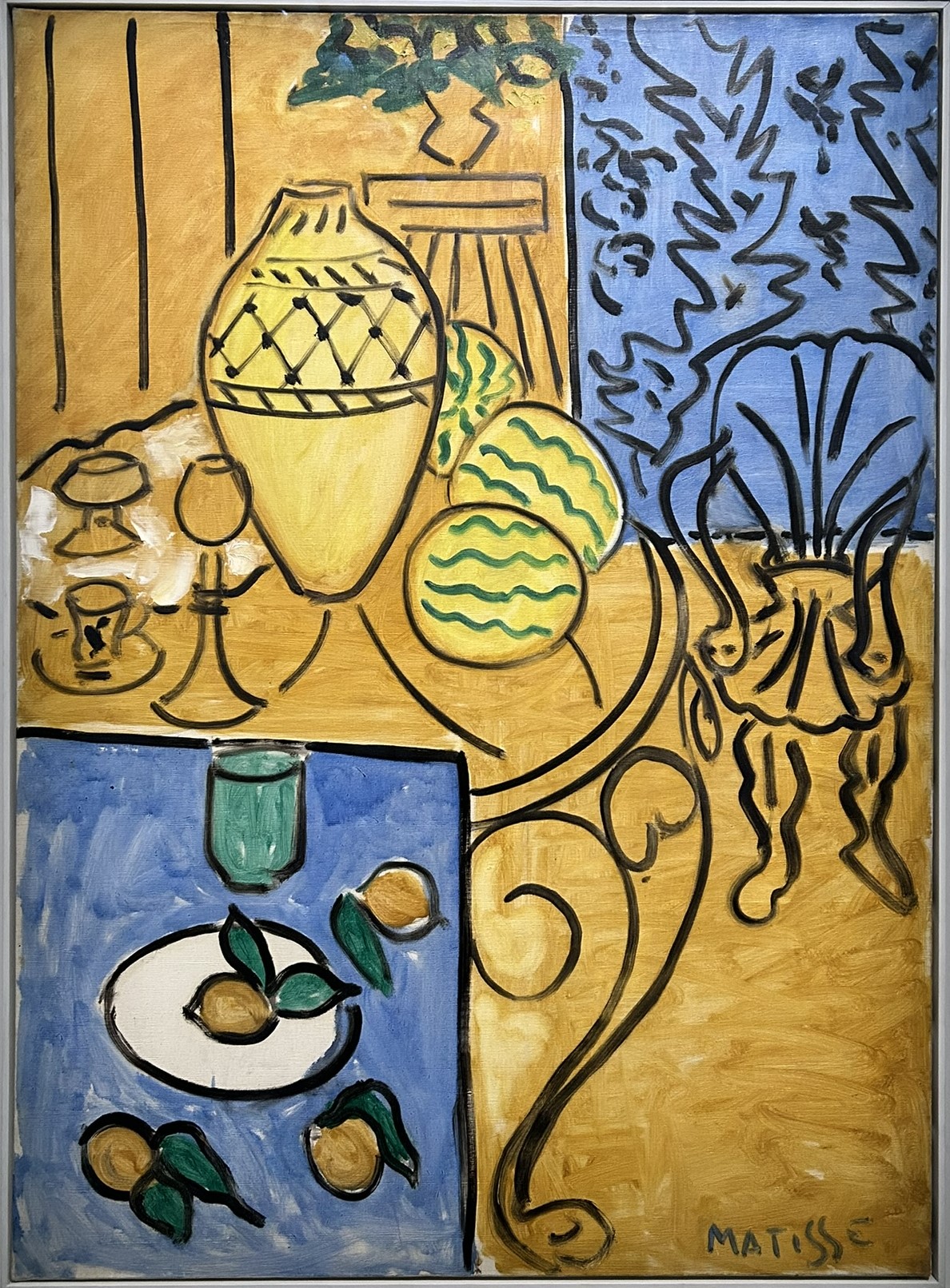
As with all the interiors, Interior in Yellow and Blue is conflictual through and through. Here, the standoff is between the two blue rectangles. Top right represents the untamable energies of the exterior. Bottom left, the seamless unity of the flattened picture surface whose sensuous forms have been “abstracted” into yellow essences floating in a purified blue. The action lies with the section between the two rectangles, torn between competing demands: surplus vitality and empty abstraction.
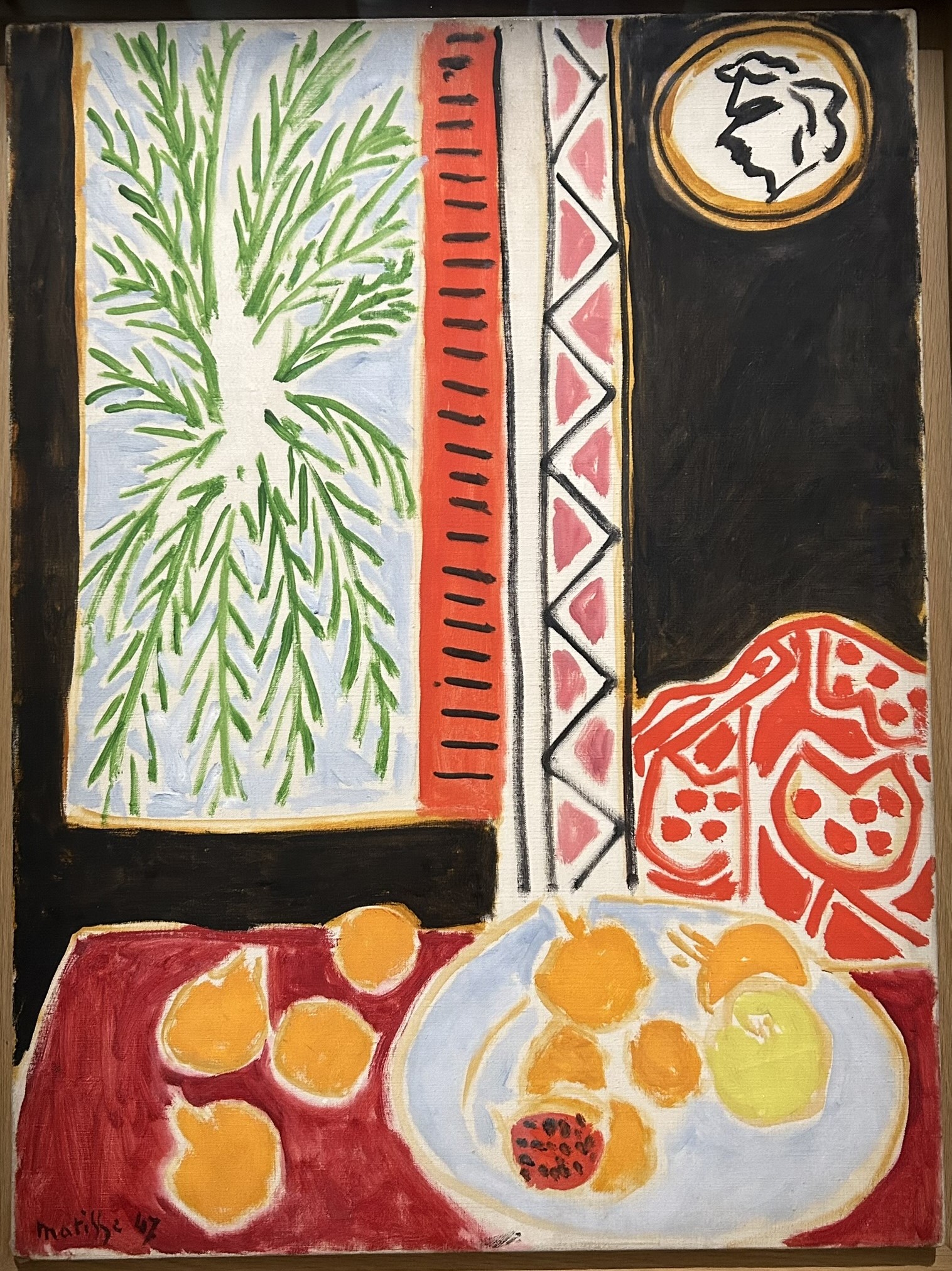
The drama of the interior series centers on the relation between ecstatic figures of the exterior and an interior space of artmaking that seeks to formalize the world into an order on the flat. In most of the works, this exterior motif emerges as a bursting palm tree caught within the rectangle of a window frame. In Still Life with Pomegranates of 1947 (fig. 4), the palm is like static electricity on a television screen. The pictures do everything in their power to contain this energy, to lock it into some kind of decorative pattern on the surface and keep the (natural and human) wildness at bay.
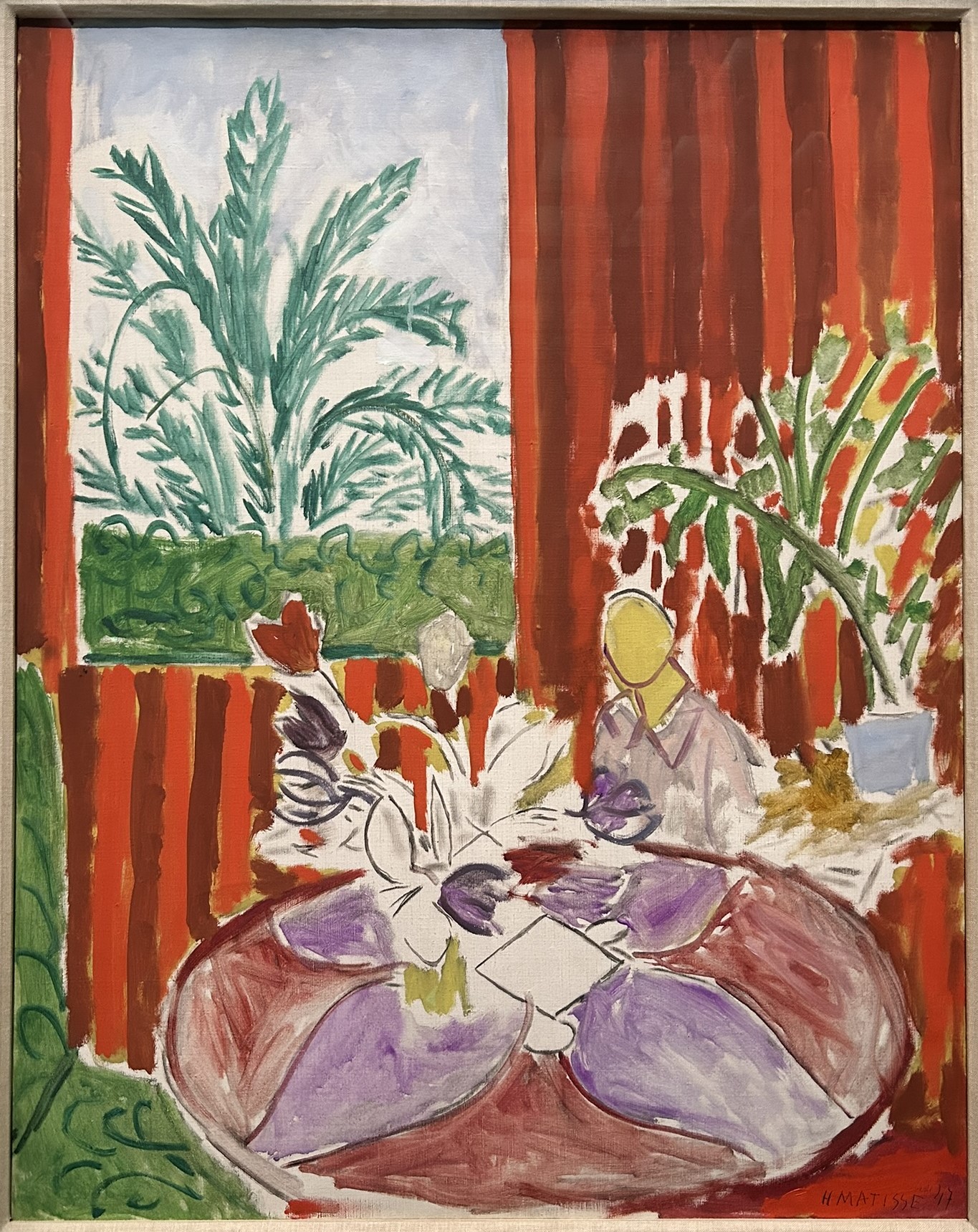
In Interior with Figure of 1947 (fig. 5), the flowers on (beside?) the table reach toward the streaming palm in the window frame; four abstract leaf forms on the table surface reduce the flowing intensity of the palm into a decorative shape. The potted plant on the right appears stuck between the ecstatic growth of the palm and the vertical lines of the wallpaper. The drama of the picture rests on the ways in which the leaves in equal parts merge with the wallpaper pattern and resist being wedged into the surface.
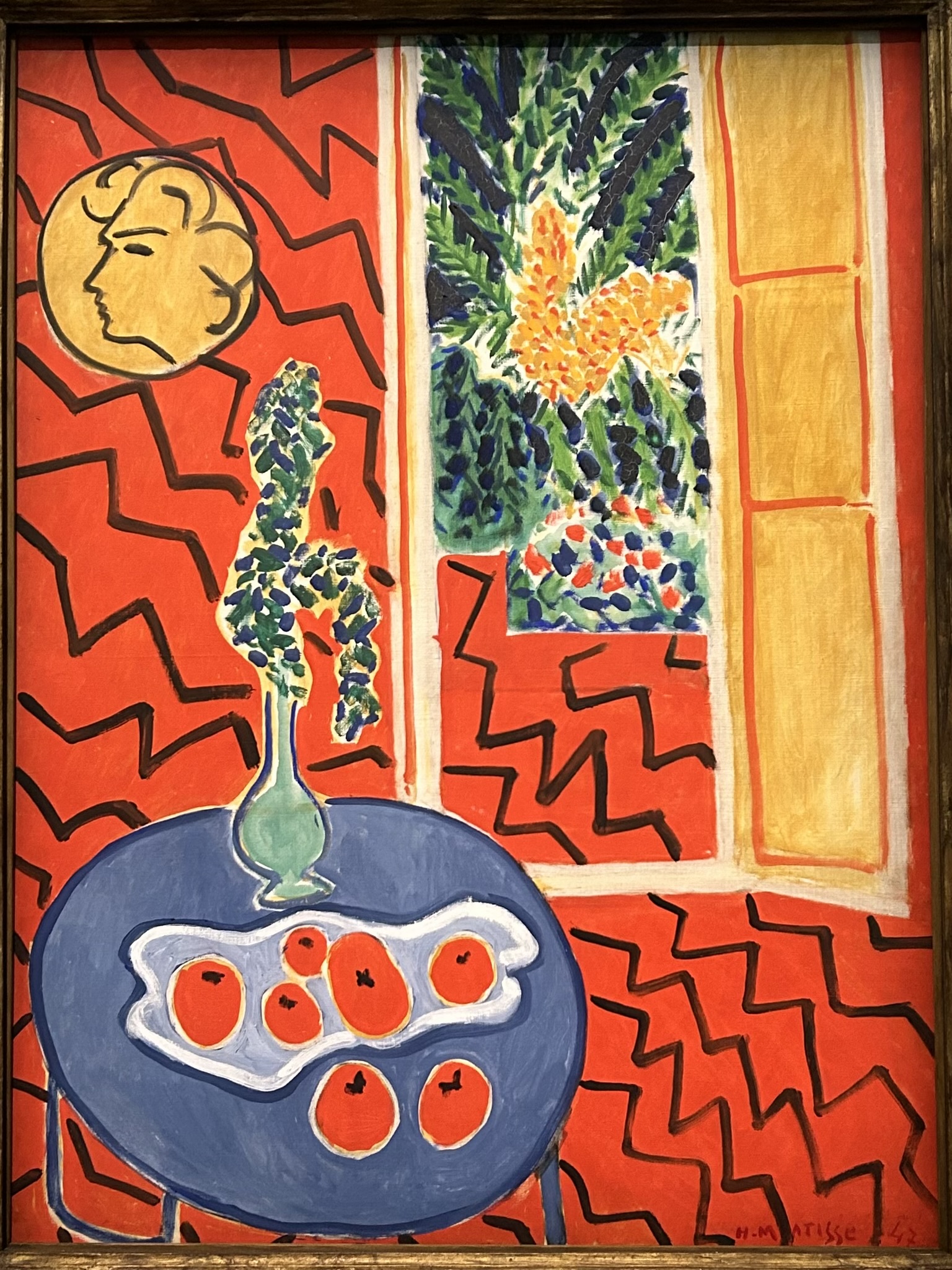
The interior series rests on a careful tug of war between unfixed and fixed, frenetic line and stiffened order. Red Interior, Still Life on a Blue Table of 1947 (fig. 6) falls on the “uncontained” side of the ledger. The exploding forms outside seem to generate inside an uncontrollable buzz across the red surface, as a zigzag lightning pattern—“hatchings hot as electric filaments,” as Alfred Barr put it—carries across the whole surface, running from the window area down to the bottom right. The potted flowers on the table (yet another container) droop as they are exposed to the blazing force of energy outside. The organically shaped plate below can’t contain the red fruit that expands beyond its edges (two of them have freed themselves from their container). At top left, Matisse includes an image of his earliest sculpture (c. 1895), a portrait medallion of Camille Joblaud, one of his early models, and the mother of his beloved daughter, Marguerite (the medallion appears in several of the late interiors). She is a revenant from an earlier life (as are the circus scenes in Jazz) and—despite its enclosed profile (almost like a coin)—she mirrors, inside, the source of energy bursting at the center of the palm at right. It is as though Matisse, near the end of his life, is trying to reclaim the energy—and the life—at the very beginning of his career.
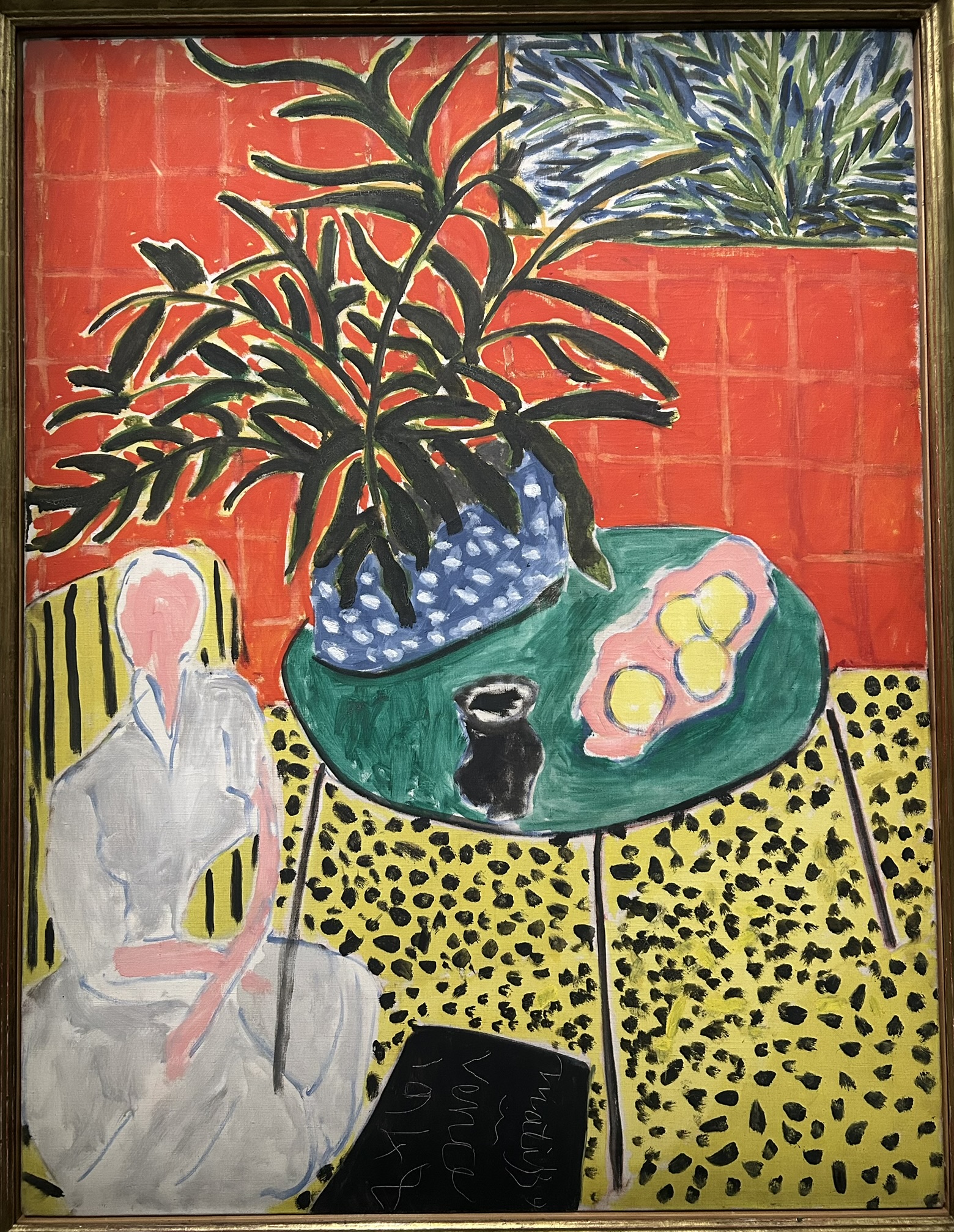
Interior with Black Fern of 1948 (fig. 7), near the end of the series, assertively contains the frenetic energy of the palm within a rectangle at top right. In direct counterpoint to the palm’s buzzing confusion is the grid that lines the red back wall of the interior. Once again, a potted plant engages with both sides of the equation. At top right, its leaves extend beyond the room into the space of the palm in the window as though sucking up its ecstatic force. At other moments, the leaves spread out along the lines of the grid, as though awaiting their capture by the formal order on the surface. Down below, a leopard skin rug plays a dual role: an explosive array of black dots dance across a yellow surface, but they are well contained within the horizontal at the midpoint of the canvas (like the portrait medallion, the skin was at once “nostalgic, all those fairground wrestlers, athletes with leopardskin belts” and painful, reminding him of a nocturnal tool used by “witchdoctors” to “rip apart anyone they encounter”). By contrast, the seated figure, faceless and pale, has lost its sensuous presence; her left arm appears as though another of the table legs, and her dress, with hints of a leaf pattern, offers the natural as commodity form. The leftmost table leg ends up on her lap, reinforcing the fact that she is a prop as much as the objects on the table. Matisse’s explicitly figurative energies were displaced almost entirely from the paintings and cut-outs to his drawings in this period (the exhibition features a range of drawings from the 1943 Theme and Variations, a wall of variations on the visage of Louis Aragon, and a late sequence of highly attenuated faces and masks that push the limit of line as a plausible carrier of embodied sensation).
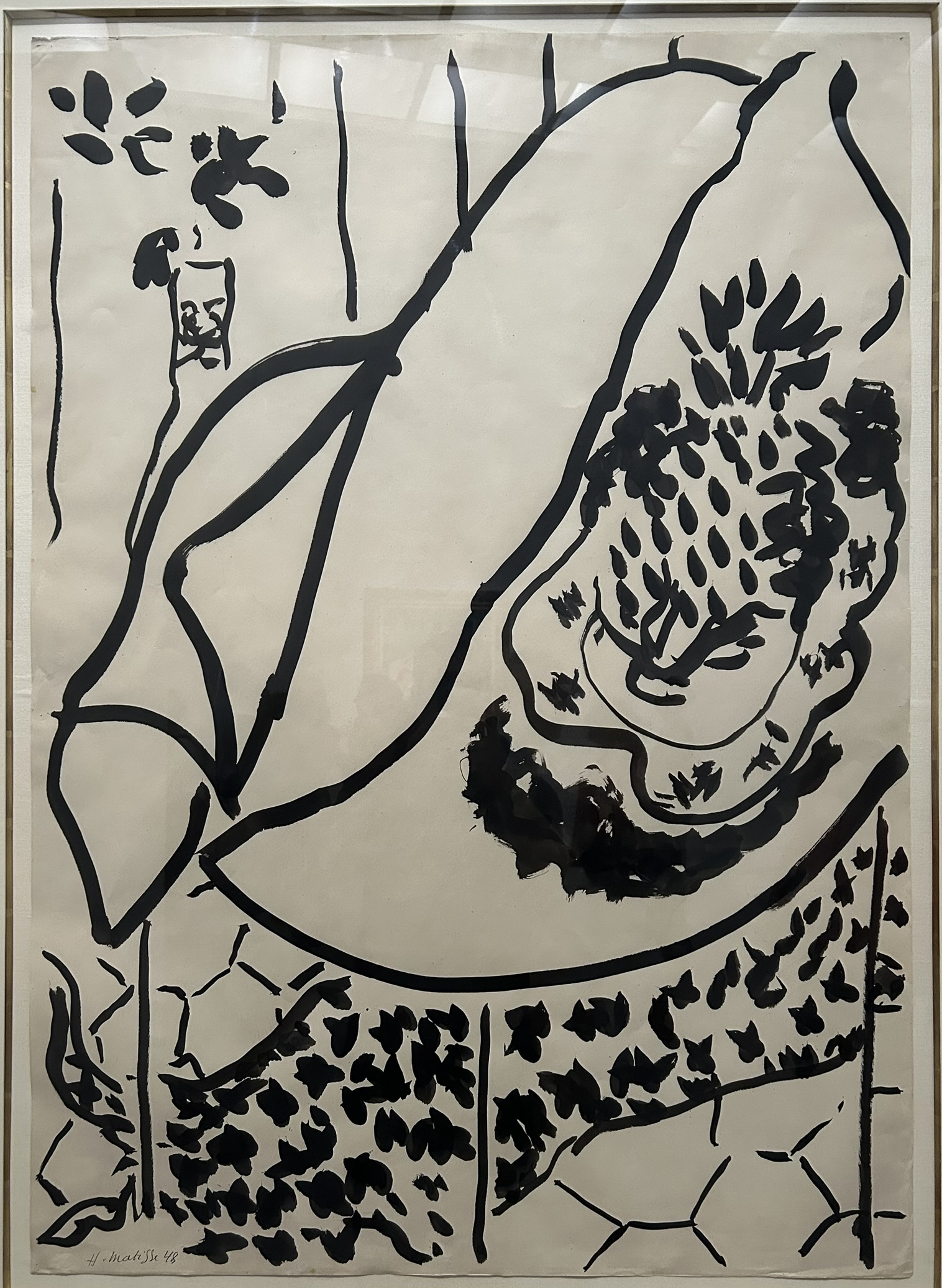
The peculiar Still Life with Pineapple of 1948 (fig. 8), one of the extraordinary black ink and brush works related to the interior scenes, reimagines the tensions of the series as a whole. Here, a broad wrapper attempts to fold over and around a prickly pineapple on a table (the leopard skin rug makes another appearance below). The pineapple is another figure—like the philodendron or the palm—for the as-yet-unformed. Art, for Matisse, is about the process of making over prickly, independent beings into formal patterns on a surface. The viewer is meant to imagine the feel of the wrapper as it (vainly) attempts to blanket the spiky fruit. We are further solicited to imagine how the pineapple will poke through any pathetic container (the drooping shape along the left edge of the wrapping might well be construed as a flaccid phallus).
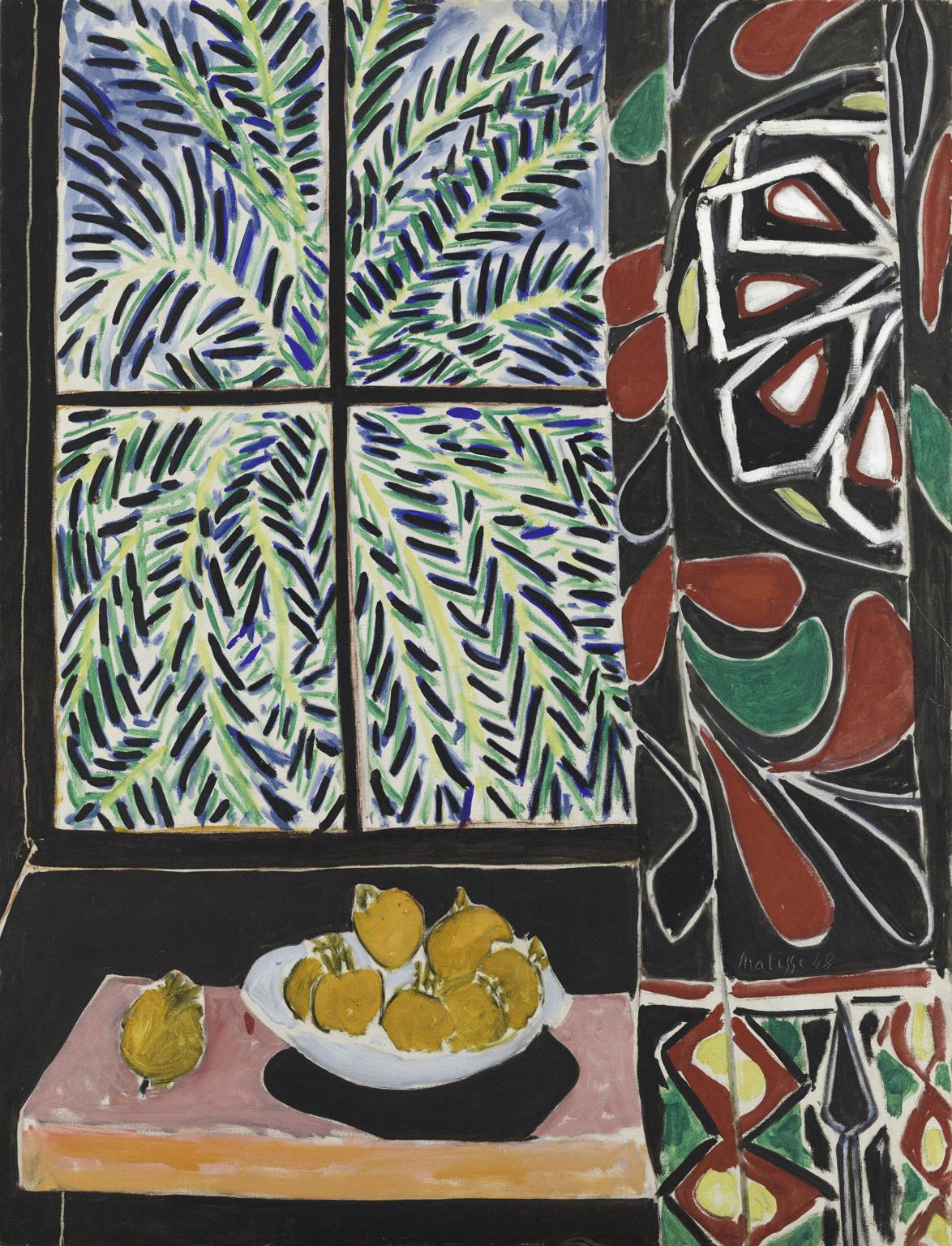
The best account we have of Matisse’s late paintings remains Alfred Barr’s 1951 description of Interior with Egyptian Curtain of 1948 (fig. 9), the concluding work of the interior series (not in the show). While Barr emphatically replays the idea of the artist as someone “peculiarly indifferent to political events,” his language captures the intensity of the pictorial battle that was intended to express the feel of contemporary events. As with Interior in Yellow and Blue, Matisse arranges three elements in irresolvable competition.
[Matisse] has hung a curtain right up against the front plane of the picture and placed the table, spatially, between it and the window. What a curtain! A barbaric modern Egyptian cotton with the most aggressive and indigestible pattern. And … what a window! In all Matisse’s score upon score of views through windows the most astonishing is this explosive palm tree with its branches whizzing like rockets from the point where the black window mullions cross.
Matisse sets the bristling palm and the strident curtain side by side in direct competition with each other. Adjoining each, he places the serene dish of pomegranates on its pink table to serve as a kind of referee who tries to keep the hopelessly adjacent contestants apart, at least in depth.
The struggle is further complicated by the fact that the palm tree is not only dynamic but dazzling. The yellow stems, the green and blue-black leaves against white set up a vibration which the curtain can oppose only through the scale of its brutal design. The radiant effect of the tree is enhanced by the black shadow cast by the dish, but the shape and size of this shadow offer support to the curtain. Yet in the end the neutrality of the still life as a third force is preserved by the complete independence of its color scheme—orange, pink and pale blue—which is as isolated from the other two areas as they are from each other.
As Barr rightly notes, “Clearly Matisse is not concerned here with that armchair serenity” he once declared as his goal. In 1908 Matisse infamously described his art as an “armchair for the tired businessman.” But who believed him? Not Matisse, who directed this barbed comment at his avant-garde comrades play-acting la vie de bohème up in Montmartre (wasn’t it always play-acting?). Henri-Edmond Cross better described Matisse as “the anxious, the madly anxious.”
Collapsing Space
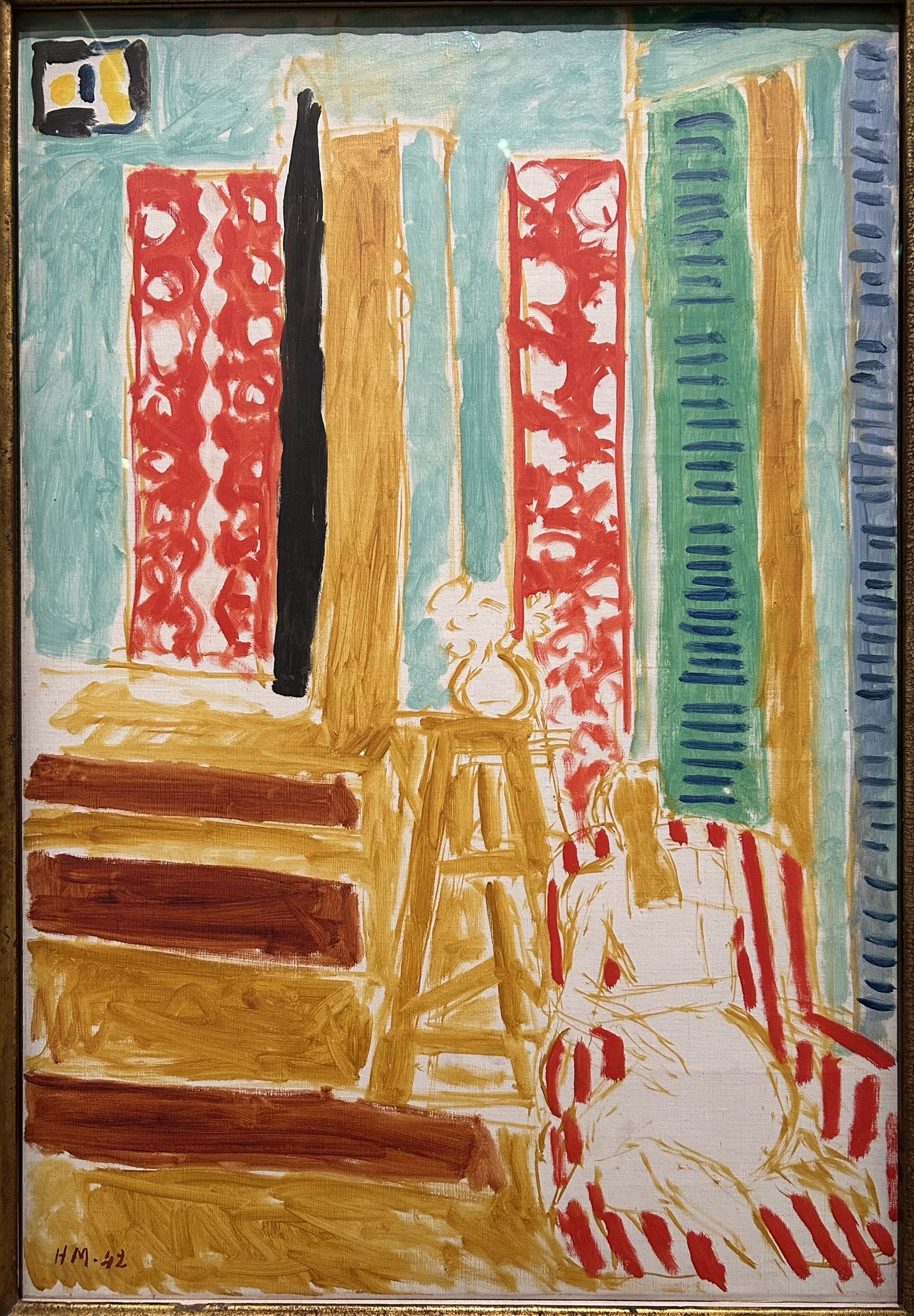
Just prior to the interior series, Matisse produced a series of small paintings of young girls in an interior that explores a related problem, this time about the feel of modern space. Five paintings—Young Girl in Pink in an Interior, 1942; Young Girl in White Dress, Black Door, 1942; Sun-Striped Interior, 1942; Young Woman in White on a Red Background, 1946; and the expansive Plum Branch, Green Background, 1948—share a complex and unnerving mode of address to the viewer. The structure of these works is most emphatically laid out in Black Door and Sun-Striped Interior (fig. 10), where a heavy dark element (a door, a painting) feels as though nailed to the upper left section of the painting. From this flattened rectangle or square, the rest of the picture seems to plunge or swing toward the viewer from left to right. Despite the modest size, Sun-Striped Interior encompasses an enormous distance from the square painting top left (lemons, again) to the series of vertical rectangles (red, black, orange, green)—all of them situated in relatively deep space—until the rhythmic pattern abruptly accelerates when it reaches the stool, right of center, with a series of advancing and expanding verticals that seem to launch themselves towards the picture plane, landing at the woman’s feet bottom right. We are given a strong sensation of forward momentum, a collapsing quality of space that is distinctly at odds with the thematics of stasis and rest—the pastoral—that dominates the series.
The Books
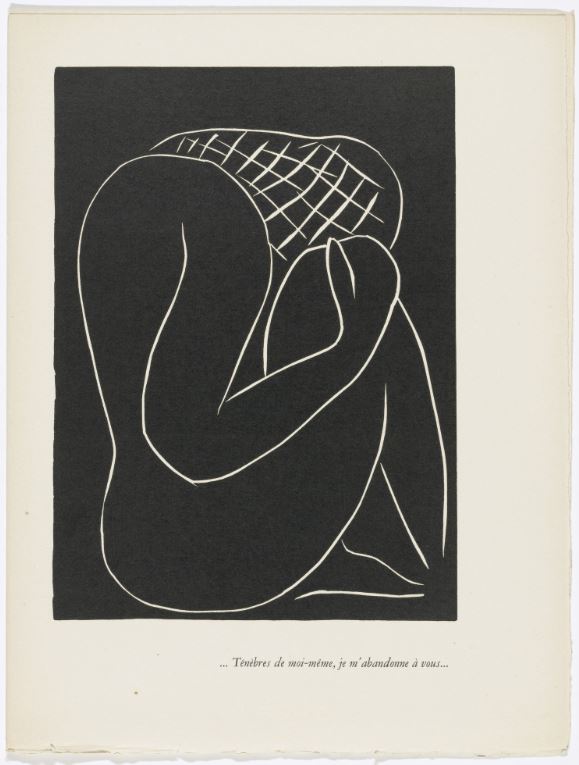
Our understanding of Matisse’s book production throughout the 1940s has been transformed by Louise Rogers Lalaurie’s groundbreaking analyses in Matisse: The Books (2020). Lalaurie reads the livres d’artiste “as a coherent body of work,” bearing a deeply “political strand” but one that has gone unnoticed, as their messages were highly “coded or subliminal.” Lalaurie sees them as broadly “subversive,” a “determinate act of resistance at the heart of the Vichy zone” in Nice where Matisse lived. Writing of Matisse’s controversial illustrations for Montherlant’s Pasiphaé (on view in the exhibition) (fig. 11), Lalaurie quotes Matisse’s closest friend at the time, André Rouveyre, telling the artist, “I should have to land you a knock-out punch for taking inspiration from such a piece of rubbish.” As Lalaurie shows, Rouveyre had nothing to worry about, as the book was intended as “an allegory of the self-delusion, sham and moral depravity at the heart of the Vichy project.”
Rather than the directly political, Lalaurie is at her best in describing the shared “narrative arc” of the books, circling around “moral and aesthetic questions that had beset Matisse throughout his artistic life.” Lalaurie shows how the viewer is implicated in narratives that trace a passage from scenes of violence to resolution, centered on how the artist’s subject relates to the artist’s (and viewers’) desire for control. Writing of Florilège des Amours de Ronsard (1948, also on view), Lalaurie describes how the “active unfolding, examination and displacing of the book’s huge pages involve the reader as protagonist. Perhaps we spied on the model bathing, turned a lover over onto her back, tasted the delights of her body, stepped out to surprise her in the wood. Matisse stages a sophisticated investigation of the ethical questions surrounding his lifelong role as a portrayer of women for his viewers’ enjoyment.” It is a bold analysis, predicated on the idea that Matisse interrogates—rather than simply replays—the “male gaze in art,” as his subjects return the look of the artist “as if in recognition” of the artist’s attempt to manipulate them. The implications of this view are significant and should alter our sense of Matisse’s project as a whole.
The Cut-Outs
On the first floor is a range of mostly small-scale cut-out works, while the upper level is devoted to large-scale, sometimes enormous, cut-outs, including The Sorrow of the King, Beasts of the Sea, Zulma, the four Blue Nudes of 1952, The Snail, Memory of Oceania, and The Sheaf. The set of issues explored in the books and paintings takes on a different character in the cut-outs. Here, the problem is less a matter of art and life than of art and artist.
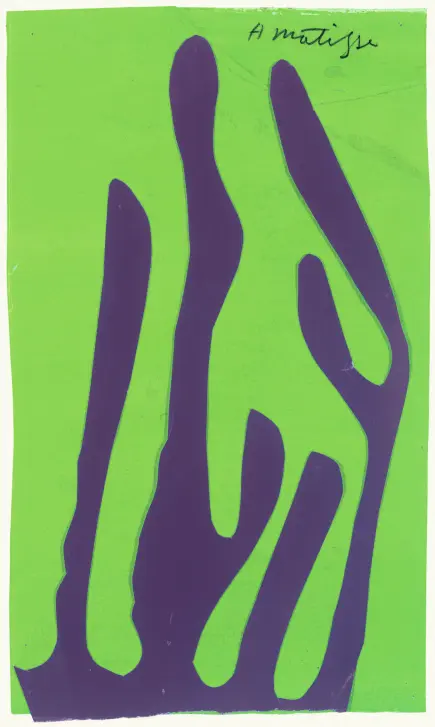
Among the array of cut-outs exhibited, one thematic element stands out as central. Although the imagery is nominally Tahitian in its references to algae and lagoons, a closer look reveals an obsessive interest in the shape and character of the human hand. As some famous clips and still photographs show, Matisse held the colored paper upright in his hands, cutting upward as he tilted the paper to create shapes in his hands. This unusual technique finds its formal expression in the works themselves, as many of them take on the character of hands or feelers. The forms in Alga on Green Background of 1947 (fig. 12), for instance, feel as though they are hung from the upper edges of the surface. Long, narrow shapes dangle in a watery substance below. Consider the shape of the green form to the right of the long dangling green element on the left. Taking on the rough shape of a hand with four fingers, two of them (at left and right) appear thumblike, with the lower and longest two shapes more like index or middle fingers. That the “hand” is extended from the top strongly unsettles any direct bodily connection with the artist’s own body before the work. The hand is set against any direct bodily analogy. One might even say that the work contains two images of the body: a hand lowered down in space and a body reaching up and around it from below.
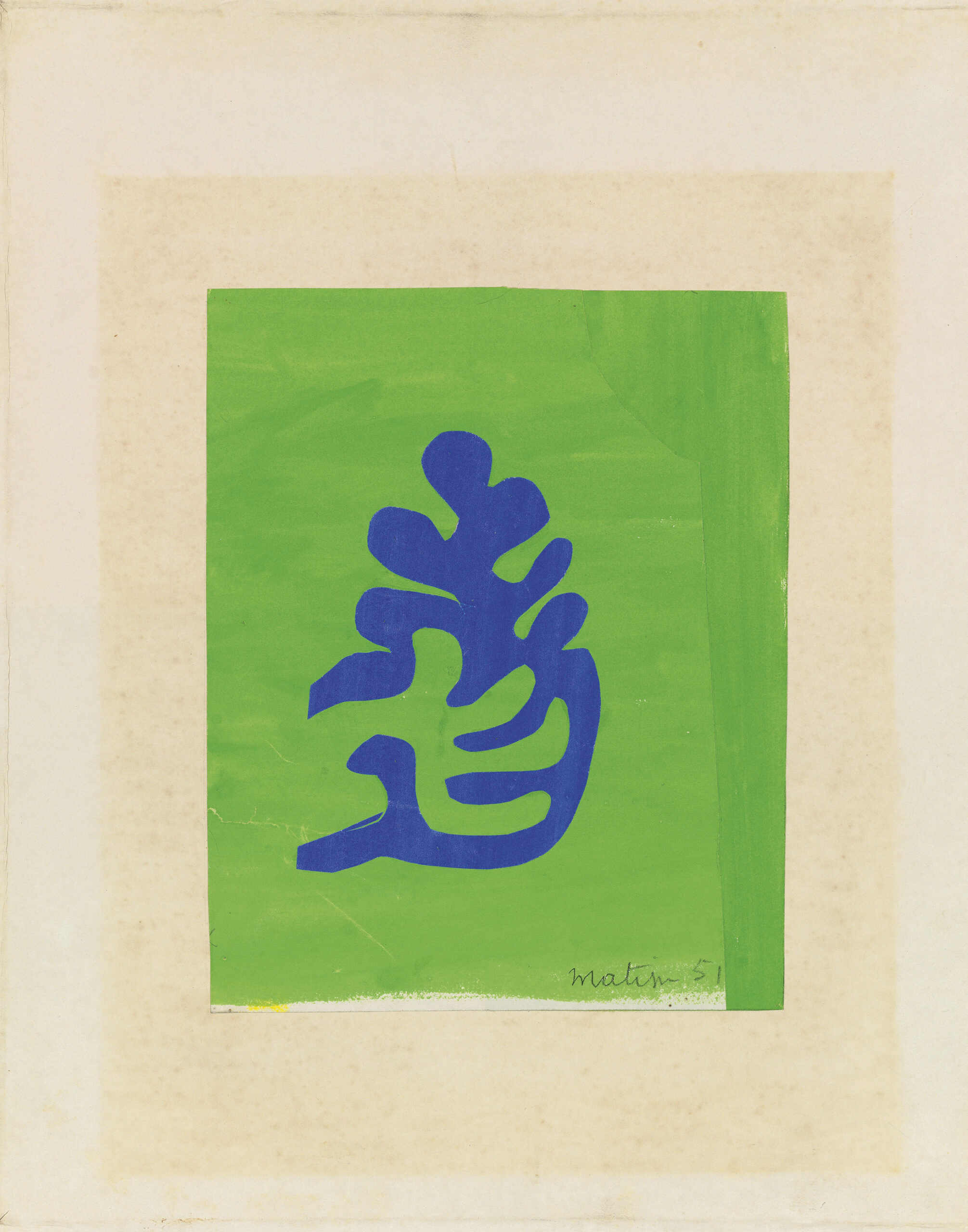
Small Blue Arabesque on Green Background of 1951 (fig. 13) sums up a range of the cut-out works. Here, a blue leaf form is placed on top of a green ground; the contoured lines shaped by the blue evoke the shape of an open palm with four fingers. Embedded in the green field, the open left “hand” suggests the larger body from which it derives, a body that parallels the artist’s own body seated before the picture. More striking still is the blue shape whose lower bounding line evokes an arm with fingers and thumb clasping the open-palm green “hand” and whose blue “thumb” grasps the hand in a gesture that feels at once intimate and tense. As though reversing the bodily orientation of the green hand, the blue body seems to emerge from the other side of the surface, as though exerting pressure from behind.
The Tableau
In the exhibition catalog, curator Claudine Grammont makes a strong case that Matisse sought to keep his works in a state of open-endedness and incompletion. It is no doubt true that Matisse resisted what Grammont calls “perfectionism and completion”—what I describe above as the threat of pure form—but he equally refused Grammont’s alternative, art as the expression of “flux,” a “transitory state of thought,” the “perpetual cinema” of the mind. Far from desiring to “leave everything unfinished,” Matisse sought to sustain the work in a space between red-hot intensity and flat pattern, electric vibrancy and (what Maurice Denis once called) “schemas of pleasure.” It was his lifelong aim, as he put it in the “Notes of a Painter,” to reach that “condensation of sensation which constitutes a tableau.” Far from being an expedient reserved for conservation, sale, or exhibition purposes—as Grammont contends—making the work “definitive,” as he put it to his son a few weeks before his death, was essential to the meaning of the work. Grammont beautifully describes Matisse’s late works as “remnants of a lost world, still pulsating with life,” but it might be better to see how that life was comprised of remnants, how for Matisse life was always already edging away under the artist’s brush, pencil, and scissors.
La vision horrible d’une œuvre pure
For Matisse, the meaning of the work was about the “pictorial and moral” process by which the transitory becomes the definitive. That the “definitive” shows marks of violence—that the achievement of the tableau required putting an end to sensation—was the burden placed on the artist, on all artists. Matisse’s modernism was an expression of the fate of sensation, of touch and connection, as it was transformed into the “definitive” work of art.
Famously, a critic once told Matisse that if he met one of his models on the street he would “run away in terror.” To which Matisse said, “I do not create a woman; I make a picture.” In the 1940s and 50s, making a “picture” was his way of both expressing and reiterating the terror of what the world had made of itself. Stéphane Mallarmé once described the “horrible vision of the pure work of art”; Matisse devoted his life to making “pure works of art”—but their purity was also an expression of horror at a world that seemed to be following his lead.

Exhibition Review: Matisse, 1941–1954, Grand Palais, Paris, March 24–July 26, 2026
Color Unbound: Henri Matisse 1941–1954 (Thames & Hudson, 2026)
Louise Rogers Lalaurie, Matisse: The Books (The University of Chicago Press, 2020)
You want to do painting? Are you happy in life? Then don’t do it.
—Matisse, Notebook 3 for Jazz
“I’m paralyzed by a kind of conventionality that prevents me from expressing myself as I should like in painting,” Henri Matisse told fellow painter Pierre Bonnard in 1940. The conventionality is, in a sense, modernist painting itself and something he helped author. He feels constricted by “the new conventions of expanses of pure color through which I must express myself fully … with no shade or modeling, and which must react with one another to suggest light, and spiritual space.” One of the key achievements of modernism—expanses of pure color—was now felt to restrain his capacity to express himself.
Near the start of Henri Matisse, 1941–1954 at the Grand Palais in Paris—featuring nearly 300 paintings, drawings, books and cut-out gouaches—is a seemingly modest still life entitled Black Philodendron and Lemons of 1943 (fig. 1). Above, a philodendron is reduced to a few stemless leaves dangling in space. Below, set out on a nearly square surface, are nine lemons, many with stems and leaves attached. The lemons appear to be circling the white plate with a lemon at its center. The lone lemon is contained by the plate, one of its leaves touching the plate’s edge, breaking its enclosing contour. It is hard not to read the stranded lemon—at the center of the frame within a frame—as (vainly) attempting to free itself from its containers.
Matisse disdained the idea that a still life was a nature morte, insisting they were as alive as his figures. “Everything that is alive and original in works of art is always the portrait of something,” he wrote near the end of his life. Matisse seemed to give freest rein to his figurative intentions with his still lifes, while his human figures tend towards inanimate props (Harmony in Red, 1908, is perhaps the ultimate expression of this reverse polarity).
Matisse often used still life to express his sense of life under threat, as though it were only by indirection that he could convey this basic human idea. The still-life creatures that inhabit his universe often appear harried and threatened and vulnerable. Many of his late still lifes are insistently partitioned. The vertical wallpaper and curtain in Black Philodendron appear, at first, as decorative motifs, but they are also, on second glance, bars of a cage. Notice how the first bar of the curtain at right severs the leaves from a lemon at the upper edge of the table. It appears that the lemons on the table are less circling the plate than fleeing their containment within frames (table, dish, and picture). Mirroring the lemon at the edge of the plate, the stem of a lemon at right has broken through the edge of the table contour, a pictorial event that appears more “hopeful” than the jailbird lemon on the plate.
Fleeing from what, exactly? The leaves of the black philodendron take on the look of a hand, or fist, bearing down on the sensuous figures below. Are the lemons trapped on the surface awaiting their fate from the encroaching monstera above? Are those Matisse’s “hands” seeking to mold and shape the sensuous colors and shapes below into “pure form”? (This is Matisse in the role of The Knife Thrower or The Cowboy with lasso in Jazz, or the King with the head of John the Baptist in the monumental Sorrows of the King.) Do they await their “aesthetic transformation” into surface decoration?
A related set of problems is on display in Young Woman with Necklace of 1942 (fig. 2). Here, a figure has been wrenched into an order on the surface: the woman’s body is made over into a design to match the necklace, not the other way around. Isn’t this what Matisse meant when he told an interviewer in 1948 that his works were always a “pictorial and moral” synthesis?
Matisse returns to Black Philodendron in the first of his astonishing series of late interiors of 1946–48 (the group of twelve painted interiors is the highlight of the show). The first of these, Interior in Yellow and Blue of 1946 (fig. 3), repeats, in reduced form, the tabletop motif of lemons and plate at the bottom left of the picture. Three lemons now surround the plate with the lemon at the center. Once again, the lemons seem pressed into the flat of an ethereal—or is it sterilized?—blue surface. At top right, the blue rectangle reappears, but the perfect circles are replaced with frenetic zigzags of the world “outside.” Along the lower edges of the upper rectangle, a humanoid chair seems to crawl into the room from outdoors. Sandwiched between the two blue rectangles is a still life in yellow dominated by a tabletop with vase and melons. The melons recapitulate the image as a whole: spherical enclosures filled with zigzag lines of frenetic animation.
As with all the interiors, Interior in Yellow and Blue is conflictual through and through. Here, the standoff is between the two blue rectangles. Top right represents the untamable energies of the exterior. Bottom left, the seamless unity of the flattened picture surface whose sensuous forms have been “abstracted” into yellow essences floating in a purified blue. The action lies with the section between the two rectangles, torn between competing demands: surplus vitality and empty abstraction.
The drama of the interior series centers on the relation between ecstatic figures of the exterior and an interior space of artmaking that seeks to formalize the world into an order on the flat. In most of the works, this exterior motif emerges as a bursting palm tree caught within the rectangle of a window frame. In Still Life with Pomegranates of 1947 (fig. 4), the palm is like static electricity on a television screen. The pictures do everything in their power to contain this energy, to lock it into some kind of decorative pattern on the surface and keep the (natural and human) wildness at bay.
In Interior with Figure of 1947 (fig. 5), the flowers on (beside?) the table reach toward the streaming palm in the window frame; four abstract leaf forms on the table surface reduce the flowing intensity of the palm into a decorative shape. The potted plant on the right appears stuck between the ecstatic growth of the palm and the vertical lines of the wallpaper. The drama of the picture rests on the ways in which the leaves in equal parts merge with the wallpaper pattern and resist being wedged into the surface.
The interior series rests on a careful tug of war between unfixed and fixed, frenetic line and stiffened order. Red Interior, Still Life on a Blue Table of 1947 (fig. 6) falls on the “uncontained” side of the ledger. The exploding forms outside seem to generate inside an uncontrollable buzz across the red surface, as a zigzag lightning pattern—“hatchings hot as electric filaments,” as Alfred Barr put it—carries across the whole surface, running from the window area down to the bottom right. The potted flowers on the table (yet another container) droop as they are exposed to the blazing force of energy outside. The organically shaped plate below can’t contain the red fruit that expands beyond its edges (two of them have freed themselves from their container). At top left, Matisse includes an image of his earliest sculpture (c. 1895), a portrait medallion of Camille Joblaud, one of his early models, and the mother of his beloved daughter, Marguerite (the medallion appears in several of the late interiors). She is a revenant from an earlier life (as are the circus scenes in Jazz) and—despite its enclosed profile (almost like a coin)—she mirrors, inside, the source of energy bursting at the center of the palm at right. It is as though Matisse, near the end of his life, is trying to reclaim the energy—and the life—at the very beginning of his career.
Interior with Black Fern of 1948 (fig. 7), near the end of the series, assertively contains the frenetic energy of the palm within a rectangle at top right. In direct counterpoint to the palm’s buzzing confusion is the grid that lines the red back wall of the interior. Once again, a potted plant engages with both sides of the equation. At top right, its leaves extend beyond the room into the space of the palm in the window as though sucking up its ecstatic force. At other moments, the leaves spread out along the lines of the grid, as though awaiting their capture by the formal order on the surface. Down below, a leopard skin rug plays a dual role: an explosive array of black dots dance across a yellow surface, but they are well contained within the horizontal at the midpoint of the canvas (like the portrait medallion, the skin was at once “nostalgic, all those fairground wrestlers, athletes with leopardskin belts” and painful, reminding him of a nocturnal tool used by “witchdoctors” to “rip apart anyone they encounter”). By contrast, the seated figure, faceless and pale, has lost its sensuous presence; her left arm appears as though another of the table legs, and her dress, with hints of a leaf pattern, offers the natural as commodity form. The leftmost table leg ends up on her lap, reinforcing the fact that she is a prop as much as the objects on the table. Matisse’s explicitly figurative energies were displaced almost entirely from the paintings and cut-outs to his drawings in this period (the exhibition features a range of drawings from the 1943 Theme and Variations, a wall of variations on the visage of Louis Aragon, and a late sequence of highly attenuated faces and masks that push the limit of line as a plausible carrier of embodied sensation).
The peculiar Still Life with Pineapple of 1948 (fig. 8), one of the extraordinary black ink and brush works related to the interior scenes, reimagines the tensions of the series as a whole. Here, a broad wrapper attempts to fold over and around a prickly pineapple on a table (the leopard skin rug makes another appearance below). The pineapple is another figure—like the philodendron or the palm—for the as-yet-unformed. Art, for Matisse, is about the process of making over prickly, independent beings into formal patterns on a surface. The viewer is meant to imagine the feel of the wrapper as it (vainly) attempts to blanket the spiky fruit. We are further solicited to imagine how the pineapple will poke through any pathetic container (the drooping shape along the left edge of the wrapping might well be construed as a flaccid phallus).
The best account we have of Matisse’s late paintings remains Alfred Barr’s 1951 description of Interior with Egyptian Curtain of 1948 (fig. 9), the concluding work of the interior series (not in the show). While Barr emphatically replays the idea of the artist as someone “peculiarly indifferent to political events,” his language captures the intensity of the pictorial battle that was intended to express the feel of contemporary events. As with Interior in Yellow and Blue, Matisse arranges three elements in irresolvable competition.
[Matisse] has hung a curtain right up against the front plane of the picture and placed the table, spatially, between it and the window. What a curtain! A barbaric modern Egyptian cotton with the most aggressive and indigestible pattern. And … what a window! In all Matisse’s score upon score of views through windows the most astonishing is this explosive palm tree with its branches whizzing like rockets from the point where the black window mullions cross.
Matisse sets the bristling palm and the strident curtain side by side in direct competition with each other. Adjoining each, he places the serene dish of pomegranates on its pink table to serve as a kind of referee who tries to keep the hopelessly adjacent contestants apart, at least in depth.
The struggle is further complicated by the fact that the palm tree is not only dynamic but dazzling. The yellow stems, the green and blue-black leaves against white set up a vibration which the curtain can oppose only through the scale of its brutal design. The radiant effect of the tree is enhanced by the black shadow cast by the dish, but the shape and size of this shadow offer support to the curtain. Yet in the end the neutrality of the still life as a third force is preserved by the complete independence of its color scheme—orange, pink and pale blue—which is as isolated from the other two areas as they are from each other.
As Barr rightly notes, “Clearly Matisse is not concerned here with that armchair serenity” he once declared as his goal. In 1908 Matisse infamously described his art as an “armchair for the tired businessman.” But who believed him? Not Matisse, who directed this barbed comment at his avant-garde comrades play-acting la vie de bohème up in Montmartre (wasn’t it always play-acting?). Henri-Edmond Cross better described Matisse as “the anxious, the madly anxious.”
Collapsing Space
Just prior to the interior series, Matisse produced a series of small paintings of young girls in an interior that explores a related problem, this time about the feel of modern space. Five paintings—Young Girl in Pink in an Interior, 1942; Young Girl in White Dress, Black Door, 1942; Sun-Striped Interior, 1942; Young Woman in White on a Red Background, 1946; and the expansive Plum Branch, Green Background, 1948—share a complex and unnerving mode of address to the viewer. The structure of these works is most emphatically laid out in Black Door and Sun-Striped Interior (fig. 10), where a heavy dark element (a door, a painting) feels as though nailed to the upper left section of the painting. From this flattened rectangle or square, the rest of the picture seems to plunge or swing toward the viewer from left to right. Despite the modest size, Sun-Striped Interior encompasses an enormous distance from the square painting top left (lemons, again) to the series of vertical rectangles (red, black, orange, green)—all of them situated in relatively deep space—until the rhythmic pattern abruptly accelerates when it reaches the stool, right of center, with a series of advancing and expanding verticals that seem to launch themselves towards the picture plane, landing at the woman’s feet bottom right. We are given a strong sensation of forward momentum, a collapsing quality of space that is distinctly at odds with the thematics of stasis and rest—the pastoral—that dominates the series.
The Books
Our understanding of Matisse’s book production throughout the 1940s has been transformed by Louise Rogers Lalaurie’s groundbreaking analyses in Matisse: The Books (2020). Lalaurie reads the livres d’artiste “as a coherent body of work,” bearing a deeply “political strand” but one that has gone unnoticed, as their messages were highly “coded or subliminal.” Lalaurie sees them as broadly “subversive,” a “determinate act of resistance at the heart of the Vichy zone” in Nice where Matisse lived. Writing of Matisse’s controversial illustrations for Montherlant’s Pasiphaé (on view in the exhibition) (fig. 11), Lalaurie quotes Matisse’s closest friend at the time, André Rouveyre, telling the artist, “I should have to land you a knock-out punch for taking inspiration from such a piece of rubbish.” As Lalaurie shows, Rouveyre had nothing to worry about, as the book was intended as “an allegory of the self-delusion, sham and moral depravity at the heart of the Vichy project.”
Rather than the directly political, Lalaurie is at her best in describing the shared “narrative arc” of the books, circling around “moral and aesthetic questions that had beset Matisse throughout his artistic life.” Lalaurie shows how the viewer is implicated in narratives that trace a passage from scenes of violence to resolution, centered on how the artist’s subject relates to the artist’s (and viewers’) desire for control. Writing of Florilège des Amours de Ronsard (1948, also on view), Lalaurie describes how the “active unfolding, examination and displacing of the book’s huge pages involve the reader as protagonist. Perhaps we spied on the model bathing, turned a lover over onto her back, tasted the delights of her body, stepped out to surprise her in the wood. Matisse stages a sophisticated investigation of the ethical questions surrounding his lifelong role as a portrayer of women for his viewers’ enjoyment.” It is a bold analysis, predicated on the idea that Matisse interrogates—rather than simply replays—the “male gaze in art,” as his subjects return the look of the artist “as if in recognition” of the artist’s attempt to manipulate them. The implications of this view are significant and should alter our sense of Matisse’s project as a whole.
The Cut-Outs
On the first floor is a range of mostly small-scale cut-out works, while the upper level is devoted to large-scale, sometimes enormous, cut-outs, including The Sorrow of the King, Beasts of the Sea, Zulma, the four Blue Nudes of 1952, The Snail, Memory of Oceania, and The Sheaf. The set of issues explored in the books and paintings takes on a different character in the cut-outs. Here, the problem is less a matter of art and life than of art and artist.
Among the array of cut-outs exhibited, one thematic element stands out as central. Although the imagery is nominally Tahitian in its references to algae and lagoons, a closer look reveals an obsessive interest in the shape and character of the human hand. As some famous clips and still photographs show, Matisse held the colored paper upright in his hands, cutting upward as he tilted the paper to create shapes in his hands. This unusual technique finds its formal expression in the works themselves, as many of them take on the character of hands or feelers. The forms in Alga on Green Background of 1947 (fig. 12), for instance, feel as though they are hung from the upper edges of the surface. Long, narrow shapes dangle in a watery substance below. Consider the shape of the green form to the right of the long dangling green element on the left. Taking on the rough shape of a hand with four fingers, two of them (at left and right) appear thumblike, with the lower and longest two shapes more like index or middle fingers. That the “hand” is extended from the top strongly unsettles any direct bodily connection with the artist’s own body before the work. The hand is set against any direct bodily analogy. One might even say that the work contains two images of the body: a hand lowered down in space and a body reaching up and around it from below.
Small Blue Arabesque on Green Background of 1951 (fig. 13) sums up a range of the cut-out works. Here, a blue leaf form is placed on top of a green ground; the contoured lines shaped by the blue evoke the shape of an open palm with four fingers. Embedded in the green field, the open left “hand” suggests the larger body from which it derives, a body that parallels the artist’s own body seated before the picture. More striking still is the blue shape whose lower bounding line evokes an arm with fingers and thumb clasping the open-palm green “hand” and whose blue “thumb” grasps the hand in a gesture that feels at once intimate and tense. As though reversing the bodily orientation of the green hand, the blue body seems to emerge from the other side of the surface, as though exerting pressure from behind.
The Tableau
In the exhibition catalog, curator Claudine Grammont makes a strong case that Matisse sought to keep his works in a state of open-endedness and incompletion. It is no doubt true that Matisse resisted what Grammont calls “perfectionism and completion”—what I describe above as the threat of pure form—but he equally refused Grammont’s alternative, art as the expression of “flux,” a “transitory state of thought,” the “perpetual cinema” of the mind. Far from desiring to “leave everything unfinished,” Matisse sought to sustain the work in a space between red-hot intensity and flat pattern, electric vibrancy and (what Maurice Denis once called) “schemas of pleasure.” It was his lifelong aim, as he put it in the “Notes of a Painter,” to reach that “condensation of sensation which constitutes a tableau.” Far from being an expedient reserved for conservation, sale, or exhibition purposes—as Grammont contends—making the work “definitive,” as he put it to his son a few weeks before his death, was essential to the meaning of the work. Grammont beautifully describes Matisse’s late works as “remnants of a lost world, still pulsating with life,” but it might be better to see how that life was comprised of remnants, how for Matisse life was always already edging away under the artist’s brush, pencil, and scissors.
La vision horrible d’une œuvre pure
For Matisse, the meaning of the work was about the “pictorial and moral” process by which the transitory becomes the definitive. That the “definitive” shows marks of violence—that the achievement of the tableau required putting an end to sensation—was the burden placed on the artist, on all artists. Matisse’s modernism was an expression of the fate of sensation, of touch and connection, as it was transformed into the “definitive” work of art.
Famously, a critic once told Matisse that if he met one of his models on the street he would “run away in terror.” To which Matisse said, “I do not create a woman; I make a picture.” In the 1940s and 50s, making a “picture” was his way of both expressing and reiterating the terror of what the world had made of itself. Stéphane Mallarmé once described the “horrible vision of the pure work of art”; Matisse devoted his life to making “pure works of art”—but their purity was also an expression of horror at a world that seemed to be following his lead.
