
The term “neoliberalism” has become a rather vague stand-in for what a minority see as the best of worlds and many others experience as the worst. An immediate question is: if neoliberalism is a new version of “liberalism,” then what exactly was that earlier liberalism, and what is the new that has been added?
Classical liberalism was born out of the revolution by a rising capitalist class against rule by kings and against feudal tradition. Its call to arms was not as glorious as universal equality but rather the defence and extension of individual property rights and markets unencumbered by the state. Having won its battle with those above, this minority was not about to let those below—the “mob” with no property rights—encroach on its victory.
This was clearly not a matter of an unfortunate phase in capitalism’s early years. To have extended that right to those without property was a threat to the prosperity of those who had. Industrial capitalism first emerged in Britain around the last quarter of the eighteenth century, and the vote was at the time denied to over 90% of the population.
The Great Reform Act of some six decades later (1832) partially eased the qualifying property standards but still left some 60% of the adult male population without the vote (voters were then defined as “male persons”). The vote was only universalized at the end of WWI, nearly a century later. By any measure of democracy and respect for workers’ rights, classical liberalism was more authoritarian and anti-working class than the neoliberalism that emerged at the end of the 1970s.
For economic liberals, capitalism was natural, inevitable, self-correcting. The Great Depression, international in scope and the deepest and most impactful crisis in capitalism’s history, exposed liberalism’s economic and social flaws. John Maynard Keynes, a staunch capitalist, expressed a pervasive alienation in the early 1930s that wasn’t limited to socialists: “The decadent international but individualistic capitalism, in … which we found ourselves after the War, is not a success. It is not intelligent, it is not beautiful, it is not just, it is not virtuous—and it doesn’t deliver the goods.”1
By the end of the thirties, even liberalism’s staunchest defenders acknowledged its failures. At a conference in 1938 called to address how to preserve liberalism’s core principles (limits on state intervention in private property rights and free markets), the group of what we would now call “conservatives” concluded the necessity of a new liberalism, one retaining liberalism’s core values but more attuned to the need for some degree of state intervention to guarantee minimum standards and economic stability. They called this new liberalism “neoliberalism.”2 This failed to take root then or in the succeeding four decades and only resurfaced in response to the crisis of the 1970s.
What replaced the exhaustion of liberalism in the thirties was Roosevelt’s New Deal. Although Roosevelt cut federal spending in 1937 to balance the budget and caused a significant downturn, the New Deal was more or less followed up in the fifties/sixties by “embedded liberalism.” Embedded liberalism accepted capitalism as the most economically efficient form of society but as having some unfortunate social failures that merited state intervention.
The two postwar decades were widely seen as capitalism’s finest moment, a Golden Age expected to last indefinitely. Even though the Golden Age proved transitory, for social democrats it continued to be their lodestar, the lost world to be regained. Even some socialists who understood its limits look back to the revival of a social democratic Golden Age as a strategic step towards socialism.
However, as the postwar economic boom ended, the Golden Age correspondingly faltered, bringing in its wake the instability of the seventies and “stagflation,” a rare combination of both unemployment and inflation. It was this crisis that set the stage for the modern neoliberal era as a counter to embedded liberalism.
The debates around neoliberalism played out on the terrain of the state-market nexus. On the right, the argument was that the economic crisis of the seventies stemmed from too much intervention in the workings of the economy; they called for less state/more markets. Most progressives, seeing the preservation of embedded liberalism as vital to hanging on to working-class gains, called for more state/less markets.
Both positions avoided the deeper underlying issues. Adolph Reed Jr., in a succinct and powerful aphorism, cut through the fog and got to the heart of the matter. The crisis of the seventies, he asserted, produced a “capitalism that has effectively freed itself from working-class opposition.”3 What Reed was pointing to and what was obscured by each side in the “more state/less state” framing was the underlying centrality of class and the ever-changing political economy of capitalism.
This essay builds on Reed’s maxim and poses a number of related issues, beginning with an elaboration of the more state/less state characterizations of liberalism and neoliberalism. It goes on to argue that periodizing capitalism into the era before the extension of the vote, when capitalists had the luxury of dealing with a working class without even the most basic of democratic rights, and capitalism after the vote, when capitalism had to cope with a working class with some degree of democratic influence, turns out to not have been the decisive break in capitalist history that seemed obvious. Rather, that critical break occurred in the Great Depression. It was then that a fading capitalism found itself having to cope with a working class that not only had the vote but demonstrated pronounced oppositional capacities beyond the franchise.
The Golden Age continues to be presented as an inspiration for progressives today. The essay challenges how progressive it really was and notes that it was precisely in the Golden Age that the American Empire emerged as the most ambitious neoliberal project in history. This leads to a discussion of how this impacted the Golden Age domestically and how this globalized neoliberalism both matched and differed from the neoliberalism we speak of today. The conclusion stresses the polarization of options in the present moment and the implications for the politics of the present.
The State-Market Nexus
States and markets are not opposites; they are part of a coherent whole. Capitalist states depend on markets to provide the investment that creates jobs and provides the tax revenue for the infrastructure and social services that help legitimate themselves and also capitalism. Markets correspondingly depend on states to function.
This is not just a matter of governments building or financing roads, ports, airports, and hospitals and providing some degree of social services. It gets to the very existence of markets. Markets are not institutions that emerged spontaneously. They had to be made, and the state was indispensable to this, providing the essential legal, administrative, and material infrastructure that converted the commons to private property and subordinated workers to their employer’s priority of accumulation.
Similarly, freer trade and capital flows are not the spontaneous result of governments stepping back to allow markets to do their thing. The mobility of goods and capital could not have occurred without governments negotiating international agreements, enforcing the rules of economic engagement, and protecting—within their own territory—international property rights in private assets.
Even the liberalization of financial markets from the early 1970s on came, as Steve Maher and Scott Aquanno have convincingly argued, with more rules because markets can readily be “gamed” and are especially volatile and crisis-prone.4 And when markets crash, it is states that intervene, sometimes massively so, to bail financial institutions out to the end of “restoring business confidence” and the persistence of capitalism.
More state in the concrete can just as readily undermine workers. For example, in responding to the crisis of the 1970s, the U.S. Fed raised interest rates to 20% in March 1980 in order to slow the economy, increase unemployment, and crush impudent unions. When Chrysler was bailed out in the midst of the crisis conditions it then faced, Paul Volcker, appointed by the Carter administration to head the Fed, was also on the board overseeing the Chrysler bailout. He was instrumental in explicitly imposing conditions if Chrysler received state funds: Chrysler would have to insist on, and its union would have to accept, a major cut in wages and the subcontracting of work to lower-wage (i.e., non-union) facilities. 5
Soon thereafter (1981), air traffic controllers defied back-to-work legislation. Many were arrested, and some were led to jail in leg irons.6 As with the conditions on Chrysler, this was certainly an example of “more state”—not, however, to serve workers but to set a path for business to follow in suppressing labour’s economic expectations. There was similarly nothing progressive in Trump increasing state expenditures on ICE, immigrant detention centres, and the military or subsidizing the expansion of oil production or bolstering cryptocurrencies.
A different example of the market-state confusion was expressed when the Great Financial Crisis hit in 2008–09. The forceful intervention of the state led many to declare this to represent the end of neoliberalism. They were right only to the extent that this crisis showed that neoliberalism wasn’t a stable, self-correcting system. But they were dreadfully wrong in seeing the government bailout, because it involved “more government,” as a rejection of neoliberalism. The government intervention was precisely about saving finance so neoliberalism could continue. And it did, in spades.
Even at a purely empirical level, total government expenditures as a share of GDP did not, as is commonly asserted, fall with the advent of neoliberalism. This ratio averaged 31.1% in the years 1970–83, peaking at 33.8% (the period of alleged high government expenditures) and averaged 33.3% in 1984–2025 (higher after neoliberalism began).7
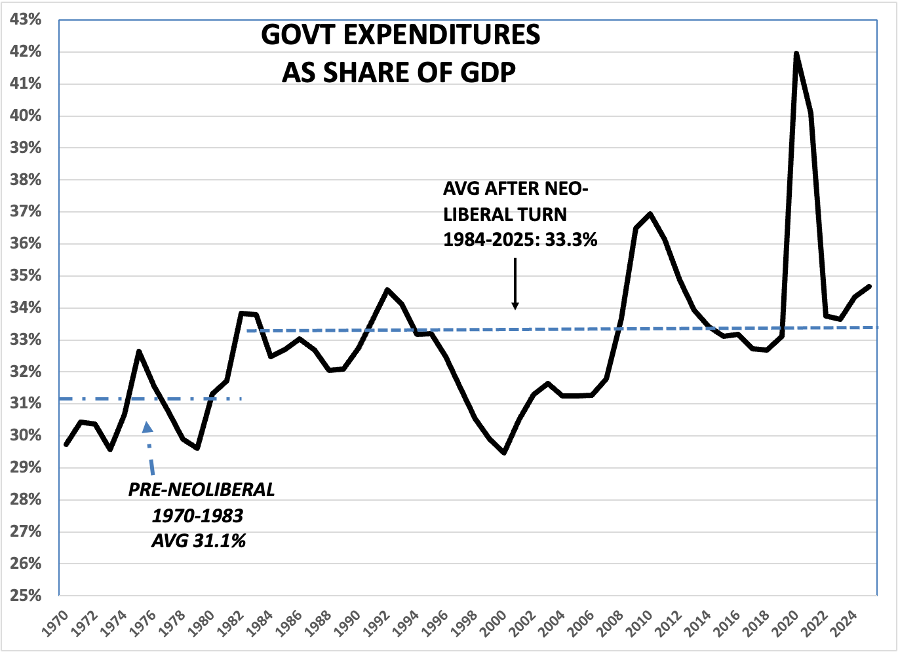
Some government expenditures, the ones most important to the working class, did indeed fall, but others increased. This tended to keep the share of government expenditures relatively stable. What the abstract support for more state clearly obfuscates is the underlying class content of state interventions. What makes the state a specifically capitalist state is not its personnel (so changing the personnel is not the ultimate goal), but the biases, structures, and capacities that it developed over a long stretch of time to support and legitimate capital accumulation. This includes containing labour. When the state does respond positively to pressure for progressive change, this highlights relative class power and organizing/mobilizing as the decisive terrain of analysis, not the role of the state in the abstract.
A related clouding of the material foundations of neoliberalism occurs in ideological critiques. Sympathetic to workers, such critiques blame neoliberalism’s advance on the revival of arguments made some time ago that favour markets over public intervention. A popular and effective standard bearer of such arguments was Milton Friedman, who declared in his 1962 introduction to Capitalism and Freedom that the “basic function” of classical liberals like himself was “to develop alternatives to existing policies, to keep them alive and available until the politically impossible becomes politically inevitable.”8
The operative word here is until. Ideology and morality matter, but primarily as adjuncts to material developments rooted in the political economy and class relationships of capitalism. The problem with prioritizing ideology is that it reinforces interventions that are primarily discursive, when what is above all needed is grounded organizing to change the balance of class power. It’s only in that context that the ideological can play its valuable role.
The Great Depression: Capitalism with a Working-Class Opposition
The fight to win the vote brought improvements for working people, institutionalized working-class interests in new parties, and raised political questions and political engagement. It is, however, noteworthy that the vote came only after capitalism was consolidated and hegemonic. This positioned it to tolerate the vote and contain working-class voters. Furthermore, channeling dissent into the vote contributed to legitimating both the state and the outcomes of the vote, obscuring the limits of one person/one vote in a class society.
A test of the impact of the vote came after World War I. By then the vote in the U.S. for white adult males (not yet women) had been in place for a while. Union density in the U.S. was around 10% when the war began and about 17% by 1920–21, a result primarily of the democratic sensibilities stimulated by the war, rising expectations, and postwar frustrations with inflation. Yet by the mid-twenties it was back to pre-war levels.
Corporations did their share to block unionization that decade through firings, infiltration by Pinkerton spies, and the carrot of company unions, insurance benefits, and sports teams to build morale. The American state used the threat of the Russian Revolution spreading domestically to create a Red Scare against radical left leaders. “More state” meant thousands arrested, hundreds deported, due process ignored, the beating of those detained, and assaults on workers at picket lines, union meetings, and in their homes. Workers had the vote, but it proved too narrow a practice to offset the power of capital and the role of the capitalist state apparatus.
The emergence of a working class that could affect the trajectory of capitalism only came with the Great Depression. The sudden shock of the Depression, its depth and international scope, along with the disorientation of capital about how to proceed undermined capitalism’s authority. The Depression signalled something more consequential than another economic downturn: the exhaustion of classical liberalism. Union density rose somewhat in the early 1930s, then exploded in 1937–39 to over 27% and increased further to reach 34% at war’s end.9
In earlier times, unemployment was generally treated by workers as an inexorable harsh reality. In the context of the Depression and the loss of liberalism’s hold on popular sentiments, unemployment became something to be protested and fought; unemployment was politicized. Where past unemployment lowered worker expectations (as in the post-WWI recession), it now led to workers becoming angrier and more insistent on mobilizing to fight the loss of jobs. Comparisons to the central planning of the Soviet Union were disconcerting. While GDP in the U.S. fell by 30% during the harshest years of the Depression and one in four workers was unemployed, the Soviet Union was at the time growing rapidly and faced shortages of labour, not shortages of work. On the far right, Hitler was propelling Germany towards an aggressively nationalist and supremacist dictatorship that was militarized and expansionist.
Roosevelt, trying to save American capitalism, looked to find a middle ground that rejected both the Soviet Union and Hitler. With significant sections of capital opposed to his policies, Roosevelt relied on workers as allies and supported collective bargaining rights (but not for farmworkers, domestics, or more public-sector workers). During the GM sit-downs in late 1936 and early 1937, he refused GM’s call to send in federal troops to quell the worker rebellions. By the fall of 1937, in the midst of the bitter “Little Steel” strike, Roosevelt was less ready to be identified with labour radicalism, endorsing the sentiment towards labour and capital of “a plague on both your houses.”10
Through the thirties, workers fought employers, the police, and the National Guard. They invented new tactics like flying pickets and, later, sit-down strikes. There were city-wide general strikes; workers published their own broadsheets, built alliances with the unemployed to limit scabs, and established soup kitchens and hospitals as needed. The CIO decision to move beyond craft unionism to organize the mass of unskilled and semi-skilled workers followed the labour upsurge and reinforced it. The Communist Party (and in the Minneapolis General Strike, the Trotskyists) were vital in inspiring workers with their confidence and strategic organizing skills. Union density, which was 11% at the end of the 1920s, was twice as high by the mid-thirties and reached 30% by war’s end.
The boundary between specific historical eras is by nature blurry. Nevertheless, the Great Depression marked a decisive turning point in the capital-labour relationship. A revolution was not imminent, but capital and the state now had to cope with a working class that had demonstrated its potential as an organized social force. Workers showed, as Bryan Palmer put it in his history of the 1934 Teamster Strike, “that the tides of history, even in times that seem to flow against change, can be put on a different course.”11 This was capitalism with a serious working-class opposition.
Demystifying the Golden Age
The working class that emerged as WWII ended was highly unionized in the key industrial sectors and had high expectations after the deprivation of the Depression years and the sacrifices made during WWII. For its part, the American state was especially concerned to legitimise capitalism not only because of the strength of the unions coming out of the war but also because of the Cold War ideological competition with the Soviet Union and the repercussions expected inside the U.S. by the initiation of the American Empire at the war’s end.12
The Empire and its drive to universalize capitalism globally and prevent the rise of new nationalisms, as in Germany, included burdens as well as benefits for America. Aside from the military expenditures at home and abroad, which were overwhelmingly financed by the U.S. state, the Cold War support for the revival of Europe and Japan meant that American industry would face intensified competition, imports would grow, and capital would flow to take advantage of opportunities abroad.
The concessions made to the working class that defined the era as the Golden Age were consequently inseparable from containing the working class as the condition for the development and spread of capitalism. This began with isolating and purging not just communists but a range of militants who could be painted with the broad anti-communist brush. That included the McCarthyist attacks on Hollywood, legislation that barred communists from union office if unions wanted to retain their legal recognition, and limits on union solidarity such as secondary pickets and support strikes. All this profoundly affected the trajectory of unions and class formation.
Once unions were cleared of their radicals, the state moved on to consolidate a depoliticized working class with economic and social concessions. These concessions are not to be dismissed. They did include significant gains and benefits that, added to the postwar economic boom, created a degree of security among workers (especially the low unemployment) that translated into working-class confidence and supported economic militancy. This proved especially significant in the mid-sixties when state expenditures for the Vietnam War and the War on Poverty increased growth and reinforced not just wage demands but the resistance, especially by a rising anti-establishment youth culture, to management authority in the workplace.
The concessions were dependent on growth to finance them. In this regard, the U.S. was in a unique position. While World War II had devastated the industrial structures of America’s potential competitors, it dramatically strengthened American industry, enabling the American state to not only deliver on worker expectations at home but also support the renewal of capitalism abroad. Corporations, more concerned to meet the pent-up consumer demand from the Depression and war, were (for a time) ready to accommodate worker gains in wages and benefits to keep the production lines humming.
For all the gains made in this era, however, its mystification as a “Golden Age” misrepresented the times. Poverty persisted, though largely hidden. Workplace wage and benefit gains came with ever-tighter production standards and health and safety concerns. The postwar world was not all that great for women who had entered industry to meet the wartime shortages and who were now “encouraged” to return to the kitchen and depend on the husband as the sole breadwinner.
The Civil Rights Movement highlighted America’s treatment of the black population to the world at a moment when the American Empire was preaching anti-colonialism abroad. The belated Civil Rights Act was a momentous breakthrough, but it also posed the critical economic/political question of how American blacks would move on to materially improve on the past. The war in Vietnam underlined the limits on the substantive sovereignty of states imposed by the American Empire in the global south but also highlighted the limits of imperial power.
Especially consequential and generally ignored was the fact that the American Empire, in the Golden Age that social democrats so admired, was not an empire like past empires but one driving the most ambitious neoliberal project in capitalism’s history. Characterizing it as “neoliberal” stems from the nature of the formal state sovereignty the American Empire offered. Sovereignty was conditional on acceptance of the Empire’s foundational goals of the universalization of property rights, freer trade, and capital flows. Substantive sovereignty—the popular capacity to determine the preferred mode of their economic and social existence independent of external conditions—was an enemy of the Empire.
The making of a global capitalism was not just something that happened “out there” but had pronounced implications at home. It opened the door to a future of sourcing abroad to take advantage of opportunities in a revived Europe and Japan and later from economic development in Asia. This increased disciplinary pressures on workers in the U.S. and helped undermine economic standards and weaken American trade unionism.
Certain policies from the fifties and sixties can nevertheless shore up demands today. For example, the corporate tax rate today is 21%; then it was over 50%. The top income tax rate is today 35%; then it was over 90%, and capitalism chugged along fine.13 The reductions in taxes allowed capital to massively increase its wealth (the top 10% have twice as much wealth as the bottom 90% combined14) while doing little for working-class households. If corporations and the rich assert that capitalism can only function with the grossest income and wealth inequalities—especially as the accumulated debt of the U.S. is now raising the need for “sacrifices”—what are they doing but condemning capitalism and its democratic pretensions?
It is one thing to try to emulate specific policy changes from the postwar years, though even this won’t get on the agenda without mobilizing a justifiably angry populist campaign against the domestic super-rich. However, proposing a whole-scale return to the Golden Age is quite another thing. The gains of that era were, for example, critically dependent on growth. GDP increased at an average of over 4.4% over the twenty years from 1950–69, and this contributed greatly to financing the so-called welfare state and significantly eased conflicts over redistribution and social priorities. In contrast, U.S. economic growth since 2000 has averaged about half of that (and just a bit more in the overall period since the end of the sixties).
Repeating the working-class gains over that period consequently demands some combination of restoring growth to those levels; extensive cuts in military expenditures, which implies a major challenge to the American Empire; and a massive redistribution of wealth. If the high growth is to be restored by looking to private capital to increase investment, this requires making capital more optimistic about the future it prefers, which would involve undermining social-democratic priorities. If instead the response is a massive state intervention that leads capital rather than serves it, it means class war. A combination of state-led growth and major redistribution of income, wealth, and power to return to the context of the Golden Age could not come from a social-democratic tweaking of the system; it demands a radical, socialist-leaning response.
This gets to a second formidable challenge. Returning to the context of the alleged Golden Age would mean undoing a good part of everything that has occurred since: markedly reversing globalization, taking on the American Empire, rolling back international financialization, correcting the staggering inequalities in income and wealth that have occurred since, and throwing neoliberalism under the bus. Above all, it would mean figuring out how to revive the strength of the labour movement.
Union sympathizers and much of the left focus on union density as the core labour question and changes in labour law and its administration as the key response. The envious benchmark is a union density back then that was triple what it is today. Yet Canada today actually has roughly three times the density of the U.S. (30% vs. 10%), and Canadian Labour is no more dynamic than the U.S. The revival of the union movement is not about the numbers but the kinds of unions that are being built (a more dynamic trade union movement is, in any case, key to reaching more workers). Moreover, though the Wagner Act was certainly a critical achievement, it only came into place as a consequence of massive upsurges that led panicked elites to look for a way to end the economic chaos and avoid its spread. The Minneapolis and San Francisco general strikes and the fifty-one-day Auto-Lite strike occurred in 1934; the Wagner Act was passed in 1935.
Especially significant was the crucial role played by communists and other socialists in the struggles that led to the labour movement’s takeoff. Absent an organization of committed socialist organizers that brings larger historical and strategic perspectives to the cause and sustains its members with a larger vision and broader connections across the class and other sympathizers, it is difficult to imagine how a new mass upsurge could emerge and be sustained.
In this respect, it is vital to return to the ultimate failure of unions and the left during the sixties. The militancy of those years is rightly envied, but the fact that it never broadened its battles into class struggles with politicized demands—like democratizing investment, finance, and the state—meant that it was vulnerable to eventual exhaustion and deal-making. Gains under capitalism are valuable but always tentative. If militancy is not converted to constantly building a broader and deeper movement, the gains themselves will, as we’ve seen, ultimately be threatened. On this measure, the Golden Age was, as we’ll discuss in the next section, in the end golden for capital, not quite so golden for the working class.
The Crisis of the Seventies
The postwar boom ended gradually, but the explosion of oil prices in 1973–74 announced its formal end. Had workers accepted the corresponding lowering of expectations that corporations and the American state called for, the subsequent recession and inflation might have brought “only” a temporary economic downturn and transition to a new oil and environmental era. But workers, especially young workers, confident after years of economic growth and low unemployment levels, saw no need to sacrifice wages and working conditions to preserve an unfair status quo. Their stubborn resistance reinforced the squeeze on profits.
Corporations, determined to protect their profits, clawed back as much as they could through raising prices. This aggravated inflation and pushed workers, in turn, to raise wages to protect their standard of living even in the context of an economy in a recession. This brought a new term into the economic lexicon: “stagflation” (economic stagnation alongside significantly rising prices). International uncertainty about how the U.S. would solve this crisis simultaneously increased pressures on the American dollar.
Through the seventies, various U.S. administrations tried one thing after another to escape the second-deepest crisis of the century: ending the dollar’s full convertibility to gold, 10% tariffs on imports (though unlike Trump, this was declared temporary), a tentative degree of stimulus, and wage controls. All failed, and eventually the state and the Fed, in spite of being nervous about how workers would respond to letting mortgage rates explode and unemployment increase, concluded that the only way to break the cycle of inflation, preserve the status of the dollar, and set the stage for a sustained restoration of corporate profits was to crush labour. The Fed raised interested rates to 18% and let unemployment rates hit 10.4%.
The increase in unemployment, along with the direct state involvement in the early eighties discussed earlier (i.e., at Chrysler and PATCO), did the job. In essence, the era of trying to legitimate capitalism to workers was over. What was needed, economic and political elites had concluded, wasn’t added checks on capitalism but giving capital more reign. A modified mode of accumulation evolved that included a radical shift in class power to capital, an acceleration of globalization, and a liberalization of finance. This deepening of capitalism came to be called “neoliberalism,” officially ending the experiment with embedded liberalism and imposing Reed’s capitalism without a working-class opposition.
At another level, it might have been expected that the slowdown in U.S. growth and intensification of international competition was ripe for the inter-imperial rivalry much of the left kept hoping would erupt and do much of the heavy lifting for it. But a crisis for the U.S. was by then a crisis for capital everywhere. As the U.S. Secretary of the Treasury John Connally told his European counterparts in 1971, “the dollar is our currency but your problem.”15 The American Empire managed to shift the crisis away from potential conflict among capitalist states to class conflict within each country (leading ultimately to neoliberalism at home and internationally).
In this telling, the origins of neoliberalism might be traced to the alleged Golden Age and its maturation at the end of the 1970s. In its earlier post-WWII form, the stage was set through the assault on left union leaders and then the channeling of the militancy of the Depression into individual consumption and social programs calibrated to operate within the confines of capitalism. Unemployment insurance, for example, was structured to keep people in the labour market and limit their flexibility in waiting for more suitable jobs. Income supports couldn’t be high enough to have people opt out of the worst and lowest-paying jobs. Socialized health care, common elsewhere, was not even attempted. And standing over all this was the American Empire, the sponsor of global neoliberalism.
Both in the postwar years and in neoliberalism at the turn to the 1980s, the state was ready to use its oppressive force—earlier to purge the left, later to weaken the spread of unionization and interfere in strikes. What distinguished the neoliberalism of the Golden Age and that of today was not a difference in prioritizing accumulation and removing barriers to capital’s advance—especially those linked to working-class strength. Rather, the difference lay in different elite and state tactics for containing the working class. In the Golden Age, state concessions to workers were the mechanism to contain workers. In the late seventies and into the eighties, the mechanism was crushing workers through high unemployment and ending a continuously improving welfare state.
In what is now called neoliberalism, the concessions of the Golden Age had become too expensive in the context of slower growth and a more competitive world. As well, the increased security workers had in the context of the welfare state, as undeveloped as it was, was judged as reinforcing labour resistance. Though originally unsure about setting aside legitimation, capital and the state subsequently learned that the labour movement was a paper tiger politically, and so expensive concessions to workers were now unnecessary.
Connecting the Golden Age to neoliberalism will be controversial, so a further elaboration may be useful. In both the early years of the golden age and in the period leading to neoliberalism, capitalism confronted working classes that it feared were too strong. In the earlier period, with left leadership influential in the union movement, it was the political dimension that was of greater concern; in the latter period, it was economic militancy. In the Golden Age, the threat was responded to not only with material concessions but with a direct weakening of left leadership (the purges) and left impulses (banning solidarity strikes). Consumerism backed by modest social programs served to integrate the mass of workers and isolate the radicals. In the later period, the left was basically gone, but economic militancy remained. This was broken by the discipline of high unemployment and the competitive pressures of neoliberal globalization.
Of critical importance here is that capital, led by the state, had coherent responses in both periods. Unions did not. In the good times of the Golden Age, with the Communists and fellow travelers largely out of the way, there was little consciousness among unions of building for the inevitable reverses to come—inevitable because the structural power of capital remained, so any gains were fragile and vulnerable as capitalist development proceeded. In the bad times, labour stubbornly fought on but never posed the limits of an economic militancy without broader politics based on democratizing industry (unionization rules, limiting closures, social criteria in planning investment).
With labour tolerating the purging of left leaders and focusing on economic gains without structural shifts in power, the Golden Age significantly foreshadowed the later “neoliberal” defeat. In spite of contrasts in labour gains/defeats in the two periods, both involved capital looking to create a capitalism without a working-class opposition, and the first period laid the grounds for the second.
Of the greatest importance in terms of what the working class now faces is that the past forty-five years and counting did not just impact the class in terms of specific material losses in consumption and social programs. More significant was the cultural turn. Possibilities, vague as they might have been, were replaced by demoralization, despair, and the fatalism of TINA (“there is no alternative”).
The accumulation of popular frustrations while capital charged ahead, accumulating profits and wealth, set the stage for a rebellion of sorts. But in the absence of an organized left, it was Trump who mobilized those frustrations. Even if Trump is defeated, the legacy he leaves may be no more than a return, with relief and lowered expectations, to the pre-Trump status quo.
The Polarization of Options
Capitalism and neoliberalism are now the same thing. There is no other capitalism on offer. The polarization of options means that the middle ground has markedly shrunk; we either accept this neoliberal capitalism and tweak it or struggle against it and build for socialism. Decades of capitalist restructuring that transformed companies, industries, and communities as well as the working class—while the labour movement watched, complained, and on occasion bravely fought back—have left an enormous strain on what is now possible. Correcting the radically heightened power of capital will not come from improving this or that labour law or quick electoral fixes.
What we absolutely don’t need is inspirational illusions about the left or the working class having turned a corner, or that capitalism is on the cusp of a definitive crisis. Inspiration comes out of effective organizing; it doesn’t substitute for organizing. And even if a serious downturn comes, this is as likely to increase pressures to return to the old status quo that was previously so hated and/or lead to solving the crisis on the already overloaded backs of working people.
Excitement about electoral possibilities has its possibilities, but we should not kid ourselves: electoral success in actually challenging capitalism demands the backing of a strong, committed, and radical base, and this is precisely what we don’t have. Nor can electoral campaigns create such a base. It’s not only that social democrats have naive assessments of the nature of the capitalist state and the structures of capitalist power. It is also that election campaigns are not the space for developing the working class into a social force.
The pull of elections is to numbers, not depth; to moderation to get the numbers; to door-knocking and minimal personal exchanges so as to move on to the next door, not to extended organizational conversations; to populist policies, not to addressing structural power. Once there is a base and a party that actually represents and contributes to organizing that base, elections can take on a different hue. That is not, however, where we stand today.
This is not to dismiss reforms and run down to the nearest picket line and scream, “The sky is falling! The only answer is socialism!” To be a socialist is to assess the moment soberly, keep the ultimate goal in mind, and address what can constructively be done. The profound defeats of the labour movement over such a long stretch of time mean that, a few important struggles aside, we are virtually starting over. The task at this moment is not winning socialism but class formation. Without this, everything else is moot.
The starting point for socialists must therefore be to engage working people in their struggles for reforms but to do so as socialists. That is, it is not radical rhetoric that is needed, nor do we need organizers joining worker struggles to get contacts for future recruitment, but neither should we see ourselves as just an additional body in the struggle. Our role is to commit to particular struggles and bring our socialist analysis, strategies, experience, and sensibilities to the struggles so as to begin the long process of making the labour movement into a social force (something akin to the spirit of the Labor Party formally launched in 1996).16
How to do this working within or alongside unions is something that has eluded socialists almost everywhere. Doing it as individuals can’t succeed; at a minimum, we will need an Organization of Socialist Organizers to develop and oversee the socialist organizers tasked with building the understandings, organizational capacities, institutions, and confidence to create a social force able to challenge capitalism. These organizers might start with the following responsibilities:
1. Reframing and extending reforms so they challenge capitalist hegemony.
Why can’t the wealthiest country in the world guarantee the basic health of its population? If healthcare is won on the basis of “to each according to their needs, from each according to their ability to pay,” why couldn’t we then extend this to dental and eye care, childcare, education, retirement income, transportation, etc.? If the environment is in crisis, can we really expect fragmented corporations competing for private profits to fix it? If AI is about to transform the world, why, in a democracy, are the vast majority of us left only watching and waiting to see how it turns out?
2. Looking to influence the form of struggle.
Preaching about the importance of class won’t cut it. The existence of a working class and its potentials can only be fully grasped by experiencing it through creative campaigns and struggles—e.g., solidarity actions within the union when one unit is under attack or loses its right to strike; on that basis, the union can call on support from other unions. Universal political demands that cut across the working class as a whole; mass actions like the Ontario Days of Action, which involved community general strikes and cross-picketing to avoid illegally closing your own workplace.
3. Expanding the scope of union education.
Unions can’t be socialist institutions, but for practical reasons, they can be encouraged to be schools for better understanding capitalism and our place in it. Any struggle must be clear on who the enemy is. The boss is generally only the face of the enemy; the enemy is capitalism, which through competitive pressures divides and disciplines us. Militancy was once enough to make gains, but the changes in capitalism and the strengthening of corporate power while our power stagnated imply that we must think in terms of class if we want to have meaningful power.
4. Reactivating our capacity to disrupt.
The capacity to disrupt has always been labour’s ace in the hole. It was the key to the development of our unions. The institutionalization of labour, however, limits the tool of disruption to every three to four years (if there is a strike). The power of disrupting supply chains was demonstrated during COVID and again when the flow of oil through the Strait of Hormuz stopped. We should learn from this. The recovery of working-class strength is intimately tied to the recovery of the capacity of workers to disrupt integrated production and key services.
5. Developing the infrastructure for struggles.
Introductory classes on socialism for the curious; cadre schools to make socialists; worker centres to train socialist organizers; production of pamphlets for study groups; tabloids focussed on specific struggles with added sections on working class and movement histories and analysis.
Neoliberalism tells us that capitalism isn’t going to do better by working people and will likely do worse. The widespread delegitimation of capitalist institutions and also of Trump as the answer to popular frustration has opened new possibilities. Some are looking to electoral politics to carry this through. The argument here is that we wish them well, but their success still fundamentally depends on what happens at the base. Our primary role as socialists in this conjuncture is to focus single-mindedly on bringing that base to life.
Notes

The term “neoliberalism” has become a rather vague stand-in for what a minority see as the best of worlds and many others experience as the worst. An immediate question is: if neoliberalism is a new version of “liberalism,” then what exactly was that earlier liberalism, and what is the new that has been added?
Classical liberalism was born out of the revolution by a rising capitalist class against rule by kings and against feudal tradition. Its call to arms was not as glorious as universal equality but rather the defence and extension of individual property rights and markets unencumbered by the state. Having won its battle with those above, this minority was not about to let those below—the “mob” with no property rights—encroach on its victory.
This was clearly not a matter of an unfortunate phase in capitalism’s early years. To have extended that right to those without property was a threat to the prosperity of those who had. Industrial capitalism first emerged in Britain around the last quarter of the eighteenth century, and the vote was at the time denied to over 90% of the population.
The Great Reform Act of some six decades later (1832) partially eased the qualifying property standards but still left some 60% of the adult male population without the vote (voters were then defined as “male persons”). The vote was only universalized at the end of WWI, nearly a century later. By any measure of democracy and respect for workers’ rights, classical liberalism was more authoritarian and anti-working class than the neoliberalism that emerged at the end of the 1970s.
For economic liberals, capitalism was natural, inevitable, self-correcting. The Great Depression, international in scope and the deepest and most impactful crisis in capitalism’s history, exposed liberalism’s economic and social flaws. John Maynard Keynes, a staunch capitalist, expressed a pervasive alienation in the early 1930s that wasn’t limited to socialists: “The decadent international but individualistic capitalism, in … which we found ourselves after the War, is not a success. It is not intelligent, it is not beautiful, it is not just, it is not virtuous—and it doesn’t deliver the goods.”1
By the end of the thirties, even liberalism’s staunchest defenders acknowledged its failures. At a conference in 1938 called to address how to preserve liberalism’s core principles (limits on state intervention in private property rights and free markets), the group of what we would now call “conservatives” concluded the necessity of a new liberalism, one retaining liberalism’s core values but more attuned to the need for some degree of state intervention to guarantee minimum standards and economic stability. They called this new liberalism “neoliberalism.”2 This failed to take root then or in the succeeding four decades and only resurfaced in response to the crisis of the 1970s.
What replaced the exhaustion of liberalism in the thirties was Roosevelt’s New Deal. Although Roosevelt cut federal spending in 1937 to balance the budget and caused a significant downturn, the New Deal was more or less followed up in the fifties/sixties by “embedded liberalism.” Embedded liberalism accepted capitalism as the most economically efficient form of society but as having some unfortunate social failures that merited state intervention.
The two postwar decades were widely seen as capitalism’s finest moment, a Golden Age expected to last indefinitely. Even though the Golden Age proved transitory, for social democrats it continued to be their lodestar, the lost world to be regained. Even some socialists who understood its limits look back to the revival of a social democratic Golden Age as a strategic step towards socialism.
However, as the postwar economic boom ended, the Golden Age correspondingly faltered, bringing in its wake the instability of the seventies and “stagflation,” a rare combination of both unemployment and inflation. It was this crisis that set the stage for the modern neoliberal era as a counter to embedded liberalism.
The debates around neoliberalism played out on the terrain of the state-market nexus. On the right, the argument was that the economic crisis of the seventies stemmed from too much intervention in the workings of the economy; they called for less state/more markets. Most progressives, seeing the preservation of embedded liberalism as vital to hanging on to working-class gains, called for more state/less markets.
Both positions avoided the deeper underlying issues. Adolph Reed Jr., in a succinct and powerful aphorism, cut through the fog and got to the heart of the matter. The crisis of the seventies, he asserted, produced a “capitalism that has effectively freed itself from working-class opposition.”3 What Reed was pointing to and what was obscured by each side in the “more state/less state” framing was the underlying centrality of class and the ever-changing political economy of capitalism.
This essay builds on Reed’s maxim and poses a number of related issues, beginning with an elaboration of the more state/less state characterizations of liberalism and neoliberalism. It goes on to argue that periodizing capitalism into the era before the extension of the vote, when capitalists had the luxury of dealing with a working class without even the most basic of democratic rights, and capitalism after the vote, when capitalism had to cope with a working class with some degree of democratic influence, turns out to not have been the decisive break in capitalist history that seemed obvious. Rather, that critical break occurred in the Great Depression. It was then that a fading capitalism found itself having to cope with a working class that not only had the vote but demonstrated pronounced oppositional capacities beyond the franchise.
The Golden Age continues to be presented as an inspiration for progressives today. The essay challenges how progressive it really was and notes that it was precisely in the Golden Age that the American Empire emerged as the most ambitious neoliberal project in history. This leads to a discussion of how this impacted the Golden Age domestically and how this globalized neoliberalism both matched and differed from the neoliberalism we speak of today. The conclusion stresses the polarization of options in the present moment and the implications for the politics of the present.
The State-Market Nexus
States and markets are not opposites; they are part of a coherent whole. Capitalist states depend on markets to provide the investment that creates jobs and provides the tax revenue for the infrastructure and social services that help legitimate themselves and also capitalism. Markets correspondingly depend on states to function.
This is not just a matter of governments building or financing roads, ports, airports, and hospitals and providing some degree of social services. It gets to the very existence of markets. Markets are not institutions that emerged spontaneously. They had to be made, and the state was indispensable to this, providing the essential legal, administrative, and material infrastructure that converted the commons to private property and subordinated workers to their employer’s priority of accumulation.
Similarly, freer trade and capital flows are not the spontaneous result of governments stepping back to allow markets to do their thing. The mobility of goods and capital could not have occurred without governments negotiating international agreements, enforcing the rules of economic engagement, and protecting—within their own territory—international property rights in private assets.
Even the liberalization of financial markets from the early 1970s on came, as Steve Maher and Scott Aquanno have convincingly argued, with more rules because markets can readily be “gamed” and are especially volatile and crisis-prone.4 And when markets crash, it is states that intervene, sometimes massively so, to bail financial institutions out to the end of “restoring business confidence” and the persistence of capitalism.
More state in the concrete can just as readily undermine workers. For example, in responding to the crisis of the 1970s, the U.S. Fed raised interest rates to 20% in March 1980 in order to slow the economy, increase unemployment, and crush impudent unions. When Chrysler was bailed out in the midst of the crisis conditions it then faced, Paul Volcker, appointed by the Carter administration to head the Fed, was also on the board overseeing the Chrysler bailout. He was instrumental in explicitly imposing conditions if Chrysler received state funds: Chrysler would have to insist on, and its union would have to accept, a major cut in wages and the subcontracting of work to lower-wage (i.e., non-union) facilities. 5
Soon thereafter (1981), air traffic controllers defied back-to-work legislation. Many were arrested, and some were led to jail in leg irons.6 As with the conditions on Chrysler, this was certainly an example of “more state”—not, however, to serve workers but to set a path for business to follow in suppressing labour’s economic expectations. There was similarly nothing progressive in Trump increasing state expenditures on ICE, immigrant detention centres, and the military or subsidizing the expansion of oil production or bolstering cryptocurrencies.
A different example of the market-state confusion was expressed when the Great Financial Crisis hit in 2008–09. The forceful intervention of the state led many to declare this to represent the end of neoliberalism. They were right only to the extent that this crisis showed that neoliberalism wasn’t a stable, self-correcting system. But they were dreadfully wrong in seeing the government bailout, because it involved “more government,” as a rejection of neoliberalism. The government intervention was precisely about saving finance so neoliberalism could continue. And it did, in spades.
Even at a purely empirical level, total government expenditures as a share of GDP did not, as is commonly asserted, fall with the advent of neoliberalism. This ratio averaged 31.1% in the years 1970–83, peaking at 33.8% (the period of alleged high government expenditures) and averaged 33.3% in 1984–2025 (higher after neoliberalism began).7
Some government expenditures, the ones most important to the working class, did indeed fall, but others increased. This tended to keep the share of government expenditures relatively stable. What the abstract support for more state clearly obfuscates is the underlying class content of state interventions. What makes the state a specifically capitalist state is not its personnel (so changing the personnel is not the ultimate goal), but the biases, structures, and capacities that it developed over a long stretch of time to support and legitimate capital accumulation. This includes containing labour. When the state does respond positively to pressure for progressive change, this highlights relative class power and organizing/mobilizing as the decisive terrain of analysis, not the role of the state in the abstract.
A related clouding of the material foundations of neoliberalism occurs in ideological critiques. Sympathetic to workers, such critiques blame neoliberalism’s advance on the revival of arguments made some time ago that favour markets over public intervention. A popular and effective standard bearer of such arguments was Milton Friedman, who declared in his 1962 introduction to Capitalism and Freedom that the “basic function” of classical liberals like himself was “to develop alternatives to existing policies, to keep them alive and available until the politically impossible becomes politically inevitable.”8
The operative word here is until. Ideology and morality matter, but primarily as adjuncts to material developments rooted in the political economy and class relationships of capitalism. The problem with prioritizing ideology is that it reinforces interventions that are primarily discursive, when what is above all needed is grounded organizing to change the balance of class power. It’s only in that context that the ideological can play its valuable role.
The Great Depression: Capitalism with a Working-Class Opposition
The fight to win the vote brought improvements for working people, institutionalized working-class interests in new parties, and raised political questions and political engagement. It is, however, noteworthy that the vote came only after capitalism was consolidated and hegemonic. This positioned it to tolerate the vote and contain working-class voters. Furthermore, channeling dissent into the vote contributed to legitimating both the state and the outcomes of the vote, obscuring the limits of one person/one vote in a class society.
A test of the impact of the vote came after World War I. By then the vote in the U.S. for white adult males (not yet women) had been in place for a while. Union density in the U.S. was around 10% when the war began and about 17% by 1920–21, a result primarily of the democratic sensibilities stimulated by the war, rising expectations, and postwar frustrations with inflation. Yet by the mid-twenties it was back to pre-war levels.
Corporations did their share to block unionization that decade through firings, infiltration by Pinkerton spies, and the carrot of company unions, insurance benefits, and sports teams to build morale. The American state used the threat of the Russian Revolution spreading domestically to create a Red Scare against radical left leaders. “More state” meant thousands arrested, hundreds deported, due process ignored, the beating of those detained, and assaults on workers at picket lines, union meetings, and in their homes. Workers had the vote, but it proved too narrow a practice to offset the power of capital and the role of the capitalist state apparatus.
The emergence of a working class that could affect the trajectory of capitalism only came with the Great Depression. The sudden shock of the Depression, its depth and international scope, along with the disorientation of capital about how to proceed undermined capitalism’s authority. The Depression signalled something more consequential than another economic downturn: the exhaustion of classical liberalism. Union density rose somewhat in the early 1930s, then exploded in 1937–39 to over 27% and increased further to reach 34% at war’s end.9
In earlier times, unemployment was generally treated by workers as an inexorable harsh reality. In the context of the Depression and the loss of liberalism’s hold on popular sentiments, unemployment became something to be protested and fought; unemployment was politicized. Where past unemployment lowered worker expectations (as in the post-WWI recession), it now led to workers becoming angrier and more insistent on mobilizing to fight the loss of jobs. Comparisons to the central planning of the Soviet Union were disconcerting. While GDP in the U.S. fell by 30% during the harshest years of the Depression and one in four workers was unemployed, the Soviet Union was at the time growing rapidly and faced shortages of labour, not shortages of work. On the far right, Hitler was propelling Germany towards an aggressively nationalist and supremacist dictatorship that was militarized and expansionist.
Roosevelt, trying to save American capitalism, looked to find a middle ground that rejected both the Soviet Union and Hitler. With significant sections of capital opposed to his policies, Roosevelt relied on workers as allies and supported collective bargaining rights (but not for farmworkers, domestics, or more public-sector workers). During the GM sit-downs in late 1936 and early 1937, he refused GM’s call to send in federal troops to quell the worker rebellions. By the fall of 1937, in the midst of the bitter “Little Steel” strike, Roosevelt was less ready to be identified with labour radicalism, endorsing the sentiment towards labour and capital of “a plague on both your houses.”10
Through the thirties, workers fought employers, the police, and the National Guard. They invented new tactics like flying pickets and, later, sit-down strikes. There were city-wide general strikes; workers published their own broadsheets, built alliances with the unemployed to limit scabs, and established soup kitchens and hospitals as needed. The CIO decision to move beyond craft unionism to organize the mass of unskilled and semi-skilled workers followed the labour upsurge and reinforced it. The Communist Party (and in the Minneapolis General Strike, the Trotskyists) were vital in inspiring workers with their confidence and strategic organizing skills. Union density, which was 11% at the end of the 1920s, was twice as high by the mid-thirties and reached 30% by war’s end.
The boundary between specific historical eras is by nature blurry. Nevertheless, the Great Depression marked a decisive turning point in the capital-labour relationship. A revolution was not imminent, but capital and the state now had to cope with a working class that had demonstrated its potential as an organized social force. Workers showed, as Bryan Palmer put it in his history of the 1934 Teamster Strike, “that the tides of history, even in times that seem to flow against change, can be put on a different course.”11 This was capitalism with a serious working-class opposition.
Demystifying the Golden Age
The working class that emerged as WWII ended was highly unionized in the key industrial sectors and had high expectations after the deprivation of the Depression years and the sacrifices made during WWII. For its part, the American state was especially concerned to legitimise capitalism not only because of the strength of the unions coming out of the war but also because of the Cold War ideological competition with the Soviet Union and the repercussions expected inside the U.S. by the initiation of the American Empire at the war’s end.12
The Empire and its drive to universalize capitalism globally and prevent the rise of new nationalisms, as in Germany, included burdens as well as benefits for America. Aside from the military expenditures at home and abroad, which were overwhelmingly financed by the U.S. state, the Cold War support for the revival of Europe and Japan meant that American industry would face intensified competition, imports would grow, and capital would flow to take advantage of opportunities abroad.
The concessions made to the working class that defined the era as the Golden Age were consequently inseparable from containing the working class as the condition for the development and spread of capitalism. This began with isolating and purging not just communists but a range of militants who could be painted with the broad anti-communist brush. That included the McCarthyist attacks on Hollywood, legislation that barred communists from union office if unions wanted to retain their legal recognition, and limits on union solidarity such as secondary pickets and support strikes. All this profoundly affected the trajectory of unions and class formation.
Once unions were cleared of their radicals, the state moved on to consolidate a depoliticized working class with economic and social concessions. These concessions are not to be dismissed. They did include significant gains and benefits that, added to the postwar economic boom, created a degree of security among workers (especially the low unemployment) that translated into working-class confidence and supported economic militancy. This proved especially significant in the mid-sixties when state expenditures for the Vietnam War and the War on Poverty increased growth and reinforced not just wage demands but the resistance, especially by a rising anti-establishment youth culture, to management authority in the workplace.
The concessions were dependent on growth to finance them. In this regard, the U.S. was in a unique position. While World War II had devastated the industrial structures of America’s potential competitors, it dramatically strengthened American industry, enabling the American state to not only deliver on worker expectations at home but also support the renewal of capitalism abroad. Corporations, more concerned to meet the pent-up consumer demand from the Depression and war, were (for a time) ready to accommodate worker gains in wages and benefits to keep the production lines humming.
For all the gains made in this era, however, its mystification as a “Golden Age” misrepresented the times. Poverty persisted, though largely hidden. Workplace wage and benefit gains came with ever-tighter production standards and health and safety concerns. The postwar world was not all that great for women who had entered industry to meet the wartime shortages and who were now “encouraged” to return to the kitchen and depend on the husband as the sole breadwinner.
The Civil Rights Movement highlighted America’s treatment of the black population to the world at a moment when the American Empire was preaching anti-colonialism abroad. The belated Civil Rights Act was a momentous breakthrough, but it also posed the critical economic/political question of how American blacks would move on to materially improve on the past. The war in Vietnam underlined the limits on the substantive sovereignty of states imposed by the American Empire in the global south but also highlighted the limits of imperial power.
Especially consequential and generally ignored was the fact that the American Empire, in the Golden Age that social democrats so admired, was not an empire like past empires but one driving the most ambitious neoliberal project in capitalism’s history. Characterizing it as “neoliberal” stems from the nature of the formal state sovereignty the American Empire offered. Sovereignty was conditional on acceptance of the Empire’s foundational goals of the universalization of property rights, freer trade, and capital flows. Substantive sovereignty—the popular capacity to determine the preferred mode of their economic and social existence independent of external conditions—was an enemy of the Empire.
The making of a global capitalism was not just something that happened “out there” but had pronounced implications at home. It opened the door to a future of sourcing abroad to take advantage of opportunities in a revived Europe and Japan and later from economic development in Asia. This increased disciplinary pressures on workers in the U.S. and helped undermine economic standards and weaken American trade unionism.
Certain policies from the fifties and sixties can nevertheless shore up demands today. For example, the corporate tax rate today is 21%; then it was over 50%. The top income tax rate is today 35%; then it was over 90%, and capitalism chugged along fine.13 The reductions in taxes allowed capital to massively increase its wealth (the top 10% have twice as much wealth as the bottom 90% combined14) while doing little for working-class households. If corporations and the rich assert that capitalism can only function with the grossest income and wealth inequalities—especially as the accumulated debt of the U.S. is now raising the need for “sacrifices”—what are they doing but condemning capitalism and its democratic pretensions?
It is one thing to try to emulate specific policy changes from the postwar years, though even this won’t get on the agenda without mobilizing a justifiably angry populist campaign against the domestic super-rich. However, proposing a whole-scale return to the Golden Age is quite another thing. The gains of that era were, for example, critically dependent on growth. GDP increased at an average of over 4.4% over the twenty years from 1950–69, and this contributed greatly to financing the so-called welfare state and significantly eased conflicts over redistribution and social priorities. In contrast, U.S. economic growth since 2000 has averaged about half of that (and just a bit more in the overall period since the end of the sixties).
Repeating the working-class gains over that period consequently demands some combination of restoring growth to those levels; extensive cuts in military expenditures, which implies a major challenge to the American Empire; and a massive redistribution of wealth. If the high growth is to be restored by looking to private capital to increase investment, this requires making capital more optimistic about the future it prefers, which would involve undermining social-democratic priorities. If instead the response is a massive state intervention that leads capital rather than serves it, it means class war. A combination of state-led growth and major redistribution of income, wealth, and power to return to the context of the Golden Age could not come from a social-democratic tweaking of the system; it demands a radical, socialist-leaning response.
This gets to a second formidable challenge. Returning to the context of the alleged Golden Age would mean undoing a good part of everything that has occurred since: markedly reversing globalization, taking on the American Empire, rolling back international financialization, correcting the staggering inequalities in income and wealth that have occurred since, and throwing neoliberalism under the bus. Above all, it would mean figuring out how to revive the strength of the labour movement.
Union sympathizers and much of the left focus on union density as the core labour question and changes in labour law and its administration as the key response. The envious benchmark is a union density back then that was triple what it is today. Yet Canada today actually has roughly three times the density of the U.S. (30% vs. 10%), and Canadian Labour is no more dynamic than the U.S. The revival of the union movement is not about the numbers but the kinds of unions that are being built (a more dynamic trade union movement is, in any case, key to reaching more workers). Moreover, though the Wagner Act was certainly a critical achievement, it only came into place as a consequence of massive upsurges that led panicked elites to look for a way to end the economic chaos and avoid its spread. The Minneapolis and San Francisco general strikes and the fifty-one-day Auto-Lite strike occurred in 1934; the Wagner Act was passed in 1935.
Especially significant was the crucial role played by communists and other socialists in the struggles that led to the labour movement’s takeoff. Absent an organization of committed socialist organizers that brings larger historical and strategic perspectives to the cause and sustains its members with a larger vision and broader connections across the class and other sympathizers, it is difficult to imagine how a new mass upsurge could emerge and be sustained.
In this respect, it is vital to return to the ultimate failure of unions and the left during the sixties. The militancy of those years is rightly envied, but the fact that it never broadened its battles into class struggles with politicized demands—like democratizing investment, finance, and the state—meant that it was vulnerable to eventual exhaustion and deal-making. Gains under capitalism are valuable but always tentative. If militancy is not converted to constantly building a broader and deeper movement, the gains themselves will, as we’ve seen, ultimately be threatened. On this measure, the Golden Age was, as we’ll discuss in the next section, in the end golden for capital, not quite so golden for the working class.
The Crisis of the Seventies
The postwar boom ended gradually, but the explosion of oil prices in 1973–74 announced its formal end. Had workers accepted the corresponding lowering of expectations that corporations and the American state called for, the subsequent recession and inflation might have brought “only” a temporary economic downturn and transition to a new oil and environmental era. But workers, especially young workers, confident after years of economic growth and low unemployment levels, saw no need to sacrifice wages and working conditions to preserve an unfair status quo. Their stubborn resistance reinforced the squeeze on profits.
Corporations, determined to protect their profits, clawed back as much as they could through raising prices. This aggravated inflation and pushed workers, in turn, to raise wages to protect their standard of living even in the context of an economy in a recession. This brought a new term into the economic lexicon: “stagflation” (economic stagnation alongside significantly rising prices). International uncertainty about how the U.S. would solve this crisis simultaneously increased pressures on the American dollar.
Through the seventies, various U.S. administrations tried one thing after another to escape the second-deepest crisis of the century: ending the dollar’s full convertibility to gold, 10% tariffs on imports (though unlike Trump, this was declared temporary), a tentative degree of stimulus, and wage controls. All failed, and eventually the state and the Fed, in spite of being nervous about how workers would respond to letting mortgage rates explode and unemployment increase, concluded that the only way to break the cycle of inflation, preserve the status of the dollar, and set the stage for a sustained restoration of corporate profits was to crush labour. The Fed raised interested rates to 18% and let unemployment rates hit 10.4%.
The increase in unemployment, along with the direct state involvement in the early eighties discussed earlier (i.e., at Chrysler and PATCO), did the job. In essence, the era of trying to legitimate capitalism to workers was over. What was needed, economic and political elites had concluded, wasn’t added checks on capitalism but giving capital more reign. A modified mode of accumulation evolved that included a radical shift in class power to capital, an acceleration of globalization, and a liberalization of finance. This deepening of capitalism came to be called “neoliberalism,” officially ending the experiment with embedded liberalism and imposing Reed’s capitalism without a working-class opposition.
At another level, it might have been expected that the slowdown in U.S. growth and intensification of international competition was ripe for the inter-imperial rivalry much of the left kept hoping would erupt and do much of the heavy lifting for it. But a crisis for the U.S. was by then a crisis for capital everywhere. As the U.S. Secretary of the Treasury John Connally told his European counterparts in 1971, “the dollar is our currency but your problem.”15 The American Empire managed to shift the crisis away from potential conflict among capitalist states to class conflict within each country (leading ultimately to neoliberalism at home and internationally).
In this telling, the origins of neoliberalism might be traced to the alleged Golden Age and its maturation at the end of the 1970s. In its earlier post-WWII form, the stage was set through the assault on left union leaders and then the channeling of the militancy of the Depression into individual consumption and social programs calibrated to operate within the confines of capitalism. Unemployment insurance, for example, was structured to keep people in the labour market and limit their flexibility in waiting for more suitable jobs. Income supports couldn’t be high enough to have people opt out of the worst and lowest-paying jobs. Socialized health care, common elsewhere, was not even attempted. And standing over all this was the American Empire, the sponsor of global neoliberalism.
Both in the postwar years and in neoliberalism at the turn to the 1980s, the state was ready to use its oppressive force—earlier to purge the left, later to weaken the spread of unionization and interfere in strikes. What distinguished the neoliberalism of the Golden Age and that of today was not a difference in prioritizing accumulation and removing barriers to capital’s advance—especially those linked to working-class strength. Rather, the difference lay in different elite and state tactics for containing the working class. In the Golden Age, state concessions to workers were the mechanism to contain workers. In the late seventies and into the eighties, the mechanism was crushing workers through high unemployment and ending a continuously improving welfare state.
In what is now called neoliberalism, the concessions of the Golden Age had become too expensive in the context of slower growth and a more competitive world. As well, the increased security workers had in the context of the welfare state, as undeveloped as it was, was judged as reinforcing labour resistance. Though originally unsure about setting aside legitimation, capital and the state subsequently learned that the labour movement was a paper tiger politically, and so expensive concessions to workers were now unnecessary.
Connecting the Golden Age to neoliberalism will be controversial, so a further elaboration may be useful. In both the early years of the golden age and in the period leading to neoliberalism, capitalism confronted working classes that it feared were too strong. In the earlier period, with left leadership influential in the union movement, it was the political dimension that was of greater concern; in the latter period, it was economic militancy. In the Golden Age, the threat was responded to not only with material concessions but with a direct weakening of left leadership (the purges) and left impulses (banning solidarity strikes). Consumerism backed by modest social programs served to integrate the mass of workers and isolate the radicals. In the later period, the left was basically gone, but economic militancy remained. This was broken by the discipline of high unemployment and the competitive pressures of neoliberal globalization.
Of critical importance here is that capital, led by the state, had coherent responses in both periods. Unions did not. In the good times of the Golden Age, with the Communists and fellow travelers largely out of the way, there was little consciousness among unions of building for the inevitable reverses to come—inevitable because the structural power of capital remained, so any gains were fragile and vulnerable as capitalist development proceeded. In the bad times, labour stubbornly fought on but never posed the limits of an economic militancy without broader politics based on democratizing industry (unionization rules, limiting closures, social criteria in planning investment).
With labour tolerating the purging of left leaders and focusing on economic gains without structural shifts in power, the Golden Age significantly foreshadowed the later “neoliberal” defeat. In spite of contrasts in labour gains/defeats in the two periods, both involved capital looking to create a capitalism without a working-class opposition, and the first period laid the grounds for the second.
Of the greatest importance in terms of what the working class now faces is that the past forty-five years and counting did not just impact the class in terms of specific material losses in consumption and social programs. More significant was the cultural turn. Possibilities, vague as they might have been, were replaced by demoralization, despair, and the fatalism of TINA (“there is no alternative”).
The accumulation of popular frustrations while capital charged ahead, accumulating profits and wealth, set the stage for a rebellion of sorts. But in the absence of an organized left, it was Trump who mobilized those frustrations. Even if Trump is defeated, the legacy he leaves may be no more than a return, with relief and lowered expectations, to the pre-Trump status quo.
The Polarization of Options
Capitalism and neoliberalism are now the same thing. There is no other capitalism on offer. The polarization of options means that the middle ground has markedly shrunk; we either accept this neoliberal capitalism and tweak it or struggle against it and build for socialism. Decades of capitalist restructuring that transformed companies, industries, and communities as well as the working class—while the labour movement watched, complained, and on occasion bravely fought back—have left an enormous strain on what is now possible. Correcting the radically heightened power of capital will not come from improving this or that labour law or quick electoral fixes.
What we absolutely don’t need is inspirational illusions about the left or the working class having turned a corner, or that capitalism is on the cusp of a definitive crisis. Inspiration comes out of effective organizing; it doesn’t substitute for organizing. And even if a serious downturn comes, this is as likely to increase pressures to return to the old status quo that was previously so hated and/or lead to solving the crisis on the already overloaded backs of working people.
Excitement about electoral possibilities has its possibilities, but we should not kid ourselves: electoral success in actually challenging capitalism demands the backing of a strong, committed, and radical base, and this is precisely what we don’t have. Nor can electoral campaigns create such a base. It’s not only that social democrats have naive assessments of the nature of the capitalist state and the structures of capitalist power. It is also that election campaigns are not the space for developing the working class into a social force.
The pull of elections is to numbers, not depth; to moderation to get the numbers; to door-knocking and minimal personal exchanges so as to move on to the next door, not to extended organizational conversations; to populist policies, not to addressing structural power. Once there is a base and a party that actually represents and contributes to organizing that base, elections can take on a different hue. That is not, however, where we stand today.
This is not to dismiss reforms and run down to the nearest picket line and scream, “The sky is falling! The only answer is socialism!” To be a socialist is to assess the moment soberly, keep the ultimate goal in mind, and address what can constructively be done. The profound defeats of the labour movement over such a long stretch of time mean that, a few important struggles aside, we are virtually starting over. The task at this moment is not winning socialism but class formation. Without this, everything else is moot.
The starting point for socialists must therefore be to engage working people in their struggles for reforms but to do so as socialists. That is, it is not radical rhetoric that is needed, nor do we need organizers joining worker struggles to get contacts for future recruitment, but neither should we see ourselves as just an additional body in the struggle. Our role is to commit to particular struggles and bring our socialist analysis, strategies, experience, and sensibilities to the struggles so as to begin the long process of making the labour movement into a social force (something akin to the spirit of the Labor Party formally launched in 1996).16
How to do this working within or alongside unions is something that has eluded socialists almost everywhere. Doing it as individuals can’t succeed; at a minimum, we will need an Organization of Socialist Organizers to develop and oversee the socialist organizers tasked with building the understandings, organizational capacities, institutions, and confidence to create a social force able to challenge capitalism. These organizers might start with the following responsibilities:
1. Reframing and extending reforms so they challenge capitalist hegemony.
Why can’t the wealthiest country in the world guarantee the basic health of its population? If healthcare is won on the basis of “to each according to their needs, from each according to their ability to pay,” why couldn’t we then extend this to dental and eye care, childcare, education, retirement income, transportation, etc.? If the environment is in crisis, can we really expect fragmented corporations competing for private profits to fix it? If AI is about to transform the world, why, in a democracy, are the vast majority of us left only watching and waiting to see how it turns out?
2. Looking to influence the form of struggle.
Preaching about the importance of class won’t cut it. The existence of a working class and its potentials can only be fully grasped by experiencing it through creative campaigns and struggles—e.g., solidarity actions within the union when one unit is under attack or loses its right to strike; on that basis, the union can call on support from other unions. Universal political demands that cut across the working class as a whole; mass actions like the Ontario Days of Action, which involved community general strikes and cross-picketing to avoid illegally closing your own workplace.
3. Expanding the scope of union education.
Unions can’t be socialist institutions, but for practical reasons, they can be encouraged to be schools for better understanding capitalism and our place in it. Any struggle must be clear on who the enemy is. The boss is generally only the face of the enemy; the enemy is capitalism, which through competitive pressures divides and disciplines us. Militancy was once enough to make gains, but the changes in capitalism and the strengthening of corporate power while our power stagnated imply that we must think in terms of class if we want to have meaningful power.
4. Reactivating our capacity to disrupt.
The capacity to disrupt has always been labour’s ace in the hole. It was the key to the development of our unions. The institutionalization of labour, however, limits the tool of disruption to every three to four years (if there is a strike). The power of disrupting supply chains was demonstrated during COVID and again when the flow of oil through the Strait of Hormuz stopped. We should learn from this. The recovery of working-class strength is intimately tied to the recovery of the capacity of workers to disrupt integrated production and key services.
5. Developing the infrastructure for struggles.
Introductory classes on socialism for the curious; cadre schools to make socialists; worker centres to train socialist organizers; production of pamphlets for study groups; tabloids focussed on specific struggles with added sections on working class and movement histories and analysis.
Neoliberalism tells us that capitalism isn’t going to do better by working people and will likely do worse. The widespread delegitimation of capitalist institutions and also of Trump as the answer to popular frustration has opened new possibilities. Some are looking to electoral politics to carry this through. The argument here is that we wish them well, but their success still fundamentally depends on what happens at the base. Our primary role as socialists in this conjuncture is to focus single-mindedly on bringing that base to life.
Notes